August 6, 2026
How Could Venezuelan Political Transition Reshape International Oil Dynamics?
The rapid transformation of Venezuela's political landscape following the capture of Nicolas Maduro represents a seismic shift in global energy architecture that extends far beyond immediate supply considerations. The US removal of Maduro and impact on global oil market dynamics now demand fundamental recalibration of supply security frameworks, as the world's largest proven crude oil reserves transition from isolation to potential full market integration under American operational control.
Understanding Venezuela's Strategic Energy Position
Venezuela's geological endowment positions the nation as holder of approximately 304 billion barrels of proven crude oil reserves, representing roughly 18% of global proven reserves. This massive resource base, concentrated primarily in the Orinoco Belt region, dwarfs even Saudi Arabia's proven reserves and establishes Venezuela as the single largest repository of recoverable crude oil on the planet.
The strategic significance extends beyond sheer volume to encompass geographic proximity to major refining centres. Venezuelan crude travels approximately 1,500-2,000 nautical miles to reach US Gulf Coast refineries, compared to 8,000-10,000 nautical miles for Middle Eastern alternatives. This proximity creates inherent economic advantages that have historically shaped regional energy supply chains and refinery configurations.
Current Production Capacity vs. Historical Output Levels
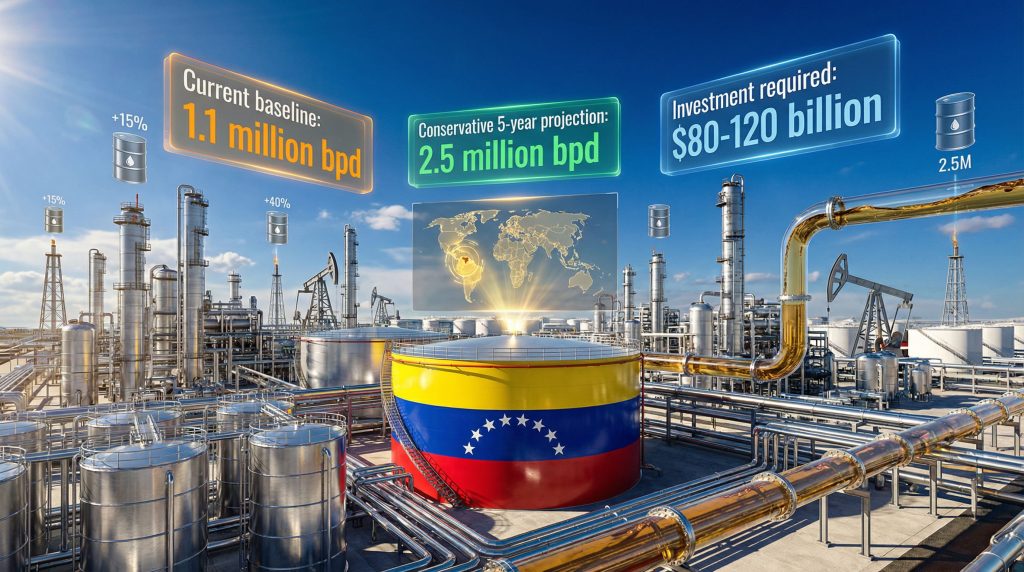
Contemporary Venezuelan production has contracted to approximately 1.1 million barrels per day (bpd), representing a devastating 63% decline from peak historical capacity that exceeded 3 million bpd during the early 2000s. This production collapse reflects systematic infrastructure deterioration rather than geological depletion, creating opportunities for rapid capacity restoration given adequate capital deployment and operational management.
The production decline timeline corresponds directly with sanctions implementation and underinvestment cycles spanning 2015-2026. During peak production periods, Venezuelan crude supplied substantial volumes to global markets, including approximately 1.3 million bpd to US Gulf Coast refineries specifically configured for heavy crude processing.
Infrastructure Degradation Assessment and Recovery Timeline
Venezuelan crude oil classification as extra-heavy crude, with API gravity between 8-12 degrees, requires specialised extraction and processing infrastructure that has suffered extensive degradation. The Orinoco Belt extraction operations depend on continuous water injection systems for pressure maintenance and crude mobility enhancement, systems that require comprehensive rehabilitation.
Infrastructure recovery encompasses multiple integrated systems:
• Wellhead equipment and subsurface infrastructure requiring complete reconditioning
• Pipeline networks spanning over 4,000 miles needing inspection and replacement
• Processing facilities for crude stabilisation and water treatment
• Export terminal capabilities for maritime transportation
Industry assessments project 18-24 months for initial infrastructure repairs to enable meaningful production increases, with substantial output recovery requiring 5-10 years of sustained capital investment.
When big ASX news breaks, our subscribers know first
What Are the Immediate Market Implications of Political Restructuring?
The immediate aftermath of Venezuela's political transition creates a complex matrix of market forces operating across different time horizons. While current Venezuelan production at 1.1 million bpd represents only 1.1% of global crude consumption, the strategic implications extend far beyond current output levels to encompass fundamental shifts in global energy leverage dynamics.
Short-Term Price Volatility Expectations
Energy market analysts anticipate marginal short-term price impacts given Venezuela's currently constrained production levels. The existing production baseline already reflects decades of sanctions-induced limitations, meaning immediate supply additions remain minimal pending infrastructure rehabilitation completion.
However, geopolitical risk premiums embedded in crude pricing may contract as political uncertainty surrounding Venezuelan assets resolves. Furthermore, our detailed oil price rally insights suggest that market participants traditionally price potential supply disruptions into futures contracts, and the establishment of stable operational control may reduce these risk components.
The temporal structure of market impacts bifurcates between immediate effects (weeks following transition) and medium-term implications (3-12 month horizon). This bifurcation reflects the lag time required for infrastructure restoration to translate into measurable production increases affecting global supply balances.
Supply Chain Disruption Risk Analysis
Venezuela's reintegration into global oil markets requires assessment of transportation chokepoint capacity and export infrastructure operational status. Historical Venezuelan crude exports flowed through Caribbean maritime routes to diverse international destinations, with transportation infrastructure requiring comprehensive evaluation following years of limited utilisation.
US embargo frameworks currently remain operational despite political transition, creating immediate legal constraints on export capabilities even as operational control transfers. This regulatory complexity requires resolution before meaningful supply chain restoration can commence, particularly as oil price crash analysis indicates potential market volatility during transition periods.
Regional Energy Security Considerations
The potential Venezuelan production revival affects regional energy security calculations across the Western Hemisphere. Caribbean nations historically dependent on Venezuelan crude through preferential supply agreements face uncertainty regarding supply continuation under new operational frameworks.
Brazilian, Colombian, and other regional energy systems developed alternative supply sources during Venezuela's production decline, creating questions about market share restoration and competitive dynamics as Venezuelan supplies potentially return to regional markets.
Which Global Players Stand to Benefit from Venezuelan Energy Revival?
The restructuring of Venezuelan oil operations creates differentiated opportunities across global energy market participants, with competitive advantages accruing to entities possessing specific technical capabilities, geographic positioning, and operational experience in heavy crude processing.
American Energy Corporation Positioning
US oil companies possess inherent advantages for Venezuelan operations through multiple convergent factors. Historical operational experience in Venezuelan fields provides institutional knowledge regarding geological characteristics, extraction requirements, and processing specifications essential for rapid production restoration.
Major US energy corporations including ExxonMobil, Chevron, and ConocoPhillips maintained substantial Venezuelan operations prior to sanctions implementation, developing technical expertise specifically applicable to Orinoco Belt production challenges. These companies retain corporate memory regarding effective extraction techniques, partnership structures, and operational protocols optimised for Venezuelan geological conditions.
The direct statement from US leadership regarding deployment of America's largest oil companies indicates preferential access to operational control over rehabilitated Venezuelan assets. This positioning provides competitive advantages through early access to reserves, operational control over production scheduling, and strategic influence over export allocation decisions.
European Refinement Capacity Realignment
European refineries face reconfiguration requirements to accommodate Venezuelan heavy crude, as most European facilities optimised for lighter crude processing from North Sea, North African, and Russian sources. The technical specifications for heavy crude processing require specialised equipment investments and operational modifications.
However, European energy corporations with diversified refinery portfolios may identify opportunities for strategic crude sourcing diversification, particularly as geopolitical tensions affect alternative supply sources. Spanish, Italian, and Dutch refiners with heavy crude processing capabilities represent potential beneficiaries of restored Venezuelan supply access.
European energy security frameworks increasingly emphasise supply source diversification following disruptions in Russian energy flows. Venezuelan crude restoration offers alternative heavy crude sources for European refineries seeking reduced dependence on concentrated supplier relationships.
Asian Import Dependency Scenarios
Asian refineries, particularly Chinese facilities, historically processed substantial Venezuelan crude volumes prior to sanctions implementation. Chinese refiners developed specific technical capabilities for Venezuelan crude processing and maintained commercial relationships with Venezuelan state entities throughout sanctions periods.
The restoration of Venezuelan exports creates potential for renewed Chinese crude imports, though this depends on sanctions framework evolution and US policy regarding third-party purchasing arrangements. Chinese energy security strategy emphasises supply source diversification, making Venezuelan crude strategically attractive for portfolio balancing.
Indian refiners also represent potential beneficiaries, as India's refinery configuration accommodates heavy crude processing and Indian energy strategy prioritises cost-effective crude sourcing regardless of geopolitical considerations.
How Might Infrastructure Investment Requirements Impact Market Entry?
The magnitude of capital requirements for Venezuelan oil infrastructure restoration creates substantial barriers to entry while simultaneously defining the competitive landscape for market participation. Capital deployment efficiency and technological capability become determining factors for successful market entry and operational scaling.
Capital Expenditure Projections for Production Recovery
Comprehensive infrastructure restoration requires capital deployment estimated between $80-120 billion across the recovery timeline. This capital requirement encompasses multiple integrated system components requiring simultaneous investment for effective production scaling.
Investment Allocation Framework:
| Infrastructure Category | Capital Requirement | Timeline | Critical Dependencies |
|---|---|---|---|
| Wellhead Infrastructure | $25-35 billion | 2-4 years | Water injection systems |
| Pipeline Networks | $15-25 billion | 3-5 years | Environmental clearances |
| Processing Facilities | $20-30 billion | 4-6 years | Technology transfer |
| Export Terminals | $10-15 billion | 2-3 years | Maritime access rights |
| Support Infrastructure | $10-15 billion | Ongoing | Utilities and logistics |
The capital intensity creates natural barriers favouring entities with substantial balance sheet capacity and access to project financing mechanisms. Smaller independent operators face significant challenges accessing the capital scale necessary for meaningful participation in Venezuelan operations.
Technology Transfer and Modernisation Needs
Venezuelan oil infrastructure requires comprehensive technological modernisation incorporating advances in extraction, processing, and environmental management systems developed during the decade-long investment hiatus. Heavy crude extraction technology has evolved substantially, offering opportunities for efficiency improvements and environmental impact reduction.
Enhanced oil recovery techniques, including advanced water injection systems, thermal recovery methods, and digital monitoring systems, represent critical technology transfer requirements. These technological capabilities exist primarily within major international oil corporations and specialised service companies.
The technology transfer process involves not merely equipment procurement but knowledge transfer regarding operational protocols, maintenance procedures, and optimisation strategies specific to Venezuelan geological conditions. This creates advantages for companies with existing heavy crude operational experience and established technology development capabilities.
Timeline Analysis for Meaningful Output Increases
Production recovery follows a phased progression reflecting infrastructure restoration sequencing and capital deployment patterns. Initial phases focus on restoring basic operational capacity, while subsequent phases emphasise capacity expansion and efficiency optimisation.
Recovery Phase Timeline:
• Phase 1 (0-24 months): Infrastructure assessment and critical repairs enabling baseline production restoration
• Phase 2 (2-5 years): Systematic capacity expansion targeting 2.5 million bpd production levels
• Phase 3 (5-10 years): Advanced recovery techniques and capacity optimisation approaching 4.0 million bpd
Each phase requires successful completion of predecessor phases, creating interdependencies that affect overall timeline execution. Delays in early phases cascade through subsequent phases, emphasising the importance of effective project management and resource coordination.
What Strategic Challenges Could Limit Energy Sector Transformation?
The transformation of Venezuelan energy assets faces multifaceted challenges extending beyond technical and financial considerations to encompass legal, regulatory, and geopolitical complexities that could materially constrain recovery timelines and operational effectiveness.
Legal Framework Complications and Asset Disputes
Venezuelan state oil assets face complex ownership and legal status questions following political transition. International law regarding state asset control during regime change creates potential for protracted legal disputes affecting operational authority and investment security.
Existing contractual obligations between Venezuelan state entities and international partners require resolution or renegotiation. Chinese, Russian, and other international entities maintained commercial relationships with previous Venezuelan authorities, creating potential competing claims on production allocation and revenue streams.
Asset seizure precedents in international law suggest that comprehensive legal frameworks must be established before major international investors commit substantial capital to Venezuelan operations. This legal clarification process could require months or years, potentially delaying meaningful investment deployment.
International Sanctions Architecture Evolution
Despite political transition, existing US sanctions on Venezuelan oil remain operational, creating immediate constraints on export capabilities and international commercial relationships. The sanctions framework requires legislative or executive modification before restored production can reach international markets freely.
European Union, Canadian, and other allied sanctions regimes developed independently of US frameworks, requiring coordination for comprehensive sanctions relief. This multilateral coordination process involves complex diplomatic negotiations potentially extending across multiple quarters.
Third-party sanctions compliance affects international corporations' willingness to engage Venezuelan operations pending clear regulatory guidance. Major international oil companies require explicit sanctions relief before committing operational resources to Venezuelan projects.
Political Stability Requirements for Long-Term Investment
Sustained infrastructure investment requires political stability guarantees extending across multiple years or decades. Major oil infrastructure projects involve capital recovery periods spanning 10-20 years, requiring confidence in sustained operational control and policy continuity.
Regional stability considerations affect Venezuelan operations, as neighbouring countries' political dynamics influence cross-border infrastructure, labour mobility, and supply chain effectiveness. Colombian, Brazilian, and Guyanese relationships with Venezuelan operations require diplomatic management.
Internal Venezuelan political dynamics could affect operational stability, as different regions or interest groups may contest new operational arrangements. Managing these internal dynamics becomes essential for maintaining operational continuity and workforce stability.
How Could This Development Affect Global Energy Pricing Power?
The potential restoration of Venezuelan oil production creates fundamental shifts in global energy market structure, affecting not merely supply volumes but strategic influence distribution among major energy producers and consumers. These changes operate through complex interactions between production capacity, transportation networks, and financial market mechanisms.
Impact on OPEC+ Production Coordination
Venezuelan reintegration into global markets occurs outside current OPEC+ production coordination frameworks, potentially creating tension between managed supply policies and unilateral production increases. Venezuela's historical OPEC membership becomes complicated under new operational control arrangements.
Furthermore, OPEC meeting impact assessments suggest that OPEC+ production quotas assume Venezuelan production constraints, and meaningful Venezuelan output increases could disrupt carefully balanced supply management strategies. Saudi Arabia and other OPEC+ producers may need to adjust production levels to accommodate Venezuelan supply additions.
The timing of Venezuelan production restoration relative to OPEC+ policy cycles creates strategic considerations for global production coordination. Rapid Venezuelan recovery could force OPEC+ policy responses affecting broader global supply management effectiveness.
Russian Energy Export Competition Dynamics
Venezuelan heavy crude competes directly with Russian Urals crude in several key markets, particularly Asian refineries configured for heavy crude processing. Restored Venezuelan production could displace Russian crude market share, affecting Russian export revenues and strategic influence.
Transportation route competition emerges as Venezuelan exports through Caribbean and Atlantic shipping lanes offer alternatives to Russian pipeline and maritime export systems. This geographic diversification provides strategic advantages for consumers seeking supply source flexibility.
Price competition between Venezuelan and Russian heavy crude could benefit global consumers while reducing producer margins. This competitive dynamic affects both countries' ability to use energy exports for geopolitical leverage.
Petrodollar System Reinforcement Mechanisms
Venezuelan oil sales conducted through US-controlled entities strengthen dollar-denominated energy transactions, reinforcing petrodollar system stability at a time when alternative payment mechanisms have gained attention. This development counters trends toward non-dollar energy trading arrangements.
The potential revival of Venezuelan oil production represents more than a supply increase. It could fundamentally alter global energy leverage dynamics, particularly as traditional pricing mechanisms face unprecedented challenges from alternative payment systems and competing reserve currencies.
US control over Venezuelan oil assets provides strategic influence over global energy pricing through supply timing decisions, export allocation policies, and pricing mechanism selection. This influence operates beyond market forces to encompass geopolitical leverage applications.
The next major ASX story will hit our subscribers first
What Are the Broader Geopolitical Energy Security Implications?
The transformation of Venezuelan energy operations creates cascading effects across global energy security frameworks, affecting strategic relationships, supply route dependencies, and energy policy calculations for major economic powers. These implications extend beyond commercial considerations to encompass national security and economic sovereignty questions.
China's Energy Import Diversification Strategy
Chinese energy security strategy emphasises supply source diversification to reduce dependence on concentrated supplier relationships and vulnerable transportation routes. Venezuelan oil restoration provides opportunities for geographic and geopolitical diversification of Chinese crude imports.
Historical Chinese-Venezuelan energy relationships involved substantial Chinese investment in Venezuelan oil infrastructure in exchange for long-term supply commitments. These arrangements require renegotiation or resolution under new operational control frameworks, affecting Chinese energy security calculations.
Chinese refineries possess technical capabilities for Venezuelan heavy crude processing developed during previous commercial relationships. This existing infrastructure provides platforms for renewed Chinese-Venezuelan energy trade pending diplomatic and commercial framework development.
European Energy Independence Pathway Analysis
European energy independence initiatives emphasise reduced dependence on single-source suppliers following disruptions in Russian energy flows. Venezuelan crude restoration provides alternative supply sources for European refineries seeking geographic diversification.
However, US control over Venezuelan operations creates new dependency relationships for European energy security. European policymakers must balance supply diversification benefits against potential strategic vulnerabilities from US-controlled energy sources.
European refinery investments in heavy crude processing capabilities could position European entities as beneficiaries of Venezuelan production restoration. These investments require long-term supply assurances and stable commercial frameworks.
Western Hemisphere Energy Integration Opportunities
Venezuelan oil restoration enables Western Hemisphere energy integration initiatives reducing dependence on transcontinental supply chains. Regional energy cooperation frameworks could develop encompassing Venezuelan, Canadian, US, and Brazilian energy resources.
Pipeline and transportation infrastructure connecting Venezuelan production to regional markets could enhance energy security for Caribbean and Central American nations historically dependent on vulnerable supply chains. These infrastructure investments require multilateral coordination and financing.
Regional refinery networks could optimise crude processing efficiency through coordinated feedstock allocation and product distribution. Venezuelan heavy crude could complement lighter crude sources from other regional producers.
Which Market Scenarios Should Energy Stakeholders Prepare For?
Energy market participants face substantial uncertainty regarding Venezuelan production recovery timelines, operational effectiveness, and market integration mechanisms. Scenario planning becomes essential for strategic positioning and risk management across multiple potential development pathways.
Accelerated Recovery Timeline Implications
An accelerated recovery scenario assumes optimal capital deployment, minimal regulatory constraints, and effective operational management producing meaningful production increases within 3-4 years rather than 5-10 years. This scenario creates substantial global supply additions potentially affecting crude prices and market dynamics.
Accelerated recovery requires unprecedented capital deployment rates and operational efficiency potentially challenging realistic implementation capabilities. However, strong geopolitical motivation and unlimited capital access could enable accelerated timelines exceeding historical infrastructure development benchmarks.
Market participants should prepare for potential oversupply conditions if Venezuelan recovery coincides with capacity additions from other global producers. This scenario particularly affects high-cost producers and marginal production sources potentially displaced by Venezuelan supply. In addition, WTI and Brent futures markets may experience increased volatility during transition periods.
Prolonged Transition Period Challenges
Extended transition scenarios assume legal complications, regulatory delays, and operational challenges producing slower-than-expected production recovery. This scenario maintains current tight global supply conditions while creating uncertainty regarding future supply availability.
Prolonged transitions affect long-term investment decisions across global energy markets, as uncertainty regarding Venezuelan supply restoration complicates capacity planning and strategic positioning for other producers and consumers.
Investment in alternative supply sources may continue during prolonged transition periods, potentially creating oversupply conditions when Venezuelan production eventually recovers. This timing mismatch creates complex market dynamics affecting global capacity utilisation.
Regional Conflict Escalation Risk Factors
Regional stability risks could disrupt Venezuelan operations regardless of initial transition success. Border tensions, internal political disputes, or broader regional conflicts could affect operational continuity and infrastructure security.
Escalation scenarios require contingency planning for potential supply disruptions affecting not only Venezuelan production but broader regional energy infrastructure. Caribbean shipping routes and pipeline networks face vulnerability during regional conflict scenarios.
International military positioning related to Venezuelan operations could create broader geopolitical tensions affecting global energy market stability beyond Venezuelan production specifically.
How Might This Reshape Long-Term Energy Investment Strategies?
The Venezuelan energy transition creates fundamental shifts in global energy investment landscape requiring strategic recalibration across multiple time horizons and geographic markets. Investment strategies must account for both direct Venezuelan opportunities and broader market implications affecting global energy asset valuations.
Portfolio Diversification Considerations for Energy Funds
Energy investment portfolios require rebalancing to account for Venezuelan production restoration effects on global supply-demand dynamics and competitive positioning across different crude types and geographic markets. Venezuelan heavy crude supply increases affect pricing relationships and competitive dynamics for similar crude grades globally.
Investment funds focused on energy infrastructure development face decisions regarding Venezuelan asset exposure versus alternative geographic opportunities. Venezuelan infrastructure investment offers potentially high returns but carries substantial political and operational risks requiring careful risk-adjusted return analysis.
Diversification strategies must consider correlation effects between Venezuelan investments and broader energy market performance. Venezuelan supply increases could negatively affect other energy investments through price suppression and market share displacement.
Infrastructure Development Priority Assessment
Global energy infrastructure investment priorities require reassessment considering Venezuelan capacity additions and their effects on transportation networks, refinery capacity requirements, and storage facility needs. Venezuelan production restoration affects infrastructure utilisation patterns across international energy systems.
Pipeline, terminal, and shipping infrastructure serving Venezuelan crude markets require capacity expansion and modernisation investments. These infrastructure investments offer strategic positioning opportunities for entities seeking exposure to Venezuelan production growth.
Refinery infrastructure investments must consider Venezuelan crude processing capabilities and market positioning relative to alternative crude sources. Heavy crude processing capacity becomes strategically valuable given Venezuelan supply restoration potential.
Technology Partnership Opportunity Evaluation
Venezuelan operations require advanced technology deployment across extraction, processing, and environmental management systems. Technology companies with heavy crude specialisation and environmental remediation capabilities face substantial opportunity in Venezuelan market development.
Strategic partnerships between technology providers and operational entities enable risk sharing and capability development for Venezuelan operations. These partnerships provide alternative exposure mechanisms for entities seeking Venezuelan market participation without direct operational involvement.
Digital technology applications in oil field management, predictive maintenance, and environmental monitoring create opportunities for technology companies serving Venezuelan operations. These applications offer recurring revenue streams and strategic positioning in restored Venezuelan energy sector.
What Economic Factors Will Determine Success?
The economic viability of Venezuelan oil sector recovery depends on multiple interconnected factors that extend beyond simple production restoration to encompass broader market dynamics, regulatory frameworks, and technological implementation strategies.
Break-Even Production Costs Analysis
Venezuelan heavy crude extraction costs vary significantly based on operational efficiency and infrastructure condition. Current estimates suggest break-even costs between $25-45 per barrel for operational fields, though degraded infrastructure may push initial costs higher until rehabilitation completes.
Capital recovery requirements for infrastructure investment create additional cost layers affecting long-term economic viability. The massive capital deployment necessary for production restoration must generate adequate returns to justify continued investment, particularly during periods when US tariffs and inflation dynamics create economic uncertainty.
Processing costs for Venezuelan extra-heavy crude exceed conventional crude processing requirements due to technological complexity and refinery specifications. These additional costs affect competitiveness versus alternative crude sources and influence market positioning strategies.
Financial Markets Integration Considerations
Venezuelan oil operations require integration with international financial systems for trade financing, revenue collection, and operational funding. Banking relationships and payment processing mechanisms must be established following years of financial isolation.
Currency exchange mechanisms become critical for Venezuelan oil revenues, particularly given potential volatility in local currency systems. Dollar-denominated transactions provide stability but require compliance with international banking regulations.
According to market analysts, credit worthiness establishment affects Venezuelan entities' ability to engage in international commercial relationships. Building credible financial track records requires time and consistent operational performance.
The transformation of Venezuelan energy operations represents a watershed moment in global energy market evolution, creating opportunities and challenges that extend far beyond immediate supply considerations. Success in navigating this transformed landscape requires comprehensive understanding of technical, financial, legal, and geopolitical complexities while maintaining strategic flexibility for multiple potential development scenarios.
Energy market participants must balance immediate positioning opportunities against long-term strategic implications, recognising that Venezuelan energy revival occurs within broader contexts of global energy transition, geopolitical realignment, and technological innovation that collectively reshape energy investment and operational frameworks for decades ahead.
Looking to Capitalise on Global Energy Market Shifts?
Discovery Alert's proprietary Discovery IQ model delivers real-time alerts on significant ASX mineral discoveries, transforming complex market data into actionable insights that help subscribers identify opportunities ahead of the broader market. With major energy transitions reshaping investment landscapes globally, position yourself strategically by exploring historic mineral discovery returns and begin your 30-day free trial today to secure your competitive edge.