
August 10, 2026
Venezuelan Supply Chain Disruptions Transform Caribbean Energy Markets
Venezuela crude flows slow Cuba feels sting as geopolitical tensions and enforcement actions reshape traditional energy supply relationships across the Caribbean basin. The disruption of established crude oil distribution networks exposes the vulnerability of regional economies dependent on single-source energy suppliers, creating cascading effects throughout multiple economic sectors.
Furthermore, these developments highlight how modern enforcement mechanisms can rapidly destabilise complex international commodity flows that have operated reliably for decades. The intersection of cyber warfare, maritime interdiction, and financial sector restrictions demonstrates the evolving nature of economic statecraft in global energy markets.
Caribbean island nations face immediate energy security challenges as their primary crude oil supply source experiences unprecedented operational constraints. This crisis reveals the fragility of energy interdependence systems that previously provided cost-effective fuel access through sophisticated transshipment arrangements.
When big ASX news breaks, our subscribers know first
Operational Infrastructure Under Mounting Pressure
Venezuela's energy export capacity confronts technical and logistical challenges that extend far beyond conventional sanctions frameworks. Recent cyberattacks targeting state oil infrastructure have exposed critical vulnerabilities within aging operational technology systems across essential energy facilities.
On December 13, 2025, a comprehensive cyber incident affected all computers operated by Petróleos de Venezuela (PdV), with malicious software systematically erasing information across enterprise systems. The attack particularly impacted operations in the Oriente Norte division, which encompasses multiple pipeline networks, refineries, and Orinoco extra-heavy crude upgraders.
Workers received instructions to operate under emergency protocols in extremely risky conditions, highlighting the systemic nature of the infrastructure compromise. The simultaneous infection of enterprise systems suggests either sophisticated malware deployment or inadequate network segmentation between operational and information technology platforms.
Maritime security concerns have intensified following the deployment of substantial US naval forces in Venezuelan waters since late September 2025. This military presence, officially justified as drug interdiction operations, has created additional deterrent effects on international shipping operations beyond its stated objectives.
Export Volume Analysis Reveals Dramatic Decline
Export volume data reveals the compound impact of these disruptions across multiple time periods:
September-December 2025 Comparison:
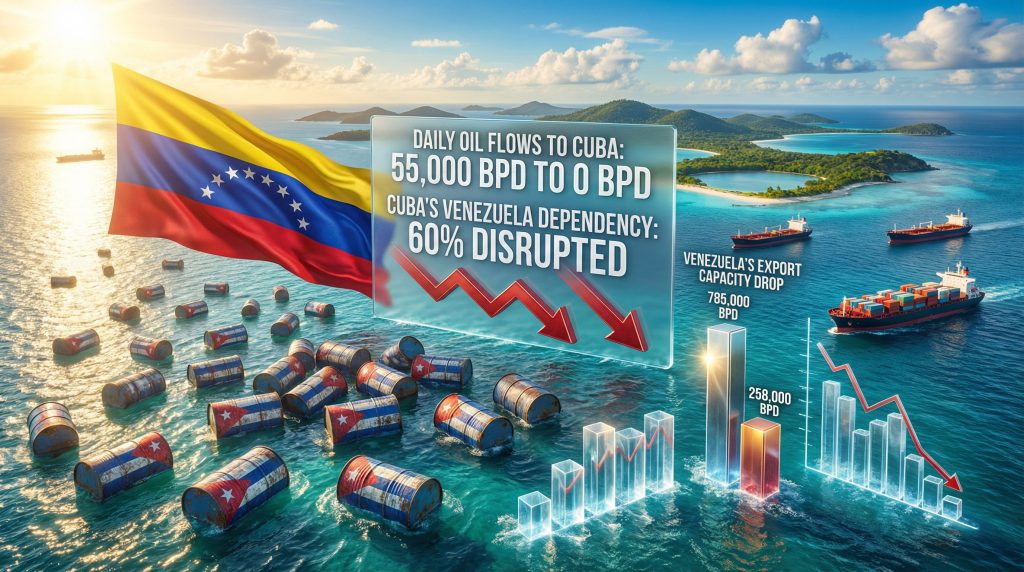
- Current period: 785,000 barrels per day
- Previous year: 792,000 barrels per day
- Variance: Minimal year-over-year difference
December 2025 Monthly Performance:
- Current volume: 258,000 barrels per day (7 cargoes)
- December 2024: 1.08 million barrels per day (17 cargoes)
- Decline: 76% reduction in monthly volumes
Financial sector restrictions compound these operational challenges by limiting transaction processing capabilities for international crude oil purchases. Consequently, banking institutions have withdrawn services for Venezuelan cargo transactions, creating additional friction in an already constrained supply chain environment.
Port facility degradation represents another constraint on export capacity, though specific throughput data remains limited. The combination of aging infrastructure, reduced maintenance capabilities, and operational disruptions has created bottlenecks in loading operations for conventional commercial shippers.
How Does Cuba's Energy Crisis Reflect Regional Vulnerability?
Cuba's energy dependency creates particularly acute vulnerability to Venezuelan supply disruptions, with approximately 60% of the island's crude requirements historically sourced through Venezuelan exports. This complete cessation of flows represents more than a bilateral trade interruption—it threatens fundamental economic stability across multiple sectors.
Cuban Premier Miguel Díaz-Canel characterised the situation as creating dire economic conditions, signalling government recognition that energy shortages extend beyond temporary supply chain friction to represent systemic economic threats. Moreover, the oil price rally has compounded these pressures by increasing alternative sourcing costs.
The historical supply arrangement operated through sophisticated transshipment mechanisms that maximised efficiency while minimising direct bilateral exposure. According to former Cuban oil vice minister Dolores Dobarro, China-bound tankers carrying Venezuelan crude would make strategic stops in Cuban ports to offload portions of cargo before continuing to final Asian destinations.
This indirect sourcing model provided Cuba with consistent fuel access without requiring dedicated export commitments from Venezuela, effectively disguising Cuban consumption within broader Asian-bound commodity flows. The arrangement demonstrated creative adaptation to complex geopolitical environments while maintaining essential energy security.
Current Supply Chain Status Assessment
| Metric | Historical Average | Current Status |
|---|---|---|
| Daily Flows to Cuba | Variable (via transshipment) | Zero |
| Cuba Import Dependency | 60% | Fully disrupted |
| Economic Impact | $2 billion annually | At risk |
| Alternative Sources | Limited options | Under evaluation |
The December 10, 2025 US seizure of a crude cargo destined for Cuba established concrete precedent for cargo confiscation, creating immediate deterrent effects on the transshipment mechanism. Shipping companies now face binary choices: complete avoidance of Venezuelan waters or acceptance of near-certain interdiction.
Power generation dependency represents the most immediate concern, as oil-fired electricity plants supply substantial portions of Cuba's grid capacity. In addition, energy rationing measures affect industrial production, healthcare facilities requiring consistent power for medical equipment, and tourism infrastructure critical to foreign currency earnings.
Alternative Supply Chain Development Faces Complex Barriers
Replacement sourcing options face substantial logistical, financial, and technical constraints that limit immediate substitution capabilities. Mexican heavy crude production could theoretically supply Caribbean markets, but transportation costs and existing export commitments create significant barriers to rapid reallocation.
Mexican crude export patterns typically serve North American refining centres with established pipeline and marine terminal infrastructure. Redirecting volumes to Caribbean destinations would require substantial logistics modifications and potentially higher transportation costs that affect delivered pricing competitiveness.
Russian fuel oil represents another potential alternative, though sanctions compliance challenges create legal and financial risks for purchasing entities. Current enforcement frameworks make Russian commodity transactions increasingly complex for Western Hemisphere buyers, particularly those with US banking relationships.
However, Middle Eastern suppliers possess substantial production capacity but face transportation cost implications when serving Caribbean markets. Extended shipping distances increase freight rates, insurance costs, and cargo transit times compared to regional Venezuelan sources.
Asian refiners, particularly in China's Shandong province, received import quotas for Venezuelan crude in late November 2025, suggesting continued demand for these volumes in markets less affected by Western enforcement actions. This geographic reallocation of Venezuelan exports maintains production incentives while redirecting flows away from Caribbean destinations.
What Processing Capacity Limitations Exist Regionally?
Caribbean refining infrastructure demonstrates limited flexibility to process alternative crude grades without substantial technical modifications. Many regional facilities were configured specifically for Venezuelan heavy crude specifications, requiring investment to handle different API gravities or sulfur content levels.
Furthermore, storage capacity constraints complicate alternative sourcing strategies, as different crude types may require segregated tank systems to prevent contamination. Emergency inventory management becomes critical when reliable supply schedules face disruption, as detailed in recent market volatility insights.
US Enforcement Strategy Reshapes Maritime Markets
Secondary sanctions implementation creates cascading effects throughout international shipping and commodity trading sectors. Insurance market responses demonstrate how financial service providers withdraw coverage for Venezuelan cargoes, effectively expanding enforcement reach beyond direct government action.
Banking sector compliance measures restrict transaction processing for Venezuelan crude purchases, creating additional friction even for transactions involving third-party intermediaries. Financial institutions adopt defensive postures rather than risk exposure to sanctions violations, as seen in broader oil price movements.
The December 10 cargo seizure established enforcement precedent that influences shipping industry behaviour patterns across the broader Caribbean basin. Consequently, market participants adopt "wait-and-see" approaches rather than committing to new Venezuelan loading contracts.
VLCC (Very Large Crude Carrier) tanker rates reflect these changing risk calculations, with rates remaining near three-year highs despite some Monday declines following enforcement actions. This pricing pattern suggests market recognition of elevated operational risks in Venezuelan waters.
Enforcement Timeline Impact Analysis
- Late September 2025: US naval deployment begins
- December 10, 2025: First cargo seizure precedent set
- December 13-15, 2025: Cyberattack compounds operational disruption
- December 16, 2025: Export volumes reach 76% monthly decline
Asset seizure precedents create legal frameworks for future enforcement actions, encouraging risk-averse behaviour among international shippers and commodity traders. This deterrent effect multiplies the impact of individual enforcement actions across broader market segments.
Global Oil Market Disruption Patterns Emerge
Asian refiners face inventory management challenges as Venezuelan crude flows experience irregular scheduling and potential disruptions. Chinese facilities in Shandong province, which received import quotas in late November 2025, must now evaluate supply reliability against alternative sourcing options.
Heavy crude differentials demonstrate widening discounts for Venezuelan grades as buyers demand compensation for increased procurement risks. This pricing pressure affects profitability for Venezuelan producers while creating potential arbitrage opportunities for risk-tolerant purchasers.
Alternative sourcing costs create premium pricing for replacement barrels as buyers compete for limited supplies of similar crude specifications. This market tightening affects regional pricing benchmarks and influences broader commodity market dynamics, contributing to patterns observed in US oil production decline analyses.
Caribbean tanker transportation rates reflect heightened volatility as vessel operators adjust routing patterns and pricing structures to account for interdiction risks. These cost increases ultimately transfer to end consumers through higher delivered fuel prices.
Regional Market Stress Indicators
- Increased price volatility for Caribbean-delivered crude
- Transportation premium expansion for Venezuelan-origin cargoes
- Insurance coverage withdrawal creating self-insurance requirements
- Alternative crude grade procurement competition intensification
The next major ASX story will hit our subscribers first
What Does Production Capacity Stabilisation Require?
Technical infrastructure recovery from the December cyberattack requires comprehensive system rebuilding and enhanced cybersecurity implementation. The simultaneous infection of operational technology platforms suggests fundamental vulnerabilities that demand systematic remediation.
International investment requirements for Venezuelan energy infrastructure modernisation face substantial barriers given current geopolitical tensions and sanctions frameworks. Foreign capital deployment becomes increasingly complex when enforcement actions target international business partnerships.
Geopolitical resolution pathways remain uncertain as diplomatic engagement operates under constrained conditions. Traditional energy sector cooperation mechanisms face disruption when broader political relationships experience fundamental strain, as analysed in recent oil price crash analysis.
Critical Recovery Factors:
- Cybersecurity system reconstruction timeline
- Foreign investment regulatory clarity
- International banking transaction normalisation
- Maritime insurance market re-engagement
Market rebalancing depends on restoration of confident commercial relationships between Venezuelan producers, international shipping companies, and end-market purchasers. This confidence rebuilding process typically requires consistent operational performance over extended periods.
"The Venezuelan oil flow disruption represents more than bilateral trade friction—it demonstrates how modern energy security depends on complex, interconnected systems vulnerable to rapid destabilisation through technological, financial, and enforcement mechanisms operating simultaneously across multiple domains."
Caribbean Energy Resilience Development Strategies
Diversification strategies require systematic development of multi-supplier procurement frameworks that reduce dependency on single-source relationships. This approach demands substantial relationship building, contract negotiation, and logistics infrastructure development across multiple geographic regions.
Strategic reserve development offers potential buffer capacity against supply chain disruptions, though storage facility construction requires substantial capital investment and ongoing maintenance costs. Emergency stockpiling capabilities must balance storage costs against security benefits.
Renewable energy acceleration presents long-term alternatives to fossil fuel dependency, particularly for island economies with substantial solar and wind resources. However, transition timelines extend beyond immediate crisis response requirements.
Regional cooperation mechanisms could enable shared infrastructure investments that improve collective energy security while reducing individual nation costs. Coordinated procurement strategies might achieve better pricing and supply reliability through combined negotiating power.
Resilience Building Priorities
-
Supply Source Diversification
- Multiple supplier relationship development
- Contract terms standardisation across suppliers
- Emergency procurement protocol establishment
-
Infrastructure Investment
- Strategic storage capacity expansion
- Transportation flexibility enhancement
- Regional distribution network coordination
-
Alternative Energy Development
- Renewable capacity acceleration
- Grid modernisation for variable supply integration
- Energy efficiency improvement programmes
Economic Consequences Beyond Energy Sectors
Tourism industry impacts extend throughout Caribbean economies as power reliability affects hospitality sector competitiveness. Frequent outages or energy rationing measures discourage visitor arrivals and reduce tourism revenue that many island economies depend upon for foreign currency earnings.
Manufacturing competitiveness suffers when energy costs increase or supply reliability decreases, affecting everything from food processing to textile production. Higher electricity costs reduce profit margins while supply interruptions disrupt production schedules.
Agricultural productivity faces direct impacts through irrigation system disruptions and food processing capability limitations. Energy-dependent agricultural operations, from greenhouse cultivation to dairy processing, require consistent power supply for optimal production.
Healthcare system strain becomes particularly acute when medical equipment depends on reliable electricity supply. Critical care facilities, vaccine refrigeration systems, and diagnostic equipment all require consistent power to maintain service levels.
Sectoral Impact Assessment
| Economic Sector | Primary Risk | Secondary Effects |
|---|---|---|
| Tourism | Power reliability | Foreign currency loss |
| Manufacturing | Energy costs | Export competitiveness |
| Agriculture | Processing disruption | Food security impacts |
| Healthcare | Equipment operation | Public health risks |
Investment Opportunities Emerging from Crisis
Energy infrastructure modernisation presents substantial investment opportunities as Caribbean nations recognise vulnerability to supply chain disruptions. Grid reliability improvements, backup generation systems, and distribution network upgrades become priority investments.
Alternative fuel development creates market opportunities for biofuel production facilities, LNG import terminals, and renewable energy projects. Crisis-driven demand acceleration often justifies investment returns that seemed marginal under normal conditions.
Storage facility expansion becomes economically attractive when supply chain reliability faces question. Strategic petroleum reserve construction, refined product storage, and emergency fuel distribution systems represent defensive investments with clear strategic value.
Transportation efficiency improvements, including pipeline construction and marine terminal upgrades, offer long-term value creation while addressing immediate logistical constraints. Infrastructure investments often provide employment benefits alongside energy security improvements.
Priority Investment Categories:
- Grid Infrastructure: Reliability improvements and backup systems
- Storage Capacity: Strategic reserves and emergency supplies
- Alternative Energy: Renewable generation and biofuel production
- Transportation: Pipeline networks and terminal facilities
Latin American Energy Geopolitics Transformation
Regional power dynamics experience fundamental shifts as traditional energy supplier relationships face disruption. Countries previously dependent on Venezuelan exports must develop new partnerships, potentially altering long-established diplomatic and economic relationships.
Economic integration implications extend beyond energy sector cooperation to affect broader regional trade frameworks. Energy security concerns may accelerate regional cooperation initiatives or create new tensions over resource allocation and pricing mechanisms.
US moves to disrupt Venezuela-Cuba oil flows demonstrate the effectiveness of maritime enforcement strategies in reshaping regional energy relationships. Policy effectiveness measurements become critical for evaluating sanctions strategy success and determining future enforcement approaches.
Future bilateral relationships will likely reflect lessons learned during current crisis periods. Post-crisis diplomatic positioning may favour countries that provided alternative supply solutions or maintained stable commercial relationships during disruption periods.
Geopolitical Realignment Factors
- Supply security prioritisation over traditional price considerations
- Regional cooperation framework development acceleration
- Alternative partnership relationship strengthening
- Energy infrastructure investment geographic diversification
The Venezuela crude flows slow Cuba feels sting situation demonstrates how rapidly modern energy systems can face disruption through simultaneous technological, financial, and enforcement pressures. Caribbean nations' experiences provide valuable lessons for energy security planning in an increasingly complex global commodity environment.
However, Venezuela's declining oil exports continue to create regional instability that extends beyond immediate participants to affect broader Caribbean economic stability and energy security planning frameworks.
Disclaimer: This analysis contains forward-looking assessments based on current market conditions and geopolitical developments. Energy market dynamics and political situations may change rapidly, affecting the accuracy of projections and investment considerations discussed. Readers should conduct independent research and consult qualified advisors before making investment decisions.
Ready to Capitalise on Energy Market Disruptions?
Discovery Alert's proprietary Discovery IQ model delivers real-time alerts on significant ASX mineral discoveries, including energy and critical materials companies positioned to benefit from global supply chain disruptions like those affecting Venezuelan crude flows. Explore how major mineral discoveries can generate substantial returns by visiting Discovery Alert's discoveries page, then begin your 30-day free trial to identify actionable investment opportunities ahead of the broader market.