May 12, 2026
Global energy markets continue evolving through complex geopolitical dynamics that reshape traditional petroleum supply relationships. The concentration of massive crude oil deposits within specific geographic regions creates both strategic opportunities and systemic vulnerabilities for international energy security planning. Understanding these dynamics requires examining how Venezuela's oil reserves influence market behavior, pricing mechanisms, and long-term supply stability.
Strategic Energy Resource Concentration Patterns
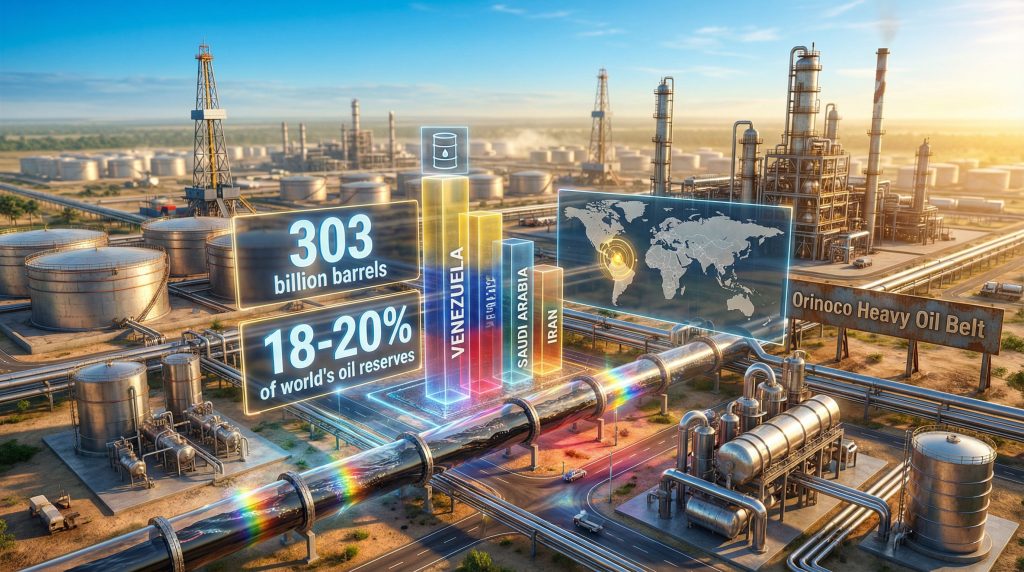
Venezuela's petroleum endowment fundamentally alters global energy calculations through sheer scale and geographic positioning. The South American nation controls approximately 303 billion barrels of proven crude oil reserves, representing roughly 18-20% of humanity's documented petroleum resources. This concentration creates unique dynamics where a single nation's political stability directly impacts global energy security frameworks.
The strategic significance extends beyond raw volume metrics. Venezuela's crude oil characteristics make it particularly valuable for specific refining infrastructure, especially facilities equipped with coking units capable of processing extra-heavy crude into high-margin petroleum products. This technical compatibility creates dedicated supply chains that cannot easily substitute alternative crude sources without significant infrastructure modifications.
Current geopolitical developments demonstrate how reserve control translates into immediate market influence. According to RFE/RL reporting from January 7, 2026, political changes in Venezuela have prompted speculation about potential production increases, with President Trump suggesting that up to 50 million barrels could be made available to markets, causing immediate oil price movements in global commodity markets.
Regional energy dependencies highlight the strategic importance of Venezuela's oil reserves. The nation currently supplies Cuba with approximately 35,000 barrels per day, representing 50% of the island's oil deficit, according to University of Texas energy analyst Jorge Pinon. This relationship demonstrates how even reduced Venezuelan production maintains critical regional influence.
When big ASX news breaks, our subscribers know first
Technical Characteristics of Venezuelan Petroleum Resources
The majority of Venezuela's oil reserves concentrate within the Orinoco Heavy Oil Belt, spanning approximately 54,000 square kilometers across four Venezuelan states. This geological formation contains extra-heavy crude deposits with API gravity ratings below 10 degrees, requiring specialized extraction and processing technologies that differ significantly from conventional crude operations.
Processing extra-heavy crude presents unique technical challenges that create both opportunities and constraints. The petroleum must be diluted with lighter hydrocarbons before pipeline transportation, creating dependencies on diluent supplies that Venezuela has historically sourced from Iran and Russia through complex trading arrangements documented by RFE/RL.
RFE/RL reporting confirms that Iranian shadow fleet vessels have exported large quantities of diluent to Venezuela in exchange for oil shipped to China and gold, illustrating how technical processing requirements create international supply chain dependencies vulnerable to sanctions enforcement. Furthermore, this creates vulnerabilities for trade war market impact considerations.
Refining infrastructure compatibility provides strategic advantages for specific market relationships. Venezuela's extra-heavy crude proves particularly valuable for specialised refineries with coker units, especially those on the U.S. Gulf Coast, which can process this dense petroleum into high-margin products including petrol and diesel fuel.
The specialised nature of Venezuelan crude creates processing bottlenecks that limit rapid production scaling. Even with adequate investment, production increases require time-intensive infrastructure development, as confirmed by International Energy Agency statements to RFE/RL emphasising that substantial investments would be required for Venezuela to reverse production declines seen in recent decades.
Historical Reserve Classification Evolution
Venezuela's oil reserves experienced dramatic expansion during the 2000s, growing from approximately 100 billion barrels to over 300 billion barrels through reclassification rather than new geological discoveries. This transformation resulted from changing economic parameters that made previously uneconomical heavy crude deposits viable for commercial development.
Rising global oil prices during the 2000s commodity boom created economic conditions where extra-heavy crude extraction became profitable, enabling reserve reclassification under international petroleum industry standards. Advanced extraction technologies simultaneously reduced processing costs, supporting the economic viability assessments required for proven reserve status.
The reclassification process illustrates how reserve estimates depend heavily on economic assumptions and technological capabilities. Resources that remain technically recoverable may not qualify as proven reserves if extraction costs exceed projected revenues at prevailing market prices. In addition, these dynamics affect WTI/Brent trends across global markets.
International investment during this period provided capital for infrastructure development that supported reserve viability assessments. Major oil companies invested in specialised processing facilities and extraction technologies, enabling more accurate evaluation of economically recoverable volumes within the Orinoco Belt formation.
This historical pattern demonstrates the dynamic nature of reserve classifications, where technological advancement and market conditions can rapidly alter the economic accessibility of petroleum resources without requiring new geological discoveries.
Current Production Constraints and Capacity Analysis
Venezuela's theoretical production capacity could reach 3-4 million barrels per day with adequate investment and infrastructure modernisation, yet current output fluctuates between 700,000-1,000,000 barrels daily, representing only 23-33% of potential capacity according to industry assessments.
Political and economic factors have created substantial production constraints over recent decades. Alexandra Sitenko, a Berlin-based political analyst quoted by RFE/RL, emphasised that "production challenges caused by long-term mismanagement and international sanctions make ramping up production time-consuming", requiring substantial capital commitments to reverse declining output trends.
Sanctions enforcement has created operational difficulties that extend beyond financial constraints. Recent RFE/RL reporting documents how U.S. blockade enforcement has forced Venezuela's PDVSA to slash production, with oil tankers exiting Venezuelan ports under cover of darkness despite U.S. blockade operations, indicating continued attempts to maintain export operations under challenging conditions.
The technical expertise gap represents another significant constraint on production capacity. Years of economic difficulties have led to skilled workforce emigration, degrading operational capabilities across Venezuela's petroleum sector. Even with lifted sanctions, rebuilding technical expertise would require substantial time and training investments.
Infrastructure modernisation needs include ageing extraction facilities, limited pipeline capacity, and outdated processing equipment. Chevron remains the notable exception among Western companies still operating in Venezuela, according to RFE/RL reporting, suggesting that specialised international expertise remains operationally necessary for complex petroleum operations.
International Market Integration and Supply Chain Dynamics
Venezuela's role in global petroleum markets extends beyond direct production volumes to influence pricing mechanisms and supply chain relationships. The concentration of such substantial reserves creates both diversification opportunities and concentration risks for international energy security planning. However, these factors contribute to oil price stagnation in certain market conditions.
China has historically served as Venezuela's primary oil customer, covering approximately 4-5% of China's oil imports from Venezuelan sources, according to International Energy Agency data cited by RFE/RL. However, recent developments suggest potential redirection of these supply relationships under changing political conditions.
Daniel Sternoff from Columbia University's Center on Global Energy Policy indicated that "Venezuelan crude exports could be meaningfully redirected away from China and towards the U.S. Gulf Coast", demonstrating how geopolitical changes can rapidly alter established trading patterns and supply chain relationships.
OPEC+ production coordination mechanisms face potential disruption from Venezuelan production changes. Russian oligarch Oleg Deripaska expressed concerns about U.S. control over Venezuelan reserves, stating that American control of Venezuelan oil fields could enable control over more than half of the world's oil reserves and potentially suppress oil prices below $50 per barrel. Furthermore, this relates to the broader OPEC production impact on global markets.
Market psychology responds rapidly to potential supply changes from Venezuelan sources. Recent headlines document how oil prices fell as Trump suggested Venezuela would turn over up to 50 million barrels, illustrating immediate market sensitivity to potential Venezuelan supply increases.
Geopolitical Implications of Reserve Concentration
What Makes Venezuela's Oil Strategically Important?
The strategic importance of Venezuela's reserves creates competition amongst major powers seeking influence over global energy flows. Political analyst Ivan Preobrazhensky noted to RFE/RL's Russian Service that "Russian, Iranian, and Chinese companies operate where the Venezuelan oil sector is not destroyed, and the United States wants to push them out".
Energy diplomacy relationships demonstrate how petroleum reserves translate into political leverage. Venezuela has historically supplied subsidised oil to Caribbean nations and maintained strategic partnerships through preferential pricing arrangements that extend beyond commercial considerations. According to analysis from Visual Capitalist, Venezuela holds the world's largest proven oil reserves.
Regional security implications affect broader hemispheric relationships. Hal Brands from the American Enterprise Institute assessed that whilst "Trump has served notice that there's only one great power in the Americas when it comes to military muscle, China will keep seeking economic, technological and political ties in the region as part of a play for long-term advantage".
How Do Reserve Concentrations Affect Global Energy Security?
The concentration of reserves creates systemic vulnerabilities for global energy markets. Political instability, sanctions enforcement, or production disruptions in Venezuela can disproportionately impact global petroleum availability and pricing, creating strategic risks for energy-dependent economies worldwide.
Financial relationships tied to petroleum exports create additional geopolitical complexities. Venezuela maintains estimated $10 billion debt to China and $2 billion debt to Iran, with oil exports serving as partial collateral for these obligations, creating multiple stakeholder interests in Venezuelan production levels.
The next major ASX story will hit our subscribers first
Economic Development Requirements and Investment Analysis
Unlocking Venezuela's complete petroleum potential requires substantial international investment estimated between $200-400 billion over 15-20 years for comprehensive infrastructure development and modernisation programmes. As noted by CNN Business, these investment requirements remain substantial despite political changes.
Investment requirements include modernisation of existing extraction facilities, construction of specialised heavy crude processing plants, pipeline infrastructure for transportation capacity, and port facilities for enhanced export capabilities. Workforce training and development programmes represent additional substantial investment needs.
The specialised nature of extra-heavy crude processing requires specific technological investments that differ from conventional oil development projects. Coking refinery infrastructure, dilution systems, and thermal processing equipment require substantial capital commitments with extended development timelines.
Recent developments indicate potential investment interest despite current constraints. RFE/RL reported that an ex-Chevron chief launched a $2 billion push to revive Venezuela's oil fields, suggesting private sector confidence in long-term development opportunities regardless of current political uncertainties.
International financing mechanisms face ongoing constraints from sanctions and political risk assessments. Traditional petroleum project financing requires stable regulatory frameworks and predictable revenue streams that remain uncertain under current conditions, potentially requiring alternative financing structures or government-to-government arrangements.
Environmental and Sustainability Considerations
What Are the Environmental Challenges?
Venezuela's extra-heavy crude development presents unique environmental challenges that differ substantially from conventional petroleum extraction projects. The higher carbon intensity compared to lighter crude oils requires additional consideration within global climate policy frameworks.
Processing requirements for extra-heavy crude result in increased water usage for extraction and refining operations, greater land use requirements for surface mining techniques, and enhanced emissions from specialised thermal processing methods. These factors create environmental compliance costs that influence project economics.
Carbon capture and storage integration opportunities could potentially offset some environmental impacts whilst maintaining petroleum development economics. Venezuela's geological formations may provide suitable storage capacity for captured emissions, though this requires additional technical assessment and investment.
How Does Venezuelan Oil Fit Into Energy Transition Plans?
The role of Venezuelan petroleum within global energy transition frameworks remains complex. Whilst renewable energy development continues globally, petroleum demand for petrochemical feedstock applications and transportation fuel may persist, creating continued market demand for Venezuelan resources during extended transition periods.
Strategic environmental planning could position Venezuelan petroleum development within sustainable energy frameworks through technology integration, emissions reduction programmes, and coordinated development with renewable energy infrastructure investments.
Long-term Strategic Energy Security Implications
Venezuela's position as holder of the world's largest proven oil reserves ensures continued relevance in global energy discussions regardless of current production challenges or geopolitical complexities. The nation's petroleum endowment represents approximately one-fifth of humanity's documented crude oil resources, making it a critical factor in long-term energy security planning.
Future market dynamics will likely depend on successful resolution of current political and economic constraints affecting Venezuelan production capacity. The potential for substantial supply increases creates both opportunities for enhanced global energy security and risks for existing market relationships and pricing structures.
Technology development in extra-heavy crude processing could enhance the economic viability of Venezuelan reserves whilst reducing environmental impacts. Advanced extraction techniques, improved refining efficiency, and carbon management systems may expand the economically recoverable portion of Venezuela's petroleum endowment.
International cooperation frameworks will likely determine how effectively Venezuelan reserves can contribute to global energy security. Successful development requires coordination amongst multiple stakeholders, including international oil companies, financial institutions, technology providers, and government entities across multiple jurisdictions.
The strategic value of Venezuelan reserves extends beyond current energy market conditions to provide optionality for future energy security planning. As global energy systems continue evolving, Venezuela's substantial petroleum endowment represents a significant strategic asset that maintains relevance across various future energy scenarios and geopolitical configurations.
Disclaimer: This analysis is based on publicly available information and industry estimates. Petroleum reserve assessments, production forecasts, and geopolitical developments involve substantial uncertainties. Investment decisions should consider multiple risk factors and seek professional analysis specific to individual circumstances.
Ready to Capitalise on Global Energy Market Shifts?
Discovery Alert's proprietary Discovery IQ model delivers real-time alerts on significant ASX mineral discoveries, including energy-related opportunities that could benefit from evolving global petroleum dynamics and geopolitical shifts. Begin your 30-day free trial today and position yourself ahead of major discoveries that have historically generated substantial returns for early investors.