August 6, 2026
Why the Next Frontier for Heavy Equipment Isn't on Earth
The history of construction machinery is a story of solving problems that seem impossible until they are not. Steam-powered excavators replaced manual labour. Hydraulic systems replaced mechanical linkages. Autonomous haul trucks replaced drivers in open-cut mines. Each transition was met with scepticism, then acceptance, then rapid adoption. The next transition is already underway, and it points not toward a new continent or a deeper seabed, but toward the Moon.
What makes this moment different from previous engineering frontiers is not just the destination. It is the absolute nature of the constraints. The Moon does not forgive engineering compromises. There are no service crews, no replacement parts shipments arriving the next morning, no atmospheric pressure to assist with hydraulics, and no gravity worth relying on for tool engagement. The machines being designed for lunar deployment must be right the first time, every time, across temperature cycles that would destroy conventional steel seals and lubricants within a single lunar day.
This is the engineering context within which the Vermeer lunar construction machine project is taking shape, and understanding that context is essential to grasping why this collaboration represents something genuinely significant for both the space industry and the broader heavy equipment sector.
When big ASX news breaks, our subscribers know first
The Lunar Surface Is Not Like Anywhere Else on Earth
Before examining the machinery itself, it is worth understanding precisely what any lunar construction system is up against. The Moon's surface environment is defined by a combination of factors that, individually, each pose serious engineering challenges. Together, they create a design problem unlike anything terrestrial equipment manufacturers have previously confronted.
Gravity on the lunar surface sits at approximately one-sixth of Earth's gravitational pull. This is not simply an inconvenience for machine operators. It fundamentally disrupts the physical principles on which conventional heavy equipment is built. On Earth, an excavator's bucket penetrates soil partly because the machine is heavy enough to hold its ground while the bucket pushes down and forward. Remove that gravitational anchor and the machine risks pushing itself away from the surface rather than into it.
Temperature is equally challenging. The lunar surface experiences swings exceeding 250 degrees Celsius between the sunlit and shadowed states of a single lunar day-night cycle, which spans approximately 29.5 Earth days. Conventional lubricants freeze or vaporise. Seals contract and crack. Metal components expand and contract at rates that fatigue standard engineering tolerances.
Then there is the regolith itself. Lunar soil is not like sand, clay, or any other terrestrial analogue despite superficial similarities. It is composed of fine, angular, glass-like particles formed over billions of years by continuous micrometeorite bombardment. Furthermore, because the Moon lacks an atmosphere and the weathering processes that round and smooth terrestrial soil particles, every grain retains its original jagged structure. Research into lunar regolith applications continues to reveal just how uniquely challenging this material is for equipment designers.
Lunar dust is not merely a nuisance. It is an active engineering threat. The Apollo astronauts reported that within hours of surface operations, abrasive regolith had worn through boot soles, jammed equipment mechanisms, and contaminated suit seals. Any machine expected to operate for months or years on the lunar surface must be designed with regolith infiltration as a primary failure mode, not an afterthought.
Finally, the hard vacuum environment means that standard hydraulic and pneumatic systems cannot function as designed. Heat cannot be dissipated through convection because there is no atmosphere to carry it away. Outgassing of materials that perform perfectly on Earth can contaminate sensitive systems and alter the mechanical properties of lubricants and polymers in ways that are difficult to predict without extensive vacuum testing.
Vermeer Corporation: Industrial Pedigree Meets Extraterrestrial Ambition
Vermeer Corporation has spent more than seven decades building equipment for conditions that most manufacturers consider too difficult. Founded in Pella, Iowa, the company built its reputation on high-torque cutting, trenching, and surface mining systems used in agriculture, utilities infrastructure, and natural resource extraction. The common thread across these applications is the need for machinery that performs reliably in abrasive, unpredictable, and mechanically demanding environments.
That engineering heritage is directly relevant to the lunar challenge. Vermeer's core product lines involve the same fundamental problem the Moon presents: how do you cut, trench, and process hard material efficiently when the environment is actively trying to destroy your equipment?
Jason Andringa, President and CEO of Vermeer Corporation, has publicly framed this initiative as a continuation of the company's foundational purpose. The characterisation is not merely rhetorical. The technical skills required to design wear-resistant cutting heads for hard terrestrial substrates, to engineer autonomous operation for remote trench-cutting systems, and to build equipment that operates continuously without operator intervention translate directly into the capability set required for lunar deployment.
The collaboration with Astroport Space Technologies was formally confirmed in April 2026, representing the intersection of Vermeer's mechanical engineering expertise and Astroport's deep knowledge of space construction systems and robotic architecture.
The UTIPA System: Engineering One Machine to Do Many Jobs
The central technical contribution from Astroport Space Technologies is the Universal Tool Implement Payload Adapter, known by the acronym UTIPA. Understanding why this system matters requires appreciating one of the most fundamental constraints of lunar construction: launch mass.
Every kilogram sent to the lunar surface costs an extraordinary amount of money. Current launch costs to lunar orbit and surface delivery remain among the most expensive logistics operations in human history, though commercial launch providers are working to reduce them. In this context, sending a dedicated machine for every construction task is economically prohibitive. The UTIPA system directly addresses this constraint by enabling a single robotic platform to accept interchangeable tool heads, allowing one unit to perform grading, trenching, compaction, mining, and infrastructure routing tasks across the construction programme.
The modular approach also has resilience implications. A machine that can swap tool heads can potentially work around a failed attachment by substituting an alternative, maintaining operational continuity in an environment where calling for a replacement part is not an option.
| Construction Task | Tool Head Function | Strategic Importance |
|---|---|---|
| Landing pad preparation | Grading and surface levelling | First requirement for any crewed or cargo missions |
| Habitation foundation | High-torque trenching and excavation | Essential for below-surface structural footings |
| Road network construction | Surface compaction and grading | Enables traversal between lunar assets |
| Helium-3 and regolith extraction | Continuous mining attachment | Underpins commercial resource operations |
| Power infrastructure routing | Trenching for cable and conduit | Supports nuclear power deployment |
Sam Ximenes, Founder and CEO of Astroport, has articulated the partnership's output in terms of delivering what he calls the foundational infrastructure layer for a permanent lunar presence. The concept of Lunar Iron, as Ximenes has framed it, refers to the kind of purpose-built construction hardware that must precede any habitation or resource extraction activity. You cannot install a nuclear power module or assemble a habitat on unprepared ground. The ground must first be graded, levelled, excavated, and consolidated.
Helium-3 and the Interlune Partnership: A Second Dimension to Vermeer's Lunar Programme
Separate from the Astroport construction collaboration, Vermeer has entered into a distinct partnership with Interlune, a company focused on the commercial extraction of helium-3 from lunar regolith. This partnership adds a resource extraction dimension to Vermeer's lunar equipment portfolio that goes beyond infrastructure construction. More broadly, it reflects growing interest in space resource extraction as a commercially viable enterprise.
Helium-3 is a rare isotope on Earth but is present in the lunar regolith in quantities deposited over billions of years by the solar wind. Because the Moon lacks a magnetic field and atmosphere to deflect solar particles, helium-3 has been implanting itself into the top few metres of the lunar surface across geological timescales. Earth's atmosphere and magnetic field prevent the same accumulation here.
The isotope carries significant commercial interest for two reasons. First, it is used as a detector medium in certain quantum computing hardware configurations and specialised scientific instruments, representing a near-term demand source. Second, it is considered a candidate fuel for next-generation nuclear fusion reactors, which would produce energy without the radioactive waste associated with conventional fission. Whether fusion power reaches commercial viability within a timeframe that justifies lunar helium-3 extraction remains one of the genuinely speculative dimensions of this commercial picture, and investors and analysts hold a wide range of views on the timeline.
Disclaimer: Projections regarding helium-3 demand from fusion energy applications involve significant uncertainty. Commercial nuclear fusion has not yet been demonstrated at scale, and timelines for its deployment are subject to substantial scientific and engineering uncertainty. Nothing in this article constitutes investment advice.
What is less speculative is the near-term demand from existing applications. Interlune has reportedly secured a purchase agreement with the U.S. Department of Energy, establishing an institutional customer base that does not depend on the commercialisation of fusion power. The company is targeting first commercial deliveries of lunar helium-3 by 2029, which creates a firm development deadline for the Vermeer excavator system.
What the Vermeer-Interlune Excavator Is Designed to Do
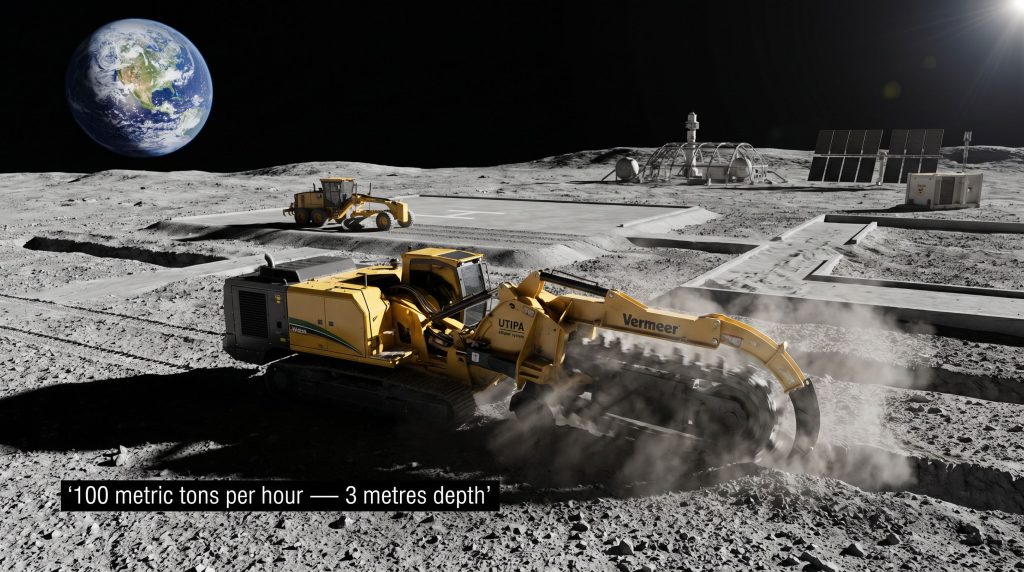
The full-scale prototype revealed in May 2025 is a continuous trencher-type excavator designed to process 100 metric tons of lunar regolith per hour, ingesting surface material, separating helium-3 gas at low temperatures through a cryogenic process, and depositing spent regolith behind the machine as it advances. The system is designed to excavate to depths of up to 3 metres below the lunar surface, where helium-3 concentrations are highest relative to the loose surface layer.
Design priorities for this machine reflect the unforgiving nature of the operating environment:
- Minimal power consumption to remain within the constraints of available solar and nuclear power sources on the lunar surface
- Low dust generation to protect solar panels, optical navigation systems, and other sensitive equipment from regolith contamination
- Reduced launch mass to keep the economics of deployment viable within commercial launch budgets
- Operational resilience across the extreme thermal cycling of the lunar day-night cycle
A sub-scale prototype was validated during 2024, with the full-scale version publicly unveiled in 2025. Development focus has now shifted toward the soil sorting and cryogenic gas separation subsystems, which represent the most technically novel aspects of the machine.
Autonomous Operation: The Non-Negotiable Design Requirement
Both the Astroport construction machine and the Interlune excavator share one absolute design requirement: full autonomous operation without real-time human control. This is not a design preference. It is a physical and operational necessity.
The communication delay between Earth and the Moon averages approximately 1.3 seconds one-way, meaning that any signal sent from a ground controller reaches the machine 1.3 seconds after it is dispatched, with the machine's response arriving another 1.3 seconds later. For fine motor control of construction equipment navigating uneven terrain, this latency makes real-time teleoperation impractical. The machine must make its own decisions in the moment.
Beyond communication latency, the initial phases of lunar base construction will necessarily occur before any crew is present on the surface. The entire point of deploying autonomous construction equipment is to prepare a site sufficiently that it is safe for humans to arrive. This means the autonomy stack must handle:
- Terrain navigation across undulating and potentially obstacle-strewn lunar surface
- Tool engagement sequencing for different substrate conditions and task types
- Obstacle detection and avoidance without sensor systems that rely on atmospheric backscatter
- Operational self-monitoring with onboard fault detection and recovery protocols
- Task completion verification to confirm that construction outcomes meet specification before advancing
The next major ASX story will hit our subscribers first
Technical Barriers That Must Be Cleared Before Any Machine Reaches the Moon
The prototype work underway in Pella, Iowa addresses the foundational mechanical engineering questions. However, progressing from a working prototype to a flight-qualified system involves a substantially more demanding set of qualification requirements.
Radiation hardening is a challenge that does not arise in terrestrial equipment development at all. The lunar surface is bathed in cosmic radiation and solar particle events that would rapidly degrade unprotected electronic systems. Every circuit board, sensor, and processing unit must be qualified for the radiation environment it will encounter over its operational life.
Materials qualification for vacuum involves testing whether every component, adhesive, lubricant, and polymer releases gases in vacuum conditions that could contaminate optical systems or alter the performance of adjacent materials. A substance that outgasses harmlessly in atmosphere can deposit a film on a camera lens or sensor array that degrades performance irreversibly in a vacuum environment.
Thermal management without convection requires entirely different engineering approaches to heat dissipation. On Earth, electronic systems are cooled partly by the air around them. In vacuum, heat can only be transferred through conduction to a thermal mass or radiated away as infrared emission. The thermal architecture of lunar equipment is therefore a primary design discipline, not a secondary consideration.
The Competitive and Industrial Landscape
Vermeer is not the only established industrial equipment manufacturer looking at the lunar opportunity. Komatsu, a global leader in autonomous mining systems, has been developing autonomous haulage and excavation technologies with potential space-adjacent applications, representing a parallel track in what observers are beginning to recognise as a structured competition among established heavy equipment makers to establish relevance in the space construction sector.
What distinguishes the established industrial manufacturers from aerospace-only contractors in this context is operational reliability data. A company with seven decades of field performance records across the world's most demanding construction environments brings something to the lunar programme that a pure aerospace contractor cannot easily replicate: proven knowledge of how machines fail under sustained operational stress, and how to design against those failure modes from the outset.
Consequently, the transition of the space industry from a government-dominated enterprise to a commercially-driven one has created the conditions under which an Iowa-based agricultural and mining equipment manufacturer can become a serious participant in lunar infrastructure development. Furthermore, just as asteroid mining advances are reshaping thinking around off-world resource economics, the Vermeer lunar construction machine project reflects a broader structural shift in how the space industry sources its operational capability.
In addition, the progression of extreme mining environments here on Earth — from deep-sea floors to polar regions — has demonstrated that industry can adapt proven equipment to conditions once considered unreachable. Similarly, the growing body of research into frontier resource extraction from environments like the deep ocean is providing engineering lessons that are being studied by those designing systems for the Moon. The machines that build the Moon's first permanent infrastructure may well carry nameplates more familiar to pipeline contractors and quarry operators than to aerospace engineers, and that is arguably exactly how it should be.
This article contains forward-looking statements and projections relating to lunar programme timelines, commercial extraction targets, and technology development milestones. These projections are subject to significant uncertainty and should not be relied upon as guarantees of future outcomes. Readers are encouraged to conduct independent research before drawing conclusions about commercial or investment implications of the developments discussed.
Want to Be First When the Next Major Resource Discovery Hits the ASX?
Discovery Alert's proprietary Discovery IQ model delivers real-time alerts on significant ASX mineral discoveries, instantly transforming complex data across more than 30 commodities into clear, actionable insights for investors at every level — explore historic discovery returns to see what early positioning can mean, and begin your 14-day free trial at Discovery Alert to secure your market-leading edge.