June 8, 2026
The Geological Lottery Victoria Already Won — And Hasn't Fully Collected
Few regions on earth have delivered as much gold relative to their surface area as the Central Victorian goldfields. The state's auriferous geology, shaped by ancient marine sediments and subsequent tectonic compression, created ideal conditions for orogenic gold mineralisation across a remarkably dense corridor. Yet despite holding what many geologists describe as one of the most prolific gold-producing terranes in the southern hemisphere, Victoria's annual output has been sliding backwards at precisely the moment gold record highs are reaching levels that would have seemed extraordinary a decade ago.
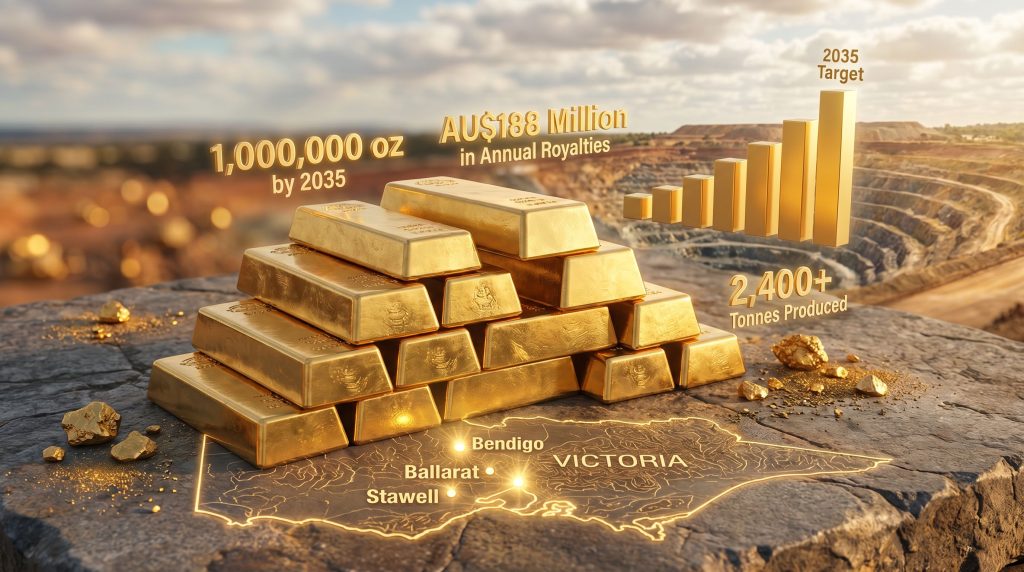
This paradox sits at the heart of a new report from the Minerals Council of Australia (MCA) Victoria, which argues the state is squandering a generational economic opportunity. The Victorian gold rush report lays out a case for tripling annual production to at least one million ounces by 2035 and details the structural reforms needed to get there.
When big ASX news breaks, our subscribers know first
Victoria's Gold Endowment: A Geological Foundation Unlike Any Other
To understand why the MCA Victoria's production ambitions are geologically credible, it helps to start with the numbers that underpin them.
Since the rush began in 1851, Victoria has yielded more than 2,400 tonnes of gold, a figure representing approximately one-third of all the gold Australia has ever produced and roughly 2% of every ounce ever extracted from the earth's crust globally. On a per-square-kilometre basis, the state has produced approximately 11 kg/km² of gold, a productivity density that exceeds every other Australian state.
The scale of the nineteenth-century rush still commands attention:
| Metric | Data Point |
|---|---|
| Total gold produced (all time) | 2,400+ tonnes |
| Share of Australian gold production | ~33% |
| Share of global all-time production | ~2% |
| Productivity density | ~11 kg/km² |
| Peak single-year output (1856) | |
| Total gold produced 1851–1896 | 61,034,682 ounces |
| Victoria's share of world production (1850s) | Over one-third globally |
During the 1850s, Victoria was producing more gold than anywhere else on the planet, accounting for over one-third of global supply. The economic and social disruption was profound: Bendigo transformed from a sheep station into a city of approximately 40,000 people within twelve months. The infrastructure laid down during this period, roads, rail corridors, and regional towns, still forms the backbone of the state's logistics network today.
From Alluvial Panning to Deep-Lead Systems: The Technological Arc
The early rush was dominated by alluvial and placer mining techniques: prospectors working creek beds and shallow gravels with pans, sluices, and cradles. Recovery was fast but shallow. As surface deposits depleted, operators pivoted to deep-lead mining, targeting buried ancient river channels filled with auriferous gravel at depths sometimes exceeding 200 metres.
This transition required significant capital, engineered shafts, pumping systems, and corporate structures that foreshadowed the modern mining company. The technical sophistication of Victorian deep-lead operations in the 1870s and 1880s was genuinely world-leading for its era. Today, modern underground mining methods, including mechanised long-hole stoping, paste fill backfilling, and real-time grade control using portable XRF analysers, have made it economically viable to pursue lower-grade ore bodies that would have been uneconomic or inaccessible to earlier operators.
The geological endowment has not diminished. What has changed is the technology available to extract it and the regulatory environment governing whether operators can reach it at all.
The Production Gap: Why Output Has Fallen Despite Record Prices
Here lies the central tension in the Victorian gold rush report narrative. Global gold prices have been at or near record nominal levels, yet Victorian production has declined from its 2021 peak rather than expanded. This counter-intuitive outcome is not explained by geological depletion or falling ore grades at operating mines. According to the MCA Victoria's analysis, the primary drag is regulatory, not geological.
The barriers identified fall into three broad categories:
-
Permitting delays: Advanced-stage projects with defined resources and completed feasibility studies are unable to convert approvals into production-stage operations within commercially viable timeframes. Permitting delays impose financing costs and erode investor confidence through extended multi-agency approval processes.
-
Geoscience underinvestment: State-funded geological mapping and exploration incentive programs have not kept pace with the prospectivity of the region. Compared with Western Australia's structured exploration support frameworks, Victoria offers junior explorers limited systematic support for targeting new deposits beyond historically established mining corridors.
-
Capital allocation drift: Institutional and junior capital is increasingly directed toward jurisdictions with predictable, efficient regulatory environments. When approval timelines are uncertain, project economics deteriorate even before a shovel enters the ground.
The net effect is that a state sitting atop a world-class geological endowment is watching capital flow to competing jurisdictions while advanced projects remain in regulatory limbo.
What the 1-Million-Ounce Target Actually Requires
The MCA Victoria's headline ambition, reaching at least one million ounces of annual gold production by 2035, implies roughly tripling current annual output. Working backwards from that target, current Victorian production sits in the range of approximately 330,000 to 340,000 ounces per year based on the implied tripling calculation.
Reaching one million ounces requires not merely expanding existing operations but bringing a meaningful pipeline of new projects through approvals and into production within a nine-year window. That is a tight timeline by any measure in the Australian regulatory environment, where projects typically require three to six years from discovery to first pour even under favourable conditions.
The economic projections attached to achieving the target are substantial:
| Economic Outcome | Projected Figure |
|---|---|
| New direct and services sector jobs | 10,000+ |
| Annual wages for Victorian workers | AU$1.2 billion |
| Current annual gold royalties | ~AU$47 million |
| Annual gold royalties at target production | AU$188 million |
| Royalty revenue growth multiple | ~4x |
The wage figure implies an average annual earnings package of approximately AU$120,000 per position across both direct and indirect employment, broadly consistent with Australian mining sector averages when accounting for the inclusion of indirect services roles.
The royalty projection is particularly significant from a fiscal policy standpoint. A fourfold increase in royalty revenue, from roughly AU$47 million to AU$188 million annually, would represent a meaningful structural contribution to state finances at a time when Victoria is managing elevated debt levels and infrastructure commitments.
James Sorahan, Executive Director of MCA Victoria, has stated that increased royalty revenue could deliver critical funding for hospitals, schools, and infrastructure, particularly if a portion of those royalties is directed back to the regional communities where mining activity takes place. (Resources Review, 28 April 2026)
The Royalty Reinvestment Question: Who Benefits?
The MCA Victoria's position goes further than simply advocating for higher production. It explicitly argues for a regional royalty allocation mechanism, directing a share of mining royalties to the communities hosting the mines themselves. This model has precedent in other Australian states and resource-producing nations where benefit-sharing arrangements are used to maintain social licence and fund regional infrastructure co-investment.
For Victoria's gold-producing regions, which include communities that have historically experienced population decline and reduced government services, a structured royalty reinvestment framework could represent a meaningful reversal of long-term economic contraction.
Where New Production Will Come From: The Project Pipeline
The established production hubs of Bendigo, Ballarat, and Stawell continue to anchor Victorian gold output. These corridors benefit from legacy infrastructure, established workforces, and decades of geological knowledge. However, reaching the one-million-ounce target cannot be achieved through incremental expansion of existing operations alone.
Emerging project corridors are attracting renewed exploration attention, and furthermore, current gold exploration trends suggest that Victoria's underexplored terranes may hold considerable upside:
-
Maldon: A historically significant goldfield being reassessed with modern exploration techniques capable of identifying mineralisation missed by earlier campaigns.
-
Kilmore: Located in the northern Melbourne hinterland, this region offers geological characteristics that differentiate it from the classical Bendigo-style saddle reef systems, pointing to potentially distinct ore styles.
-
Loddon Shire: Positioned along underexplored geological structures with proximity to established processing infrastructure.
Beyond these identified zones, Victoria contains geological terranes that remain genuinely underexplored relative to their prospectivity. The state's geology includes multiple gold deposit styles: orogenic quartz vein systems, intrusion-related gold, and alluvial deposits, each requiring different exploration approaches. Systematic geophysical surveying and deep drilling programs could identify new resource corridors that have no surface expression and would not have been detectable with historical exploration tools.
Victoria vs. Western Australia: The Regulatory Comparison That Matters
No analysis of Victorian gold sector constraints is complete without benchmarking against Western Australia, which dominates Australian gold production by a wide margin. The structural differences are significant:
| Factor | Victoria | Western Australia |
|---|---|---|
| Regulatory environment | Multi-agency, slower approvals | Streamlined, single-agency coordination |
| Exploration incentive frameworks | Limited formal programs | Well-established co-funded programs |
| Geological mapping investment | Below prospectivity benchmark | Extensive, regularly updated |
| Regional infrastructure maturity | High (legacy networks) | Variable by sub-region |
| Junior explorer activity | Declining relative to prospectivity | Consistently high |
| Current gold production dominance | Tertiary contributor | Primary national contributor |
The contrast is not primarily geological. Victoria's rocks are not inferior to WA's Yilgarn Craton in terms of gold endowment per unit area. The difference lies in the conditions under which capital can be deployed, approvals obtained, and projects brought to production.
The next major ASX story will hit our subscribers first
The Policy Agenda: What Industry Is Calling For
The MCA Victoria's reform recommendations cluster around three operational priorities:
Streamlining the Approvals Pipeline
The industry body is calling for reduced permitting timeframes, consolidated multi-agency assessment processes, and benchmarking of Victorian approval timelines against best-practice frameworks in other Australian states. Single-agency coordination models, where one government body manages cross-portfolio approvals, have demonstrably reduced approval durations in comparable jurisdictions without compromising environmental or heritage outcomes.
Geoscience Investment and Workforce Development
State-funded geoscience mapping programs reduce exploration risk for private operators, particularly junior exploration incentives that lack the balance sheet capacity to fund deep geological surveys independently. Co-funding models, where government provides regional-scale geophysical data and companies fund detailed follow-up work, have successfully unlocked new discovery pipelines in WA and Queensland.
University and TAFE partnerships targeting geoscience and mining engineering enrolments would, in addition, address the parallel workforce gap, ensuring that production growth aspirations are matched by a skilled regional labour force.
Directing Royalty Revenue Back to Producing Regions
A formalised mechanism for allocating a percentage of gold royalties to host communities would serve both a social licence function and a practical infrastructure investment role. Regions with active mining operations often face infrastructure demands, road upgrades, water systems, emergency services, that exceed their rates base capacity. Royalty co-investment frameworks could consequently bridge that gap effectively.
The Bull and Bear Cases for Victorian Gold
The bull case rests on a genuine convergence of favourable conditions: world-class geological endowment, record gold prices providing exceptional project economics, a defined policy reform agenda with industry and community support, and emerging project pipelines in multiple corridors ready to advance if approvals are available. The gold outlook for miners further reinforces the strength of this investment thesis.
The bear case centres on execution risk. Regulatory reform in Australian states is rarely rapid. Entrenched approval processes involve multiple agencies, legislative frameworks, and stakeholder consultation requirements that resist quick modification. Capital that has already drifted to WA or international jurisdictions will not return immediately based on policy announcements alone.
The pivot point is whether the Victorian government treats the MCA's Victorian gold rush report as a credible reform blueprint or as an industry lobbying document to be acknowledged and filed. The geological case for investment is compelling. The economic case is quantifiable. The policy case, however, remains the variable.
Frequently Asked Questions: Victorian Gold Rush Report
What is the MCA Victoria's gold production target for 2035?
The MCA Victoria is advocating for the state to reach at least one million ounces of annual gold production by 2035, representing approximately three times current output levels.
How many jobs could a Victorian gold expansion create?
Achieving the one-million-ounce target is projected to generate more than 10,000 new positions across direct mining operations and the broader services sector, according to the MCA Victoria report.
How much could gold royalties increase if production triples?
Royalty revenues are projected to grow approximately fourfold, from roughly AU$47 million currently to AU$188 million per year at target production levels.
Why has Victorian gold production declined despite high gold prices?
The decline from the 2021 production peak is attributed primarily to regulatory constraints and slow permitting processes rather than geological depletion, according to the MCA Victoria's analysis.
Which new regions in Victoria show gold exploration potential?
Beyond established hubs at Bendigo, Ballarat, and Stawell, emerging project areas in Maldon, Kilmore, and the Loddon Shire are identified as prospective zones for near-term development. The Victorian government's gold mining resources provide further detail on the geological context across these corridors.
How significant is Victoria's gold history globally?
During the 1850s, Victoria accounted for over one-third of global gold production. In total, the state has produced more than 2,400 tonnes of gold, approximately 2% of all gold ever mined worldwide.
This article contains forward-looking projections and economic modelling sourced from the Minerals Council of Australia Victoria report as reported by Resources Review (28 April 2026). Projections regarding employment, royalty revenues, and production targets are subject to regulatory, market, and operational variables. This content does not constitute financial or investment advice.
Want to Know When the Next Major ASX Gold Discovery Hits the Market?
Victoria's world-class geological endowment and record gold prices are creating compelling conditions for significant new discoveries — and Discovery Alert's proprietary Discovery IQ model ensures subscribers receive real-time alerts the moment major ASX mineral discoveries are announced, turning complex data across 30+ commodities into clear, actionable insights. Explore how historic discoveries have delivered extraordinary returns on Discovery Alert's dedicated discoveries page, and begin your 14-day free trial today to position yourself ahead of the broader market.