June 18, 2026
The Processing Gap That Could Define Australia's Rare Earth Future
For decades, a quiet imbalance has shaped the global rare earth supply chains: nations rich in deposits have exported raw ore while a single country has controlled what happens next. The refining, the chemistry, the value creation. That arrangement is now under structural pressure, and the scramble to build processing capability outside China's sphere has become one of the defining industrial policy challenges of the 2020s. Pilot plants, metallurgical testwork, and feasibility studies may sound like incremental steps, but in the rare earth sector, they represent the difference between a resource nation and a processing nation.
That distinction matters enormously right now.
When big ASX news breaks, our subscribers know first
Why Heavy Rare Earths Are the Sector's Most Contested Prize
Not all rare earths are created equal. The 17 elements that carry the rare earth designation vary enormously in price, availability, and strategic sensitivity. Light rare earths such as lanthanum and cerium are relatively abundant and widely processed. Heavy rare earths, by contrast, occupy a far more precarious position in global supply chains.
Elements like dysprosium and terbium, both classified as heavy rare earths (HREEs), are critical inputs for the high-performance permanent magnets used in electric vehicle motors and wind turbine generators. Their scarcity is compounded by geography: known economically viable deposits are concentrated in a small number of locations globally, and China controls the overwhelming majority of processing capacity for these materials, estimated at somewhere between 85% and 90% of global output according to widely cited industry figures.
This concentration creates a vulnerability that Western industrial policy has struggled to address. Processing capacity, not just ore reserves, is the real strategic chokepoint. Furthermore, Australia's critical minerals strategy has increasingly recognised this distinction as central to securing long-term industrial advantage.
The Clay-Hosted Advantage: A Geological Factor Investors Often Overlook
Among the deposit types being explored globally, clay-hosted rare earth mineralisation has attracted growing attention for reasons that extend well beyond geology. In conventional hard-rock REE deposits, rare earth elements are locked within crystalline mineral structures, often requiring high-temperature roasting, acid baking, or other energy-intensive pyrometallurgical steps to liberate them.
Clay-hosted deposits work differently. Rare earth ions sit adsorbed onto clay mineral surfaces, held by relatively weak electrostatic bonds. This means they can be mobilised using straightforward leaching processes, avoiding the need for the thermal cracking steps that drive up both capital and operating costs in conventional REE processing.
The commercial implication is significant: a simplified processing flowsheet means fewer unit operations, lower energy consumption, reduced reagent complexity, and a structurally more scalable operation. For junior developers working with constrained capital budgets, these characteristics can be the difference between a project that attracts financing and one that does not.
Industry Insight: The ionic adsorption clay (IAC) deposit model, originally identified and developed extensively in southern China, is now being recognised in mineralogically similar formations in other jurisdictions. Australia's emerging clay-hosted REE projects represent a geologically distinct but processing-analogous category that could replicate the cost advantages that made Chinese IAC deposits so commercially dominant.
North Stanmore and the Victory Metals Rare Earths Pilot Plant in Perth
Victory Metals' North Stanmore project, located near Cue in the Mid West region of Western Australia, sits within this clay-hosted deposit category. The project hosts a heavy rare earth concentration profile that distinguishes it from the more common light rare earth deposits that dominate Australia's existing production landscape.
To validate and optimise the extraction process for this deposit type, Victory Metals established a dedicated processing demonstration facility in Burswood, Perth. Developed over more than three years in collaboration with Curtin University, one of Australia's most active applied research institutions in resources engineering, the Victory Metals rare earths pilot plant in Perth was officially inaugurated in June 2026, with federal Resources Minister Madeleine King presiding over the opening.
The geographic separation between the Cue extraction site and the Perth processing facility is deliberate. Pilot plant infrastructure requires proximity to technical expertise, specialist equipment suppliers, and research partners, all of which are concentrated in Perth rather than in remote inland Western Australia.
What the Pilot Plant Has Already Demonstrated
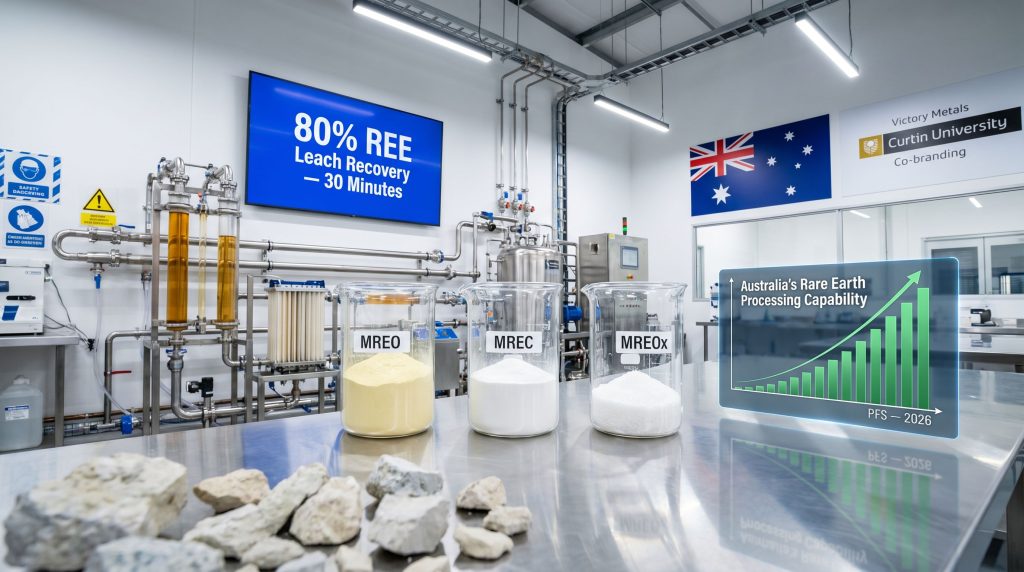
The facility is designed to produce three distinct intermediate product forms, each representing a different stage in the downstream rare earth processing chain:
| Product Type | Chemical Form | Role in Supply Chain |
|---|---|---|
| Mixed Rare Earth Oxide (MREO) | Oxide concentrate | Primary feedstock for separation refineries |
| Mixed Rare Earth Carbonate (MREC) | Carbonate precipitate | Common intermediate processing form |
| Mixed Rare Earth Oxalate (MREOx) | Oxalate precipitate | Alternative intermediate for specific refinery configurations |
The ability to produce all three product forms gives Victory commercial flexibility. Different offtake partners, particularly those operating their own downstream separation facilities in Japan, South Korea, or Europe, may prefer different intermediate specifications. Producing representative samples of each increases the company's ability to engage across a wider buyer universe.
The 80% Leach Recovery Achievement: Why It Matters More Than It Sounds
Perhaps the most technically significant recent development from the North Stanmore programme is the demonstration of approximately 80% rare earth leach recovery within just 30 minutes under revised leach parameters. For those outside the metallurgical sector, this figure may appear abstract. Its commercial implications, however, are concrete.
Leach residence time is a primary driver of reactor sizing, and reactor sizing directly influences capital expenditure. A process that achieves target recovery in 30 minutes requires substantially less tank volume than one needing two or three hours, which translates directly into lower infrastructure cost per tonne of ore processed. Simultaneously, high leach recovery at optimised reagent conditions reduces the quantity of rare earth value reporting to tailings, improving the overall economics of each tonne mined.
These revised parameters are being incorporated into the project's pre-feasibility study (PFS), which is targeted for completion in 2026. This sequencing matters for investors: PFS-level cost estimates carry significantly more credibility with potential financiers than preliminary economic assessments or scoping studies. Consequently, the rare earth processing challenges that have stalled comparable projects elsewhere make this recovery result particularly noteworthy.
Step-by-Step: How the Pilot Plant Validates the Commercial Flowsheet
-
Ore Feed Preparation – Clay-hosted material from North Stanmore is processed into a consistent feed specification suitable for the leaching circuit.
-
Optimised Leaching – Feed material enters the leach circuit under revised parameter conditions, achieving approximately 80% REE dissolution within 30 minutes.
-
Solid-Liquid Separation – The leach residue is separated from the pregnant leach solution (PLS) containing dissolved rare earth ions.
-
Selective Precipitation – Dissolved REEs are precipitated from solution using chemical conditions optimised for each target product form (oxide, carbonate, or oxalate).
-
Representative Sampling – Product batches of sufficient volume are collected for dispatch to potential offtake partners for independent technical evaluation.
-
Data Capture and PFS Integration – All process parameters, recovery rates, reagent consumption, and product quality data feed directly into the pre-feasibility study modelling.
The Commercial Logic of Producing Samples Before Signing Anything
A pilot plant's role in rare earth project development is often misunderstood by generalist investors. It is not merely a technical exercise. It is a commercial prerequisite.
International buyers of rare earth intermediates, whether Japanese magnet manufacturers, South Korean electronics producers, or European defence supply chain participants, operate under rigorous qualification processes before committing to long-term supply agreements. These processes require representative product samples of sufficient volume to conduct internal testing across multiple production parameters.
Laboratory-scale samples, no matter how analytically promising, cannot satisfy this requirement. Pilot-scale production can. The commissioning of the Victory Metals rare earths pilot plant in Perth therefore marks a transition from a development-stage project to a commercially-engaged one.
Commercial Reality: In the rare earth sector, a rare earth offtake deal is not simply a sales contract. It is a validation signal that sophisticated, technically literate buyers have evaluated the product and deemed it specification-compliant. For junior developers seeking project finance, a signed or advanced offtake discussion can be as important as a strong PFS outcome in unlocking institutional capital.
What Western Buyers Are Prioritising Beyond Price
The rare earth market's geopolitical dimension has fundamentally altered buyer decision-making over the past several years. The factors driving offtake discussions in 2026 extend well beyond conventional commodity considerations:
-
Supply chain sovereignty: Allied-nation buyers are placing explicit value on sourcing from politically stable, geopolitically aligned jurisdictions.
-
Traceability and provenance: Downstream manufacturers facing ESG disclosure requirements need verifiable supply chain documentation that Chinese-sourced materials often cannot provide.
-
Product consistency across production runs: Single sample results are insufficient. Buyers require evidence of reproducibility across multiple pilot runs before entering binding agreements.
-
Scalability confidence: Process data must demonstrate linear scalability without material efficiency degradation at commercial throughput volumes.
Australia's established rule of law, existing critical minerals partnerships with Japan, the United States, and EU member states, and its transparent regulatory environment address several of these priorities simultaneously.
Where North Stanmore Sits in Australia's Rare Earth Development Landscape
Australia's rare earth sector has historically been characterised by light rare earth dominance, with Lynas Rare Earths' Mt Weld operation representing the country's only significant operating producer. North Stanmore's heavy rare earth profile positions it in a different and arguably more strategically sensitive market segment.
| Project | Developer | Deposit Type | Current Stage | Key REE Profile |
|---|---|---|---|---|
| North Stanmore | Victory Metals | Clay-hosted HREE | Pilot plant operational (2026) | Heavy REE dominant |
| Mt Weld | Lynas Rare Earths | Carbonatite | Operating mine + processing | Light REE dominant |
| Nolans Bore | Arafura Resources | Phosphate-hosted | Feasibility/development | LREE with some HREE |
| Browns Range | HAS | Xenotime-hosted | Pilot completed | Heavy REE |
Note: Project status information is based on publicly available data and is indicative only.
The absence of operating heavy rare earth producers in Australia outside of niche or early-stage contexts underscores the significance of North Stanmore's development trajectory. Dysprosium and terbium, the HREEs most critical for high-performance permanent magnet production, currently have extremely limited non-Chinese supply. Projects capable of producing these elements at commercial scale with a simplified processing pathway occupy a strategically distinctive market position.
From Pilot Plant to Production: Understanding the Development Pathway
For investors and industry observers tracking the Victory Metals rare earths pilot plant in Perth, understanding where this milestone sits in the broader project development sequence is essential for calibrating expectations appropriately.
The standard critical minerals development pathway follows a well-defined progression:
-
Pilot plant commissioning confirms process viability and generates commercial samples (completed June 2026).
-
Pre-feasibility study (PFS) integrates pilot data into capital and operating cost estimates, with completion targeted in 2026.
-
A definitive feasibility study refines all technical and economic parameters to bankable standard.
-
Environmental approvals establish the regulatory framework for construction and operation.
-
Final investment decision (FID) triggers project financing and construction commencement.
Each stage requires the successful completion of the previous one. The pilot plant commissioning therefore represents a genuine gating event, not a procedural formality.
Disclaimer: This article is informational in nature and does not constitute financial advice. Statements regarding project timelines, development outcomes, and commercial discussions involve forward-looking assumptions that are subject to material risk and uncertainty. Readers should conduct independent research and seek professional financial advice before making investment decisions.
The next major ASX story will hit our subscribers first
Frequently Asked Questions: Victory Metals Pilot Plant and North Stanmore
What is the Victory Metals rare earths pilot plant in Perth?
It is a rare earth extraction and processing demonstration facility located in Burswood, Perth, co-developed with Curtin University. The facility validates the company's low-complexity extraction process for its North Stanmore clay-hosted heavy rare earth deposit near Cue, WA. It was officially opened in June 2026.
Why does the pilot plant not use high-temperature cracking?
North Stanmore's clay-hosted mineralisation allows rare earth ions to be leached directly from the clay matrix without requiring the high-temperature roasting or acid baking steps common in hard-rock REE processing. This geological characteristic is a primary driver of the project's cost competitiveness and processing simplicity.
What leach recovery rates have been demonstrated?
Recent testwork demonstrated approximately 80% rare earth leach recovery within a 30-minute leach duration under optimised conditions, a result being incorporated into the 2026 pre-feasibility study.
What products does the facility produce?
The pilot plant produces mixed rare earth oxide (MREO), mixed rare earth carbonate (MREC), and mixed rare earth oxalate (MREOx) as intermediate products, all standard feedstocks for downstream separation and refining operations.
What happens after the pilot plant stage?
The next major milestone is completion of the pre-feasibility study in 2026, followed by a definitive feasibility study, environmental approvals, and ultimately a final investment decision before commercial construction commences.
Want to Stay Ahead of the Next Major Mineral Discovery?
Discovery Alert's proprietary Discovery IQ model scans ASX announcements in real time, instantly identifying significant mineral discoveries — including the emerging heavy rare earth sector — and translating complex data into actionable investment insights for traders and long-term investors alike. Explore historic discoveries and the substantial returns they have generated, then begin your 14-day free trial at Discovery Alert to position yourself ahead of the broader market.