August 21, 2026
The Andean Copper Race: Why the World's Next Mining Giant Faces Its Toughest Test
Few corners of the global mining industry generate as much structural tension as large-scale copper development in South America's Andean corridor. The forces at play are well understood in theory: surging long-term copper demand drivers include electrification, a shrinking pipeline of world-class deposits, and a handful of frontier jurisdictions sitting atop enormous reserves. However, what is less commonly appreciated is just how rarely all of these variables converge in a single project at the same moment.
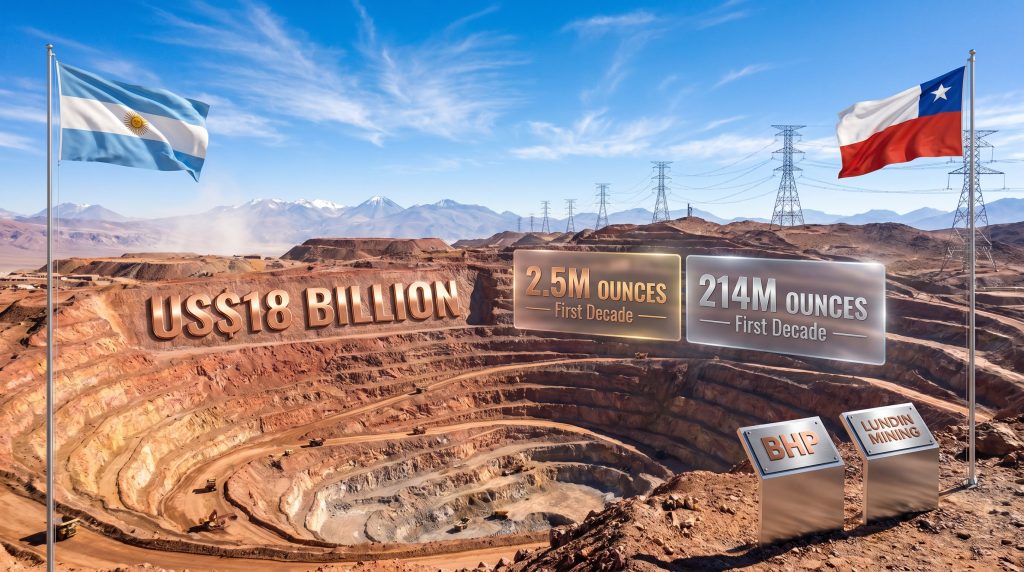
The Vicuña and Argentine provinces seek to unblock the US$18bn project, with the development straddling the Argentina-Chile border in the high-altitude Andes of San Juan province. The project sits at the intersection of sovereign risk, energy infrastructure politics, and a newly constructed regulatory framework that Argentina's government has staked considerable credibility on delivering.
Understanding what Vicuña represents, and why it remains partially stalled, requires working through several distinct layers of complexity simultaneously.
When big ASX news breaks, our subscribers know first
A Project That Redefines Scale in the Americas
The Vicuña development combines two underlying deposits, Josemaría and Filo del Sol, into a single integrated operation targeting copper, gold, and silver extraction at a scale that very few projects anywhere on earth can match. Positioned within San Juan province along the Andean range that divides Argentina from Chile, the combined resource sits within one of the most mineralised geological corridors on the planet. This belt has historically produced some of the continent's most productive porphyry copper-gold giants.
What separates Vicuña from other large Andean copper projects is the simultaneous scale across three separate metals. Current projections indicate the operation could rank among the world's top five producers of copper, gold, and silver concurrently, which is an extraordinarily rare threshold. Most large-scale copper mines generate meaningful gold and silver credits, but achieving top-five status across all three metals at once reflects the exceptional grade and mineralisation characteristics of these deposits.
The production numbers themselves illustrate why the global mining industry is paying close attention:
| Metric | First-Decade Total | 25-Year Annual Average |
|---|---|---|
| Copper | 2.5 million tonnes | 395,000 tonnes |
| Gold | 5.5 million ounces | 711,000 ounces |
| Silver | 214 million ounces | 22.2 million ounces |
To contextualise the copper figures: global mined copper production currently sits at roughly 22 million tonnes per year. Vicuña's projected annual average of approximately 395,000 tonnes over 25 years would represent close to 1.8% of total current global output from a single project, a significant contribution given that the industry is already struggling to bring enough new supply online.
For Argentina specifically, these numbers represent a transformational shift. The country has historically been a secondary copper producer compared to regional heavyweights Chile and Peru. A fully operational Vicuña would materially reposition Argentina in global supply chain conversations and fundamentally alter the country's export revenue profile over the coming decades.
The capital commitment required reflects this scale. First copper production is targeted for 2030, with US$7 billion in capital deployed by that date. The full development lifecycle carries a total investment envelope of US$18 billion, making this one of the largest single resource investments ever proposed for Argentine soil.
RIGI: The Policy Architecture That Makes or Breaks Megaproject Economics
No analysis of Vicuña's investment case is complete without understanding what RIGI actually does and why projects of this capital intensity cannot proceed without something like it.
Argentina has a well-documented history of sovereign risk events that have deterred major resource investment. Currency controls, export tax changes, nationalisation episodes, and shifting regulatory frameworks have periodically undermined investor confidence across multiple commodity cycles. For a project requiring US$18 billion committed over multiple decades, this historical backdrop creates a fundamental financing problem.
RIGI, the Régimen de Incentivo para Grandes Inversiones introduced under President Javier Milei's administration, was designed to address exactly this problem. Furthermore, the regime provides qualifying large-scale investments with a package of protections including:
- Fiscal stability guarantees locking in tax treatment for the project's economic life
- Reduced export tax obligations that improve the economic viability of high-capital-intensity operations
- Legal certainty frameworks that limit subsequent government interference with approved project terms
- Repatriation rights for a portion of foreign currency earnings, addressing a historically persistent concern for international investors
The critical distinction is that RIGI is not merely a facilitator of the Vicuña investment. Senior Argentine government officials, including Economy Minister Luis Caputo and Foreign Minister Pablo Quirno, have publicly characterised RIGI's protections as a prerequisite for the project's existence in its current form. Without the multi-decade legal certainty that RIGI provides, the financing architecture required to commit US$18 billion simply could not be constructed.
The US$6 billion Vicuña component is currently under formal RIGI evaluation, within a broader portfolio of Argentine projects totalling US$18 billion seeking the same protections. The outcome of that evaluation process will have direct consequences for both the project timeline and for Argentina's broader credibility as a jurisdiction for large-scale resource investment.
BHP, Lundin Mining, and the Logic of Joint Venture Structures
The partnership structure behind Vicuña reflects a pattern increasingly common in frontier mining environments where capital requirements exceed what any single company can comfortably absorb and where operational risk benefits from being shared.
Vicuña Corp, the joint venture entity through which BHP and Lundin Mining are jointly developing the project, brings together complementary capabilities. BHP contributes the financial firepower and copper development track record of the world's largest diversified mining company. Lundin Mining provides project-level technical leadership and has disclosed an initial phase construction budget of US$4.5 billion for the first development phase.
The capital phasing structure is worth understanding in detail:
- Phase one construction: US$4.5 billion (Lundin Mining disclosed commitment)
- Total investment by 2030: US$7 billion to achieve first copper production
- Full lifecycle investment envelope: US$18 billion across the project's operating life
This staged approach is not simply a financial preference. Phased capital deployment is a deliberate risk management mechanism in frontier jurisdictions. By sequencing investment commitments to milestone achievements, both partners retain optionality at each stage while building a progressively larger sunk cost that increases the political cost of any regulatory interference for the host government.
From a technical standpoint, large open-pit copper porphyry systems like those at Josemaría and Filo del Sol typically require substantial upfront stripping and infrastructure development before production begins. The capital intensity of the first phase reflects this reality, with much of the US$4.5 billion committed before a single tonne of copper concentrate leaves the site.
The 500kV Grid Problem: Why Infrastructure Politics Can Kill a Mining Project
The most immediate obstacle facing the Vicuña project is neither regulatory approval nor environmental evaluation. It is a dispute between Argentine provinces over high-voltage electricity grid access, a problem that sits outside the direct control of BHP, Lundin Mining, or even the national government.
Large open-pit copper operations are extraordinary consumers of electricity. Processing equipment, grinding mills, pumping systems, and ventilation infrastructure at a mine of Vicuña's projected scale require continuous, reliable power supply measured in hundreds of megawatts. The 500kV high-voltage transmission standard referenced in the project's infrastructure planning is not an arbitrary engineering choice. It reflects the minimum grid architecture capable of delivering power at the volumes and reliability levels required.
The dispute involves interprovincial negotiations over rights to connect to and transit through existing grid infrastructure, a question that in Argentina's federal system requires coordination between provincial governments that have their own economic and political interests. Consequently, San Juan province, where the mine is located, has a strong interest in resolving this dispute quickly, given the economic development upside at stake.
Without confirmed 500kV grid access, no bankable feasibility study can be completed, no project financing can be closed, and no construction timeline can be credibly maintained. The grid dispute is not a peripheral complication. It is a foundational blocker for the entire US$18 billion investment programme.
As of the time of writing, no publicly confirmed resolution to this interprovincial dispute has been announced, and the situation has opened the door to the possibility of international arbitration.
The Environmental and Social Dimensions Running in Parallel
While the grid dispute commands immediate attention, environmental and social evaluation processes are proceeding alongside it, adding additional timeline complexity. Both Josemaría and Filo del Sol require completion of environmental impact assessments under Argentine and San Juan provincial law before construction authorisations can be granted.
High-altitude Andean mining projects face distinctive environmental scrutiny around water resource management, glacial proximity, and ecosystem impact. Social licence dynamics in mining-affected communities across the Andean corridor have become progressively more complex over the past decade, reflecting broader regional trends in community rights and consultation frameworks.
The interaction between unresolved interprovincial infrastructure disputes and ongoing environmental evaluation creates a compounding risk environment: delays in one process can cascade into delays in the other, extending the critical path to first production beyond the 2030 target.
How Argentina Compares to Its Copper Rivals
The competitive context for Vicuña matters because capital is not captive to any single jurisdiction. BHP and Lundin Mining both have alternative deployment options across their respective global portfolios. If Argentina's risk-reward calculus deteriorates relative to Chile or Peru, capital allocation decisions shift accordingly.
| Factor | Argentina (Post-RIGI) | Chile | Peru |
|---|---|---|---|
| Regulatory Certainty | Improving under RIGI framework | Established but under constitutional review pressure | Elevated political and community risk |
| Infrastructure Maturity | Developing | Advanced | Moderate |
| Fiscal Incentive Depth | High under RIGI | Moderate | Variable |
| Interprovincial Complexity | Active challenge | Lower | Moderate |
| Copper Resource Quality | World-class | World-class | World-class |
Chile has historically been the default destination for large copper investment in South America, but its regulatory environment has faced growing uncertainty. Furthermore, Peru has experienced significant political instability at the national level, combined with persistent social conflicts at individual project sites that have delayed or suspended multiple major developments.
Argentina under RIGI is attempting to position itself as the more predictable alternative, offering stronger fiscal incentive depth than either competitor in exchange for accepting higher baseline sovereign risk. However, the ongoing copper supply crunch means that whether this trade-off proves compelling depends heavily on whether the current policy architecture proves durable through future electoral cycles.
The next major ASX story will hit our subscribers first
The Critical Path to 2030 First Production
For Vicuña and Argentine provinces seek to unblock the US$18bn project to achieve its stated 2030 production target, a sequential series of milestones must be completed within a compressed timeframe. The critical path looks roughly as follows:
- Resolution of the interprovincial 500kV grid access dispute
- Completion of RIGI formal evaluation and approval for the US$6 billion Vicuña component
- Finalisation of environmental impact assessment processes for both Josemaría and Filo del Sol
- Bankable feasibility study completion and project financing closure
- Construction commencement and phased ramp-up toward production
Each of these steps has dependencies on the others, and several involve parties over whom the project's joint venture partners have limited direct influence. The grid dispute resolution requires provincial government negotiation. RIGI approval involves federal regulatory process. Environmental completion involves provincial agency review.
The scenario matrix below illustrates how key variables interact with the 2030 target:
| Scenario | Trigger Condition | Likely Outcome |
|---|---|---|
| Base Case | Grid access resolved within 12 months, RIGI approved | 2030 first production achievable |
| Delay Scenario | Interprovincial dispute extends 18-24 months | First production pushed to 2031-2032 |
| Disruption Scenario | RIGI legal challenge or policy reversal | Significant capital reallocation risk; JV restructuring possible |
| Acceleration Scenario | Federal intervention resolves grid dispute rapidly | Construction front-loaded; 2030 target secured |
Note: Scenario projections represent analytical estimates based on publicly available information and should not be interpreted as financial forecasts or investment advice. Mining project timelines involve significant uncertainty.
San Juan Province and the Broader Argentine Economic Transformation
San Juan province's geological endowment extends well beyond Vicuña. The province hosts multiple significant mineral systems within the same Andean corridor, making it one of the most compelling destinations for Argentina copper exploration in the region. Provincial authorities have been actively working to develop the infrastructure and regulatory environment needed to support a materially larger mining sector than currently exists.
For Argentina's national economic programme under President Milei, a project of Vicuña's scale represents a highly visible test case for the broader investment attraction strategy. The country's current account position, foreign currency reserves, and export diversification ambitions all benefit from large-scale mining development. Employment creation across construction, operations, logistics, and supply chain sectors in the San Juan region represents an additional economic multiplier that provincial authorities are keenly focused on protecting.
The downstream effects of a fully operational Vicuña complex would extend well beyond the mine gate: road and rail upgrades, port infrastructure enhancements, regional service industry development, and potentially significant energy infrastructure investment across San Juan province.
Whether those downstream effects materialise on anything close to the projected timeline depends on whether the interprovincial grid dispute and the RIGI approval process can be navigated successfully. The project's partners, the provincial government of San Juan, and Argentina's national administration all share a strong interest in that outcome, but interest alignment does not automatically translate into resolution speed in complex multi-party infrastructure negotiations. In addition, this major copper system underscores just how significant the regional mineralisation opportunity truly is.
Frequently Asked Questions: Vicuña, Josemaría, and Filo del Sol
What is the Vicuña project and where is it located?
Vicuña is a joint venture mining development combining the Josemaría and Filo del Sol deposits within the Andean region of San Juan province, Argentina. The project targets copper, gold, and silver production at a scale that current projections suggest would position it among the world's top five producers across all three metals simultaneously.
Who owns the Vicuña mining project?
Vicuña Corp is the joint venture entity through which BHP and Lundin Mining are jointly developing the project. Each partner contributes capital, technical expertise, and operational capacity to the venture, with Lundin Mining providing disclosed project-level leadership on the initial construction phase.
How much will the Vicuña project cost to build?
The total investment envelope across the full development lifecycle is estimated at US$18 billion. The initial construction phase carries a disclosed budget of US$4.5 billion, with US$7 billion targeted for deployment by 2030 to achieve first copper production.
What is RIGI and why does it matter for Vicuña?
RIGI is Argentina's Large Investment Incentive Regime, introduced under President Milei's administration to provide fiscal stability, tax concessions, and legal certainty for major long-term investments. Senior government officials have characterised RIGI's protections as a foundational prerequisite for the Vicuña project's financial viability, given the multi-decade capital commitment the project requires.
What are the main risks facing the project's timeline?
The primary near-term risk is an unresolved interprovincial dispute over 500kV high-voltage grid infrastructure access, which is essential for powering the mine's operations at scale. Secondary risks include the pace of RIGI formal evaluation, the completion of environmental assessment processes, and the durability of Argentina's broader regulatory and fiscal framework.
When is first copper production expected from Vicuña?
Current projections target first copper production by 2030, contingent on resolution of the grid infrastructure dispute, completion of RIGI approval and environmental evaluation processes, successful project financing closure, and timely construction commencement. However, delays in any of these sequential milestones would push that target beyond 2030.
Want to Track the Next Major Copper Discovery Before the Market Does?
Discovery Alert's proprietary Discovery IQ model instantly scans ASX announcements to identify significant mineral discoveries — including copper — delivering real-time alerts that help both traders and long-term investors act ahead of the broader market. Explore historic examples of major mineral discoveries and their extraordinary returns, then begin your 14-day free trial to secure your market-leading advantage.