May 22, 2026
Vietnam's Critical Minerals Revolution: How New Processing Facilities Could Reshape Global Supply Chains
Global supply chain vulnerabilities have created unprecedented opportunities for countries with strategic mineral resources to establish themselves as alternative processing hubs. The rare earth metals sector, dominated by Chinese operations for decades, now faces a fundamental shift as Southeast Asian nations develop competitive processing capabilities that could transform international material flows.
The convergence of electric vehicle demand acceleration, renewable energy expansion, and supply chain diversification imperatives has created market conditions favouring new regional processing centres. Vietnam's emergence as a strategic destination for rare earth metal production represents more than geographic diversification – it signals the potential for entirely new supply chain architectures that could reduce single-country dependencies whilst meeting rapidly expanding global demand.
When big ASX news breaks, our subscribers know first
Strategic Infrastructure Development Transforms Vietnam's Mineral Processing Landscape
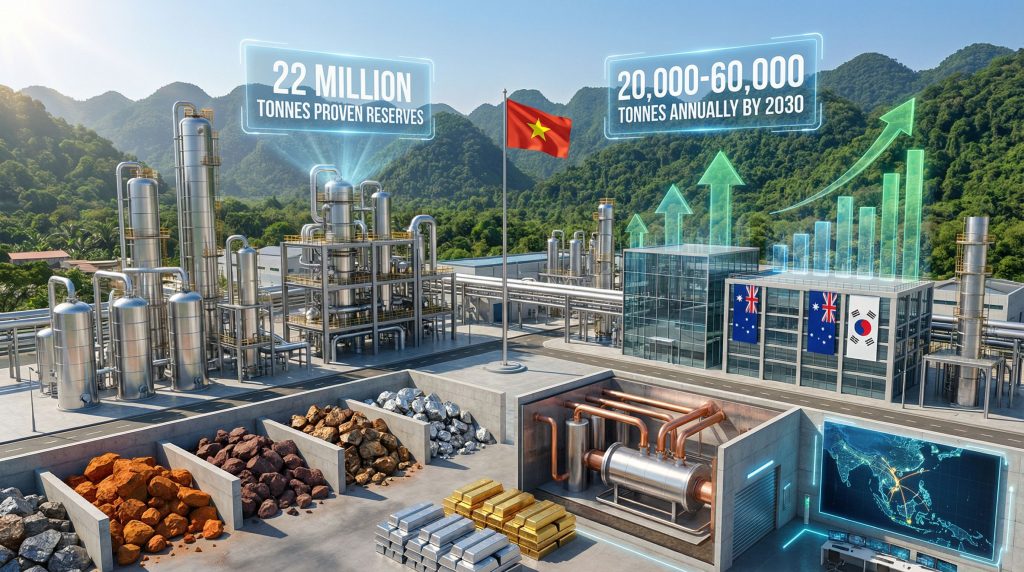
Vietnam's positioning as a rare earth processing destination builds on substantial domestic reserves estimated at 22 million tonnes, combined with strategic geographic advantages for serving Asian manufacturing centres. The Lynas Rare Earths plant in Vietnam concept represents a collaborative model that leverages Australian mining expertise with South Korean metallurgical technology to establish competitive processing capabilities outside traditional supply chains.
The preliminary framework agreement between Lynas Rare Earths and LS Eco Energy demonstrates how international partnerships can accelerate technology transfer whilst sharing both development risks and market opportunities. Furthermore, this collaboration model addresses critical gaps in rare earth metal production by combining essential capabilities.
This strategic partnership involves Lynas considering a rare earth processing plant alongside South Korean partners. The initiative builds upon lessons from mining industry evolution and contemporary supply chain requirements.
Key Partnership Components:
- Resource extraction competencies from established Australian mining operations
- Advanced processing technologies from South Korean industrial specialists
- Strategic market positioning for direct access to Asian manufacturing demand
Processing Capacity Development Timeline
The planned Vietnamese facility focuses on converting rare earth oxides into high-purity metals essential for permanent magnet manufacturing. This downstream processing capability directly addresses supply chain bottlenecks that have historically concentrated production in single geographic regions.
Production Sequence Implementation:
- Initial Operations: Samarium metal production targeting specialised industrial applications
- Capacity Expansion: Neodymium-praseodymium (NdPr) metal processing for electric vehicle motors
- Advanced Processing: Heavy rare earth metals including dysprosium and terbium for high-performance applications
The cross-investment structure involves convertible instruments worth A$30-33 million, creating aligned financial incentives between partners whilst ensuring long-term operational stability throughout market development phases.
Electric Vehicle Supply Chain Integration Creates New Market Dynamics
The Vietnamese processing initiative directly responds to supply chain constraints affecting electric vehicle manufacturing, where permanent magnets containing rare earth metals serve as critical components in traction motors. Current global EV production relies heavily on Chinese-processed materials, creating vulnerability to supply disruptions and pricing volatility.
In addition, the development supports critical minerals energy security objectives across multiple nations. The initiative also connects to broader Australia's critical minerals reserve strategic planning considerations.
Market Demand Evolution by Application Sector:
| Application Category | Current Annual Demand | 2030 Projected Demand | Growth Trajectory |
|---|---|---|---|
| EV Traction Motors | 15,000 tonnes | 45,000 tonnes | 200% increase |
| Wind Turbine Generators | 8,000 tonnes | 20,000 tonnes | 150% increase |
| Consumer Electronics | 12,000 tonnes | 18,000 tonnes | 50% increase |
The facility's focus on high-purity metal production addresses specific technical requirements for electric vehicle motors requiring consistent magnetic performance across temperature ranges, wind turbine generators demanding corrosion resistance, and industrial automation systems needing precision magnetic components.
Processing Technology Integration Enables Competitive Manufacturing
The planned Vietnamese operation emphasises metallurgical processes that convert rare earth oxides into finished metals suitable for magnet manufacturing. This technical capability represents a critical advancement in non-Chinese supply chain development, as most alternative producers historically focused on oxide production rather than metal finishing.
The processing sequence involves sophisticated separation and purification techniques that require specialised equipment and technical expertise. However, the collaboration with LS Eco Energy brings established metallurgical knowledge from South Korea's industrial base, whilst Lynas contributes proven rare earth extraction and initial processing capabilities.
What Technical Infrastructure Is Required?
Key Infrastructure Components:
- Specialised furnace systems for metal reduction operations
- Atmospheric control equipment preventing oxidation during processing
- Quality assurance laboratories ensuring consistent product specifications
- Environmental management systems meeting international standards
The facility design incorporates modern processing technologies that optimise both operational efficiency and environmental compliance, addressing sustainability concerns that increasingly influence supply chain decisions.
Regional Integration Strengthens Southeast Asian Mineral Networks
Vietnam's rare earth processing development connects to broader regional mineral processing initiatives across Southeast Asia. The country's ASEAN membership provides trade facilitation advantages that could enhance logistics efficiency for both raw material imports and finished product exports.
Furthermore, geopolitical factors including US–China trade impact considerations create additional incentives for supply chain diversification through Southeast Asian processing hubs.
Strategic Geographic Advantages:
- Proximity to major manufacturing centres in South Korea and Japan
- Established shipping infrastructure connecting to global markets
- Regional trade agreements facilitating material flows
- Cost-competitive processing environment supporting margin sustainability
The Vietnamese facility represents a node in an emerging regional network that could include processing operations in multiple Southeast Asian countries, each specialising in different aspects of the rare earth value chain.
Investment Implications Extend Beyond Direct Processing Operations
The development of Vietnam's rare earth processing capabilities creates investment opportunities across multiple industrial sectors. The establishment of metal processing facilities requires substantial supporting infrastructure, from specialised equipment suppliers to workforce development programmes.
These developments create important investment strategy insights for portfolio managers considering exposure to critical minerals processing sectors. Moreover, Reuters reports the partnership agreement encompasses broader strategic considerations.
The strategic positioning of Vietnam as a processing hub creates cascading effects throughout the regional industrial ecosystem, generating opportunities for technology providers, logistics companies, and environmental management specialists.
Primary Investment Themes:
- Processing equipment manufacturers supplying specialised furnaces and separation systems
- Logistics infrastructure providers optimising supply chain connections
- Environmental technology companies delivering compliance solutions
- Industrial service providers supporting ongoing operations
The A$30-33 million initial investment commitment represents preliminary capital allocation, with total facility development costs likely requiring substantially larger financial commitments as operations scale toward commercial production levels.
The next major ASX story will hit our subscribers first
Regulatory Framework Evolution Supports Strategic Development
Vietnam's national critical minerals policy creates favourable conditions for international partnerships through streamlined permitting processes and foreign investment incentives. The regulatory framework emphasises technology transfer and domestic capability development whilst maintaining environmental compliance standards.
Policy Support Mechanisms:
- Expedited project approval processes for strategic mineral initiatives
- Foreign investment facilitation encouraging technology transfer
- Export promotion programmes supporting processed material sales
- Workforce development support building technical capabilities
The regulatory environment balances foreign investment attraction with domestic industrial development objectives, creating conditions that support sustainable long-term operations whilst building local technical expertise.
Supply Chain Resilience Benefits Drive Strategic Interest
The Vietnamese processing initiative addresses supply chain diversification imperatives that have gained prominence across multiple industries. Single-source dependencies for critical materials create vulnerabilities that companies increasingly seek to mitigate through geographic diversification.
Risk Mitigation Benefits:
- Geographic diversification reducing single-country supply dependencies
- Technology security through non-Chinese processing capabilities
- Market competition fostering innovation and cost optimisation
- Operational redundancy providing alternative supply sources
The development timeline faces several critical dependencies, including regulatory approvals, technology transfer completion, and infrastructure development. These factors could influence operational commencement schedules and capacity ramp-up phases.
How Will This Impact Global Market Structure?
The Lynas Rare Earths plant in Vietnam initiative signals broader structural changes in global critical mineral supply chains. The emergence of alternative processing centres creates competitive pressure that could influence pricing, quality standards, and technological innovation across the industry.
Projected Global Processing Capacity Distribution (2030):
| Geographic Region | Processing Share | Competitive Advantages |
|---|---|---|
| China | 65% | Integrated supply chain, cost efficiency |
| Southeast Asia | 20% | Strategic location, international partnerships |
| North America | 10% | Technology leadership, domestic market access |
| Other Regions | 5% | Specialised applications, niche markets |
The Vietnamese facility contributes to a multipolar supply structure that enhances global market stability whilst providing manufacturers with alternative sourcing options. Consequently, this diversification trend reflects broader strategic considerations beyond purely economic factors.
Market Structure Implications:
- Reduced pricing volatility through increased supply competition
- Improved supply security via geographic distribution
- Enhanced innovation pressure driving technological advancement
- Strengthened international cooperation in critical mineral development
The successful implementation of the Lynas Rare Earths plant in Vietnam strategy could serve as a model for other countries seeking to develop strategic mineral processing capabilities whilst attracting international investment and technology transfer.
Investment Disclaimer: This analysis contains forward-looking statements and projections that involve inherent risks and uncertainties. Rare earth market dynamics, regulatory changes, and technological developments may significantly impact actual outcomes. Readers should conduct independent research and consult qualified financial advisors before making investment decisions related to rare earth processing companies or Vietnam-focused investment opportunities.
Ready to Capitalise on Critical Minerals Breakthroughs?
Discovery Alert's proprietary Discovery IQ model delivers instant notifications when ASX-listed companies announce significant mineral discoveries, including those in critical minerals and rare earth sectors. With Vietnam's strategic positioning creating new supply chain opportunities, staying informed about Australian mining discoveries could help position your portfolio ahead of major market movements.