May 22, 2026
The Democratic Republic of Congo's mineral wealth positions it at the center of an intensifying global competition for battery metals, where strategic partnerships increasingly outweigh pure financial considerations. The recent Virtus Minerals Congo mining deal exemplifies this shift, demonstrating how security credentials and geopolitical alignment can influence approval processes over traditional mining expertise and higher financial offers.
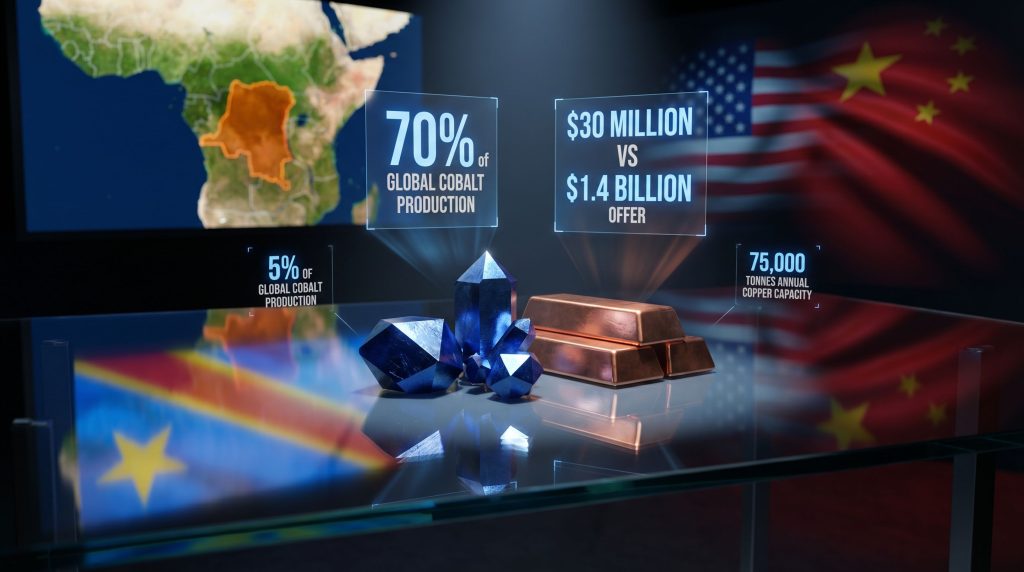
The Democratic Republic of Congo controls more than 70% of global cobalt production while maintaining substantial copper and lithium reserves, positioning it as an essential node in battery supply chains for electric vehicle manufacturing. This mineral wealth has attracted competing offers from various international partners, with recent developments highlighting how security considerations and technology transfer promises can influence decision-making processes over purely financial metrics. Furthermore, the US–China trade dynamics continue to shape these strategic partnerships.
How Operational Claims Shaped This Strategic Transaction
The Virtus Minerals Congo mining deal reveals significant discrepancies between stated operational capabilities and documented evidence, raising questions about transparency in critical mineral partnerships. According to investigation findings, Virtus claimed through its website that CEO Phil Braun had established and operated the only American-owned copper and cobalt mining and processing company in the DRC through subsidiary ROK Metals.
However, documented evidence contradicts these operational claims. ROK Metals attempted to acquire a copper-cobalt processing plant in Likasi that has remained idle since 2012, yet the acquisition was never completed despite repeated attempts. Court records from May 2024 show the facility had not been sold, with multiple purchase attempts postponed or cancelled after bidders failed to provide required payments.
Timeline of Misrepresented Operations
| Period | Claimed Status | Documented Reality |
|---|---|---|
| 2024-2025 | Operating copper-cobalt plant | Facility idle since 2012 |
| May 2024 | Established processing operations | Court shows no completed sale |
| June 2024 | Received $2M USAID grant | Grant later suspended |
| August 2024 | Continued operational claims | USAID discovered lack of ownership |
State-owned lender Sofide, serving as the privileged creditor seeking repayment through potential plant sale, confirmed the facility remains unsold and inactive. A senior judicial source verified that the plant stays under its original owner CAM Resources and has never been restarted since becoming idle.
When big ASX news breaks, our subscribers know first
The Failed Processing Plant Acquisition Strategy
ROK Metals' website continued describing the company as actively developing a copper-cobalt leaching beneficiation plant in Likasi, targeting high-grade copper cathode production for late 2023. These representations persisted despite the facility's documented inactivity and unresolved ownership status.
The situation became more complex when USAID awarded ROK Metals a $2 million grant in June 2024, describing it as a Congolese copper cathode processing plant with US private sector investment. Documentation reveals this grant was suspended in August 2024 after USAID discovered ROK Metals did not actually own the plant, contrary to representations made to program officials.
Key findings regarding the USAID grant:
- Grant awarded June 2024 based on operational claims
- Suspended August 2024 due to ownership verification failures
- No funds were ever disbursed before USAID's dissolution
- Correspondence shows continued acquisition attempts through suspension period
- USAID was dismantled in July 2025 before plant purchase completion
Security Credentials Versus Mining Expertise
The Virtus Minerals Congo mining deal demonstrates how security backgrounds can influence approval processes in strategic mineral partnerships. Phil Braun brings US Army Green Beret experience while Andrew Powch contributes former US Navy officer credentials to the leadership team.
A senior Congolese official familiar with the approval process indicated that security experience of Virtus executives factored into Kinshasa's decision-making, particularly given Washington's mediation role in peace efforts between Congo and neighbouring Rwanda. This prioritisation of security credentials over traditional mining track records reflects the complex geopolitical environment surrounding critical mineral access. Additionally, this approach aligns with the broader critical minerals strategy being implemented globally.
The emphasis on security qualifications rather than operational mining capabilities suggests a fundamental shift in how resource-rich nations evaluate partnership proposals. Traditional metrics focusing on technical expertise, financial capacity, and operational track records appear to carry less weight when strategic security considerations enter the equation.
Strategic Value Against Financial Competition
The decision to select Virtus Minerals' $30 million acquisition over competing offers demonstrates how geopolitical considerations increasingly override pure economic calculations in critical mineral partnerships. The Democratic Republic of Congo's choice reflects broader strategic positioning rather than maximising immediate financial returns.
This preference for strategic alignment over higher financial offers represents a significant departure from traditional resource extraction negotiations. The US-DRC strategic minerals partnership, established in 2024, provides the framework for this approach by offering Congo preferential access to American investment in exchange for critical mineral access rights. However, the impact of recent executive order on minerals may further influence these arrangements.
Geopolitical Partnership Benefits
The strategic partnership model offers several non-financial advantages:
- Technology transfer agreements for processing capabilities
- Development assistance commitments beyond extraction activities
- Security cooperation frameworks addressing regional stability
- Infrastructure investment promises extending beyond mining operations
- Workforce development programmes aligned with international standards
These strategic benefits aim to provide long-term value that purely financial transactions cannot deliver, though quantifying their actual worth remains challenging without specific implementation details.
Operational Realities Behind Strategic Claims
The actual production capabilities underlying the Virtus Minerals Congo mining deal centre on Chemaf's Etoile and Mutoshi mines, which account for approximately 5% of global cobalt production. These operations represent the tangible assets acquired through the March 2025 transaction, distinct from the processing plant claims that proved unfounded.
Production targets and capacity metrics:
- 75,000 tonnes annual copper capacity (pre-acquisition projections)
- 20,000 tonnes annual cobalt capacity (pre-acquisition projections)
- 5% of global cobalt output from acquired mining operations
- $700 million total investment commitment over development timeline
Partnership Structure and Financial Backing
The acquisition involves multiple international stakeholders beyond Virtus Minerals itself. India's Lloyds Metals and Energy serves as the operating partner, bringing technical mining expertise to complement Virtus's strategic positioning. New York-based Orion Resource Partners provides financial backing, including a $200 million contribution from the Virtus-Lloyds partnership structure.
This multi-party arrangement addresses some concerns about Virtus's limited operational mining experience by incorporating established mining operators and financial institutions with relevant industry backgrounds. Furthermore, this approach reflects broader trends in mining industry innovation where partnerships combine strategic positioning with technical expertise.
Reshaping Global Battery Metal Supply Networks
The Virtus Minerals Congo mining deal establishes a precedent for alternative partnership models that prioritise strategic alignment over maximum financial returns in critical mineral supply chains. This approach aims to reduce Western dependence on Chinese-controlled extraction, processing, and export networks in the Democratic Republic of Congo.
China's historical dominance in DRC mineral operations extends across the entire value chain, from extraction through refining and export logistics. The US-DRC partnership framework represents an attempt to create parallel supply networks that bypass Chinese-controlled infrastructure while developing alternative processing capabilities within Congo. This development has also been explored extensively by Virtus Minerals in their expansion efforts.
Technology Transfer and Value-Added Production
Unlike traditional extraction-focused agreements, the strategic partnership emphasises developing processing capabilities within Congo rather than exporting raw materials for processing elsewhere. This approach aims to:
- Establish copper-cobalt processing facilities under Western control
- Transfer metallurgical technologies for value-added production
- Develop local technical expertise through training programmes
- Create alternative export channels bypassing Chinese logistics networks
- Build processing infrastructure compatible with Western manufacturing standards
The success of this technology transfer approach remains unproven, particularly given the processing plant acquisition failures documented in Virtus's track record. In addition, other companies are pursuing similar strategies, such as the recent cobalt project expansion initiatives elsewhere.
The next major ASX story will hit our subscribers first
Risk Factors in Strategic Mineral Partnerships
The discrepancies between Virtus Minerals' stated capabilities and documented evidence highlight potential vulnerabilities in strategic partnership vetting processes. Jean-Pierre Okenda of Sentinel of Natural Resources emphasised the importance of verifying that companies possess necessary technical, financial and operational capacity before approval.
Due Diligence and Transparency Concerns
The USAID grant sequence illustrates how initial representations can secure government support before adequate verification occurs. The $2 million grant approval based on operational claims that proved false suggests gaps in due diligence protocols for strategic mineral partnerships.
Critical implementation risks include:
- Technical expertise gaps in complex metallurgical processing operations
- Infrastructure development requirements in remote locations without existing facilities
- Regulatory compliance across multiple jurisdictions with different standards
- Community relations and local stakeholder management in politically sensitive areas
- Environmental standards alignment with international expectations and local regulations
Long-term Viability Questions
The emphasis on security credentials over operational mining expertise raises questions about whether strategic partnerships can successfully execute complex industrial projects. Traditional mining operations require extensive technical knowledge, substantial capital investment, and proven operational capabilities that security backgrounds do not necessarily provide.
Implications for Future Critical Mineral Agreements
The precedent established by the Virtus Minerals Congo mining deal may influence how other resource-rich nations approach critical mineral partnerships. The model of prioritising strategic alignment over financial maximisation could extend to other jurisdictions with significant mineral reserves.
Potential Replication Across Resource-Rich Nations
Similar strategic partnership frameworks might emerge in:
- Lithium-producing regions including Chile, Argentina, and Bolivia
- Rare earth element sources such as Vietnam, Brazil, and Kazakhstan
- Nickel supply networks in Indonesia, Philippines, and New Caledonia
- Copper-producing nations seeking alternatives to Chinese investment models
Evolution of Resource Diplomacy Frameworks
Traditional resource extraction agreements focused primarily on economic terms, tax arrangements, and production quotas. The Congo model suggests future partnerships will increasingly incorporate:
- Security cooperation components addressing regional stability concerns
- Technology transfer requirements for local value-added processing
- Supply chain alignment commitments ensuring strategic partner access
- Geopolitical positioning considerations in approval processes
This evolution reflects broader great power competition dynamics where resource access becomes intertwined with security partnerships and strategic positioning rather than purely commercial transactions.
Assessing Strategic Partnership Viability
The documented gaps between stated capabilities and verified track records suggest significant challenges ahead. Without demonstrated technical competence in complex metallurgical operations, strategic partnerships risk failing to deliver promised production levels or technology transfer benefits.
"The Democratic Republic of Congo's mineral wealth makes it essential for global battery supply chains, but successful extraction requires proven operational capabilities rather than strategic positioning alone."
Financial performance will ultimately determine whether the strategic partnership model can scale beyond initial political agreements. If Virtus cannot achieve projected production levels from the Etoile and Mutoshi mines, or fails to establish functioning processing capabilities, the precedent may discourage similar partnerships elsewhere.
The broader implications extend beyond individual mining projects to questions about how democratic nations can effectively compete with authoritarian state-backed enterprises in critical mineral markets. Balancing strategic objectives with operational competence remains a fundamental challenge for resource diplomacy in an era of intensifying great power competition.
Disclaimer: This analysis contains forward-looking statements and assessments based on publicly available information. Mining operations involve significant risks including technical, financial, regulatory, and geopolitical factors that could materially affect outcomes. Readers should conduct independent research and consult qualified professionals before making investment decisions related to critical mineral partnerships or mining sector investments.
Want to Stay Ahead of Critical Mineral Discovery Opportunities?
Discovery Alert's proprietary Discovery IQ model provides real-time alerts on significant ASX mineral discoveries, instantly identifying actionable opportunities in the critical minerals sector before broader market awareness. Start your 14-day free trial today to access immediate notifications on cobalt, lithium, and other battery metal discoveries that could reshape global supply chains.