
May 20, 2026
Vision 2030's Industrial Catalyst
Saudi Arabia's economic transformation has entered a decisive phase where strategic manufacturing partnerships are fundamentally reshaping the Kingdom's industrial landscape. The Rosond Saudi industrial expansion represents far more than equipment assembly operations. This evolution signals a comprehensive shift toward autonomous mining services infrastructure that could revolutionize supply chain integration across the broader Middle Eastern region.
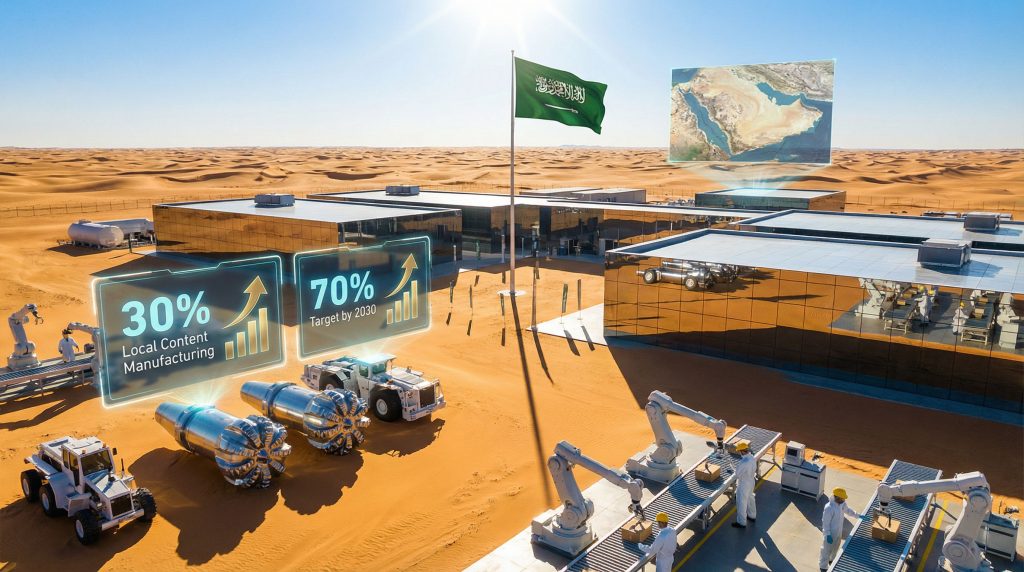
The Kingdom's manufacturing localization initiatives have reached a critical threshold where 30% domestic content requirements are driving genuine technology transfer rather than superficial assembly operations. This strategic approach balances international expertise acquisition with indigenous capability development, creating sustainable industrial ecosystems that extend beyond immediate project requirements.
Recent developments in the drilling equipment sector demonstrate how foreign partnerships can accelerate domestic manufacturing sophistication while maintaining quality standards aligned with international exploration industry benchmarks. The integration of six decades of accumulated drilling expertise with Saudi Arabia's strategic positioning and capital availability creates unprecedented opportunities for regional manufacturing leadership.
When big ASX news breaks, our subscribers know first
What Does 30% Local Content Manufacturing Mean for Regional Mining Investment?
The implementation of 30% localization requirements represents a carefully calibrated balance between technology acquisition and domestic capability building. This threshold enables meaningful knowledge transfer while maintaining operational efficiency during the transition period. Manufacturing agreements targeting this percentage create structured pathways for progressive skill development across fabrication, assembly, and technical integration processes.
Strategic Localization Framework Analysis
The 30% localization commitment encompasses multiple manufacturing components including structural elements, mechanical assemblies, and technical integration services. This comprehensive approach ensures that domestic capabilities develop across the complete value chain rather than concentrating on isolated components or basic assembly operations.
Manufacturing timelines targeting 12-month deployment cycles from agreement execution to operational deployment demonstrate the accelerated nature of contemporary localization initiatives. This compressed schedule suggests adaptation of existing manufacturing infrastructure rather than greenfield facility development, indicating strategic utilization of established Saudi industrial capacity.
Furthermore, exploring the broader context of Saudi exploration licenses reveals how regulatory frameworks support these industrial developments. Regional competitive positioning reveals varying approaches to manufacturing localization across Gulf Cooperation Council nations:
| Country | Current Manufacturing Integration | 2030 Localization Targets | Primary Advantages |
|---|---|---|---|
| Saudi Arabia | 15% baseline capacity | 70% comprehensive coverage | Capital availability, geographic positioning |
| UAE | 25% established infrastructure | 50% targeted expansion | Advanced logistics networks |
| Qatar | 10% emerging capabilities | 40% strategic development | Specialized energy expertise |
| Oman | 12% foundational systems | 45% diversification focus | Mineral resource proximity |
Manufacturing Value Chain Integration
Local content manufacturing extends beyond component sourcing to encompass fabrication processes, quality assurance protocols, and technical support systems. This integrated approach creates employment opportunities across multiple skill levels while developing specialized expertise in mining equipment manufacturing.
The manufacturing partnership structure establishes Bin Harkil Metal Industries as the primary fabrication and assembly partner, responsible for structural welding, component integration, and technical support services. This comprehensive role indicates substantial existing manufacturing capability requiring technology adaptation rather than fundamental infrastructure development.
However, understanding mining permitting insights becomes crucial for successful implementation of these manufacturing capabilities. The manufacturing agreement with Bin Harkil demonstrates how strategic partnerships can accelerate industrial development timelines.
Critical Implementation Framework: Successful localization depends on three interdependent pillars – sustained technology transfer protocols, comprehensive workforce development programs, and strategic supply chain integration. Without coordinated development across all three areas, localization initiatives risk becoming assembly operations rather than genuine industrial capability builders.
Quality control standards must maintain international specifications while scaling domestic production capacity. This balance requires rigorous testing protocols, certification processes, and continuous monitoring systems to ensure locally manufactured components meet exploration industry requirements.
How Will Technology Transfer Reshape Saudi Arabia's Industrial Ecosystem?
Technology transfer mechanisms in this partnership extend beyond equipment specifications to include operational methodologies, quality management systems, and continuous improvement processes. The integration of six decades of drilling expertise creates opportunities for Saudi engineering teams to participate in advanced manufacturing techniques previously unavailable domestically.
Knowledge Transfer Architecture Development
Rosond South Africa's role as the technical innovation center supporting Saudi operations establishes a structured knowledge transfer framework. This arrangement enables progressive capability development where technical expertise flows systematically rather than through ad-hoc training initiatives.
Engineering capability migration encompasses multiple technical domains:
• Structural engineering principles for drilling rig stability and operational efficiency
• Component integration methodologies ensuring system reliability across challenging operational environments
• Quality assurance protocols maintaining international standards throughout manufacturing processes
• Operational optimization techniques maximizing equipment performance and longevity
Workforce development initiatives target specialized manufacturing skills, technical support capabilities, and systems integration expertise. These programs address the technical requirements for domestic manufacturing while creating career advancement pathways within the expanding mining services sector.
Innovation Hub Creation Strategy
The partnership positions Saudi Arabia as a potential regional center for drilling technology advancement rather than merely a manufacturing location. This strategic positioning creates opportunities for research and development activities, technical innovation, and continuous product improvement within the Kingdom.
Innovation infrastructure development includes testing facilities, engineering design capabilities, and technical training centers supporting both immediate manufacturing requirements and long-term technological advancement. Consequently, the integration of data-driven mining operations becomes essential for optimising these technological advances.
Technology transfer success depends on maintaining intellectual property protection while enabling comprehensive knowledge sharing. This balance requires careful partnership structuring to ensure mutual benefits while protecting proprietary technologies and processes. The Rosond Arabia establishment provides a model for successful international technology partnerships.
What Are the Macro-Economic Implications for Mining Services Investment?
Manufacturing localization in the mining services sector generates multiple economic benefits extending beyond direct equipment production. Import substitution effects reduce foreign exchange requirements while creating export opportunities for regional markets experiencing similar mining development phases.
Market Structure Transformation Analysis
The strategic manufacturing agreement represents significant annual market potential, with regional expansion opportunities reaching substantial scale by 2030 as neighboring Gulf states pursue comparable localization strategies. This growth trajectory reflects broader Middle Eastern economic diversification initiatives prioritising domestic manufacturing capability development.
Regional hub development positions Saudi Arabia as a manufacturing center for Middle East and North African markets rather than serving exclusively domestic demand. This expanded market scope creates economies of scale supporting sustained investment in manufacturing infrastructure and technical capabilities.
Capital equipment ecosystem development generates upstream and downstream industry linkages connecting component suppliers, assembly operations, maintenance services, and technical support providers. These interconnected relationships strengthen overall industrial resilience while creating employment opportunities across multiple skill levels.
Investment Flow Analysis Framework
Manufacturing localization attracts complementary investments in supply chain infrastructure, workforce development, and technical support services. This multiplier effect amplifies the economic impact beyond initial manufacturing facility investments.
Regional competitive dynamics shift as Saudi Arabia develops manufacturing capabilities that potentially serve broader Middle Eastern markets. This positioning creates strategic advantages in equipment availability, technical support proximity, and supply chain reliability for regional mining operations.
In addition, leveraging joint ventures insights can enhance these competitive advantages through strategic partnerships. Export market development opportunities emerge as manufacturing capabilities mature and production capacity exceeds domestic requirements. International market penetration becomes feasible once quality standards and production efficiency reach competitive levels.
How Does This Initiative Support Vision 2030's Mining Sector Objectives?
The manufacturing partnership directly aligns with Vision 2030's economic diversification strategy by reducing petroleum dependency while expanding industrial base capabilities. The Rosond Saudi industrial expansion contributes to non-oil revenue generation while creating sustainable employment opportunities in technical sectors.
Diversification Strategy Alignment Assessment
Mining investment attractiveness increases through demonstrated advanced technical capabilities and infrastructure readiness. International mining companies evaluate technical support availability, equipment reliability, and supply chain efficiency when selecting operational locations.
Cost competitiveness improves through local sourcing options and reduced supply chain distances. Shorter logistics chains decrease operational expenses while improving equipment availability and maintenance response times.
Strategic partnerships facilitate joint ventures between international operators and Saudi entities, creating opportunities for technology transfer, market access, and operational expertise sharing. These collaborative arrangements strengthen the Kingdom's position in regional mining development.
Infrastructure Readiness Demonstration
The successful implementation of drilling equipment manufacturing demonstrates Saudi Arabia's capacity for complex technical manufacturing and quality assurance. This capability signals readiness for additional mining-related manufacturing initiatives across various equipment categories.
Regional supply chain integration creates network effects where manufacturing capabilities in one sector support development in related industries. Mining services manufacturing expertise transfers to other heavy equipment sectors, amplifying industrial development benefits.
What Challenges Could Impact Implementation Success?
Technical integration risks require careful management to maintain international quality standards while scaling domestic production. Component sourcing coordination between local and international suppliers demands sophisticated supply chain management and quality control systems.
Risk Assessment and Mitigation Framework
| Risk Category | Probability Level | Potential Impact | Mitigation Approach |
|---|---|---|---|
| Technical Quality Control | Medium | High operational consequences | Comprehensive quality assurance protocols |
| Supply Chain Coordination | Low | Medium cost implications | Diversified sourcing strategies |
| Skills Development Gaps | High | Medium timeline impact | Accelerated training programs |
| Market Demand Fluctuations | Medium | High financial exposure | Regional market diversification |
Skills gap management represents the highest probability challenge requiring coordinated training initiatives across technical disciplines. Addressing specialised manufacturing expertise requirements demands partnerships with educational institutions and accelerated workforce development programs.
Market Development Scenarios Analysis
Implementation success scenarios range from limited domestic market satisfaction to comprehensive regional manufacturing leadership. Best-case outcomes involve Saudi Arabia capturing significant Middle Eastern market share while establishing export capabilities to international markets.
Challenge scenarios include technology transfer complications extending implementation timelines by 18-24 months. These delays could impact competitive positioning and market penetration opportunities, requiring adaptive strategies and contingency planning.
Technical quality maintenance requires continuous monitoring and improvement systems ensuring locally manufactured equipment meets international standards consistently. Quality control failures could damage reputation and market acceptance, threatening long-term success.
The next major ASX story will hit our subscribers first
How Will This Model Influence Other Gulf State Industrial Strategies?
Regional competitive responses appear likely as UAE and Qatar evaluate comparable manufacturing localization initiatives in mining services and related industrial sectors. This competitive dynamic could accelerate technology transfer and industrial development across the Gulf region.
Regional Competitive Response Patterns
UAE manufacturing acceleration strategies may focus on Dubai and Abu Dhabi industrial zones leveraging established logistics infrastructure and international business relationships. Counter-strategies could emphasise specialised equipment categories or alternative technology partnerships.
Qatar's industrial diversification initiatives following major infrastructure development phases create opportunities for mining services manufacturing serving both domestic requirements and regional export markets. Lessons from Saudi implementation could inform Qatar's approach to technology transfer partnerships.
Oman's mineral resource proximity provides natural advantages for specialised mining equipment manufacturing serving extraction operations across the region. Cross-border collaboration potential includes integrated supply chains and technology sharing agreements.
Cross-Border Collaboration Opportunities
GCC manufacturing network development could create integrated supply chains spanning multiple Gulf states with specialised production focusing on comparative advantages. This collaborative approach maximises regional manufacturing efficiency while reducing external dependencies.
Technology sharing agreements between regional partners could accelerate capability development while reducing individual country investment requirements. Joint research and development initiatives strengthen overall technological advancement across participating nations.
Multi-country funding mechanisms for large-scale manufacturing projects create opportunities for shared infrastructure and coordinated industrial development. These collaborative approaches distribute financial risks while maximising regional benefits.
What Does Success Look Like by 2030?
Measurable success indicators include annual drilling rig manufacturing capacity meeting regional demand while maintaining quality standards equivalent to international production facilities. Employment generation targets encompass direct manufacturing positions and indirect support roles across the supply chain.
Long-term Strategic Positioning Framework
Best-case scenario outcomes position Saudi Arabia as the regional hub for mining equipment manufacturing, capturing 40% of Middle Eastern market share through competitive pricing, quality assurance, and technical support proximity. This market leadership creates sustainable competitive advantages and export opportunities.
Base-case implementation achieves successful domestic market supply with limited regional expansion during initial phases. This outcome satisfies Vision 2030 localization objectives while creating foundation capabilities for future market expansion.
Challenge scenario management addresses technology transfer complications that could delay full implementation by 18-24 months. Adaptive strategies and contingency planning ensure project completion despite potential obstacles.
Production targets include annual manufacturing capacity sufficient for domestic requirements plus regional export opportunities. Quality benchmarks must maintain international standards while achieving cost competitiveness versus imported alternatives.
Export development success involves penetrating regional markets while establishing international competitiveness in selected market segments. This expansion creates sustainable revenue streams supporting continued investment in manufacturing capabilities and technological advancement.
Industrial Transformation Blueprint Implementation
This manufacturing localization initiative transcends drilling equipment production to demonstrate comprehensive frameworks for strategic partnerships accelerating industrial capability development. The model provides structured approaches for balancing foreign expertise with domestic capacity building while supporting broader economic diversification objectives.
The partnership's success will likely influence similar initiatives across multiple industrial sectors, potentially reshaping international technology companies' approaches to Middle Eastern market entry and long-term collaboration strategies. Regional governments may adopt comparable frameworks for other manufacturing localization priorities.
Strategic implementation requires sustained commitment across technology transfer, workforce development, and supply chain integration. Success depends on coordinated development rather than isolated progress in individual areas, emphasising the importance of comprehensive planning and execution.
Long-term implications extend beyond immediate manufacturing benefits to include regional industrial ecosystem development where Saudi Arabia's capabilities influence broader Middle Eastern mining services infrastructure. This transformation creates opportunities for sustained economic diversification aligned with Vision 2030 objectives while establishing competitive advantages in emerging regional markets through the Rosond Saudi industrial expansion.
Looking for the Next Breakthrough Mining Discovery?
Discovery Alert's proprietary Discovery IQ model delivers real-time notifications on significant ASX mineral discoveries, instantly transforming complex geological data into actionable investment insights. Explore historic discoveries that have delivered exceptional returns, then begin your 14-day free trial today to gain your market-leading advantage ahead of major announcements.