July 20, 2026
The Geology Behind the Headlines: Why Porphyry Scale Matters Before a Single Resource Is Declared
Copper exploration at the early stage is fundamentally a game of geological probability. Investors and geologists alike must assess whether a drill program has intercepted something genuinely large or whether encouraging numbers from a handful of holes represent a localised anomaly with limited expansion potential. The difference between those two outcomes, measured in metres of mineralised continuity and the geometry of alteration systems, can determine whether a junior explorer becomes a major acquisition target or fades into obscurity.
Against that backdrop, the Vizsla Copper Thira drill results released in July 2026 carry a significance that extends well beyond the individual intercepts themselves. What Phase One of the Thira program has demonstrated is not just grade or depth, but systematic spatial continuity across a footprint large enough to warrant serious geological attention.
When big ASX news breaks, our subscribers know first
Understanding Porphyry Copper Systems Before Assessing the Numbers
Porphyry copper deposits are fundamentally different from vein-hosted or sediment-hosted ore bodies. They form when magmatic-hydrothermal fluids, typically associated with intermediate to felsic intrusions, permeate large volumes of rock over geologically extended periods. The result is disseminated and stockwork copper mineralisation spread across massive, often cylindrical or tabular bodies that can extend hundreds of metres in every direction.
What makes them economically compelling at scale is precisely their bulk tonnage potential. Individual grades may appear modest, but when a deposit spans hundreds of millions or billions of tonnes, even 0.3 to 0.5% copper-equivalent grades can support decades of open-pit or block-cave mining operations. The world's largest copper mines, including deposits in Chile, Peru, and the American Southwest, are almost exclusively porphyry systems.
Several characteristics distinguish high-quality porphyry targets from marginal ones:
- Near-surface mineralisation that begins within tens of metres of the surface, dramatically reducing stripping ratios in any future open-pit scenario
- Vertical continuity exceeding 500 metres, which supports both open-pit and underground resource potential
- Multi-metal assemblages including copper, molybdenum, silver, and gold, each contributing to copper-equivalent calculations
- Mineralisation that remains open in multiple directions, indicating the current drilling represents a fraction of the system's true extent
- Structural evidence of multiple porphyry intrusive phases within the same alteration corridor, suggesting district-scale rather than single-deposit architecture
All five of these characteristics are present at Thira. That combination is what elevates the Vizsla Copper Thira drill results from routine exploration news to something geologically noteworthy.
How Strong Are the Phase One Assay Results at Thira?
Breaking Down the Phase One Intercepts
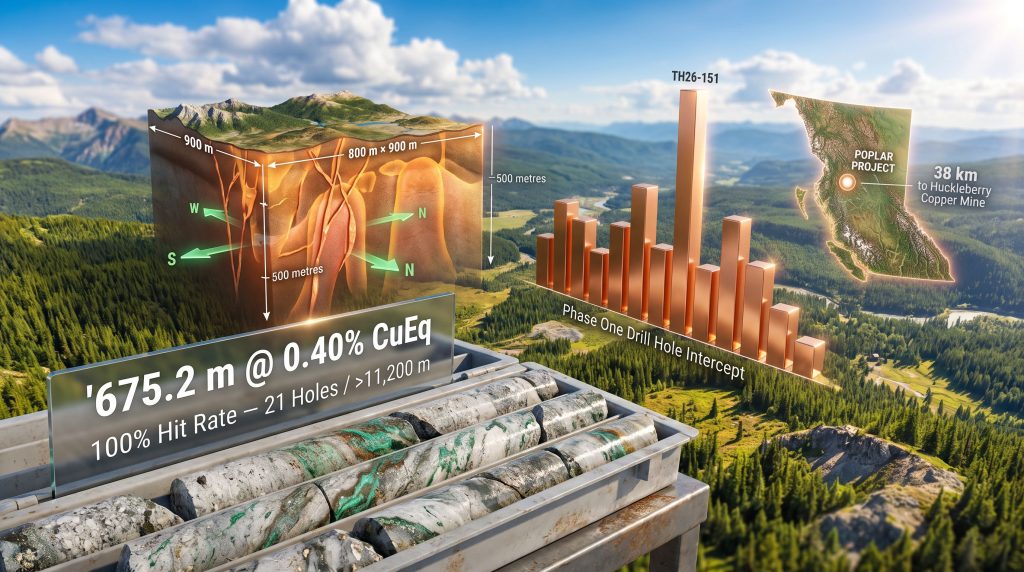
The Phase One program at Thira comprised 21 drill holes across more than 11,200 metres of total drilling. Every single hole encountered porphyry-related mineralisation, a 100% hit rate that is statistically uncommon in early-stage programs and typically reflects exceptionally strong geological targeting informed by prior geophysical and geochemical surveying.
The headline intercepts are summarised below:
| Drill Hole | Total Interval | CuEq Grade | High-Grade Sub-Interval | Depth From Surface |
|---|---|---|---|---|
| TH26-154 | 472.8 m | 0.40% CuEq | 304.8 m @ 0.48% CuEq | 13.2 m |
| TH26-151 | 675.2 m | 0.40% CuEq | 435.0 m @ 0.49% CuEq | 31.8 m |
| TH26-148 | 483.0 m | 0.40% CuEq | 205.5 m @ 0.50% CuEq | 9.0 m |
| TH25-143 | 411.7 m | 0.27% CuEq | 122.0 m @ 0.36% CuEq | 14.3 m |
| TH26-163 (Copper Pond) | 177.3 m | 0.31% CuEq | Eastern extent confirmed | Separate target |
The sheer length of these intercepts warrants emphasis. Hole TH26-151 returned 675.2 metres of continuous porphyry mineralisation from just 31.8 metres depth. For context, many producing copper mines operate open pits that are shallower than that total interval length. When a drill hole encounters nearly 700 metres of ore-grade material before reaching its terminal depth, the geological interpretation almost always centres on whether the drill stopped before the mineralisation did.
What Hole TH26-154 Reveals About System Architecture
The flagship hole TH26-154 was specifically designed to probe the northern boundary of previously identified copper-molybdenum mineralisation. Its raw assay data includes 0.26% copper, 0.017% molybdenum, 0.87 g/t silver, and 0.04 g/t gold across a 472.8-metre interval from 13.2 metres downhole. The copper-equivalent calculation of 0.40% CuEq reflects the combined economic contribution of all four metals.
The presence of a 304.8-metre higher-grade core zone grading 0.48% CuEq within the broader interval is particularly significant. In porphyry geology, higher-grade cores often reflect proximity to the causative intrusive centre, which is typically the most intensely mineralised portion of the system. Identifying a core zone in what was initially a boundary-testing hole suggests the centre of the system lies somewhere within or adjacent to the current drill footprint, potentially hosting even stronger grades.
Silver as a Meaningful By-Product: An Underappreciated Element
One aspect of the Vizsla Copper Thira drill results that receives less attention than copper and molybdenum is the silver contribution. High-grade zones within Phase One returned silver values reaching 1.24 to 1.29 g/t Ag, which is meaningful in the context of large-tonnage porphyry economics.
Silver in porphyry systems typically occurs as a peripheral metal, found in greater concentrations toward the outer edges of the alteration envelope where lower temperatures favour silver-bearing mineralogy. Its presence at elevated grades in Thira's high-grade zones adds by-product credit potential that can materially improve project economics in future feasibility studies, even if the absolute silver grades appear modest compared to primary silver deposits.
The Broader Poplar Project System: One Centre Among Several
Mapping an 8-Kilometre Alteration Corridor
The Poplar Project occupies 44,200 hectares in central British Columbia, approximately 38 kilometres from the operating Huckleberry Copper Mine. Understanding the project's scale requires thinking beyond Thira as a standalone discovery. Furthermore, the mineral exploration importance of systematic corridor mapping becomes clear when multiple targets begin to coalesce into a coherent district-scale picture.
The geological architecture within the project area has been interpreted as a multi-centre porphyry system distributed across an 8-kilometre alteration corridor. Three distinct targets have now been drill-tested within this corridor:
- Thira – the primary porphyry discovery with a confirmed footprint of approximately 800 metres by 900 metres, copper-molybdenum-silver-gold mineralisation, and vertical continuity to at least 500 metres
- Camp Lake – broad copper mineralisation intervals support interpretation as a second porphyry centre within the same alteration system
- Copper Pond – hole TH26-163 confirmed eastern copper-molybdenum-silver mineralisation grading 0.31% CuEq across 177.3 metres
Additionally, approximately 10 kilometres north of Thira lies the Poplar deposit itself, a separate near-surface copper-gold porphyry system with its own independent drill focus. The clustering of multiple mineralised centres across a structurally coherent corridor is a hallmark of district-scale porphyry systems worldwide.
Comparing Thira to the Poplar Deposit
| Feature | Thira Discovery | Poplar Deposit |
|---|---|---|
| Deposit Style | Porphyry Cu-Mo-Ag-Au | Porphyry Cu-Au |
| Start Depth | Near-surface (~9-32 m) | Near-surface |
| Current Footprint | ~800 m x 900 m | Established resource |
| Phase Status | Phase One complete | Separate drill focus |
| Primary Metals | Cu, Mo, Ag, Au | Cu, Au |
| Molybdenum Present | Yes (avg ~0.017%) | Not primary |
The molybdenum content at Thira deserves particular attention. Molybdenum is a critical industrial metal used primarily in high-strength steel alloys for aerospace, automotive, and energy infrastructure applications. It trades as a separate commodity from copper, and its concentration at Thira adds a second revenue stream that pure copper-gold porphyries lack. In copper-molybdenum systems globally, molybdenum credits can reduce the effective cash cost of copper production by a meaningful margin depending on molybdenum pricing cycles.
The Discovery Timeline: Building a Geological Case Methodically
From First Signal to Phase One Completion
The progression of geological understanding at Thira followed a disciplined, stepwise approach:
- 2025 – Discovery hole TH25-138: Returned approximately 500 metres of continuous porphyry-related mineralisation, establishing that a large-scale system existed
- Late 2025 – Follow-up hole TH25-145: Confirmed 237.3 metres grading 0.51% CuEq, validating both grade quality and lateral continuity
- Spring 2026 – Phase One launch: Two-rig program commenced, systematically testing the three-dimensional geometry of the mineralised system
- July 2026 – Final Phase One results: All 21 holes reported with no pending assays, confirming a footprint of approximately 800 x 900 metres with vertical continuity to at least 500 metres
This stepwise progression matters for investors attempting to assess geological credibility. The fact that each phase built logically on prior results, rather than producing erratic or contradictory data, suggests coherent mineralisation rather than isolated high-grade pods. For those interpreting drill results across multiple phases, this kind of methodical consistency is a positive technical signal.
A 100% hit rate across 21 Phase One drill holes is statistically uncommon in early-stage porphyry exploration and typically indicates that prior geophysical and geochemical work, often including induced polarisation surveys and soil sampling grids, successfully delineated the mineralised volume before drilling began.
Phase Two Drilling: Where the Geological Logic Points Next
Three Priority Targets and Their Geological Rationale
Phase Two drilling at the Poplar Project is designed around three specific geological questions left unanswered by Phase One:
-
Structural offsets of Thira – porphyry systems are frequently disrupted by post-mineralisation faulting, which can displace ore bodies laterally or vertically. Identifying and testing these structural offsets can reveal additional mineralised volumes that are spatially separated from the main system but genetically related to it
-
Southern Camp Lake extension – the interpretation of Camp Lake as a second porphyry centre within the corridor requires systematic testing of its southern boundary, which remains undrilled
-
Eastern Copper Pond margin – TH26-163 confirmed mineralisation but did not define its eastern limit. Step-out drilling to the east will determine whether Copper Pond represents a discrete pod or a more continuous eastward extension of the broader system
The Phase Two program is planned at approximately 8,000 metres across approximately 16 holes using a two-rig configuration. Importantly, Vizsla Copper commences its aggressive drill program as a fully funded operation, meaning no capital raises are required to complete the next phase of work.
The next major ASX story will hit our subscribers first
Market Response and What Valuation Context Tells Us
Reading the Share Price Movement
Vizsla Copper's shares advanced 4.6% to C$1.13 on the Toronto Venture Exchange following the Phase One results release, placing the company's market capitalisation at approximately C$101.9 million.
That figure deserves analytical framing rather than simple reporting. At roughly C$100 million, the market is pricing exploration optionality, not a defined copper resource. No formal mineral resource estimate exists for Thira. The valuation reflects the market's probabilistic assessment of what Thira might become, discounted by the technical, permitting, and financial risks inherent in advancing an early-stage porphyry discovery toward production.
Important Disclaimer: Nothing in this article constitutes financial advice. Share price data and market capitalisation figures represent historical information at the time of the announcement. Investors should conduct their own independent due diligence before making any investment decision. Early-stage exploration companies carry significant risks, including exploration failure, commodity price volatility, and capital raising requirements.
The absence of a formal resource estimate also creates what exploration investors sometimes describe as asymmetric upside potential. If Phase Two drilling continues to expand the known mineralised footprint and Phase One grades are sustained or improved, the pathway toward a resource estimate becomes clearer. Re-rating events in junior miners at this stage have historically been disproportionately large relative to individual drill announcements.
Why British Columbia's Geology and Infrastructure Context Matter
The Canadian Cordillera as a Porphyry Copper Province
British Columbia sits within the Canadian Cordillera, which forms part of the broader circum-Pacific porphyry copper belt — the same geological province that hosts the world's largest known copper deposits in Chile and Peru. The BC segment of this belt has produced world-class mines including Highland Valley Copper, Copper Mountain, and the now-operating Huckleberry Mine, the latter of which sits just 38 kilometres from the Poplar Project.
The proximity to Huckleberry is more than a geographic footnote. It establishes that this portion of central BC has demonstrated mineralisation at production scale, that regional infrastructure including roads and power exists within reasonable proximity, and that First Nations consultation frameworks and provincial permitting processes are established in the region. None of this guarantees a smooth development path for Thira, but it reduces the baseline infrastructure uncertainty that burdens more remote discoveries.
Copper's Structural Demand Backdrop
The macro environment for new copper discoveries has rarely been more constructive. The ongoing copper supply crunch has intensified focus on large-scale porphyry discoveries in stable jurisdictions. According to data compiled by the International Energy Agency, global copper demand is projected to roughly double by 2040 relative to 2020 levels, driven primarily by electric vehicle manufacturing, renewable energy grid infrastructure, and power transmission upgrades.
Porphyry deposits account for approximately 60% of global mined copper supply, according to the United States Geological Survey, and new large-scale porphyry discoveries in stable jurisdictions have become increasingly scarce over the past two decades. For comparison, projects such as the Reko Diq copper-gold project in Pakistan illustrate just how globally competitive the race for large-scale porphyry copper resources has become.
Molybdenum adds a separate dimension. As a critical alloying metal in high-performance steels, molybdenum demand is structurally linked to aerospace, defence, and energy sector capital expenditure cycles. Its supply is heavily concentrated in a small number of primary molybdenum mines and as a by-product of large copper-molybdenum porphyry operations, meaning new by-product molybdenum resources carry strategic value independent of copper pricing.
Frequently Asked Questions: Vizsla Copper Thira Drill Results
What is the Thira Porphyry Discovery?
Thira is a copper-molybdenum-silver-gold porphyry system located within Vizsla Copper's Poplar Project in central British Columbia. Phase One drilling confirmed a mineralised footprint of approximately 800 metres by 900 metres, extending from near-surface to at least 500 metres depth, with all 21 Phase One drill holes encountering porphyry-related mineralisation.
What Were the Strongest Intercepts from Phase One?
The three strongest intercepts by total interval length include 675.2 metres grading 0.40% CuEq from 31.8 metres depth in hole TH26-151, 483.0 metres at 0.40% CuEq from 9.0 metres in TH26-148, and 472.8 metres at 0.40% CuEq from 13.2 metres in TH26-154, which also contains a 304.8-metre higher-grade core at 0.48% CuEq.
Is Thira a Standalone Deposit or Part of a Larger System?
Geological interpretation following Phase One positions Thira as one of multiple porphyry centres within an 8-kilometre alteration corridor. The Camp Lake and Copper Pond targets have both returned mineralisation consistent with additional porphyry centres, suggesting the broader system may be significantly larger than the Thira footprint alone. In this respect, Thira echoes the district-scale architecture seen at other major copper system discoveries across the Americas.
What Metals Does Thira Contain Beyond Copper?
Phase One confirmed molybdenum averaging approximately 0.017% in key intercepts, silver reaching 1.24 to 1.29 g/t Ag in high-grade zones, and gold at approximately 0.04 g/t in the flagship hole. All four metals contribute to copper-equivalent grade calculations.
Does a Mineral Resource Estimate Exist for Thira?
As of July 2026, no formal mineral resource estimate has been published for Thira. The project remains at the active exploration and drill-definition stage, with Phase Two results expected to materially advance the geological data required for future resource estimation. However, a major copper system elsewhere in the Americas demonstrates that systematic phased drilling can move rapidly from discovery to resource estimation when geological continuity is well-established.
Key Takeaways After Phase One
The collective picture painted by Phase One is one of genuine geological scale combined with methodical execution:
- Scale confirmation: An 800 by 900 metre footprint with vertical continuity exceeding 500 metres positions Thira among the more substantive recent porphyry discoveries in British Columbia
- Grade consistency: Multiple holes returning 0.40% CuEq across intervals of 400 to 675 metres demonstrates that high grades are not isolated to a single drill hole
- Open mineralisation: Geological openness in most directions means the current footprint is more likely a minimum than a maximum estimate of the system's true size
- Multi-centre architecture: Camp Lake and Copper Pond as separate but related targets within the same corridor materially strengthens the district-scale thesis
- Molybdenum and silver credits: By-product metal contributions add economic complexity that pure copper-gold systems lack and may improve long-term project economics in feasibility modelling
- Execution quality: A 100% Phase One hit rate and a fully funded Phase Two program reflect strong technical targeting and financial planning discipline
For those tracking the Vizsla Copper Thira drill results over time, the most important data to watch in Phase Two will be whether structural offset testing reveals additional mineralised volumes, whether the Camp Lake southern extension maintains comparable grades to Thira, and whether Copper Pond can be developed into a continuous mineralised body rather than a discrete intercept. The answers to those three questions will define whether the Poplar Project's alteration corridor confirms its district-scale potential or consolidates around Thira as the primary economic target.
Readers seeking broader context on porphyry copper exploration across British Columbia and Canada can access ongoing industry reporting through the Canadian Mining Journal at canadianminingjournal.com.
Want to Be Alerted the Moment a Major Copper Discovery Hits the ASX?
Discovery Alert's proprietary Discovery IQ model scans ASX announcements in real time, instantly identifying significant mineral discoveries — including large-scale porphyry copper systems like those reshaping the sector — and delivering actionable insights to subscribers before the broader market reacts. Explore historic discovery returns on Discovery Alert's dedicated discoveries page and begin your 14-day free trial today to position yourself ahead of the next major find.