August 25, 2026
How Development Finance Institutions Are Reshaping Junior Mining Capital Structures
In precious metals development, the source of capital often communicates more than the amount itself. Junior mining companies operating in politically complex jurisdictions have long understood that institutional relationships, particularly with sovereign-aligned lenders, can reframe how a project is perceived across the entire financing ecosystem. The Vizsla Silver financing from FIFOMI, finalised in mid-2026, illustrates this dynamic with unusual clarity.
Understanding what this deal actually represents, beyond its headline figure, requires examining the mechanics of development finance institutions, the specific structure of the facility, and the broader transactional environment reshaping Mexico's silver sector right now.
When big ASX news breaks, our subscribers know first
Understanding FIFOMI: Mexico's Mining-Specific Development Lender
FIFOMI, formally known as Fideicomiso de Fomento Minero, operates as a government trust specifically designed to provide structured financial support to the mining industry. Unlike commercial banks, which evaluate mining loans primarily through credit risk and collateral frameworks, FIFOMI's mandate is inherently developmental. It exists to facilitate the growth of Mexico's mining sector, both for domestically operated projects and those controlled by foreign-listed companies.
This distinction matters considerably. When a state-backed institution with a sector-specific mandate extends financing to a foreign operator, it signals a degree of institutional alignment that a standard commercial loan simply cannot replicate. Furthermore, the participation of FIFOMI carries implicit weight in terms of how co-investors, offtake partners, and future lenders interpret project risk.
FIFOMI financing also differs structurally from the capital sources most commonly used by junior silver developers:
- Commercial bank debt typically requires secured collateral over project assets and is subject to conventional credit metrics.
- Silver streaming agreements avoid dilution but effectively sell future production at a discount to spot, permanently altering project economics.
- Equity raises on the TSX or TSXV are highly dilutive and subject to market sentiment volatility.
- Royalty financing offers revenue-linked capital but compounds the long-term economic burden on producing assets.
A FIFOMI working capital facility, by contrast, is unsecured, competitively priced, and carries no production-linked obligations.
Breaking Down the Vizsla Silver FIFOMI Loan Structure
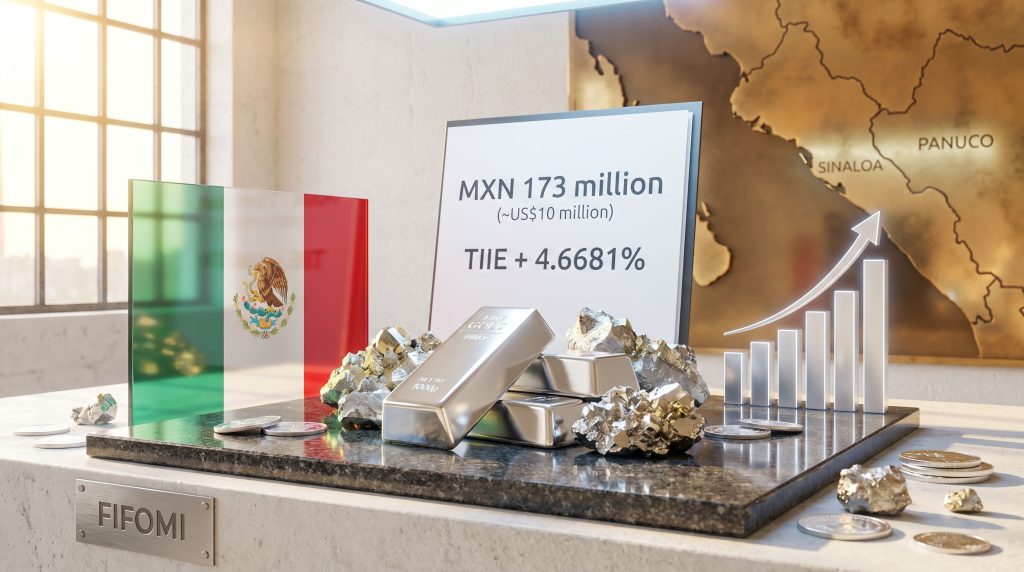
The Vizsla Silver financing from FIFOMI totals MXN 173 million, equivalent to approximately US$10 million, and has been structured as an unsecured working capital facility. The key terms are outlined below:
| Parameter | Detail |
|---|---|
| Facility Amount | MXN 173 million (~US$10 million) |
| Loan Classification | Unsecured working capital |
| Tenor | 5 years |
| Principal Grace Period | 2 years |
| Interest Rate | TIIE + 4.6681% |
| Repayment Frequency | Quarterly |
| Origination Fee | 1.0% (one-time) |
The interest rate is benchmarked to TIIE, which stands for Tasa de Interés Interbancaria de Equilibrio, Mexico's interbank reference rate. The total borrowing cost floats with this benchmark, with a fixed spread of 4.6681 percentage points applied above it. For a development-stage project in an emerging market jurisdiction, accessing unsecured debt at this pricing represents a structurally favourable outcome compared with most alternatives available at this stage of project maturation.
The two-year principal grace period is a particularly noteworthy feature. It allows Vizsla Silver to deploy the working capital without facing principal repayment pressure during what is typically the most cash-intensive phase of pre-production or early-production development. Quarterly repayments then commence over the remaining three-year period following the grace window. For further context on how this facility was secured, Vizsla Silver's official announcement outlines the full terms.
"A two-year principal holiday is not a standard feature of commercial mining credit. It reflects the developmental rather than purely commercial nature of FIFOMI's lending mandate, and it provides the borrower with meaningful cash flow management flexibility during a capital-intensive transition period."
The Panuco Silver-Gold Project: Context and Scale
The facility is designated for operating and working capital expenditures at the Panuco silver-gold project, located in Sinaloa, one of Mexico's most historically significant precious metals producing states. Panuco is widely recognised as one of the highest-grade silver-gold development projects in the Americas, a distinction that attracts institutional attention but also raises the capital intensity of bringing it to full-scale production.
At US$10 million, the FIFOMI facility addresses near-term liquidity requirements rather than constituting the primary construction finance solution for Panuco's full development. Investors should understand this contextual boundary clearly: the facility does not materially alter the larger capital requirement the project carries. Its significance is better understood through the institutional relationship it establishes and the signalling effect it generates for future financing rounds.
Sinaloa's position as a historic silver jurisdiction also adds geological credibility. The state sits within Mexico's Sierra Madre Occidental belt, a geologically prolific corridor that has produced silver mineralisation for centuries and continues to host some of the continent's most prospective epithermal vein systems. In addition, analysis of the precious metals market in 2025 highlights why institutional appetite for high-grade silver assets like Panuco continues to grow.
The Strategic Hire That Preceded the Deal
One of the lesser-discussed but highly material factors behind the Vizsla Silver financing from FIFOMI is a personnel decision Vizsla made prior to the loan closing. The company appointed a former head of FIFOMI as its Vice President of Government Relations, a deliberate strategic move that built direct institutional familiarity between Vizsla's leadership and FIFOMI's internal processes.
In development finance, relationship capital is frequently as important as financial capital. A former institution head brings procedural knowledge, credibility with existing FIFOMI staff, and an understanding of how the trust evaluates project risk. This hire likely served as a significant facilitating factor in structuring and ultimately closing the facility.
This approach carries forward-looking implications as well. A government relations function staffed at this seniority level suggests Vizsla is positioning itself for deeper sovereign stakeholder engagement ahead of larger financing rounds, potentially including further FIFOMI tranches or parallel instruments from other state-aligned institutions.
Why Institutional Alignment Matters in Mexico's Current Regulatory Environment
Mexico's mining sector is navigating a period of genuine policy uncertainty. Recent federal legislative shifts and statements from government officials have generated notable concern among mining investors about the long-term regulatory stability of the jurisdiction. The federal ban on open-pit mining has created direct friction between central government mandates and state economies, particularly in Sonora.
Against this backdrop, receiving financing from a government-linked institution carries a nuanced signal. It does not insulate a project from regulatory risk, and it should not be interpreted as any form of explicit government approval or project-specific endorsement. However, FIFOMI's participation does indicate that a state-aligned body has assessed the Panuco project through its own institutional lens and determined the facility to be appropriate.
For international investors evaluating Mexican mining exposure, this distinction has practical relevance. Development finance institution involvement has historically served as a partial de-risking signal in other jurisdictions, and Mexico's mining finance ecosystem is no exception.
The next major ASX story will hit our subscribers first
How the FIFOMI Facility Compares to Other Capital Sources
| Financing Type | Security Required | Dilution Risk | Strategic Signal |
|---|---|---|---|
| FIFOMI Working Capital Facility | Unsecured | None | High (state alignment) |
| Commercial Bank Debt | Secured (assets) | None | Moderate |
| Silver Streaming Agreement | Project cash flows | None (dilutive to economics) | Moderate |
| Equity Raise (TSX/TSXV) | None | High | Variable |
| Royalty Financing | Revenue-linked | None (dilutive to economics) | Low-Moderate |
The unsecured nature of the FIFOMI facility is arguably its most underappreciated attribute. Taking on debt without pledging mineral assets or surface infrastructure as collateral preserves Vizsla's financial flexibility for subsequent financing rounds, including potential project finance structures that would typically require a first-priority security package over Panuco's assets. Consequently, junior mining investments in 2025 and beyond increasingly reflect this kind of tiered capital structuring as a preferred approach.
Mexico's Silver Sector: A Wave of M&A and Financing Activity in 2026
The Vizsla Silver FIFOMI transaction is not occurring in isolation. Across multiple Mexican states, a concentrated burst of transactional activity is reshaping the country's silver development landscape:
- J2 Metals and Sierra Plata (Guerrero): The TSXV granted regulatory approval for J2 Metals to finalise its option agreement with Impact Silver for the Sierra Plata silver-gold-antimony project. The project's antimony exposure carries elevated strategic relevance following the mineral's designation as critical by both the United States and the European Union. The benefits of antimony as a critical mineral have become an increasingly compelling investment narrative.
- Sierra Madre Gold and Silver and Del Toro Mine (Zacatecas): Mexico's antitrust agency COFECE granted regulatory clearance for Sierra Madre's acquisition of the Del Toro silver mine from First Majestic Silver. The company is replicating the restart playbook it applied successfully at its La Guitarra mine in the State of Mexico.
- Silverco Mining and La Negra Mine (Querétaro): Silverco completed its acquisition of Nuevo Silver, taking 100% ownership of the La Negra mine and completing its transition from developer to active producer status.
- Americas Gold and Silver – Silver Stream Termination: The company reached an agreement with Sprott Mining to terminate a silver delivery obligation covering 592,000 ounces of silver, issuing 7,956,696 common shares at a deemed price of US$5.57 per share. This eliminated more than US$45 million in variable future debt obligations and coincided with the company reporting record silver production and revenue for Q1 2026.
"The clustering of acquisition completions, regulatory approvals, and new financing structures across Guerrero, Zacatecas, Querétaro, and Sinaloa during mid-2026 points to an accelerating consolidation cycle driven by elevated silver prices and improving institutional appetite for Mexican precious metals assets."
Furthermore, the broader mining consolidation trends in 2025 provide useful context for understanding why this wave of deal activity is occurring now rather than in prior cycles.
Steel Trade Barriers and Their Second-Order Impact on Mexican Mining
A dimension of the Vizsla Silver financing story that rarely receives adequate attention is the inflationary cost pressure building across Mexico's mining development pipeline from simultaneous steel trade protectionism in three major economic blocs.
The European Parliament voted in mid-2026 to overhaul its steel trade safeguards by cutting tariff-free import volumes by 47% and doubling the excess import tariff to 50%. This move mirrors concurrent protectionist measures being implemented by both the United States and Mexico itself. Indeed, tariffs affecting commodity markets in 2025 have set the stage for these compounding inflationary pressures across the development pipeline.
Steel is not a peripheral input in silver-gold project development. It is a primary material for:
- Processing plant construction and structural frameworks
- Shaft sinking and underground development support systems
- Tailings management infrastructure
- Camp and surface facility construction
When three major trade blocs tighten steel barriers simultaneously, the cost inflation effect compounds rather than cancels. Development-stage projects carrying significant remaining capital expenditure, including Panuco, face a more expensive construction environment than feasibility studies completed even 12 to 18 months earlier may have assumed. This context makes the cash flow flexibility provided by the FIFOMI grace period more operationally relevant than it might appear on paper.
It is also worth noting that Vizsla Silver has simultaneously pursued a broader project finance mandate. Vizsla Silver's $200M agreement with Macquarie signals that the FIFOMI facility is one component of a larger, layered capital strategy rather than a standalone financing solution.
Frequently Asked Questions: Vizsla Silver FIFOMI Financing
What does Vizsla Silver intend to use the FIFOMI loan for?
The facility is earmarked for working capital and operating expenditures at the Panuco project in Sinaloa. It is not structured to fund the major capital expenditure required to bring Panuco to full production scale.
Is the FIFOMI facility secured against Panuco's assets?
No. The loan is classified as unsecured, meaning FIFOMI has not taken a charge over Panuco's mineral rights, surface infrastructure, or other project assets as collateral.
When does Vizsla Silver need to begin repaying principal?
A two-year grace period applies to principal repayments. Quarterly principal instalments begin after this period and continue over the remaining three years of the five-year term.
What is the effective interest rate?
The loan is priced at TIIE plus a fixed spread of 4.6681 percentage points. The total borrowing cost floats with Mexico's interbank benchmark, making it sensitive to movements in Mexican monetary policy.
Does this financing solve Panuco's full capital requirement?
At US$10 million, this facility addresses near-term liquidity rather than the full capital stack required for production-scale development. Investors should not interpret it as a project finance solution.
Key Takeaways for Investors Evaluating the Vizsla Silver FIFOMI Facility
Several points deserve clear emphasis for investors assessing the significance of this deal:
- The US$10 million facility is a working capital instrument, and its scale should be interpreted accordingly within the context of Panuco's total capital requirements.
- FIFOMI's participation establishes an institutional relationship with Mexico's sovereign-aligned mining finance infrastructure, carrying value well beyond the immediate loan quantum.
- The appointment of a former FIFOMI head to Vizsla's government relations function was a strategic precursor to this transaction and signals an intent to deepen sovereign stakeholder engagement ahead of larger capital raises.
- Mexico's regulatory environment remains genuinely uncertain for mining investors, and FIFOMI participation does not constitute project-specific government endorsement or protection from policy risk.
- Rising steel input costs driven by concurrent protectionist trade policies across the EU, US, and Mexico represent an underappreciated capital cost risk for development-stage projects in the region.
- The broader deal environment across Mexico's silver sector in 2026 reflects an active consolidation cycle, with multiple transactions reaching completion simultaneously across Guerrero, Zacatecas, Querétaro, and Sinaloa.
This article contains analysis of publicly available information and forward-looking context. It does not constitute financial advice. Investors should conduct independent due diligence before making investment decisions related to any company or project mentioned.
Want to Identify the Next Major Silver or Precious Metals Discovery Before the Broader Market?
Discovery Alert's proprietary Discovery IQ model delivers real-time alerts on significant ASX mineral discoveries, transforming complex geological and market data into actionable investment insights for both short-term traders and long-term investors — explore historic discovery returns on Discovery Alert's discoveries page to understand the scale of opportunity, then begin your 14-day free trial at Discovery Alert to position yourself ahead of the market.