
June 12, 2026
Why Junior Mining Capital Structures Are Getting More Sophisticated
The era of a single debt facility carrying a junior mining project from feasibility to production is largely over. In its place, a more architecturally complex approach has emerged, one where developers layer sovereign financing instruments alongside institutional debt and convertible equity-linked notes to reduce construction-phase risk, preserve shareholder optionality, and signal project legitimacy to regulators and offtake buyers simultaneously. This multi-instrument discipline, once reserved for mid-tier producers, is now filtering down to the junior development space, and the Vizsla Silver Panuco mine financing story is one of the clearest illustrations of that shift in action.
What makes this particular capital structure worth examining in detail is not just the scale of the funding secured, but the strategic sequencing of each instrument and what each layer communicates to different stakeholder groups. Understanding how these pieces fit together reveals as much about modern project development in jurisdictions like Mexico as it does about the Panuco project itself.
When big ASX news breaks, our subscribers know first
The Panuco Project: Scale That Commands Serious Capital
What the Feasibility Numbers Actually Mean
Located in Sinaloa, Mexico, the Panuco silver-gold project sits within one of Latin America's historically productive mineral corridors. The November 2025 definitive feasibility study delivered economics that are genuinely rare at the feasibility stage of a junior-controlled asset.
The key metrics tell a compelling story:
| Metric | Panuco (Vizsla Silver) | Typical Junior Silver Developer |
|---|---|---|
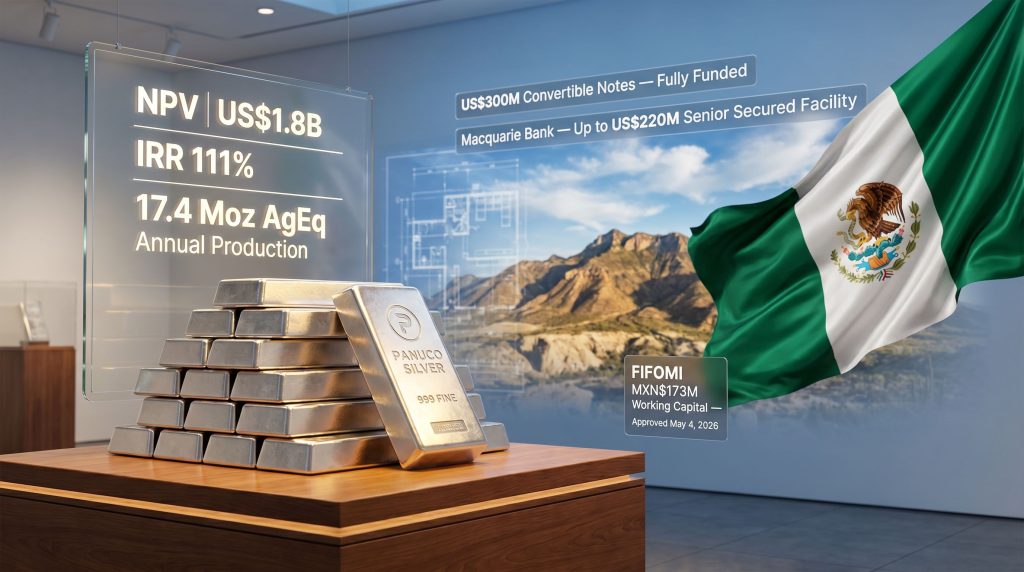
| Annual AgEq Production | 17.4 Moz | 3 to 8 Moz |
| After-Tax NPV (5%) | US$1.8 billion | US$200M to US$600M |
| IRR | 111% | 25 to 45% |
| Payback Period | 7 months | 3 to 5 years |
| Initial Mine Life | 9.4 years | 6 to 10 years |
| Base Case Silver Price | US$35.50/oz | Varies |
| Base Case Gold Price | US$3,100/oz | Varies |
An after-tax IRR of 111% at feasibility stage is an almost anomalous figure in the mining world. To contextualise this: most investment-grade mining projects at pre-construction stage are considered robust at IRRs between 25% and 45%. Exceeding 100% implies that the project's undiscounted cash flows repay initial capital investment within less than a year, which is confirmed by the seven-month payback period stated in the study.
A seven-month capital payback period does not merely reassure lenders about credit risk. It fundamentally changes the risk-return calculus for every instrument in the capital stack, from senior secured debt to equity-linked convertibles. Lenders who might otherwise demand strict covenants and security over all project assets can afford to offer more flexible terms when payback occurs faster than most feasibility studies even project.
The US$1.8 billion after-tax NPV against a junior-controlled capital structure creates what analysts describe as a significant re-rating gap — the difference between where a project is valued during development and what it should theoretically be worth once de-risked through construction and commissioning. This gap is precisely what sophisticated capital allocators are attempting to arbitrage through the instruments described below.
The Three-Layer Vizsla Silver Panuco Mine Financing Structure
How the Capital Stack Was Assembled
The Vizsla Silver Panuco mine financing was not assembled in a single transaction. It was constructed in three distinct tranches across approximately nine months, each serving a different function within the overall funding architecture.
Summary of the Complete Capital Stack:
| Financing Instrument | Provider | Amount | Purpose | Status |
|---|---|---|---|---|
| Senior Secured Project Finance Mandate | Macquarie Bank | Up to US$220M | Construction and development | Mandated September 2025 |
| Convertible Notes (Cash-Settled, Capped Call) | Capital Markets | US$300M | Full development funding | Completed November 2025 |
| Working Capital Facility (Unsecured) | FIFOMI (Mexican Government) | MXN$173M (~US$10M) | Operating and working capital | Approved May 2026 |
Tranche One: The Macquarie Senior Debt Mandate
In September 2025, Macquarie Bank was mandated as lead arranger, agent, and sole underwriter for a senior secured project finance facility of up to US$220 million. This represented the conventional backbone of the capital structure, a debt instrument collateralised against project assets and conditioned on feasibility study completion, equity funding milestones, and permitting progress.
Importantly, the mandate included an initial US$25 million early-drawdown tranche, providing near-term liquidity ahead of full facility activation. The Macquarie mandate sent a clear market signal: a globally recognised infrastructure and resources bank had conducted sufficient due diligence on Panuco's technical and economic merits to underwrite a nine-figure debt commitment.
Tranche Two: The US$300 Million Convertible Notes Issuance
Two months later, in November 2025 and concurrent with the Feasibility Study release, Vizsla Silver completed a US$300 million convertible notes issuance. These cash-settled, capped-call instruments carry a 5% coupon and are structured to provide capital flexibility while limiting shareholder dilution through the capped-call mechanism. Furthermore, the various ASX capital raising methods employed in comparable development scenarios illustrate how instrument design can meaningfully affect shareholder outcomes.
The capped-call structure is worth explaining in plain terms. In a standard convertible note, the bondholder can convert debt into equity at a predetermined price, which creates dilution for existing shareholders if the stock rises. A capped-call overlay involves the issuer simultaneously purchasing call options that offset the dilutive effect up to a defined share price ceiling. This means the company benefits from the lower cost of convertible debt without surrendering unlimited upside to noteholders.
Following this issuance, Vizsla Silver declared the project fully funded for development and construction, a milestone that de-risks the development timeline materially for all stakeholders.
Tranche Three: The FIFOMI Working Capital Facility
The third and most strategically nuanced component of the Vizsla Silver Panuco mine financing is the MXN$173 million (approximately US$10 million) unsecured working capital facility from FIFOMI, Mexico's Mining Development Trust. The credit agreement was signed on February 26, 2026, through Minera Canam S.A. de C.V., Vizsla's Mexican operating subsidiary, and FIFOMI's internal credit committee formally approved the facility on May 4, 2026.
Key facility terms include:
- Five-year term with quarterly interest and principal payments
- Interest rate: TIIE funding rate plus a 4.6681% margin
- Two-year grace period on principal repayments, preserving early-stage cash flow
- One-time commission fee of 1.0% of the total facility value
- Proceeds restricted exclusively to operating and working capital expenditures at Panuco
The TIIE (Tasa de Interés Interbancaria de Equilibrio) is Mexico's interbank interest rate benchmark, functionally equivalent to SOFR in the United States or SONIA in the United Kingdom. A margin of 4.6681% over TIIE for an unsecured facility extended to a foreign-controlled junior mining company represents competitive pricing, reflecting FIFOMI's developmental mandate rather than pure commercial lending logic.
Understanding FIFOMI: Mexico's Strategic Mining Finance Tool
What FIFOMI Is and Why It Matters
FIFOMI operates as a public trust within Mexico's financial system, overseen by the Ministry of Economy, with a mandate to promote the development and global competitiveness of Mexico's domestic mining sector. Its tools include direct financing, technical assistance, and training programs aimed at strengthening the industry's productive capacity.
For foreign-controlled developers, FIFOMI participation carries significance well beyond the face value of any credit facility. When a sovereign-backed institution extends financing to a foreign mining company, it functions as an institutional assessment of that project's economic legitimacy, social contribution, and regulatory standing. This is not formal government endorsement of the project, but it does represent a meaningful signal that the project has passed FIFOMI's internal evaluation criteria related to economic and social viability.
Three distinct risk-reduction benefits flow from this participation:
- Credibility signalling to co-investors, offtake counterparties, and permitting agencies that the project meets sovereign economic development criteria
- Low-cost working capital that reduces dependence on higher-cost commercial debt for operational expenditures during the construction-to-production transition
- Institutional relationship building with federal agencies whose approvals are required before construction can commence
The Government Relations Layer: Appointing Institutional Knowledge
Why Personnel Strategy Is Part of the Financing Architecture
Concurrent with the FIFOMI facility announcement in May 2026, Vizsla Silver appointed Angel Gómez, the former Director General of FIFOMI himself, as Vice President of Government Relations, based in Mexico City. His mandate is to lead engagement with the Ministry of Economy, the General Directorate of Mines, and SEMARNAT as Panuco advances toward its targeted construction start in the second half of 2026.
This appointment is not incidental to the financing story. It reflects a conscious organisational architecture decision: the company is investing in regulatory intelligence as a form of project risk management. Gómez's institutional knowledge of how Mexico's federal permitting agencies evaluate applications, prioritise workflows, and respond to developer engagement provides capabilities that cannot be replicated through external legal counsel alone.
Michael Konnert, President and CEO of Vizsla Silver, described Gómez as someone whose years leading the very institutions the company now needs to work with, combined with the ministerial relationships he built across Mexico's federal government, provide exactly the inside operational knowledge required during the permitting phase. This type of strategic hire reflects a broader truth: in complex sovereign jurisdictions, regulatory navigation is a core competency, not an administrative function.
Mexico's Permitting Environment: Why It Requires a Dedicated Strategy
The regulatory landscape confronting any mining developer in Mexico has become demonstrably more complex in recent years. SEMARNAT is increasingly applying updated water management regulations and forestry standards to applications that may have been filed years prior, creating a shifting compliance target that demands continuous engagement rather than a one-time submission process.
Mexico's mining sector recorded a year-on-year production decline of 5.8% in 2025, with regulatory uncertainty identified as a primary variable weighing on investment decisions across the sector. This statistic is important context: it means Panuco is being developed against a backdrop of sector-wide headwinds that have constrained production growth for otherwise technically sound projects.
Santiago Suárez, Partner at Servicios Legales Mineros, has articulated the core challenge clearly: advancing a project in Mexico demands not only formal regulatory compliance, but technical credibility, demonstrated social licence, and a durable institutional strategy capable of generating genuine trust with authorities including SEMARNAT. This framing positions permitting success as a relationship outcome rather than a purely procedural one, which is precisely why Gómez's appointment carries strategic weight.
Mexico's Policy Environment and the Silver Supply Chain Narrative
Federal Signals That Matter for Project Timing
Mexico's Minister of Economy, Marcelo Ebrard, confirmed at the XXXVI International Mining Convention 2025 that the federal government intends to accelerate mining permit approvals and streamline pending procedures in 2026. The rationale framing this commitment centred on securing supply chains as a national economic priority, reflecting Mexico's broader industrial strategy around electromobility and advanced manufacturing.
Separately, in February 2026, the Mexico-US Action Plan on Critical Minerals established a bilateral framework to integrate Mexican mining production into North American supply chains. The framework targets electromobility, advanced manufacturing inputs, and strategic mineral security — areas where silver plays a dual role as both a monetary metal and an industrial input with growing demand from photovoltaic solar manufacturing and electronics.
Silver's industrial demand profile has shifted materially over the past decade. The metal is now consumed in solar panel production, electric vehicle components, 5G infrastructure, and medical devices, in addition to its traditional role in jewellery and silverware. This evolving demand profile means a large-scale silver producer like Panuco occupies a strategically relevant position in North American industrial supply chains, not only as a precious metals asset.
It is important to note that while these policy directions and bilateral frameworks create a broadly supportive context for large-scale silver projects in Mexico, they do not constitute project-specific government backing or accelerated permitting for Panuco specifically. The policy environment and the FIFOMI facility are distinct matters.
The next major ASX story will hit our subscribers first
Panuco Development Timeline: Key Milestones
| Date | Milestone |
|---|---|
| September 2025 | Macquarie Bank mandated for up to US$220M senior secured project finance facility |
| November 2025 | Feasibility Study completed; US$300M convertible notes finalised; project declared fully funded |
| February 26, 2026 | FIFOMI credit agreement signed with Minera Canam S.A. de C.V. |
| May 4, 2026 | FIFOMI internal credit committee formally approves MXN$173M working capital facility |
| May 2026 | Angel Gómez appointed VP Government Relations; construction start targeted 2H26 |
What This Model Means for Junior Mining Developers Globally
The Institutional Alignment Playbook
The approach Vizsla Silver has assembled at Panuco represents an emerging template for how technically credible junior developers can navigate sovereign-jurisdiction complexity without sacrificing equity value or construction timeline certainty. In addition, the broader context of mining industry consolidation reinforces why securing robust, multi-layered capital structures has become increasingly important for junior developers seeking to retain project control.
The key structural lessons for developers operating in similar environments include:
- Diversify the capital stack across instrument types to reduce single-lender dependency and preserve equity flexibility through instruments like capped-call convertibles
- Engage sovereign financing institutions early in the development cycle, where FIFOMI participation functions as both a financial instrument and a political signal
- Invest in regulatory intelligence through personnel rather than relying exclusively on external legal representation, particularly in jurisdictions where agency relationships drive approval timelines
- Align project narrative with national policy priorities, framing development within the host country's industrial and supply chain strategy to strengthen federal-level alignment
- Sequence capital raises to build institutional confidence, with each tranche reinforcing the credibility established by the previous one
This playbook is replicable in other jurisdictions where sovereign financing institutions exist and where regulatory complexity demands genuine institutional engagement. The combination of multilateral debt, equity-linked notes, sovereign working capital financing, and a dedicated government relations function staffed by former regulators creates a multi-dimensional risk management architecture that goes well beyond traditional project finance. Furthermore, eligible exploration-stage companies may also benefit from complementary programmes such as the junior minerals exploration incentive, which can support earlier-stage capital efficiency before a full project finance stack becomes necessary.
Frequently Asked Questions: Vizsla Silver Panuco Mine Financing
Is the Panuco Project Fully Funded for Construction?
Following the completion of the US$300 million convertible notes issuance in November 2025, Vizsla Silver declared the project fully funded for development and construction. The subsequent FIFOMI facility provides dedicated working capital support, supplementing rather than replacing the primary capital structure. Investors seeking broader exposure to similar opportunities may also consider share purchase plans as one mechanism for participating in development-stage capital raises.
What Is the Difference Between the Macquarie Facility and the Convertible Notes?
The Macquarie mandate represents conventional senior secured project finance, debt collateralised against project assets with conditions tied to feasibility, permitting, and equity milestones. The convertible notes structure is a cash-settled, capped-call instrument that functions as equity-linked debt, providing capital without equivalent collateral requirements while the capped-call mechanism limits dilution to existing shareholders up to a defined price ceiling. For a comprehensive overview of Vizsla's 2025 year-end summary, the company's official release outlines the full strategic context behind these financing decisions.
Where Does Vizsla Silver Trade?
Vizsla Silver Corp. trades on the TSX and NYSE American under the ticker VZLA, and on the Frankfurt Stock Exchange under 0G31.
When Is Construction at Panuco Expected to Begin?
Vizsla Silver has indicated a targeted construction start in the second half of 2026, contingent on completion of outstanding permitting processes with SEMARNAT and the General Directorate of Mines.
This article is intended for informational purposes only and does not constitute financial advice. Statements regarding project economics, financing structures, and development timelines involve forward-looking assumptions that are subject to material risks and uncertainties. Readers should conduct their own due diligence and consult a qualified financial adviser before making investment decisions.
Want To Spot the Next Major Mineral Discovery Before the Market Does?
Discovery Alert's proprietary Discovery IQ model scans ASX announcements in real time, transforming complex mineral data into actionable investment insights — the same kind of structural opportunity analysis that underpins sophisticated capital decisions like those explored above. Start your 14-day free trial at Discovery Alert today, or explore how historic mineral discoveries have generated extraordinary returns for early-positioned investors.