July 19, 2026
What Are VLCC Shipments and Why Do They Matter for Global Oil Markets?
The maritime oil transportation industry operates through a sophisticated hierarchy of vessel classes, each engineered for specific capacity requirements and trade route optimization. Within this framework, Very Large Crude Carriers represent the apex of bulk liquid transportation technology, fundamentally altering the economics of intercontinental petroleum movements. Furthermore, VLCC shipments from Venezuela have emerged as a significant development in global energy trade following recent sanctions relief.
Understanding Very Large Crude Carriers (VLCCs) in Maritime Oil Transport
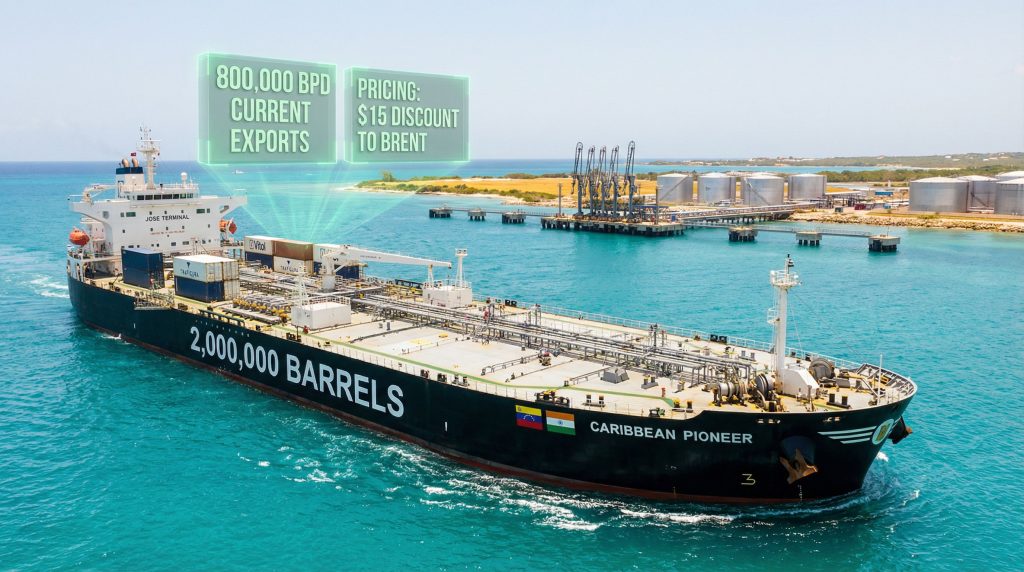
Very Large Crude Carriers constitute the largest category of oil tankers in regular commercial operation, designed to transport crude oil across major oceanic trade routes. These vessels achieve their classification through strict capacity parameters, with each VLCC capable of carrying up to 2 million barrels of oil per voyage, according to Reuters reporting on Venezuelan export developments.
The engineering specifications of VLCCs reflect decades of maritime design evolution, incorporating advanced cargo handling systems, double-hull construction for environmental protection, and sophisticated navigation technology. Their massive scale enables economies of scale that smaller vessel classes cannot achieve, particularly relevant for long-distance crude oil movements between continents.
Economic Advantages of 2-Million Barrel Capacity Vessels
The transition from medium-sized tankers to VLCC deployment creates substantial per-barrel cost reductions across multiple operational categories. Transportation analysts cited by Reuters indicate that VLCC utilisation significantly lowers shipping expenses compared to smaller vessel classes, particularly important when profit margins face pressure from crude oil pricing dynamics.
Consider the capacity differential between vessel classes currently serving Venezuelan export routes:
- Panamax vessels: 450,000-700,000 barrels
- Aframax tankers: 450,000-700,000 barrels
- Suezmax carriers: Approximately 1,000,000 barrels
- VLCC vessels: 2,000,000 barrels
This capacity advantage means a single VLCC cargo eliminates the need for approximately three to four smaller tanker voyages. Consequently, this reduces crew costs, fuel consumption per barrel transported, and port handling expenses proportionally.
VLCC Market Dynamics and Current Charter Rate Environment
The global VLCC charter market operates within complex supply-demand dynamics influenced by seasonal crude oil demand patterns, geopolitical developments affecting major trade routes, and fleet availability across key shipping regions. Current market conditions have created opportunities for cost-effective VLCC deployment on routes where such vessels were previously uneconomical.
Maritime industry sources indicate that Venezuelan crude exporters and their trading partners are capitalising on favourable charter rate conditions to optimise transportation economics. However, analysts note that tanker rates have surged to six-year highs, creating both opportunities and challenges for deployment strategies. The deployment of VLCCs is expected to accelerate deliveries from March 2026 onwards while simultaneously addressing storage capacity constraints that have accumulated during the rapid export volume expansion following sanctions relief.
When big ASX news breaks, our subscribers know first
How Has Venezuela's Oil Export Infrastructure Evolved Since Sanctions Relief?
Venezuela's petroleum export infrastructure has undergone rapid operational transformation following the lifting of US trade restrictions, with export volumes increasing 60% month-over-month from approximately 500,000 barrels per day in December 2025 to 800,000 bpd in January 2026, according to Reuters data. This dramatic expansion has necessitated strategic adjustments to vessel deployment patterns and terminal operations.
Terminal Capacity Analysis at Jose Port and PDVSA Operations
The Jose terminal, operated by state energy company PDVSA, functions as Venezuela's primary crude export facility, handling approximately 70% of the country's total export throughput. This strategic infrastructure asset has demonstrated capability to accommodate VLCC loading operations, with March 2026 representing the first documented allocation of VLCC loading slots under the post-sanctions regulatory framework.
The terminal's operational significance extends beyond simple throughput capacity. Its geographic positioning, storage connectivity, and loading infrastructure have enabled Venezuela to transition from smaller vessel deployments to large-scale VLCC operations without requiring major infrastructure modifications. Industry sources indicate this adaptability has been crucial for managing the rapid export volume increases experienced since sanctions relief.
| Terminal Metric | Current Status | VLCC Impact |
|---|---|---|
| Export Share | 70% of national volumes | Maintained |
| Vessel Types | Previously Aframax/Panamax | Now includes VLCC |
| Loading Slots | March 2026 VLCC allocation | First post-sanctions VLCCs |
| Storage Relief | Millions of barrels accumulated | Expected reduction via larger shipments |
Transition from Aframax/Panamax to VLCC Charter Strategy
Since January 2026, Venezuelan export operations have primarily utilised medium-sized Panamax and Aframax tankers with capacity ranges between 450,000 and 700,000 barrels, primarily serving US refinery destinations. This vessel deployment strategy reflected the immediate post-sanctions focus on restoring established trade relationships with American petroleum processors.
The strategic pivot toward VLCC utilisation represents a deliberate optimisation of existing terminal infrastructure rather than capacity expansion. Trading houses and Venezuelan exporters have recognised that larger vessel deployments can achieve multiple objectives simultaneously: reducing per-barrel transportation costs, accelerating inventory turnover, and accessing previously unavailable destination markets that prefer large-volume crude imports.
Storage Backlog Reduction Through Larger Vessel Deployments
Venezuela's rapid export volume expansion has created an unintended consequence: the accumulation of millions of barrels in storage facilities as intended buyers in US and European markets could not immediately absorb the increased availability. This storage backlog has created operational challenges and opportunity costs for Venezuelan crude producers.
VLCC deployment offers a strategic solution to this storage accumulation problem. Each 2-million-barrel VLCC cargo represents a significant inventory reduction that smaller vessels cannot achieve efficiently. The larger shipments are specifically designed to accelerate the drawdown of accumulated crude oil inventories while establishing new buyer relationships in markets capable of absorbing large-volume imports.
Venezuelan exporters are utilising VLCC deployment as a dual-purpose strategy: optimising transportation economics while systematically reducing the storage backlog that accumulated during the rapid post-sanctions export expansion.
Which Trading Houses Are Leading Venezuela's VLCC Charter Operations?
The Venezuelan VLCC charter market has been dominated by three major international trading houses, each bringing distinct operational capabilities and buyer networks to post-sanctions crude oil commerce. These entities have secured preferential access to Venezuelan export capacity through individual licensing arrangements and established relationships with state energy company PDVSA.
Vitol's Strategic Positioning in Venezuelan Crude Markets
Vitol has emerged as the leading participant in Venezuelan VLCC operations, securing charter rights for multiple vessels with March 2026 loading allocations at Jose terminal. The trading house has chartered at least two VLCCs (Nissos Kea and Nissos Kythnos) for Indian destinations, demonstrating sophisticated buyer relationship management and cargo optimisation capabilities.
The company's strategic approach extends beyond simple vessel chartering to encompass integrated supply chain management. Vitol has established direct relationships with major Indian refiners, including a 2-million-barrel cargo purchase by Reliance Industries for March 2026 loading, indicating long-term strategic positioning rather than opportunistic trading activity.
Trafigura's Role in Large-Scale South American Oil Logistics
Trafigura has positioned itself as a significant participant in Venezuelan VLCC deployment through the charter of the Arzanah (2-million-barrel capacity) for March loading at Jose terminal. This engagement reflects the trading house's broader South American crude logistics operations and established infrastructure for managing large-scale petroleum movements.
The company's involvement in Venezuelan VLCC operations demonstrates sophisticated risk management and market access capabilities. Trafigura's charter activities are integrated with its existing Asian buyer networks, particularly targeting Indian refiners seeking heavy crude feedstock diversification away from Russian supply sources.
Chevron's Return to Venezuelan Export Operations
Chevron has re-entered Venezuelan crude trading through a combination of direct sales and vessel charter arrangements, marking the American oil major's return to significant South American operations after years of sanctions-imposed restrictions. The company has completed its first Boscan crude sale to India's Reliance Industries since December 2023, representing a milestone in normalised US-Venezuela energy trade.
The company's operational approach differs from pure trading houses, incorporating direct buyer relationships and integrated refinery supply arrangements. Chevron has engaged multiple medium-sized tanker time-charter contracts for Venezuelan crude transportation while simultaneously exploring VLCC deployment opportunities for large-volume Asian deliveries.
Major VLCC Charters from Venezuela (March 2026)
| Vessel Name | Trading House | Capacity (Barrels) | Loading Terminal | Destination |
|---|---|---|---|---|
| Nissos Kea | Vitol | 2,000,000 | Jose Terminal | India |
| Nissos Kythnos | Vitol | 2,000,000 | Jose Terminal | India |
| Arzanah | Trafigura | 2,000,000 | Jose Terminal | India |
| Olympic Lion | TBD | 2,000,000 | Venezuelan Waters | India (Expected) |
Why Is India Becoming the Primary Destination for Venezuelan VLCC Cargoes?
India's emergence as the primary destination for Venezuelan VLCC shipments reflects a convergence of refinery technical capabilities, strategic supply diversification objectives, and favourable crude oil pricing dynamics. Moreover, given current geopolitical tensions, this trend aligns with broader trade war oil market effects shaping global energy flows. The South Asian nation previously held the position as Venezuela's third-largest buyer before US sanctions were imposed in 2019, establishing proven refinery compatibility and commercial relationships.
Indian Refinery Demand for Heavy Crude Grades
Indian refiners have demonstrated sophisticated technical capabilities for processing Venezuelan heavy crude grades, with their facilities specifically configured to handle the complex refining requirements of high-sulphur, heavy crude feedstocks. This technical compatibility has enabled rapid resumption of Venezuelan crude imports following sanctions relief.
Multiple major Indian refiners have actively acquired Venezuelan heavy crude cargoes in recent months:
- Indian Oil Corp (IOC): State-owned refiner with heavy crude processing capability
- Bharat Petroleum Corp (BPCL): Integrated refiner seeking supply diversification
- HPCL Mittal Energy (HMEL): Joint venture refiner with advanced processing technology
- Reliance Industries: Private sector refiner with extensive crude sourcing operations
These refiners possess the technical infrastructure necessary to process Venezuelan Merey heavy crude and other grades, having maintained operational knowledge from pre-sanctions trading relationships.
Reliance Industries' Strategic Crude Sourcing Diversification
Reliance Industries has positioned itself as a key anchor buyer for Venezuelan VLCC cargoes, actively pursuing both indirect purchases through trading houses and direct supply arrangements with PDVSA. The company's strategic approach reflects sophisticated supply chain risk management and cost optimisation objectives.
Industry sources indicate that Reliance Industries is actively seeking direct purchase arrangements with Venezuelan state entities, suggesting institutional confidence in long-term supply sustainability and crude oil quality consistency. This strategic engagement extends beyond opportunistic spot purchases toward integrated supply relationship development.
Comparative Analysis: Russian vs. Venezuelan Heavy Crude Pricing
Venezuelan crude pricing dynamics have created compelling economic incentives for Indian refiners seeking cost-effective heavy crude feedstock alternatives. Venezuelan Merey heavy crude has been trading at approximately $15 per barrel below Brent benchmark pricing, creating significant margin opportunities for refiners capable of processing heavy crude grades.
The pricing differential has been influenced by market backwardation conditions, where later deliveries trade at discounts to prompt supplies. This pricing environment has made Venezuelan crude particularly attractive to Indian refiners implementing supply diversification strategies while maintaining cost competitiveness.
Indian refiners including IOC, BPCL, and HMEL are deliberately pursuing Venezuelan heavy crude acquisitions as part of a broader strategic objective to reduce dependence on Russian oil imports while securing cost-effective refinery feedstock.
What Economic Factors Drive the Shift to VLCC Transportation?
The economic rationale for VLCC deployment in Venezuelan crude exports stems from multiple converging factors: transportation cost optimisation, storage carrying cost reduction, and market timing advantages. These economic drivers have become particularly compelling given Venezuelan crude pricing dynamics and the substantial volume increases following sanctions relief. Furthermore, current oil price stagnation factors have intensified the need for cost-effective transportation solutions.
Cost Per Barrel Analysis: VLCC vs. Smaller Vessel Classes
VLCC transportation economics demonstrate substantial per-barrel cost advantages compared to smaller vessel deployments across multiple cost categories. The economies of scale achieved through 2-million-barrel capacity create proportional reductions in crew costs, fuel consumption per barrel transported, insurance expenses, and port handling fees.
Vessel Class Comparison for Venezuelan Exports
| Vessel Type | Capacity Range | Previous Usage | Cost Efficiency |
|---|---|---|---|
| VLCC | 2,000,000 barrels | New deployment | Highest |
| Suezmax | 1,000,000 barrels | Caribbean transshipment | Medium |
| Aframax | 700,000 barrels | US refinery direct | Lower |
| Panamax | 450,000 barrels | Regional distribution | Lowest |
The cost differential becomes particularly significant on long-distance routes such as Venezuela-to-India voyages, where the fixed costs of vessel operation can be distributed across the maximum possible cargo volume.
Market Backwardation Impact on Venezuelan Crude Pricing
Current market backwardation conditions, where later crude oil deliveries trade at discounts to prompt supplies, have created specific challenges for Venezuelan crude marketing. Trading houses have indicated that such pricing structures have reduced the attractiveness of Venezuelan crude in spot markets, necessitating operational adjustments to maintain commercial viability.
VLCC deployment addresses backwardation challenges through several mechanisms:
- Volume consolidation: Larger cargoes can be marketed more effectively to refiners seeking substantial volumes
- Transportation cost reduction: Lower per-barrel shipping costs improve net realisations
- Market access: VLCC capability opens Asian destinations previously uneconomical for smaller vessels
- Storage cost elimination: Faster inventory turnover reduces carrying costs
Transportation Economics at $15 Discount to Brent Benchmark
Venezuelan crude exporters face margin pressure from the approximately $15 per barrel discount to Brent benchmark pricing that characterises current Merey heavy crude valuations. This substantial discount necessitates aggressive cost management across all operational categories to maintain commercial attractiveness.
VLCC deployment directly addresses this margin pressure by optimising the largest controllable cost component: transportation expenses. The per-barrel savings achieved through VLCC utilisation can represent a meaningful percentage of the total margin available on discounted Venezuelan crude sales.
How much can VLCCs reduce Venezuelan oil transportation costs?
VLCCs can significantly reduce per-barrel transportation costs compared to smaller Aframax (450,000-700,000 barrels) and Panamax vessels, particularly important when Venezuelan Merey heavy crude trades at approximately $15 per barrel below Brent benchmark pricing.
Current VLCC Charter Rate Environment and Market Pressures
The global VLCC charter market has experienced favourable rate conditions that have enhanced the economic attractiveness of large vessel deployment for Venezuelan crude exports. Maritime industry sources indicate that current charter rates enable cost-effective VLCC utilisation on routes where such vessels were previously uneconomical.
This favourable charter rate environment reflects broader tanker market dynamics, including seasonal demand patterns, geopolitical disruptions affecting alternative trade routes, and fleet availability in the Atlantic Basin. Venezuelan crude exporters have strategically timed their VLCC deployment to capitalise on these favourable market conditions.
How Do Geopolitical Developments Affect VLCC Deployment Strategies?
The geopolitical landscape surrounding Venezuelan crude exports has fundamentally transformed with the lifting of US trade restrictions, creating new strategic opportunities and operational considerations for VLCC deployment. These developments have expanded buyer pools, modified risk assessments, and altered competitive dynamics in global crude oil markets.
US Treasury General License Impact on Buyer Pool Expansion
The US Treasury Department's issuance of a general license broadly permitting Venezuelan oil exports in late January 2026 has substantially expanded the potential buyer pool beyond the previously limited group of individually licensed entities. This regulatory change has created new market opportunities for VLCC deployment by enabling access to a broader range of international refiners.
Prior to the general license framework, Venezuelan crude exports were restricted to trading houses and refiners holding specific individual authorisations from US authorities. The expanded licensing framework has enabled:
- Increased buyer competition: More potential purchasers competing for Venezuelan crude cargoes
- Destination diversification: Access to markets previously restricted by licensing limitations
- Volume scalability: Larger total addressable market supporting VLCC-sized cargo requirements
- Price discovery improvement: Enhanced market mechanisms through increased participation
Sanctions Enforcement Against Shadow Fleet Operations
The normalisation of Venezuelan crude trade has reduced reliance on shadow fleet operations that characterised the sanctions period, enabling deployment of high-quality VLCC tonnage with transparent ownership structures. This transition has improved operational reliability and reduced counterparty risks associated with non-transparent vessel operations.
VLCC deployment benefits from this improved regulatory environment through:
- Enhanced vessel quality: Access to modern, well-maintained tonnage
- Transparent ownership: Clear vessel registry and beneficial ownership structures
- Insurance availability: Comprehensive marine insurance coverage from established providers
- Port access: Unrestricted access to major international terminals and facilities
Strategic Implications of US-Venezuela Oil Trade Normalisation
The restoration of normalised trade relationships between the United States and Venezuela has created strategic implications extending beyond immediate commercial opportunities. VLCC deployment strategies must consider long-term trade flow patterns, infrastructure development priorities, and competitive positioning in evolving market structures.
US refiners including Valero Energy, Phillips 66, and Citgo Petroleum are preparing to increase Venezuelan oil processing at their facilities, potentially affecting global crude flow patterns and VLCC deployment strategies. The integration of Venezuelan crude into established US refinery operations may influence vessel size requirements and destination preferences over time.
The next major ASX story will hit our subscribers first
What Are the Operational Challenges in Venezuelan VLCC Loading?
VLCC loading operations at Venezuelan terminals present unique technical and logistical challenges that differ substantially from smaller vessel operations. These challenges encompass terminal infrastructure limitations, storage coordination requirements, and operational timing constraints that must be carefully managed to ensure successful cargo completion.
Port Infrastructure Capacity at Jose Terminal
Jose terminal's infrastructure has demonstrated capability to accommodate VLCC loading operations, though the scale of these vessels requires careful operational planning and resource allocation. The terminal's existing loading systems, berth configurations, and nautical access channels have been validated for 2-million-barrel cargo operations scheduled for March 2026.
Key infrastructure considerations for VLCC operations include:
- Berth availability: Scheduling coordination for extended loading periods
- Loading rate optimisation: Maximising throughput while maintaining cargo quality
- Channel depth: Ensuring adequate water depth for fully loaded VLCC draft requirements
- Storage connectivity: Coordinating tank farm operations with loading schedules
Storage Tank Farm Utilisation and Inventory Management
The accumulated storage of millions of barrels in Venezuelan facilities has created both challenges and opportunities for VLCC loading operations. While substantial inventory provides cargo availability assurance, efficient storage management becomes critical for maintaining crude oil quality and optimising loading sequences.
VLCC loading operations require sophisticated inventory management to ensure:
- Grade segregation: Maintaining crude oil quality specifications throughout storage and loading
- Volume coordination: Ensuring adequate inventory availability for complete 2-million-barrel cargoes
- Quality consistency: Managing multiple storage tanks to achieve homogeneous cargo composition
- Loading sequence optimisation: Minimising demurrage through efficient tank-to-vessel transfer operations
Weather Windows and Loading Time Optimisation
Venezuelan coastal weather patterns and seasonal variations create operational windows that must be carefully considered for VLCC loading operations. The extended loading times required for 2-million-barrel cargoes increase exposure to weather-related delays compared to smaller vessel operations.
Operational planning considerations include:
- Seasonal weather patterns: Avoiding periods of increased storm activity or adverse sea conditions
- Loading duration: Planning for extended loading periods required for VLCC capacity
- Contingency planning: Maintaining operational flexibility for weather-related schedule adjustments
- Demurrage management: Optimising loading efficiency to minimise vessel waiting time costs
Which Crude Grades Are Most Suitable for VLCC Export?
Venezuelan crude oil production encompasses multiple grades with distinct characteristics, market positioning, and refinery compatibility profiles. VLCC deployment strategies must consider crude grade properties, blending opportunities, and destination market preferences to optimise cargo composition and commercial outcomes.
Merey Heavy Crude Characteristics and Refinery Compatibility
Merey heavy crude represents Venezuela's primary export grade, characterised by high sulphur content and heavy specific gravity that requires specialised refinery processing capabilities. This crude grade has established market acceptance among refiners equipped with heavy crude processing infrastructure, particularly in Asian markets.
Key characteristics of Venezuelan Merey heavy crude include:
- API Gravity: Typically 16-20 degrees API (heavy crude classification)
- Sulphur Content: High sulphur content requiring specialised desulphurisation processing
- Viscosity: Higher viscosity necessitating heated storage and transportation
- Refinery Compatibility: Suitable for complex refineries with heavy crude processing capability
The grade's heavy characteristics make it particularly suitable for VLCC transportation, as the economies of scale achieved through large vessel deployment help offset the additional handling costs associated with heavy crude operations.
Boscan Grade Properties and Market Positioning
Boscan crude represents a distinct Venezuelan grade that has returned to international markets following sanctions relief. Chevron completed its first Boscan crude sale to India's Reliance Industries since December 2023, marking the revival of this grade in regular export schedules after approximately six years of restricted availability.
Boscan crude characteristics include:
- Ultra-heavy classification: Extremely heavy crude requiring specialised processing
- Limited production: Smaller volumes compared to Merey heavy crude
- Niche market positioning: Specific refiner demand from technologically advanced facilities
- Premium processing requirements: Suitable only for refiners with advanced heavy crude capabilities
The grade's return to export markets demonstrates Venezuelan production diversification and the ability to serve specialised refiner requirements through VLCC deployment.
Blending Strategies for Optimal VLCC Cargo Composition
VLCC cargo composition strategies can incorporate blending opportunities to optimise crude oil specifications for specific destination markets. The large cargo volumes enable sophisticated blending approaches that smaller vessels cannot economically achieve.
Potential blending strategies include:
- Grade mixing: Combining multiple Venezuelan crude grades to achieve target specifications
- Quality optimisation: Adjusting sulphur content and API gravity through strategic blending
- Market customisation: Tailoring cargo specifications to specific refiner requirements
- Volume utilisation: Maximising storage tank utilisation through strategic grade combinations
Chevron has completed its first Boscan crude sale to India's Reliance Industries since December 2023, marking the return of this heavy grade to international markets after a six-year absence from regular export schedules.
How Will VLCC Adoption Impact Regional Tanker Markets?
The deployment of VLCCs for Venezuelan crude exports creates ripple effects throughout regional tanker markets, particularly in the Caribbean and Atlantic Basin where medium-sized vessels have experienced tight availability conditions. Consequently, these market impacts extend beyond Venezuelan trade to influence broader regional shipping dynamics, particularly as US oil production decline trends reshape demand patterns.
Caribbean Medium-Sized Tanker Availability Relief
Sources cited by Reuters indicate that VLCC deployment is expected to ease tight availability conditions for medium-sized tankers in the Caribbean region. This market relief stems from reduced demand for Aframax and Panamax vessels previously required for Venezuelan crude transportation.
The availability improvement affects multiple regional trade patterns:
- Reduced charter rate pressure: Decreased competition for medium-sized tonnage
- Enhanced scheduling flexibility: Improved vessel availability for other Caribbean crude movements
- Regional trade optimisation: Better vessel allocation for intra-regional petroleum product movements
- Cost reduction: Lower charter rates for Caribbean refiners and traders utilising smaller vessels
Atlantic Basin Crude Carrier Utilisation Patterns
VLCC deployment for Venezuelan exports represents a strategic shift in Atlantic Basin crude carrier utilisation, with larger vessels handling long-haul movements while smaller tonnage focuses on regional and medium-distance transportation requirements.
This utilisation optimisation creates several market dynamics:
- Fleet specialisation: Clearer delineation between regional and intercontinental vessel deployment
- Route efficiency: Optimal vessel class matching with specific trade route characteristics
- Market segmentation: Distinct charter markets for different vessel size categories
- Operational flexibility: Enhanced ability to respond to changing crude flow patterns
Time-Charter Market Dynamics for Venezuelan Trade Routes
The integration of VLCCs into Venezuelan export operations has influenced time-charter market dynamics as trading houses and oil companies adjust their vessel requirements. Chevron and several US refiners have hired dozens of Aframax and Panamax tankers under time-charter contracts, while simultaneously exploring VLCC deployment opportunities.
Time-charter market impacts include:
- Duration optimisation: Longer-term charter arrangements for established trade routes
- Cost predictability: Fixed charter rates providing cost certainty for regular export operations
- Fleet planning: Strategic vessel allocation balancing VLCC and medium-sized tonnage requirements
- Market stability: Reduced spot market volatility through increased time-charter activity
What Does Venezuela's VLCC Strategy Mean for Global Oil Supply Chains?
VLCC shipments from Venezuela represent a significant evolution in global crude oil supply chain architecture, with implications extending far beyond immediate commercial arrangements. This strategic shift affects intercontinental trade flows, refinery supply patterns, and competitive dynamics in international energy markets. Additionally, these developments occur alongside broader oil price rally analysis trends that shape global market dynamics.
Export Volume Projections Beyond 800,000 BPD Current Levels
Venezuelan crude export volumes have demonstrated substantial growth momentum, increasing from approximately 500,000 barrels per day in December 2025 to 800,000 bpd in January 2026. VLCC deployment is expected to support continued volume expansion by providing the transportation capacity necessary for large-scale international deliveries.
Export Volume Growth Trajectory
| Period | Export Volume (BPD) | Primary Vessel Types | Key Destinations |
|---|---|---|---|
| Dec 2025 | 500,000 | Aframax/Panamax | US Refineries |
| Jan 2026 | 800,000 | Mixed Fleet | US/Caribbean |
| Mar 2026 | 850,000+ (Projected) | VLCC Integration | India/Asia |
The volume expansion trajectory suggests potential for continued growth as VLCC deployment enables access to previously underutilised destination markets. Asian refiners' demonstrated appetite for Venezuelan heavy crude indicates substantial demand capacity beyond current export levels.
Integration with US Refinery Expansion Plans
US refiners including Valero Energy, Phillips 66, and Citgo Petroleum are preparing to increase Venezuelan oil processing at their facilities, creating integrated supply chain relationships that could influence long-term VLCC deployment strategies. Furthermore, this trend intersects with OPEC production impact decisions that shape global crude availability. This refinery capacity expansion suggests sustained demand for Venezuelan crude across multiple vessel size categories.
The integration of Venezuelan crude into US refinery operations creates several strategic considerations:
- Supply security: Long-term Venezuelan crude availability supporting refinery investment decisions
- Transportation optimisation: Balancing VLCC Asian deliveries with smaller vessel US movements
- Market flexibility: Maintaining optionality between regional and intercontinental crude sales
- Infrastructure development: Potential terminal and storage investments supporting increased volumes
Long-term Implications for Western Hemisphere Crude Flows
The normalisation of Venezuelan crude exports and VLCC deployment represents a fundamental shift in Western Hemisphere energy trade patterns. The restoration of Venezuela as a significant crude exporter affects competitive dynamics, supply security, and market integration across the Americas.
Strategic implications include:
- Supply diversification: Enhanced energy security through increased regional production
- Trade route optimisation: Evolution of crude flow patterns optimising transportation economics
- Market integration: Improved price discovery and arbitrage opportunities across regional markets
- Competitive dynamics: Venezuelan crude competing with other Western Hemisphere producers
What is Venezuela's current oil export capacity?
Venezuelan oil exports reached approximately 800,000 barrels per day in January 2026, up from roughly 500,000 bpd in December 2025, following the lifting of US oil blockade restrictions and implementation of new licensing frameworks.
Future Outlook: VLCC Fleet Expansion and Market Evolution
The successful implementation of Venezuelan VLCC operations in March 2026 establishes a foundation for sustained growth in large vessel deployment, with implications for fleet expansion, market participation, and infrastructure development. This evolution reflects broader trends in global crude oil transportation optimisation and market integration.
Projected Growth in Venezuelan VLCC Charter Activity
The initial deployment of four VLCCs for March 2026 loading represents the foundation for expanded large vessel utilisation as Venezuelan export volumes continue growing. Market conditions supporting current VLCC deployment are expected to persist, encouraging additional trading houses and refiners to pursue large cargo arrangements.
Growth projections consider several supporting factors:
- Volume sustainability: Continued Venezuelan production increases supporting regular VLCC requirements
- Market acceptance: Proven refiner demand for large Venezuelan crude cargoes
- Cost advantages: Demonstrated transportation economics favouring VLCC deployment
- Infrastructure capability: Jose terminal's proven ability to handle VLCC loading operations
Potential New Trading House Participation
The expansion of US Treasury licensing frameworks and demonstrated commercial success of initial VLCC deployments may attract additional trading houses to Venezuelan crude operations. The general license structure enables broader market participation beyond the current focus on Vitol, Trafigura, and Chevron.
Potential new entrants may include:
- Established crude traders: Major international trading houses seeking Venezuelan market access
- Regional specialists: Entities with specific expertise in South American or Asian crude markets
- Integrated oil companies: International oil majors pursuing supply diversification strategies
- Financial trading entities: Investment-focused participants seeking crude oil arbitrage opportunities
Infrastructure Development Requirements for Sustained Growth
Sustained VLCC deployment growth may necessitate infrastructure enhancements at Venezuelan terminals, storage facilities, and supporting maritime infrastructure. While current operations demonstrate adequate capability, expanded volumes could require systematic capacity improvements.
Infrastructure development priorities include:
- Terminal capacity expansion: Additional VLCC berths and loading infrastructure
- Storage tank construction: Enhanced crude oil storage capacity supporting larger export volumes
- Pipeline connectivity: Improved transportation links between production areas and export terminals
- Maritime infrastructure: Channel deepening and navigational aid improvements for VLCC operations
The success of Venezuelan VLCC deployment demonstrates the transformative potential of strategic vessel class optimisation in global crude oil markets. As export volumes continue expanding and market acceptance grows, VLCC shipments from Venezuela are positioned to become a permanent feature of international energy trade, offering sustained benefits for exporters, trading houses, and destination market refiners seeking cost-effective heavy crude supplies.
Disclaimer: This analysis is based on publicly available information and industry reports. Crude oil markets are subject to significant volatility and regulatory changes that may affect actual outcomes. Investment and commercial decisions should consider comprehensive due diligence and professional advice.
Want to Capitalise on Energy Market Developments?
Stay ahead of critical energy sector discoveries with Discovery Alert's real-time alerts on significant ASX mining and exploration announcements, powered by its proprietary Discovery IQ model. With major developments reshaping global oil markets, smart investors recognise the importance of identifying emerging opportunities in Australian resource markets before they become mainstream news. Begin your 14-day free trial today to gain immediate access to actionable insights across over 30 commodities, all simplified into clear, gold-equivalent metrics for informed decision-making.