August 5, 2026
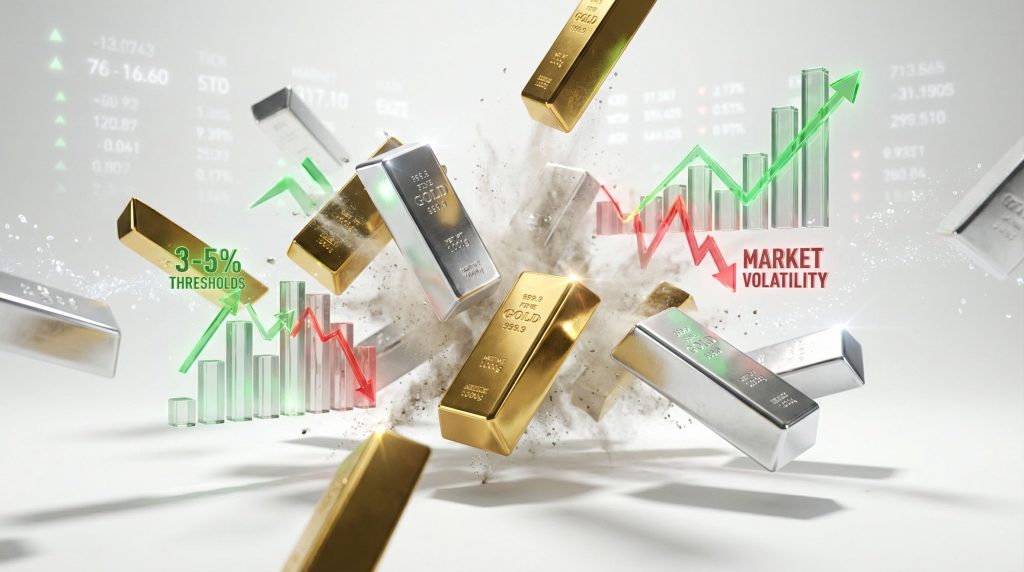
Volatility in gold and silver markets presents complex challenges that require sophisticated understanding of market mechanics and institutional dynamics. Professional traders recognize that these extreme price movements emerge from complex interactions between physical supply constraints, derivative market mechanics, and macroeconomic policy shifts. Recent market events demonstrate how these forces can generate dramatic price swings that challenge conventional risk management approaches while creating strategic positioning opportunities for informed investors seeking to understand gold inflation hedge strategies.
What Defines Extreme Volatility in Precious Metals Markets?
Technical Definitions and Historical Benchmarks
Extreme volatility in precious metals requires precise quantitative definitions to distinguish normal market fluctuations from genuinely significant events. Market analysts typically classify daily percentage movements exceeding 5% as extreme volatility events, creating measurable thresholds for systematic analysis.
Recent market data reveals striking acceleration in volatility clustering patterns. During January 2026, gold experienced five extreme volatility days within a single month, compared to only six such events during the entire preceding year. This represents an 83% concentration of annual extreme movements within just one month, demonstrating how volatility clusters in concentrated time periods.
Silver exhibited even more dramatic clustering, with nine extreme volatility days in January 2026, matching the total for all of 2025. The most significant single-day movement occurred on January 31, 2026, when silver declined 27.5% in one session, representing the largest daily decline since the early phases of the 1980-2002 bear market cycle.
| Metal | Extreme Days (Jan 2026) | Extreme Days (All 2025) | Acceleration Factor |
|---|---|---|---|
| Gold | 5 days | 6 days | 83% of annual total in one month |
| Silver | 9 days | 9 days | 100% of annual total in one month |
Volatility Clustering Phenomenon
The concentration of extreme movements within specific timeframes reflects the clustering phenomenon inherent in precious metals markets. This statistical pattern occurs when periods of high volatility are followed by continued high volatility, while calm periods tend to persist until external shocks disrupt market equilibrium.
Bear's Eye View (BEV) analysis provides sophisticated measurement frameworks for tracking volatility patterns. BEV values represent the percentage decline from the most recent all-time high, offering standardised comparison across different price levels. Gold's BEV declined from 125 on Wednesday, January 29, 2026, to 111 by Friday's close, representing a -12.3% BEV reading.
This clustering behaviour demonstrates predictable mathematical properties where extreme events tend to occur in concentrated bursts rather than random distribution. Professional analysts utilise this understanding to anticipate periods when position sizing adjustments become crucial for portfolio protection.
Statistical Evidence of Volatility Persistence
Historical analysis reveals that precious metals volatility exhibits stronger persistence characteristics than equity markets. Once extreme volatility begins, the probability of additional extreme days increases significantly over the following weeks and months.
The January 31, 2026 market event provides clear evidence of this persistence pattern. Gold experienced a 9.69% single-day decline, the largest daily drop in over forty years since the early 1980s. This magnitude of movement typically signals the beginning of extended volatility periods rather than isolated events.
Market structure analysis indicates that liquidity flows create the fundamental driver of volatility clustering. When institutional capital moves rapidly into or out of precious metals markets, the resulting price discovery process generates multiple extreme days as supply and demand equilibrium reestablishes at new levels.
When big ASX news breaks, our subscribers know first
How Do Institutional Trading Mechanisms Amplify Price Volatility?
Futures Market Dynamics and Leverage Effects
The precious metals futures complex operates through highly leveraged mechanisms that can amplify price movements far beyond underlying supply-demand fundamentals. COMEX gold and silver contracts require relatively small margin deposits compared to notional values, creating leverage ratios that magnify both upward and downward price momentum.
Contract rollover periods generate particular vulnerability to extreme volatility as large institutional positions must be transferred between delivery months. These mechanical trading requirements can create artificial selling or buying pressure independent of fundamental market conditions.
Margin requirement adjustments serve as volatility control mechanisms, yet they often arrive after extreme movements have already occurred. When exchanges raise margin requirements following large price moves, leveraged traders face forced liquidation, potentially accelerating the very volatility these measures aim to control.
Algorithmic trading systems compound these effects by executing pre-programmed responses to price movements without regard for fundamental value considerations. Stop-loss orders and momentum-following algorithms can create cascading effects where initial price moves trigger additional selling or buying waves.
ETF Flow Dynamics and Market Structure
Physical-backed precious metals ETFs create unique market dynamics through their creation and redemption mechanisms. Large institutional flows into or out of these vehicles require corresponding purchases or sales of physical metal, directly impacting spot prices.
The arbitrage process between ETF share prices and underlying metal values can generate significant trading volumes during volatile periods. Authorised participants must rapidly execute large block transactions to maintain proper price relationships, contributing to intraday volatility spikes.
Cross-market arbitrage opportunities emerge when price discrepancies develop between spot, futures, and ETF prices. Professional trading firms exploit these inefficiencies through high-frequency trading strategies that can amplify short-term price movements.
Mining equity ETFs add another layer of complexity, as these instruments often exhibit leverage characteristics relative to underlying metal prices. The XAU mining index demonstrated this amplification effect during the January 31, 2026 event, declining approximately 12% in a single session while experiencing a BEV reading of -15.25%.
What Macroeconomic Factors Create Systematic Volatility Patterns?
Currency Correlation Analysis
Dollar strength cycles create systematic volatility patterns in precious metals through inverse correlation relationships. When the U.S. Dollar Index (DXY) experiences rapid appreciation or depreciation, gold and silver prices typically exhibit amplified opposite movements due to their dollar-denominated pricing structure.
Central bank policy divergence generates additional currency volatility that transmits directly to precious metals markets. Furthermore, interest rate differential changes between major economies create capital flows that impact both currency values and commodity pricing simultaneously.
Real interest rate environments provide the most significant macroeconomic influence on precious metals volatility. When inflation-adjusted yields rise rapidly, precious metals face selling pressure as opportunity costs increase. Conversely, declining real rates often trigger aggressive institutional repositioning toward metals exposure.
Inflation Expectations and Risk-Off Scenarios
Rapidly changing inflation expectations create institutional portfolio rebalancing that generates extreme volatility in precious metals markets. Professional managers must adjust position sizes and asset allocations as inflation forecasts evolve, creating concentrated trading periods.
Recent precious metals appreciation reflects decades of accumulated monetary inflation effects finally being recognised by institutional investors. Moreover, the concept of using gold as an inflation hedge has gained significant traction as investors seek protection against currency debasement.
The U.S. national debt expansion trajectory provides fundamental support for precious metals valuations, yet creates periodic policy conflicts when officials attempt to suppress metal prices. This dynamic generates the systematic volatility in gold and silver markets as market forces clash with official sector preferences.
Critical Market Insight: The complete exhaustion of U.S. Treasury silver reserves in 2002, following decades of holdings measured in billions of ounces since 1965, created permanent supply-side constraints that amplify volatility during demand surges.
Geopolitical event clustering produces safe-haven demand surges that can overwhelm normal market-making capacity. When multiple international crises develop simultaneously, precious metals markets can experience liquidity shortages that magnify price movements in both directions.
Why Do Gold and Silver Exhibit Different Volatility Characteristics?
Market Size and Liquidity Differentials
The fundamental size difference between gold and silver markets creates dramatically different volatility profiles. Daily gold trading volumes range from $180-220 billion globally, while silver typically sees only $8-12 billion in daily turnover. This 20:1 volume differential means equivalent dollar flows create proportionally larger price impacts in silver.
Physical market depth varies significantly between the two metals. Gold benefits from deep institutional holdings accumulated over decades, providing natural stabilisation during extreme events. Silver's more concentrated industrial stockpiles offer less buffering capacity against large institutional flows.
Price impact sensitivity calculations reveal that silver requires significantly smaller dollar amounts to generate large percentage moves. Professional traders recognise this characteristic and often use silver positions for leveraged exposure to precious metals themes while maintaining core gold positions for stability.
Understanding these dynamics becomes crucial when considering the potential for a silver market squeeze, which could amplify existing volatility patterns significantly.
Industrial vs. Monetary Demand Volatility
Silver's dual-use profile creates competing demand pressures that generate unique volatility characteristics. Industrial applications account for substantial silver consumption, yet these users often exhibit price-insensitive buying patterns during short-term volatility spikes.
Technology sector demand cycles affect silver price stability through concentrated purchasing patterns from major electronics manufacturers. These industrial buyers often execute large transactions during specific production cycles, creating predictable yet significant demand fluctuations.
Gold's primary monetary role eliminates most industrial demand volatility, focusing price movements on investment and central bank activities. This monetary focus creates different volatility timing patterns, with gold often exhibiting more sustained trends rather than sharp industrial-driven spikes.
Silver's performance acceleration demonstrates these dynamics clearly. From $30 per ounce in January 2025 to $118 per ounce by late January 2026, silver achieved a 293% uncorrected advance within twelve months. This unprecedented appreciation rate exceeded historical norms by substantial margins, reflecting decades of suppressed valuations finally correcting.
How Can Investors Navigate Extreme Volatility Periods?
Position Sizing and Risk Management Frameworks
Volatility-adjusted position sizing methodologies become essential during extreme market periods. Professional investors typically reduce position sizes as volatility increases, maintaining constant risk exposure rather than constant dollar amounts. This approach prevents portfolio damage during unexpected extreme events.
Stop-loss strategies require careful consideration in precious metals markets due to their volatility clustering characteristics. Traditional percentage-based stops often trigger during temporary spikes, forcing exits before major trends develop. Many experienced traders prefer time-based stops or fundamental criteria rather than price-based triggers.
Portfolio allocation adjustments during high-volatility regimes should focus on core vs. satellite positioning strategies. Maintaining base precious metals exposure while reducing speculative positions allows investors to participate in long-term trends while avoiding excessive short-term risk.
Timing Strategies for Volatile Markets
Dollar-cost averaging demonstrates particular effectiveness during extreme volatility periods in precious metals markets. Regular purchase schedules automatically capture advantageous pricing during temporary selloffs while avoiding the psychological pressures of timing market tops and bottoms.
Contrarian positioning opportunities frequently emerge following major selloffs in precious metals. The January 31, 2026 decline created potential entry points for investors with available capital, as extreme negative days often mark temporary oversold conditions rather than trend reversals.
Technical analysis reliability decreases during high-volatility periods as normal support and resistance levels become less predictive. However, investors can benefit from understanding broader market cycles guide principles when making strategic decisions.
What Historical Patterns Predict Future Volatility Cycles?
Secular Bull Market Volatility Characteristics
Analysis of 1970s precious metals bull market patterns reveals consistent volatility acceleration as trends mature. Early-stage bull markets typically exhibit more controlled advances with occasional sharp corrections, while mature phases demonstrate increasing volatility in both directions.
Current market conditions suggest precious metals may be entering a more energetic phase characterised by expanded volatility clustering. Gold's achievement of 100 new all-time highs since November 2023 indicates sustained institutional accumulation that often precedes heightened volatility periods.
Government intervention attempts historically create volatility spikes as official sector actions conflict with market forces. The suggestion that recent extreme declines represent policy maker intervention implies future volatility may increase as this dynamic intensifies.
Professional analysts studying the gold price forecast acknowledge that these patterns often signal sustained periods of elevated market turbulence.
Seasonal and Cyclical Volatility Trends
Precious metals historically exhibit higher volatility during first and fourth quarters, coinciding with institutional rebalancing periods and year-end position adjustments. January's extreme volatility clustering fits this seasonal pattern while exceeding normal magnitude expectations.
Quarterly rebalancing effects create predictable periods when large institutional flows impact precious metals markets. Professional investors can anticipate these timing patterns and adjust position sizing accordingly to manage volatility exposure.
Leading Indicators for Volatility Regime Changes
Options market signals provide advance warning of volatility regime changes through put/call ratio analysis and implied volatility measurements. Extreme readings in these indicators often precede major volatility clusters by several days or weeks.
Commitment of Traders report patterns reveal institutional positioning changes that frequently precede volatility acceleration. Large speculator position extremes often coincide with impending volatility increases as these positions require unwinding during market stress.
Cross-asset correlation breakdowns serve as reliable volatility predictors. When normal relationships between precious metals and other asset classes deteriorate, it typically signals approaching volatility increases across multiple markets simultaneously.
The next major ASX story will hit our subscribers first
What Role Do Supply Chain Disruptions Play in Price Volatility?
Physical Market Tightness Indicators
Spot-to-futures price relationships during supply stress provide early warning signals for volatility acceleration. When physical metal premiums expand significantly above futures prices, it indicates supply chain strain that often precedes extreme price movements.
Regional premium variations create arbitrage opportunities while simultaneously generating volatility catalysts. When geographic price differentials exceed transportation costs by substantial margins, it signals market dislocations that contribute to overall volatility.
Mining production disruptions impact long-term price stability through reduced supply availability. However, these effects typically manifest gradually rather than creating immediate volatility spikes, unless combined with sudden demand increases.
Central Bank Activity and Market Volatility
Official sector buying and selling patterns create systematic volatility through their concentrated transaction timing. Central banks often execute large transactions during specific policy periods, generating temporary supply-demand imbalances.
Reserve diversification trends affect long-term volatility by changing the underlying demand structure for precious metals. As central banks increase gold allocations, it reduces available supply for private markets while creating more price-insensitive demand.
Policy coordination effects between major central banks can either dampen or amplify precious metals volatility depending on the degree of cooperation or conflict in their approaches to monetary policy.
How Should Long-Term Investors Approach Volatile Precious Metals Markets?
Strategic Allocation Considerations
Core vs. satellite positioning provides optimal frameworks for managing precious metals exposure during volatile periods. Maintaining base allocations (5-10% of total portfolio) regardless of volatility while using smaller satellite positions (2-3%) for tactical opportunities balances participation with risk control.
Rebalancing frequency optimisation during volatile periods requires careful consideration of transaction costs versus volatility capture benefits. Many institutional investors reduce rebalancing frequency during extreme volatility to avoid excessive trading costs while maintaining strategic allocations.
Tax-efficient strategies for managing volatile precious metals positions include utilising tax-advantaged accounts for frequent trading while holding long-term positions in taxable accounts to benefit from capital gains treatment.
Physical vs. Paper Exposure During Volatility
Counterparty risk considerations become crucial during extreme market stress as paper instruments may face settlement difficulties. Physical holdings eliminate counterparty risk but create storage and liquidity trade-offs that investors must carefully evaluate.
Derivative instrument behaviour during volatility spikes often involves tracking errors and liquidity constraints that can disadvantage investors. ETF premiums and discounts can expand significantly during extreme events, affecting execution quality.
Storage and liquidity trade-offs for physical holdings require balance between security and accessibility. Professional storage solutions provide security while maintaining reasonable liquidity, though at higher costs than paper alternatives.
Furthermore, investors seeking to understand overall gold market performance should consider how volatility patterns can impact broader investment strategies, particularly during periods of extreme market stress.
Managing Expectations in Volatile Markets
Understanding volatility in gold and silver markets requires recognising these price swings as fundamental characteristics rather than temporary anomalies. Successful navigation demands preparation for extreme movements, sophisticated risk management approaches, and maintaining strategic perspective during short-term turbulence.
The acceleration of volatility clustering patterns observed in early 2026 suggests investors should prepare for continued extreme price movements as monetary policy conflicts intensify and institutional positioning adjusts to new market realities.
Professional investors who develop frameworks for managing volatility in gold and silver markets can transform these challenging conditions into strategic opportunities. The key lies in understanding the underlying mechanisms driving extreme price movements while maintaining discipline during periods of maximum market stress.
Consequently, successful precious metals investing during volatile periods requires combining technical understanding with strategic patience. Investors must balance the opportunities created by extreme price movements against the risks inherent in highly volatile markets, ensuring their approach aligns with long-term wealth preservation objectives.
Ready to Capitalise on Mining Discovery Opportunities?
Discovery Alert delivers real-time notifications of significant ASX mineral discoveries using its proprietary Discovery IQ model, helping investors identify actionable trading opportunities before the broader market reacts. Explore how historic discoveries have generated exceptional returns and begin your 14-day free trial today to gain a competitive edge in volatile precious metals markets.