June 13, 2026
The Infrastructure Economics Behind Peru's Next Major Zinc Operation
The economics of underground mining are rarely decided at the ore face. They are determined months or years earlier, in the planning rooms where engineers choose between building from scratch or building on what already exists. That foundational decision separates projects that struggle to justify their capital from those that can absorb commodity price volatility and still deliver viable returns. Brownfield development, the practice of extending new production from existing operational infrastructure, represents one of the most powerful but underappreciated levers in modern mining economics. The Volcan Romina project in Peru is a textbook illustration of this principle in action.
When big ASX news breaks, our subscribers know first
Peru's Central Highlands: A Maturing Zinc Corridor Expanding Northward
Peru consistently ranks among the world's top three zinc-producing nations, contributing roughly 10 to 12 percent of global mined zinc supply each year, according to data compiled by the United States Geological Survey. The country's mining heartland has historically centred on Junin, Pasco, and Ancash, where massive polymetallic systems have underpinned decades of production. However, the Lima Region's highland provinces are drawing increasing attention as brownfield operators seek to unlock adjacent mineralisation around established processing hubs.
The Huaral Province, situated within that Lima highland corridor, hosts the Volcan Romina project in Peru, a US$140 million near-term development that targets the Puagjanca polymetallic ore body. What makes this geography compelling is not just the deposit itself but the operational proximity to Volcan Compañía Minera's existing Alpamarca processing unit, 14.9 kilometres away. That distance transforms a capital-intensive greenfield scenario into a staged, infrastructure-leveraged development with a substantially different risk profile.
Volcan is one of Peru's largest zinc-lead-silver producers, with operations across the central Andes covering a portfolio of underground and combined mining units. The company's strategic orientation in recent years has shifted toward extracting maximum value from its existing asset base while integrating digital technologies across its operational footprint. Romina sits at the intersection of both objectives: a brownfield expansion that also serves as the proving ground for the company's Mining 4.0 technology agenda.
Geological Setting and What the Puagjanca Ore Body Represents
The Puagjanca ore body is hosted within Chulec Formation limestones, a carbonate sequence deposited during the Cretaceous period that appears widely across Peru's central mining belt. Carbonate-hosted polymetallic deposits in this formation typically exhibit stratiform to stratabound mineralisation patterns, where zinc, lead, and silver sulphides replace original carbonate material along favourable structural and stratigraphic horizons. This mineralisation style has important practical implications: ore grade distribution tends to be more predictable than in structurally controlled vein systems, supporting tighter resource estimation confidence intervals.
The Romina resource base, as defined in the April 2024 mining plan, totals 11.9 million tonnes at grades of 5.1% zinc, 2.8% lead, and 1.3 ounces per tonne silver. To contextualise the grade significance, operating zinc mines globally average head grades between 3 and 5 percent zinc, according to industry benchmarking data. Romina's 5.1% sits above that central range, providing a structural cost advantage at the mining and metallurgical recovery stages.
The polymetallic character of this deposit matters beyond the headline zinc number. The simultaneous production of lead concentrate and silver-bearing by-products creates revenue diversification that helps cushion zinc price cyclicality, a feature particularly valued by smelters and offtake buyers seeking multi-metal supply agreements.
The deposit will be extracted using a combined open-pit and underground approach. Near-surface mineralisation accessed from the surface carries a strip ratio of 2.48 tonnes of waste per tonne of ore, which is considered moderate for Andean open-pit operations and reflects the deposit's relatively shallow dip and favourable geometry. As ore grades and geometry transition at depth, underground development takes over, extending the economically accessible resource envelope beyond what surface methods alone could reach.
The Roberto Letts Tunnel: Engineering the Underground Pathway
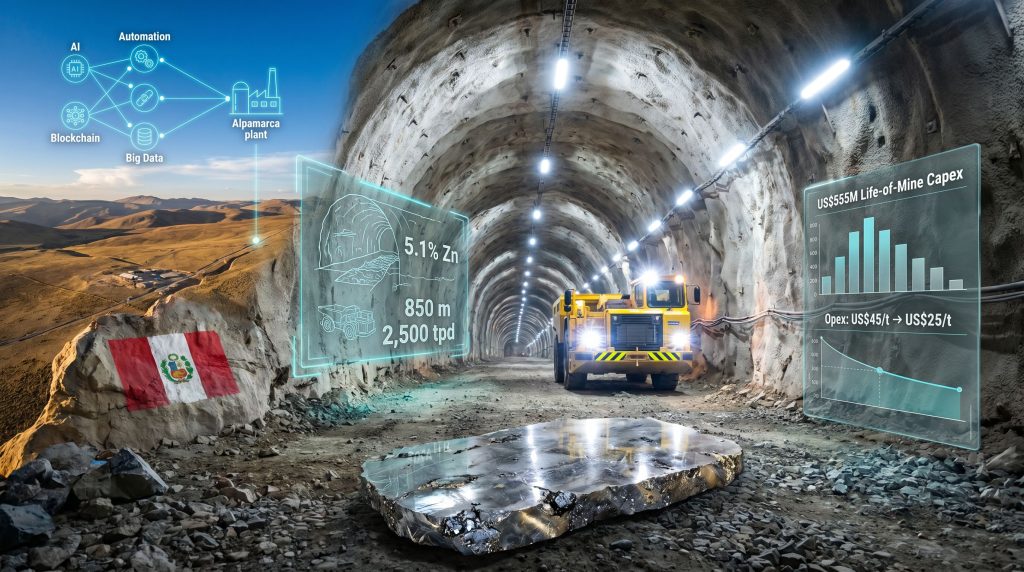
In combined open-pit and underground operations, the underground access infrastructure is almost always the critical-path item. Surface works can proceed in parallel, but without a functioning underground portal and development ramp, the deeper ore zones remain inaccessible. At Romina, this role is fulfilled by the Roberto Letts Tunnel, an 850-metre horizontal access drive excavated through Chulec Formation limestone. This tunnel development has been a defining milestone in advancing the project toward its production target.
The tunnel's technical specifications reflect deliberate engineering trade-offs:
- Cross-sectional area of 21 m² accommodates standard trackless mining equipment, including load-haul-dump units and underground trucks, without requiring oversize excavation
- A gradient of 12% sits at the upper range of standard trackless ramp design, a deliberate choice that maximises ore haulage speed while remaining within safe operational limits for wheeled equipment
- Chulec Formation limestone as the host rock presents competent but variable ground conditions, requiring careful drill-and-blast design and systematic ground support installation to manage carbonate jointing and potential dissolution features
Beyond ore haulage, the tunnel serves as the distribution spine for all underground services: ventilation airways, power cabling, water supply and drainage lines, and compressed air reticulation. This multi-service function means the tunnel's geometry and gradient influence operational efficiency across every underground activity, not just ore movement.
The significance of tunnel completion as a project milestone cannot be overstated. It is the gateway through which every tonne of underground ore must pass on its way to surface processing. Overall project construction was reported at 50% completion by August 2025, with tunnel advancement serving as the leading indicator of readiness for the underground production phase targeted in the second quarter of 2026.
Capital Expenditure Architecture: Understanding the US$140M and US$555M Numbers
A common source of confusion in mining project reporting is the relationship between construction-phase capital commitments and full life-of-mine capital envelopes. The Volcan Romina project in Peru carries both figures, and furthermore, understanding the distinction is essential for accurate project assessment.
The US$140 million figure represents the near-term capital commitment covering active construction and development infrastructure, including the Roberto Letts Tunnel, underground development ramp, surface access roads, waste rock management systems, wastewater treatment facilities, and concentrator plant modifications at Alpamarca. This is the capital being deployed through 2025 and into 2026 to bring the project to first production.
The US$555 million represents the total life-of-mine capital expenditure across the project's full 13-year operational period, structured approximately as follows:
| Project Phase | Approximate Annual Capex | Nature of Expenditure |
|---|---|---|
| Years 1 to 8 | US$16 to 19 million per year | Sustaining capital and staged expansion |
| Years 9 to 13 | ~US$2 million per year | Minimal sustaining requirements |
| Total Life of Mine | US$555 million | Full project basis |
The front-loaded capital profile is characteristic of combined open-pit and underground operations, where simultaneous surface stripping, underground development, and processing plant commissioning occur in parallel during the early years. As infrastructure matures and is progressively depreciated, sustaining capital requirements fall sharply, a pattern that directly feeds into the project's declining cost structure over time.
Operating expenditure follows a similar trajectory. The first nine years of operation carry an estimated US$45 per tonne processed, excluding selling costs and corporate overheads. This compresses to approximately US$25 per tonne in the final four years as infrastructure is fully amortised and process optimisation matures. For context, US$45 per tonne is competitive for a combined open-pit and underground polymetallic operation in Peru, where industry operating cost ranges typically sit between US$40 and US$60 per tonne depending on ore complexity and site-specific conditions.
The Alpamarca Brownfield Advantage: Infrastructure That Changes the Equation
One of the least discussed but most consequential aspects of the Volcan Romina project in Peru is what it does not need to build. The proximity to Volcan's Alpamarca mining unit means that Romina can access a suite of capital-intensive infrastructure components that would otherwise require full construction funding in a greenfield scenario.
| Infrastructure Component | Status at Alpamarca | Romina Application |
|---|---|---|
| Concentrator Plant (2,500 tpd) | Operational | Processes Romina ore via haul road |
| Tailings Storage Facility | Existing | Capacity allocated to Romina production |
| Workforce Camp and Accommodation | Established | Supports Romina construction and operations teams |
| Yanahuin Transmission Line | Operational | Provides electrical power supply to Romina |
| Regional Access Road Network | Existing | Extended and upgraded for Romina ore haulage |
The 14.9-kilometre separation between the two operations is entirely manageable within standard Andean mining practice. Dedicated haul roads connecting a satellite mine to a central processing plant are a routine operational configuration across Peru's polymetallic districts. Consequently, the infrastructure costs associated with road construction and ore haulage are substantially lower than those of building an independent processing facility.
The capital saving from this shared infrastructure arrangement runs into tens of millions of dollars when compared to a fully standalone greenfield development requiring independent construction of a concentrator, tailings facility, and power supply. This brownfield leverage is a primary reason the Romina project's economics are materially better than its headline capital numbers might initially suggest.
Infrastructure specifically constructed for Romina includes the Roberto Letts Tunnel, the underground development ramp, the waste rock dump and management systems, the wastewater treatment plant, a surface magazine for explosives storage, and extended haul road connections to Alpamarca.
The next major ASX story will hit our subscribers first
Regulatory Milestones and Peru's Environmental Permitting Framework
Peru's mining permitting landscape involves several regulatory agencies operating in sequence. The National Environmental Certification Service for Sustainable Investments, known by its Spanish acronym Senace, functions as the primary gateway for environmental impact assessment approval on large-scale mining projects. Without Senace certification, no material earthworks or infrastructure development can legally proceed.
Senace granted environmental impact assessment approval for the Volcan Romina project in March 2025, a milestone that directly unlocked the US$85 to US$90 million 2025 construction budget and confirmed Volcan's ability to mobilise construction contractors and commence civil works on schedule. The approval also cleared the pathway for subsequent permits from the Ministry of Energy and Mines (MINEM) covering mining operations, and from the National Water Authority (ANA) governing water use and management at the site.
The Romina project's navigation of this multi-agency process without reported material delays or community opposition as of mid-2026 is a meaningful signal for project execution risk assessment. Community relations challenges and permitting bottlenecks represent the two most common causes of schedule slippage in Peruvian mining development. However, Romina's progress to date suggests effective stakeholder engagement alongside regulatory compliance.
Investors and industry observers tracking Andean project development timelines should note that a clean permitting pathway through Senace, followed by an uninterrupted construction ramp, is far from universal in Peru's mining sector. Romina's execution record to date differentiates it from many comparable projects in the region.
Mining 4.0 at Romina: Digital Technologies Embedded from Day One
Volcan formally launched a company-wide Mining 4.0 transformation initiative, positioning the Romina project as a flagship implementation site. The significance of this timing cannot be understated: embedding digital technologies from initial commissioning, rather than retrofitting them onto an established operation, creates fundamentally different outcomes in terms of data continuity, equipment compatibility, and workforce culture.
The four core technology categories being deployed at Romina are:
- Automation applied to drilling, haulage, and processing equipment to reduce human exposure in hazardous zones and improve operational cycle time consistency
- Artificial intelligence used for ore grade prediction and processing circuit optimisation, targeting improvements in metallurgical recovery rates for zinc, lead, and silver concentrates
- Big data analytics enabling real-time capture of operational data across mining and processing circuits, supporting predictive maintenance programmes that reduce unplanned equipment downtime
- Blockchain applications providing supply chain traceability from mine to customer, increasingly demanded by European and Asian zinc buyers operating under responsible sourcing requirements
Volcan commenced dedicated operator training programmes for these Mining 4.0 systems in March 2026, specifically targeting the Romina workforce. The structured training deployment confirms that technology integration at this site is a scheduled operational commitment, not an aspirational roadmap item. In addition, industry research on comparable mining digitalisation programmes suggests that operations embedding automation and analytics technologies from commissioning typically achieve meaningfully better equipment utilisation rates and lower maintenance cost profiles across the first five years compared to operations that retrofit these systems post-production.
Production Timeline and Market Entry Positioning
When Does Romina Begin Production?
The Romina project is structured around a 13-year mine life based on the April 2024 mining plan, with initial production targeted for the second quarter of 2026. The production ramp-up sequence progresses through several defined phases:
- 2025: Active construction of tunnel, underground ramp, surface infrastructure, and concentrator preparation
- Q2 2026: First ore commissioned through the Alpamarca concentrator following tunnel completion and underground portal establishment
- 2026 to 2027: Progressive throughput ramp toward nameplate capacity of 2,500 tonnes per day
- 2027 onward: Steady-state production across the full mine life, processing polymetallic ore through the shared Alpamarca facility
Romina's concentrate output will consist of zinc concentrate, lead concentrate, and silver-bearing by-products, the standard commercial configuration for Andean polymetallic operations. Zinc concentrate from Peruvian producers is primarily marketed to Asian smelters in China, South Korea, and Japan, alongside European consumers, through a mix of long-term offtake agreements and spot market transactions.
How Does Romina Fit Into the Global Zinc Supply Picture?
The timing of Romina's production entry coincides with a period of increasing pressure on global zinc supply pipelines. The zinc market has periodically experienced concentrate tightness as major established mines age through declining grade profiles and new project development lags behind demand growth. Global zinc consumption is broadly projected to grow at approximately 2 to 3 percent annually through 2030, driven by galvanised steel demand from infrastructure investment in emerging markets and the rapid expansion of renewable energy installations, including wind towers and solar mounting structures, according to International Zinc Association market assessments.
Romina's 5.1% zinc head grade positions it favourably within this supply context. Higher-grade operations carry lower unit processing costs and better metallurgical recovery profiles, translating directly into competitive cash cost positioning along the industry cost curve.
Exploration Upside and Long-Term Development Optionality
A feature of the Romina development that extends beyond the current resource base is the exploration potential in the surrounding areas of the Puagjanca ore body. The infrastructure investment being made to bring Romina into production creates a physical and logistical platform from which resource extension drilling can be conducted efficiently and at relatively low incremental cost.
This brownfield exploration model is a well-established value-creation pathway in Andean polymetallic districts. Once access tunnels, underground ramps, and surface infrastructure are in place, the cost per metre of additional resource definition drilling falls substantially compared to drilling from a greenfield position. Furthermore, additional resource definition could extend the current 13-year mine life, support throughput increases beyond the 2,500 tpd design capacity, or identify discrete satellite ore bodies amenable to extraction via the existing infrastructure network.
Readers should note that exploration potential is speculative by nature. Resource extension targets have not been publicly delineated into defined resource estimates, and actual outcomes will depend on future drilling results and geological continuity beyond current resource boundaries.
Key Project Metrics at a Glance
| Parameter | Detail |
|---|---|
| Project Location | Huaral Province, Lima Region, Peru |
| Target Ore Body | Puagjanca polymetallic deposit |
| Geological Host | Chulec Formation limestones |
| Total Mineral Resources | 11.9 Mt at 5.1% Zn, 2.8% Pb, 1.3 oz/t Ag |
| Near-Term Construction Capital | US$140 million |
| Life-of-Mine Capital (Total) | US$555 million |
| Mine Life | 13 years |
| Processing Capacity | 2,500 tpd via Alpamarca concentrator |
| Underground Access | Roberto Letts Tunnel (850 m, 21 m², 12% grade) |
| Distance to Alpamarca | 14.9 km |
| Environmental Approval | Senace, March 2025 |
| Production Target | Q2 2026 |
| Early-Phase Opex | US$45/t (years 1 to 9) |
| Late-Phase Opex | US$25/t (years 10 to 13) |
The Volcan Romina project in Peru represents the convergence of favourable geology, brownfield infrastructure economics, a disciplined regulatory pathway, and technology-forward operational design. As the Roberto Letts Tunnel advances toward completion and the project enters its commissioning phase, Romina is positioned to add a competitive, long-life source of polymetallic production to Peru's already formidable zinc supply contribution. For analysts tracking Andean mining development pipelines, it offers a detailed case study in how infrastructure leverage and grade quality combine to define project viability in a market environment where new zinc supply is increasingly difficult to bring online.
This article is for informational purposes only and does not constitute financial advice or an investment recommendation. Mining project timelines, capital estimates, and production forecasts are subject to change based on operational, geological, regulatory, and market conditions. Readers should conduct independent due diligence before making any investment decisions.
Want to Identify the Next Major ASX Mineral Discovery Before the Market Does?
Discovery Alert's proprietary Discovery IQ model scans ASX announcements in real time, instantly identifying high-potential mineral discoveries across zinc, lead, silver, and more than 30 other commodities — converting complex geological data into clear, actionable investment insights. Explore how historic discoveries have delivered substantial returns on Discovery Alert's dedicated discoveries page, and begin your 14-day free trial today to position yourself ahead of the broader market.