August 14, 2026
Western Australia's mining sector operates within complex geological, economic, and technological frameworks that determine long-term investment viability. Understanding these interconnected systems becomes crucial as global commodity markets experience unprecedented volatility while demand patterns shift toward critical minerals strategy essential for renewable energy infrastructure. The convergence of traditional resource extraction with emerging technology requirements creates unique opportunities for jurisdictions capable of adapting their operational frameworks, particularly as wa resources sector growth continues to demonstrate resilience.
What Makes Western Australia Australia's Mining Capital?
Western Australia's dominance in Australia's resources landscape stems from extraordinary geological endowments spanning 2.5 million square kilometers of mineral-rich terrain. The state's Precambrian shield geology hosts world-class deposits across multiple commodity groups, from the Pilbara's massive iron ore formations to the Archean greenstone belts containing significant gold mineralization.
Geographic Advantages and Resource Endowment
The Pilbara region alone contains some of Earth's largest iron ore reserves, with banded iron formations (BIFs) dating back 2.5 billion years providing exceptionally high-grade ore suitable for steel production. These geological advantages translate into operational benefits through:
• Proximity to Asian markets reducing shipping distances by 30-50% compared to Atlantic Basin suppliers
• Deep-water port infrastructure at Dampier, Port Hedland, and Fremantle enabling efficient bulk commodity exports
• Established rail networks connecting remote mining operations to coastal shipping facilities
• Stable geological conditions minimizing seismic risks and extreme weather disruptions
The state's diverse mineral provinces include the Eastern Goldfields, containing over 150 years of continuous gold production history, and emerging critical mineral deposits in the Midwest region supporting battery technology supply chains.
Economic Scale and National Contribution
Western Australia's resources sector generates nearly 50% of Australia's total export earnings, according to recent Department of Energy, Mines, Industry Regulation and Safety (DEMIRS) data. This economic contribution extends beyond direct mining activities through:
| Economic Impact | Value/Scale | Source |
|---|---|---|
| Total Employment | 147,685 FTE positions | DEMIRS 2024-25 |
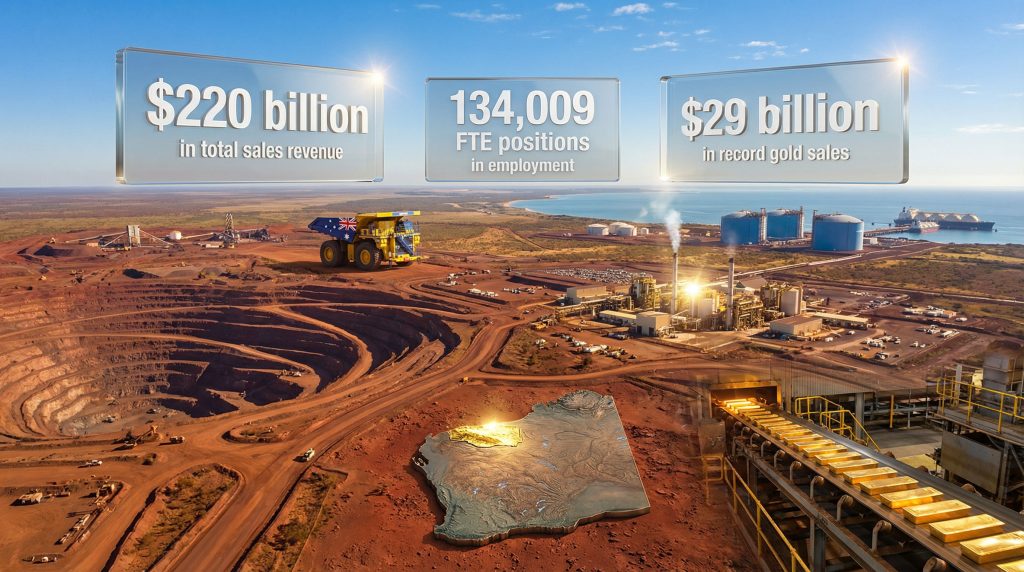
| On-site Mining | 134,009 positions | DEMIRS reporting |
| Exploration | 4,248 positions | Government statistics |
| Petroleum Sector | 9,428 positions | Industry data |
The employment distribution across regional communities creates economic multiplier effects, with mining wages typically exceeding national averages by 40-60%. Mining royalties contribute substantially to state revenue, funding infrastructure development and public services across Western Australia.
Furthermore, regional integration connects WA's resource outputs with national manufacturing supply chains, particularly steel production facilities in Newcastle and Port Kembla. Long-term supply agreements with international trading partners provide revenue stability while supporting project financing for expansion investments.
When big ASX news breaks, our subscribers know first
How Did WA Achieve Record-Breaking Performance in 2024-25?
Western Australia's resources sector achieved $220 billion in aggregate sales during 2024-25, representing record performance despite challenging global economic conditions. This achievement resulted from strategic positioning across diversified commodity portfolios combined with operational excellence initiatives, highlighting sustained wa resources sector growth.
Total Sales Revenue Analysis
The $220 billion sales figure reflects resilient demand patterns across WA's major export commodities, with revenue streams diversified across multiple sectors reducing single-commodity dependency risks. Currency exchange dynamics provided additional support, with Australian dollar weakness relative to major trading currencies enhancing export competitiveness.
Market positioning strategies enabled WA producers to capture premium pricing during periods of supply tightness. Long-term offtake agreements, particularly in LNG markets, provided revenue certainty while spot market exposure captured upside price movements during favorable market conditions.
Investment Confidence Indicator: Total mining and petroleum investment reached $33 billion with additional committed projects valued at $49 billion, demonstrating sustained industry confidence in Western Australia's resource potential and regulatory environment.
Employment Resilience Metrics
Employment stability across WA's resources sector reflects structural demand strength and operational efficiency improvements. The maintenance of 147,685 total FTE positions during global economic uncertainty demonstrates sector resilience:
On-site mining employment of 134,009 positions represents the core operational workforce managing production, processing, and logistics activities. These roles span multiple skill levels from equipment operators to metallurgical engineers, creating diverse career pathways within regional communities.
Exploration employment grew to 4,248 positions, reflecting increased investment in resource discovery and development. This expansion indicates industry confidence in future commodity demand and discovery potential across WA's mineral provinces.
However, petroleum sector employment maintained 9,428 positions supporting LNG production, processing, and export operations. These specialised roles require advanced technical skills and typically command premium compensation packages.
Which Commodities Led Western Australia's Growth Trajectory?
Western Australia's commodity performance during 2024-25 demonstrated the benefits of diversification while highlighting the impact of global economic uncertainty on individual sectors. Traditional commodities maintained strong performance while emerging mineral segments showed varying results based on market conditions.
Gold Sector Breakthrough Performance
Gold achieved all-time record sales of $29 billion, driven by exceptional price performance and modest production increases. Output reached 6.7 million ounces (209 tonnes), representing steady operational performance across WA's established gold fields. This success demonstrates how the gold market surge contributed significantly to overall sector performance.
Global gold prices averaged above US$2,300 per ounce during the first half of 2025, reflecting safe-haven demand amid geopolitical tensions and monetary policy uncertainty. This pricing environment created exceptional margins for WA gold producers, with many operations generating all-in sustaining costs (AISC) below US$1,400 per ounce.
Production efficiency gains across WA gold operations included:
• Automated mining equipment reducing labour costs and improving safety metrics
• Advanced metallurgical processing increasing recovery rates from existing ore bodies
• Predictive maintenance systems minimising equipment downtime and maximising throughput
• Energy optimisation programs reducing power costs through renewable energy integration
Iron Ore: The Economic Anchor
Iron ore generated $122 billion in sales from near-record production of 864 million tonnes, maintaining its position as WA's largest export commodity by value. This performance reflected stable Chinese steel demand despite broader economic concerns affecting global growth projections, aligning with iron ore price trends.
Supply fundamentals supported iron ore pricing through structural factors:
• Chinese steel mill demand remaining above 900 million tonnes annually
• Global supply constraints from aging mines and reduced capital investment
• Quality premiums for WA's high-grade ore suitable for efficient steel production
• Supply chain integration reducing transportation costs and delivery timeframes
Consequently, WA's iron ore operations benefit from economies of scale enabling competitive cost structures. Major producers maintain AISC below US$25 per tonne, providing significant margins during favourable pricing environments.
LNG Market Positioning
Liquefied natural gas achieved $36 billion in sales, ranking among the highest annual values recorded for WA's LNG sector. This performance reflected robust Asian energy demand and successful project expansions increasing export capacity.
Major project developments supporting LNG growth included:
• Woodside Scarborough project adding processing capacity and extending field life
• Chevron Gorgon facility expansions increasing annual production throughput
• Infrastructure optimisation reducing unit production costs and improving reliability
• Long-term supply agreements providing revenue certainty for project financing
Asian energy security concerns, particularly in Japan and South Korea, created sustained demand for Australian LNG exports. Supply agreements typically extend 15-20 years, providing cash flow visibility supporting continued investment in production capacity.
What Investment Patterns Are Shaping WA's Mining Future?
Investment allocation across Western Australia's resources sector reflects both immediate operational requirements and long-term strategic positioning for emerging commodity demand. The $33 billion in current investment combined with $49 billion in committed projects demonstrates substantial capital commitment to sector expansion, according to WA's resources sector outlook.
Capital Allocation Strategies
Investment patterns reveal strategic prioritisation across different development phases:
Sustaining capital investments focus on maintaining production capacity at existing operations through equipment replacement, infrastructure maintenance, and processing facility upgrades. This category typically represents 60-70% of total capital allocation.
Growth capital deployments target capacity expansions, new project developments, and processing capability enhancements. These investments require longer payback periods but provide significant production increases and operational flexibility.
For instance, exploration capital totalling $2.57 billion demonstrates commitment to resource base expansion and new discovery potential. This investment level reflects both rising exploration costs and increased geological complexity requiring advanced exploration technologies.
Exploration Expenditure Breakdown
The distribution of exploration spending reveals industry risk preferences:
| Exploration Category | Investment | Percentage | Risk Profile |
|---|---|---|---|
| Brownfields | $2.03 billion | 79% | Lower geological risk |
| Greenfields | $540 million | 21% | Higher discovery potential |
Brownfields exploration dominance reflects industry preference for extending known mineral systems rather than pursuing grassroots discovery programs. This approach provides higher success probabilities while building upon existing infrastructure and operational expertise.
Cost inflation challenges affecting exploration include:
• Skilled labour shortages driving wages above historical averages
• Equipment supply constraints increasing rental rates and purchase costs
• Fuel price volatility affecting drilling and transportation expenses
• Technology adoption costs requiring upfront investment in advanced exploration methods
Project Pipeline Analysis
The $49 billion committed project pipeline spans multiple commodity sectors and development stages. Major categories include:
LNG expansion projects represent the largest single investment category, with Scarborough, Browse, and other developments requiring substantial infrastructure construction. These projects typically require 4-6 years from final investment decision to first production.
Iron ore sustaining investments focus on maintaining production capacity as higher-grade ore bodies deplete. Mine life extensions and processing upgrades ensure continued competitiveness in global iron ore markets.
Moreover, critical minerals processing facilities represent emerging investment opportunities as global demand for battery materials increases. These projects often require specialised processing technologies and environmental approvals.
How Are Emerging Commodities Reshaping WA's Resource Portfolio?
Western Australia's commodity mix is evolving beyond traditional iron ore and gold production toward materials essential for global energy transition initiatives. This transformation creates opportunities while presenting challenges related to market volatility and technical complexity, particularly regarding energy transition minerals.
Mineral Sands Market Leadership
Mineral sands achieved record sales of $1.4 billion, highlighting WA's competitive advantages in heavy mineral processing and global supply chain positioning. This sector produces titanium dioxide, zircon, and rutile serving diverse industrial applications.
End-use applications driving mineral sands demand include:
• Titanium dioxide pigments for paints, coatings, and plastics manufacturing
• Zircon ceramics for refractory applications in steel production and advanced manufacturing
• Rutile concentrates for aerospace components and high-performance industrial applications
• Renewable energy components including wind turbine structures and solar panel frameworks
WA's mineral sands operations benefit from high-grade heavy mineral concentrations and established processing infrastructure reducing unit production costs. Global supply constraints create favourable pricing environments for Australian producers.
Critical Minerals Positioning
The global energy transition creates substantial demand growth potential for battery minerals and renewable energy materials. However, market volatility affects near-term project economics:
Lithium market corrections following rapid price increases in 2021-2023 created challenging conditions for new project development. Many lithium projects require prices above US$15,000 per tonne for economic viability, while current markets trade below US$12,000 per tonne.
Nickel price volatility reflects competing supply from different production methods, with Indonesian nickel pig iron production affecting traditional sulphide ore markets. WA nickel operations focus on high-grade sulphide deposits suitable for battery precursor production.
Furthermore, copper exploration increased significantly as electrification trends drive demand growth projections. WA's geological provinces contain substantial copper potential, particularly in association with gold mineralisation systems.
Rare earth processing capabilities remain underdeveloped despite significant resource potential. Establishing downstream processing requires substantial capital investment and technical expertise currently concentrated in China.
What Challenges and Opportunities Define the Sector's Outlook?
Western Australia's resources sector navigates complex market dynamics while positioning for long-term growth opportunities. Understanding these challenges and opportunities becomes critical for investment decision-making and strategic planning, particularly as wa resources sector growth continues evolving.
Market Volatility Management
Commodity price cycles create ongoing challenges requiring sophisticated risk management strategies:
Operational flexibility enables producers to adjust production levels based on market conditions. Variable cost structures allow operations to remain profitable during price downturns while maximising output during favourable market conditions.
Financial hedging mechanisms protect revenue streams through forward sales contracts, options positions, and currency hedging strategies. These instruments provide cash flow certainty supporting project financing and operational planning.
In addition, portfolio diversification across multiple commodities reduces exposure to single-commodity price cycles. Integrated mining companies benefit from natural hedging when different commodities experience varying market conditions.
Global Energy Transition Impact
The worldwide shift toward renewable energy systems creates substantial demand growth for specific mineral categories:
Battery mineral requirements for electric vehicle production and grid energy storage systems drive demand for lithium, nickel, cobalt, and graphite. Projected demand growth rates exceed 15% annually through 2030 for several battery materials.
Renewable energy infrastructure requires substantial quantities of copper, aluminium, steel, and rare earth elements. Wind turbines, solar panels, and transmission infrastructure create new demand centres beyond traditional industrial applications.
However, grid modernisation projects supporting renewable energy integration require advanced materials for transmission lines, transformers, and energy storage systems. These applications often demand higher-grade materials than conventional uses.
Regional Economic Development
Resources sector investments create multiplier effects throughout regional economies:
Community investment programs support local employment, education, and infrastructure development. Mining companies typically contribute 1-3% of revenue toward community development initiatives creating shared value arrangements.
Indigenous partnership agreements establish framework arrangements recognising traditional land rights while enabling resource development. These agreements often include employment targets, business development opportunities, and cultural heritage protection provisions.
Skills development initiatives address labour shortages through training programs, apprenticeships, and university partnerships. The resources sector requires diverse skill sets from equipment operators to metallurgical engineers.
The next major ASX story will hit our subscribers first
How Does WA's Performance Compare to Global Mining Jurisdictions?
Western Australia competes globally for mining investment capital based on geological prospectivity, regulatory frameworks, and operational cost structures. Comparative analysis reveals competitive strengths and areas requiring continued attention. Recent analysis from WA's mining sector performance confirms these competitive advantages.
Competitive Advantages Assessment
WA's investment attractiveness stems from multiple factors supporting long-term project viability:
Regulatory stability provides confidence for multi-decade mining investments requiring substantial upfront capital commitments. Environmental approval processes, while rigorous, follow established frameworks enabling project planning and risk assessment.
Skilled workforce availability supports complex mining and processing operations. Australian mining education programs and operational experience create competitive advantages in technical expertise and safety performance.
Transportation infrastructure reduces logistics costs through established rail networks, port facilities, and shipping arrangements. Proximity to Asian markets provides natural cost advantages versus competitors in Africa or South America.
Consequently, political risk profiles remain favourable compared to many alternative mining jurisdictions. Stable democratic institutions, property rights protection, and transparent legal systems attract international investment capital.
Market Share Analysis
Western Australia maintains leading global positions across multiple commodity markets:
| Commodity | Global Market Share | Competitive Position |
|---|---|---|
| Iron Ore | ~55% seaborne trade | Market leader |
| Gold Production | ~10% global output | Top 3 producer |
| LNG Exports | ~20% global trade | Major supplier |
| Mineral Sands | ~25% global output | Significant player |
These market positions provide pricing influence and supply security for international customers while generating substantial economic returns for Australian stakeholders.
Operational cost comparisons generally favour WA operations due to economies of scale, established infrastructure, and operational expertise. However, rising labour costs and regulatory compliance requirements create ongoing cost pressures requiring continuous productivity improvements.
How Is Technology Transforming Mining Operations?
Technological advancement represents a critical factor in maintaining competitive positioning across global mining markets. Innovation adoption accelerates operational efficiency while addressing safety and environmental challenges facing the industry.
The implementation of ai in mining operations demonstrates how technology integration transforms traditional mining practices:
Automated drilling systems improve precision and reduce operational risks through remote-controlled equipment and real-time data monitoring. These systems optimise blast patterns while minimising environmental impact through reduced ground vibration and dust generation.
Predictive maintenance algorithms analyse equipment performance data to prevent failures before they occur. This approach reduces downtime costs while extending equipment life cycles through optimised maintenance scheduling.
Digital twin technology creates virtual replicas of mining operations enabling scenario planning and operational optimisation. These systems support decision-making through advanced modelling and simulation capabilities.
What Does the Future Hold for Western Australia's Resources Sector?
Long-term sector outlook depends on successful navigation of structural demand changes, technology adoption, and sustainability requirements. These factors will reshape WA's competitive position over the next decade, with wa resources sector growth remaining a key economic driver.
Five-Year Growth Projections
Industry analysts project continued strength across traditional commodities while emerging opportunities develop in critical minerals sectors:
Critical minerals production expected to increase substantially as processing capabilities expand and global demand accelerates. Battery materials, rare earth elements, and specialty metals present significant growth opportunities.
Energy transition demand drivers support copper, aluminium, and steel requirements for renewable energy infrastructure. Grid modernisation and electrification trends create sustained demand growth projections.
Technology adoption improvements enhance operational efficiency through automation, artificial intelligence, and advanced processing methods. These innovations reduce operational costs while improving environmental performance.
For instance, sustainability requirements increasingly influence project development through carbon footprint considerations, water management practices, and biodiversity protection measures.
Strategic Investment Priorities
Future investment patterns will likely emphasise value-added processing and technology integration:
Processing capability development reduces reliance on raw material exports while capturing additional value from mineral resources. Downstream processing creates employment opportunities and improves project economics.
Value-added manufacturing integration connects mining operations with industrial processing and manufacturing activities. These linkages create supply chain efficiencies and economic diversification opportunities.
Research and development partnerships with universities and technology companies accelerate innovation adoption and technical capability development. These collaborations support competitive advantages in operational efficiency and environmental performance.
Furthermore, digital transformation initiatives improve productivity through data analytics, predictive maintenance, and operational optimisation systems. Technology adoption becomes essential for maintaining competitive cost structures.
Long-term Industry Outlook: Sustained sector strength projected through 2026 across gold, iron ore, and LNG markets, with critical minerals providing additional growth opportunities as global energy transition accelerates demand for specialised materials.
Policy Framework Evolution
Regulatory developments will shape future sector performance through streamlined processes and sustainability requirements:
Environmental compliance standards drive innovation in mining methods, waste management, and ecological restoration practices. These requirements create competitive advantages for operators developing superior environmental performance capabilities.
Indigenous rights recognition establishes partnership frameworks supporting resource development while protecting cultural heritage and traditional land use practices. These arrangements become standard practice across major mining projects.
However, international trade agreements facilitate market access while establishing supply chain security arrangements for critical minerals. Government-to-government agreements support private sector investment in strategic mineral development.
The convergence of geological advantages, established infrastructure, and evolving market demand positions Western Australia's resources sector for continued growth despite cyclical commodity price variations. Success will depend on adaptation to changing demand patterns while maintaining operational excellence across traditional commodity sectors. Investment in processing capabilities, technology adoption, and sustainability practices will determine long-term competitive positioning as global markets transition toward renewable energy systems requiring new material supply chains.
Ready to Capitalise on Western Australia's Mining Boom?
Discovery Alert's proprietary Discovery IQ model delivers real-time alerts on significant ASX mineral discoveries, instantly empowering subscribers to identify actionable opportunities in WA's thriving resources sector ahead of the broader market. Understand why major mineral discoveries can lead to substantial market returns by exploring Discovery Alert's dedicated discoveries page, and begin your 30-day free trial today to position yourself ahead of the market.