June 19, 2026
Revolutionary Water Conservation Achieves Global Benchmarks
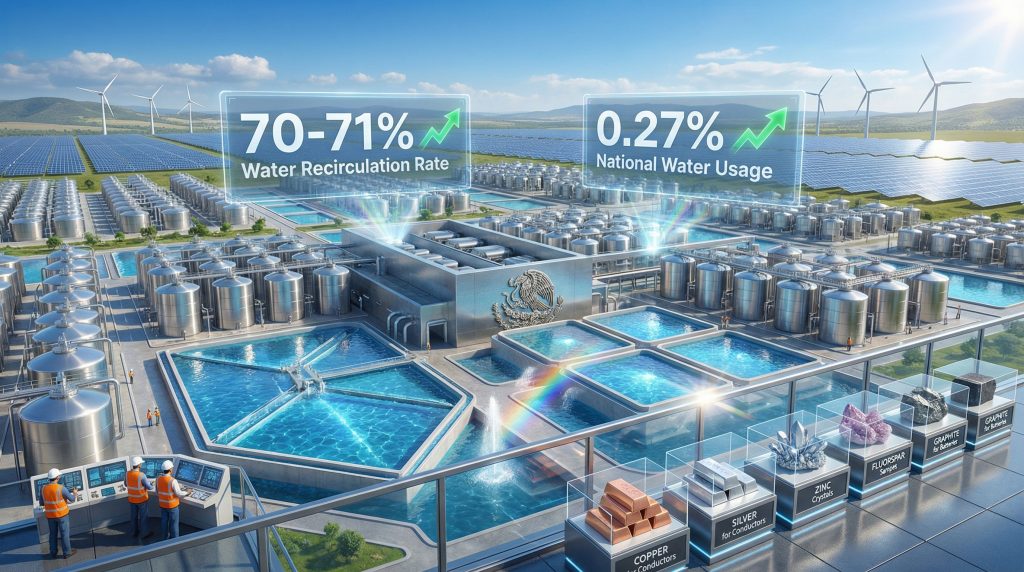
Mexico mining sustainability initiatives have established unprecedented water efficiency standards through systematic infrastructure investment and technological innovation. The sector's 0.27% consumption of all national water concessions positions Mexican mining operations among the most resource-efficient globally, particularly significant given that primary extraction regions operate under water-stressed conditions across northern and central states.
Advanced recirculation systems achieve 70-71% water recovery rates through comprehensive closed-loop technologies that treat and redirect wastewater back into operational processes. This contrasts dramatically with traditional single-use extraction models, reducing freshwater withdrawals while maintaining production capacity across diverse geological formations. Furthermore, these innovations align with broader mine reclamation trends emphasising environmental restoration.
The implementation of 100 treatment plants nationwide provides distributed water management infrastructure capable of processing various water qualities from process water to treated wastewater across multiple mining operations. These facilities employ sophisticated filtration, chemical treatment, and biological processing technologies that enable continuous recirculation while meeting strict environmental discharge standards.
Treatment Infrastructure Technology and Capacity
Modern treatment facilities integrate multiple processing stages including:
• Primary treatment: Physical separation of suspended solids and heavy metals through settling and filtration
• Secondary processing: Chemical precipitation and neutralisation of acidic drainage
• Tertiary treatment: Advanced oxidation and biological treatment for organic compound removal
• Quality monitoring: Continuous analytical testing ensuring water meets recirculation standards
The geographic distribution of treatment plants addresses regional water stress variations, with higher concentration in northern states including Sonora, Chihuahua, and Durango where mining operations encounter greater water scarcity challenges.
Regulatory Framework Driving Water Conservation
Mexico's water management regulations establish stringent authorisation processes through SEMARNAT (Mexico's Environmental Secretariat) requiring comprehensive environmental impact assessments before project approval. The 2023 Mining Reform specifically prohibits new concessions in water-scarce regions designated by environmental authorities, directly addressing historical conflicts between resource extraction and ecosystem protection. Additionally, Mexico's mining chamber has embraced sustainability by committing to best practices.
Key regulatory mechanisms include:
• Water concession requirements: Mandatory permits for all water extraction with annual usage monitoring
• Discharge quality standards: NOMs (Mexican Official Standards) establishing maximum contaminant levels for treated water
• Recirculation mandates: Regulatory incentives promoting closed-loop system adoption
• Regional restrictions: Protected area designations preventing mining in ecologically sensitive watersheds
When big ASX news breaks, our subscribers know first
Renewable Energy Integration Transforms Mining Operations
Mexico mining sustainability strategy emphasises clean energy adoption as fundamental to operational competitiveness and regulatory compliance. Currently, 41 mining units generate or consume renewable energy, representing 36% of total industry energy consumption with targeted expansion to 44% by 2030 aligned with national climate commitments. These initiatives are part of broader renewable energy solutions transforming the sector.
This 8-percentage-point increase over five years requires substantial infrastructure investment in solar and wind technologies across mining sites, particularly leveraging Mexico's exceptional solar irradiance in central and northern regions and consistent wind resources in southern states.
Solar and Wind Power Integration Strategies
Mining operations deploy diversified renewable energy approaches combining on-site generation with power purchase agreements:
On-site solar installations capitalise on Mexico's high solar irradiance, particularly effective for operations in Sonora, Durango, and Zacatecas where consistent sunshine enables reliable daytime power generation for energy-intensive processing operations.
Wind power agreements leverage consistent wind resources in states including Oaxaca and the Isthmus of Tehuantepec, providing complementary renewable generation during low-solar periods and supporting 24-hour operational requirements.
Power Purchase Agreements (PPAs) with utility-scale renewable providers enable mining companies to secure long-term clean energy contracts without direct infrastructure investment, particularly valuable for operations in regions with limited on-site renewable potential.
Critical Minerals Supporting Global Clean Energy Transition
| Mineral | Primary Applications | Mexico's Production Role | Renewable Energy Connection |
|---|---|---|---|
| Copper | Solar panels, EV infrastructure | Major regional supplier | Essential for electrical conductivity in renewable systems |
| Silver | Solar technology, electronics | Leading global producer | Critical for photovoltaic cell efficiency |
| Zinc | Battery components, renewable systems | Significant reserves | Key component in energy storage solutions |
| Fluorspar | Clean technology manufacturing | Strategic resource | Used in aluminium and steel production for wind turbines |
| Graphite | Battery electrodes, energy storage | Emerging production | Critical for lithium-ion battery anodes |
The renewable energy transition directly reduces operational carbon footprint of minerals destined for global clean energy infrastructure, creating positive feedback loops where sustainable extraction supports downstream decarbonisation objectives.
2030 Renewable Energy Implementation Roadmap
Achieving the 44% renewable energy target requires systematic infrastructure development addressing technical and financial challenges:
Investment requirements encompass solar panel installations, wind turbine deployment, battery storage systems for off-peak energy management, and grid integration infrastructure for remote mining locations with limited electrical connectivity.
Technology specifications prioritise crystalline solar panels for high-efficiency applications, advanced wind turbine designs capable of operating in diverse meteorological conditions, and industrial-scale battery storage enabling continuous operations during renewable generation intermittency. These developments reflect broader industry evolution trends towards sustainability.
Regional distribution strategies concentrate solar deployment in high-irradiance northern states while maximising wind power utilisation in southern regions with consistent wind patterns, optimising renewable resource availability across Mexico's diverse geographical mining regions.
Comprehensive Regulatory Architecture Ensures Environmental Compliance
Mexico operates one of the world's most extensive mining regulatory frameworks, encompassing 27+ laws governing mining operations with 9 mining-specific statutes complemented by Mexican Official Standards (NOMs) covering environmental protection, occupational safety, explosives management, water use, land access, and fiscal compliance.
This multi-layered approach creates comprehensive oversight addressing the full mining lifecycle from pre-permitting environmental assessment through operational compliance to site closure and long-term liability management. Moreover, these regulations highlight the decarbonisation benefits achievable through comprehensive policy frameworks.
2023 Mining Reform: Paradigm Shift Toward Sustainability
The 2023 Mining Reform introduced fundamental structural changes prioritising environmental protection and community engagement:
Public bidding processes replaced first-come, first-served concession allocation with competitive bidding enabling government assessment of environmental commitment and technical capabilities before award. This transparency enhancement allows authorities to prioritise proposals demonstrating superior sustainability practices and community benefit.
Protected area restrictions prohibit new concessions in protected ecological areas, indigenous territories without consent, or water-scarce regions designated by SEMARNAT, directly addressing historical conflicts between mining expansion and ecosystem conservation.
Community consultation mandates establish free, prior, and informed consent (FPIC) requirements obligating mining companies to engage indigenous communities and stakeholders before project commencement, creating legal pathways for community input on environmental and social impacts.
Indigenous profit-sharing mechanisms allocate 5% of mining revenues from operations in indigenous territories to affected communities, creating direct economic benefit and incentive alignment between mining success and community welfare.
International Standards Integration and Certification Excellence
Mexico mining sustainability leadership manifests through comprehensive certification adoption with 221 national certifications and 84 international certifications achieved in 2024, demonstrating commitment to global best practices.
Critical certifications include:
• ISO 14001 (Environmental Management Systems): Systematic environmental policy implementation, objective-setting, and continuous improvement processes
• ISO 45001 (Occupational Health & Safety Management): Worker safety through hazard identification, risk assessment, and incident prevention protocols
• International Cyanide Management Code: Production, transportation, and use standards preventing environmental contamination for gold and silver processing
• Towards Sustainable Mining (TSM): Performance indicators across 10 principles including child labour prevention, indigenous rights respect, and environmental liability management
These certifications align Mexican mining with international sustainability expectations while providing market access advantages in ESG-conscious global supply chains.
Regulatory Enforcement and Compliance Mechanisms
The layered regulatory structure creates multiple enforcement pathways through federal agencies including SEMARNAT, PROFEPA (environmental enforcement), and STPS (labour standards), ensuring comprehensive oversight across environmental, safety, and social compliance dimensions.
The regulatory framework addresses environmental stewardship not as compliance burden but as competitive prerequisite for market access and operational legitimacy in an increasingly sustainability-focused global marketplace.
Mining operations simultaneously comply with general environmental law, mining-specific regulations, water use standards, labour protection requirements, and hazardous materials handling protocols, creating robust safeguards against environmental degradation and social disruption. These measures demonstrate how effective mining sustainability practices are driving industry transformation.
Economic Multiplier Effects Drive Regional Development
Mexico mining sustainability generates substantial economic spillover effects extending far beyond direct extraction operations through comprehensive supply chain integration and industrial connectivity. The sector directly supports 192 productive industries while providing intermediate or final inputs to 123 economic sectors, creating extensive value-added networks across multiple regions.
Supply Chain Integration and Economic Connectivity
| Economic Indicator | 2024 Performance | Regional Impact Scale |
|---|---|---|
| Economic Spillover | MX$260 billion | Multi-sector value creation |
| Fiscal Revenue Contribution | MX$45.3 billion | Government program funding |
| Industrial GDP Share | 8.7% | Manufacturing sector support |
| Employment Support | 10.7 million jobs | Direct and indirect positions |
| Foreign Currency Generation | 6th largest nationally | Export competitiveness |
The MX$260 billion economic spillover represents total value generated across mining-adjacent sectors through value-added processing, manufacturing, and specialised services, demonstrating a multiplier effect of approximately 5.7× relative to direct fiscal revenue generation.
Regional Supplier Network and Business Development
Mining operations maintain relationships with 5,500+ regional supplier businesses, indicating geographic distribution of economic benefit extending beyond extraction sites into comprehensive support networks spanning:
• Exploration support services: Geological consulting, drilling contractors, and analytical laboratories
• Equipment supply and maintenance: Heavy machinery, specialised tools, and technical components
• Transportation and logistics: Raw material movement, processed mineral shipping, and supply chain coordination
• Specialised manufacturing: Custom equipment fabrication, replacement parts production, and technical modifications
This distributed supplier network mitigates risk of economic benefit concentration while creating resilient regional economies supporting mining operations across diverse geographical areas.
Strategic Position in North American Supply Chains
Mexico's mineral resources and processing capabilities establish the country as indispensable to North American manufacturing and clean energy development. Critical mineral availability for electromobility and advanced manufacturing positions Mexico at the centre of regional supply chain resilience initiatives under the USMCA framework.
Sectoral integration examples include:
Automotive sector connectivity: Copper and silver mining directly supplies electrical components, wiring systems, and battery infrastructure for Mexico's expanding electric vehicle manufacturing as automotive production transitions toward electrification.
Electronics and consumer goods: Silver from Mexican operations is essential for electronics fabrication, solar panel production, and high-conductivity applications supporting Mexico's growing electronics manufacturing sector.
Renewable energy equipment manufacturing: Copper, silver, and zinc inputs support solar panel production, wind turbine component manufacturing, and battery production facilities increasingly located in Mexico as nearshoring accelerates.
Construction and infrastructure development: Zinc-coated steel and copper-based components from mining operations supply Mexico's construction sector and infrastructure projects supporting economic development across multiple regions.
Environmental Investment Portfolio Drives Innovation
Mexican mining companies invested $438 million in environmental initiatives during 2024, encompassing technology modernisation, operational efficiency improvements, community development programmes, and ecosystem restoration projects. This substantial investment portfolio demonstrates industry commitment to sustainable development extending beyond regulatory compliance toward proactive environmental stewardship.
Technology Modernisation and Operational Efficiency
Environmental investments prioritise advanced technologies reducing resource consumption and environmental impact:
Water treatment technology upgrades enhance recirculation efficiency and treatment quality, enabling higher recovery rates while reducing freshwater requirements across operations in water-stressed regions.
Energy efficiency improvements include equipment modernisation, process optimisation, and automation systems reducing overall energy consumption while maintaining production capacity.
Waste minimisation technologies optimise ore processing to reduce tailings generation and improve mineral recovery rates, decreasing environmental footprint per unit of production. These advancements complement comprehensive waste management solutions across the industry.
Monitoring and control systems provide real-time environmental data enabling immediate response to operational deviations and continuous optimisation of environmental performance.
Waste Management Innovation and Permanent Responsibility
Mexico's regulatory framework establishes comprehensive waste liability systems requiring mining companies to maintain long-term responsibility for environmental stewardship:
• Site rehabilitation requirements: Mandatory restoration plans addressing post-mining land use and ecosystem recovery
• Closure plan mandates: Financial guarantees ensuring adequate funding for site closure and long-term monitoring
• Permanent liability frameworks: Ongoing responsibility for environmental performance extending beyond operational periods
• Advanced disposal regulations: Strict standards protecting critical ecosystems from mining waste impacts
Community Development and Social Investment
Environmental investment portfolios increasingly integrate community development initiatives recognising the interconnection between social and environmental sustainability:
Educational programmes support technical training and capacity building in mining communities, creating local expertise for environmental monitoring and sustainable development initiatives.
Healthcare infrastructure development improves community health outcomes while addressing potential health impacts from mining operations through enhanced medical facilities and preventive care programmes.
Economic diversification projects support alternative livelihood development in mining regions, reducing community dependence on extraction activities while building resilient local economies.
Future Challenges and Strategic Opportunities
Mexico mining sustainability faces evolving challenges requiring adaptive strategies and innovative solutions as global demand for critical minerals intensifies alongside environmental protection expectations.
Regulatory Implementation and Business Adaptation
The transition to enhanced regulatory frameworks creates implementation challenges requiring systematic business adaptation:
Permit processing efficiency remains a critical bottleneck as government agencies develop capacity to evaluate complex environmental impact assessments under new regulatory standards.
Industry resistance mitigation requires collaborative approaches addressing legitimate business concerns while maintaining environmental protection objectives through stakeholder engagement and technical support.
Administrative capacity building encompasses training government personnel in advanced environmental assessment techniques and emerging technologies supporting sustainable mining practices.
Technology Integration and Innovation Pathways
Advancing technology offers opportunities for enhanced environmental performance and operational efficiency:
Advanced monitoring systems utilise satellite imagery, IoT sensors, and artificial intelligence for real-time environmental compliance tracking and predictive maintenance reducing environmental risks.
Automation and digitalisation reduce human environmental exposure while optimising resource utilisation through precision control systems and data-driven decision making.
Research partnerships with academic institutions and technology companies accelerate innovation in sustainable mining techniques, environmental remediation, and clean energy integration.
Community Engagement and Indigenous Rights Protection
Sustainable mining requires comprehensive community partnership approaches addressing historical grievances while creating shared value:
Free, prior, and informed consent implementation establishes systematic consultation processes ensuring meaningful community participation in mining project development and ongoing operations.
Cultural preservation initiatives protect indigenous heritage sites and traditional practices while enabling responsible resource development through collaborative planning and impact mitigation.
Long-term partnership models create enduring relationships between mining companies and communities through profit-sharing, employment opportunities, and capacity building initiatives extending beyond operational periods.
Environmental and social sustainability increasingly determines market access and operational viability as global supply chains prioritise ESG compliance and responsible sourcing standards.
The evolution of Mexico mining sustainability demonstrates how comprehensive environmental stewardship, regulatory compliance, and community engagement create competitive advantages while supporting national economic development and global clean energy transition objectives.
The next major ASX story will hit our subscribers first
Frequently Asked Questions About Mexico Mining Sustainability
How does Mexico's mining water efficiency compare internationally?
Mexico's 0.27% national water usage rate positions the country among the most water-efficient mining jurisdictions globally, with the 70-71% water recirculation rate exceeding international benchmarks for water stewardship in arid and semi-arid mining regions.
What makes Mexico critical for global clean energy mineral supply?
Mexico's abundant reserves of copper, silver, zinc, fluorspar, and graphite provide essential materials for solar panel manufacturing, electric vehicle battery production, hydrogen energy systems, and next-generation electronics, with strategic geographic proximity to North American manufacturing centres.
How effective are the 2023 mining reforms for environmental protection?
The reforms establish comprehensive protection through competitive concession allocation, protected area restrictions, mandatory community consultation, indigenous profit-sharing mechanisms, and enhanced environmental impact assessment requirements, fundamentally changing mining project development approaches.
What role does renewable energy play in mining sustainability?
Renewable energy adoption reduces operational carbon footprint while supporting production of critical minerals for clean energy infrastructure, creating positive feedback loops where sustainable extraction enables downstream decarbonisation across global supply chains.
Disclaimer: This analysis incorporates current policy frameworks and industry performance data that may evolve as regulatory implementation progresses and market conditions change. Investment decisions should consider comprehensive due diligence including regulatory risks, technological developments, and market dynamics affecting Mexico's mining sector.
Ready to Discover the Next Major Mineral Breakthrough?
Discovery Alert provides instant notifications on significant ASX mineral discoveries, powered by its proprietary Discovery IQ model, turning complex mining opportunities into actionable investment insights. Visit Discovery Alert's dedicated discoveries page to explore historic examples of exceptional returns, then begin your 30-day free trial to position yourself ahead of the market.