June 14, 2026
The Governance Gap That Could Determine Mining's Future in Southern Africa
Across the world's most mineral-rich geographies, a quiet but accelerating tension is reshaping how resource extraction is financed, permitted, and ultimately judged. It is not a tension about commodity prices, geopolitical trade flows, or even the energy transition, though all of these matter. It is, at its most fundamental level, a tension about water. In semi-arid regions where ancient aquifers took millennia to fill and river systems serve entire civilisations, the industrial demand for water is colliding with biological necessity in ways that no amount of capital can easily resolve.
South Africa sits at precisely this intersection. The country holds some of the world's most significant reserves of gold, platinum group metals, coal, and a growing portfolio of critical minerals. Yet it operates within a hydrological reality that places severe constraints on how those resources can be extracted sustainably. Understanding why water security is critical to the future of mining in South Africa requires looking beyond individual projects and into the structural relationship between governance, hydrology, and long-term economic legitimacy.
When big ASX news breaks, our subscribers know first
South Africa's Water Arithmetic: Why the Numbers Do Not Favour Complacency
South Africa's per capita renewable freshwater availability sits at approximately 1,200 cubic metres per person per year, placing it below the United Nations threshold of 1,700 m³ per capita that defines water stress. This is not a marginal shortfall. It is a chronic condition that worsens as population growth, urbanisation, and industrial demand compress the available supply from multiple directions simultaneously.
The geography of South Africa's mining heartland compounds this problem significantly. Annual rainfall across much of the Witwatersrand gold fields, the Northern Cape diamond and iron ore regions, and significant parts of Limpopo's platinum corridor ranges between 400mm and 700mm per annum. These are not environments that naturally replenish water systems at the pace that industrial abstraction demands. Groundwater recharge rates in many mining catchments are measured in millimetres per year, not litres per second.
Climate science adds a further layer of urgency. The Intergovernmental Panel on Climate Change's Sixth Assessment Report projects that southern Africa will experience declining rainfall of between 5% and 20% by 2050 depending on emissions trajectories, with increased frequency and severity of drought events across the region. For mining operators whose long-term project plans extend across multiple decades, this is not a distant scenario. It is a planning variable that is already narrowing operational margins.
Rand Water and Awsisa chairperson Ramateu Monyokolo made this point explicitly in an opinion piece published by Creamer Media's Mining Weekly in April 2026, noting that in a semi-arid country already experiencing the pressures of climate change, the contradiction between water-intensive mining and hydrological sustainability can no longer be treated as a secondary issue. (Monyokolo, R., Mining Weekly, Creamer Media, 28 April 2026.)
Mining's Dual Burden: Consumption and Contamination
What makes South Africa's water-mining tension particularly difficult to resolve is that the sector does not merely consume water in large volumes. It also degrades the systems from which that water is drawn, creating a compounding problem that outlasts the productive life of most operations by decades. Responsible mining practices demand that this dual burden be addressed comprehensively rather than treated as separate compliance obligations.
Acid mine drainage (AMD) is the most documented and most costly expression of this dynamic. When pyrite and other sulphide minerals are exposed to oxygen and water during underground mining, a chemical reaction produces highly acidic, metal-laden effluent. The resulting leachate typically carries pH levels below 3.0 and elevated concentrations of iron, aluminium, copper, zinc, and cadmium, all of which are toxic to aquatic ecosystems and dangerous to human health.
The Witwatersrand basin, once home to the world's most productive gold mining complex, now carries the environmental legacy of that extraction long after large-scale operations ceased in the 1990s and early 2000s. Underground workings that once reached depths exceeding 3,000 metres are now partially flooded. As dewatering infrastructure has been decommissioned, groundwater levels have rebounded, dissolving sulphide minerals along the way and pushing contaminated water toward the surface and into connected river systems. The Blesbokspruit and portions of the Vaal River system have been measurably affected.
Monyokolo observed that decades after the closure of many gold mines, toxic water continues to decant into rivers and groundwater systems, threatening human health and ecosystems, with the costs borne largely by the state and the public, while historical beneficiaries of mining have long since exited the scene. (Mining Weekly, Creamer Media, 28 April 2026.)
This is not merely an environmental observation. It represents a structural governance failure in which the social and financial costs of industrial activity were systematically externalised onto public institutions and communities who derived limited benefit from the original extraction. Furthermore, it highlights why water security critical to the future of mining in South Africa must be treated as a central governance priority, not an afterthought.
The table below summarises the principal water-related impacts of mining activity in South Africa:
| Impact Category | Mechanism | Affected System | Primary Cost Bearer |
|---|---|---|---|
| Acid mine drainage | Sulphide oxidation in flooded workings | Rivers, wetlands, groundwater | State and public sector |
| Groundwater contamination | Leaching from tailings and waste rock | Aquifer systems, boreholes | Mixed (state and operators) |
| Wetland destruction | Physical footprint of operations | Biodiversity, natural water retention | Regulatory enforcement gap |
| Excessive abstraction | Direct water-use licence drawdown | Surface and ground water systems | Shared catchment users |
| Post-closure rebound | Dewatering cessation and groundwater rise | Urban and peri-urban water supply | State-funded remediation |
The Constitutional Dimension: Water as a Legal Right, Not a Negotiable Input
South Africa's Constitution occupies an unusual position in global governance frameworks. Section 27(1)(b) of the Bill of Rights enshrines access to sufficient water as a fundamental right, placing water policy within a constitutional rather than purely administrative context. This means that any regulatory framework permitting mining activity to compromise water availability or quality carries potential constitutional deficiency, not merely environmental or reputational risk.
This framing, articulated by Monyokolo in his April 2026 analysis, shifts the analytical lens considerably. A mining project that generates economic returns while degrading the water security of surrounding communities is not simply a poorly managed operation. It is an operation that may be in conflict with the supreme law of the land. The intersection of water rights, mineral rights, and community rights represents one of the most complex and least publicly understood governance challenges in South African resource law.
The Department of Water and Sanitation (DWS) operates as the primary gatekeeper of this constitutional mandate within the mining sector, administering water-use licences under the authority of the National Water Act, 1998 (Act 36 of 1998), Section 40. Licence conditions are designed not merely to protect environmental systems but to actively prioritise the water needs of historically marginalised communities, a developmental objective that places equity considerations at the centre of resource allocation decisions.
As Monyokolo described it, the DWS positions water not as an input for profit but as a developmental enabler, a framing that fundamentally reorients the governance logic from maximising extraction to maximising long-term stewardship. (Mining Weekly, Creamer Media, 28 April 2026.)
Operation Vulindlela: Reforming Licensing Without Lowering Standards
One of the more practically significant regulatory developments in recent years has been the administrative reform of water-use licence processing through Operation Vulindlela, the joint Presidency and National Treasury initiative designed to reduce structural bottlenecks across key economic sectors.
Under the National Water Act, the DWS is required to issue or refuse a water-use licence application within 90 calendar days of receiving a complete application. Historically, significant backlogs developed well beyond this statutory timeframe, creating investment uncertainty for mining companies and complicating project financing timelines. Operation Vulindlela has introduced process reforms that improve adherence to these statutory windows, directly reducing the administrative drag that previously deterred some mining investment.
The significance of this reform lies in its framing. Rather than relaxing environmental standards to accelerate approvals, the initiative has focused on administrative efficiency — processing speed without reduced scrutiny. This distinction matters considerably for communities adjacent to mining operations, for whom a faster approval process accompanied by robust environmental conditions is a very different outcome than a faster process with reduced oversight.
Monyokolo confirmed that Operation Vulindlela has improved licence processing within statutory timelines, enhancing certainty for mining investors, while emphasising that the DWS has simultaneously identified practical measures to mitigate environmental and social risks. (Mining Weekly, Creamer Media, 28 April 2026.)
Is There Enough Water for New Mining Investment?
This may be the single most consequential question facing South Africa's resource sector in the near term, and the honest answer is nuanced. Water scarcity is not absolute. It is conditional on governance quality, allocation efficiency, and cross-sector behaviour. Consequently, natural capital in mining must be factored into project planning from the earliest feasibility stages.
Monyokolo offered a direct assessment: sufficient water exists to accommodate new mining investment, but only if water users across all sectors commit collectively to conservation and efficient use. The availability of water for industrial growth is therefore not primarily a hydrological question. It is a governance question. (Mining Weekly, Creamer Media, 28 April 2026.)
Three conditions must be met simultaneously for water availability to support meaningful new investment:
-
Binding conservation commitments must be adopted across agriculture, municipalities, and all industrial users, not merely mining operators who collectively represent a fraction of total national water demand.
-
On-site water recycling and reuse infrastructure must be built at scale within mine sites, reducing freshwater abstraction ratios and cutting dependence on external water supply systems.
-
Coordinated catchment management through multi-stakeholder governance forums must ensure that water is allocated across competing demands in a manner that reflects constitutional, developmental, and ecological priorities rather than purely economic ones.
Without all three of these conditions operating in parallel, new mining investment will intensify the existing pressure on already stressed catchment systems, generating operational risk for the very projects it is meant to enable.
The next major ASX story will hit our subscribers first
Turning Liabilities Into Assets: Innovation in Mine Water Treatment
Perhaps the most underappreciated shift currently underway in South Africa's mining water landscape is the gradual reconceptualisation of mine-affected water from environmental liability to recoverable industrial resource. This is not a marginal technical shift. It represents a fundamental reframing of the economics of mine water management, and it aligns closely with broader mining sustainability transformation goals that are reshaping the sector globally.
Frameworks such as MAMDIWAS (Mine-Affected and Mine-Influenced Water Solutions) are developing treatment technologies capable of converting contaminated mine water, including AMD, into water suitable for industrial reuse or municipal supply. In Mpumalanga's coal belt, mining operators have constructed dedicated treatment systems that process millions of litres of contaminated water daily and supply purified water to adjacent communities, effectively converting a waste stream into a community service.
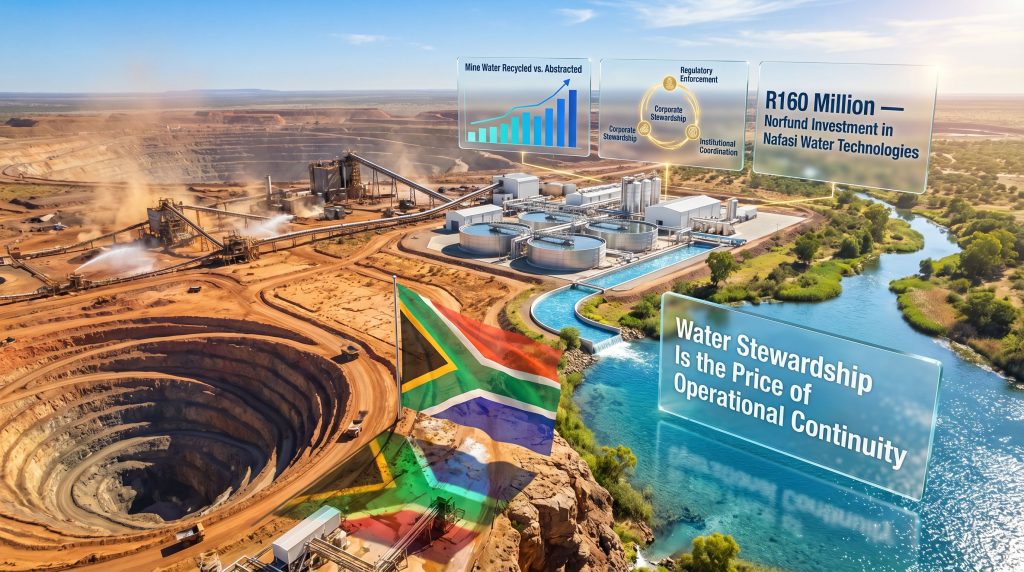
The commercial case is increasingly compelling. Institutional capital is beginning to recognise mine water treatment as a viable asset class. Norfund's R160 million commitment to Nafasi Water Technologies represents one of the more visible examples of development finance flowing toward this opportunity, signalling that water treatment at mining scale can generate returns sufficient to attract dedicated investment rather than relying solely on compliance budgets.
The following table compares solution types and their multi-dimensional benefits:
| Solution Type | Operational Benefit | Community Benefit | Environmental Benefit |
|---|---|---|---|
| AMD treatment and reuse | Reduces freshwater abstraction costs | Treated water supply to municipalities | Prevents river and groundwater contamination |
| On-site wastewater recycling | Lowers operational water costs | Reduces competition with agricultural users | Decreases effluent discharge volumes |
| Regional bulk water infrastructure | Improves operational water security | Expands access in underserved areas | Supports catchment-level water management |
| Post-closure water management | Reduces long-term liability provisions | Protects communities from legacy contamination | Preserves aquifer and river system health |
The MAMDIWAS framework goes further than technology alone. It explicitly incorporates post-mining economic transition planning, recognising that water treatment infrastructure can generate lasting employment and skills development opportunities that outlast the mine's productive life. This positions water management as a mechanism for delivering on just transition commitments rather than simply satisfying regulatory compliance requirements.
Community Water Security and the Governance Quality Variable
Research examining communities located in South Africa's mining regions reveals a finding that challenges some popular assumptions: proximity to active mining operations does not automatically correlate with degraded water access. In certain contexts, active mines have invested in local water infrastructure in ways that measurably improved access and health outcomes for surrounding communities.
However, this positive correlation is strongly contingent on the quality of local governance. Where institutional accountability is robust, mining investment in water infrastructure generates broader community benefit. Where governance is weak, the same proximity correlates with contamination risk, restricted access, and diminished long-term water security. Mine reclamation strategies that incorporate community water planning from the outset tend to produce substantially better outcomes across both dimensions.
The quality of local governance is the decisive variable in determining whether mining proximity improves or degrades community water security. Infrastructure investment alone is insufficient without institutional accountability to ensure that systems are maintained and fairly administered.
Monyokolo affirmed this logic in noting that communities are central to water decision-making through catchment management forums, water user associations, and traditional authority participation structures. These frameworks ensure that water is not only protected but leveraged as a tool for empowerment and inclusive development. (Mining Weekly, Creamer Media, 28 April 2026.)
These participation mechanisms also align with Sustainable Development Goal 6 (Clean Water and Sanitation), creating a framework in which sound water governance simultaneously advances constitutional obligations, development objectives, and the social licence conditions that mining operations increasingly require to maintain community acceptance.
The Long-Term Stewardship Imperative: Planning Beyond the Life of Mine
One of the most significant gaps between current mining practice and genuine water stewardship lies in the temporal horizon of planning. Most mining companies develop operational water management plans. Far fewer develop comprehensive strategies that model hydrological outcomes across the full post-closure period, including groundwater rebound scenarios, AMD emergence timelines, and the long-term financial provisions required to manage contamination after production ceases.
The Witwatersrand experience provides the most instructive precedent available. Gold mines that closed without adequate post-closure water management provisions have generated AMD remediation obligations that were ultimately absorbed by the public sector, creating a multi-billion rand fiscal liability that was never budgeted for at the time of production. In addition, mining decarbonisation benefits are increasingly intertwined with water stewardship outcomes, as lower-emissions operations frequently require less water-intensive energy systems.
Regulators are increasingly requiring post-closure water management plans as conditions of new water-use licences, shifting this financial obligation back to operators. For mining investors, this represents a material change in the cost structure of new projects and a growing area of due diligence scrutiny. Operations that have not provisioned adequately for post-closure water liabilities carry balance sheet risks that may not be fully visible in conventional financial analysis.
Strategic water investment priorities for operators seeking to meet both regulatory and community expectations include:
- Conducting comprehensive water footprint assessments across all operational catchments before project commissioning.
- Investing in on-site water recycling systems to reduce freshwater abstraction ratios to best-practice levels.
- Engaging proactively in catchment management forums and water user associations throughout the operational period.
- Developing post-closure water management plans as a standard component of project feasibility, not as a late-stage regulatory requirement.
- Exploring acid mine water treatment as both a compliance solution and a revenue-generating asset with potential to supply municipal water networks.
Furthermore, research on mining's effects on water security consistently demonstrates that early-stage planning significantly reduces long-term remediation costs and community health impacts.
Building the Three-Pillar Governance Model
The central governance challenge is constructing a framework in which mining's economic contribution actively reinforces rather than undermines water system integrity. No single actor can accomplish this. Monyokolo was explicit: the only durable solution lies in cooperation where regulators enforce strong environmental standards, companies invest in responsible water management, and institutions coordinate collective action. (Mining Weekly, Creamer Media, 28 April 2026.)
This three-pillar structure can be summarised as follows:
| Pillar | Actor | Core Responsibility |
|---|---|---|
| Regulatory Enforcement | Department of Water and Sanitation | Set and enforce environmental licence conditions; monitor abstraction and discharge compliance |
| Corporate Stewardship | Mining companies | Fund responsible water management; provision for post-closure obligations; invest in treatment infrastructure |
| Institutional Coordination | Catchment agencies, municipalities, communities | Align water allocation across sectors; ensure inclusive governance and community participation |
Progress within this model requires measurement frameworks that extend beyond mineral output volume. A genuinely comprehensive assessment of the mining sector's contribution to sustainable development must incorporate:
- Aquifer health and groundwater recharge rates in mining catchments across reporting periods.
- River flow integrity and water quality levels downstream of active and closed operations.
- Community health outcomes in water-stressed mining regions correlated with proximity and governance quality.
- The ratio of mine water recycled versus freshwater abstracted from external sources.
- Financial provisions established for post-closure water management as a percentage of total rehabilitation liability.
Measuring Progress by What Is Left Behind
The long-term legitimacy of South Africa's mining sector will increasingly be assessed not only by the minerals it extracts but by the condition of the water systems, communities, and ecosystems it leaves behind. This is not merely an ethical position. It is a commercial and operational reality that is being written progressively into regulatory licence conditions, investor due diligence frameworks, and community consent processes.
Monyokolo captured this shift precisely: the measure of progress in mining cannot be defined solely by the volume of mineral wealth extracted. It must also be assessed by whether rivers still flow, aquifers still sustain life, and communities are healthier and more empowered because water policy served all, not just a few. (Mining Weekly, Creamer Media, 28 April 2026.)
For investors, operators, and policymakers, the practical implication is clear. Water stewardship is no longer a peripheral sustainability consideration. It is a foundational prerequisite for operational continuity, regulatory compliance, and the long-term social licence that determines whether new investment is welcomed or resisted. In South Africa's semi-arid, constitutionally grounded governance environment, water security is critical to the future of mining in South Africa — and it is the condition on which that future ultimately depends. Understanding and adopting responsible mining practices in relation to water stewardship is no longer optional; it is the baseline expectation from regulators, communities, and institutional investors alike.
The views of Ramateu Monyokolo referenced throughout this article were published in an opinion piece via Creamer Media's Mining Weekly on 28 April 2026. This article is intended for informational purposes only and does not constitute financial, legal, or investment advice. Forward-looking statements and projections, including climate modelling, investment outlooks, and regulatory assessments, are subject to uncertainty and should not be relied upon as definitive forecasts.
Want to Stay Ahead of Significant ASX Mineral Discoveries in Real Time?
Discovery Alert's proprietary Discovery IQ model instantly identifies high-potential ASX mineral announcements across more than 30 commodities, giving both short-term traders and long-term investors the market edge needed to act decisively — explore Discovery Alert's historic discoveries to see the scale of returns major finds have generated, then begin a 14-day free trial at Discovery Alert to position yourself ahead of the broader market.