June 4, 2026
West Africa's Strategic Energy Position Through Advanced Offshore Exploration
Across the Atlantic margin of West Africa, exploration companies are deploying sophisticated technologies to unlock hydrocarbon resources in shallow water environments previously considered marginal prospects. This exploration renaissance represents a fundamental shift in how energy companies approach risk assessment and capital allocation in emerging petroleum provinces.
The technical evolution of offshore drilling capabilities has enabled operators to achieve commercial discovery rates exceeding 60% in Nigeria's shallow offshore areas, transforming regional energy security calculations and reshaping investment flows across the broader West African petroleum landscape. Furthermore, these developments are closely watched by analysts conducting oil price rally analysis to understand global supply dynamics.
When big ASX news breaks, our subscribers know first
Nigeria's Strategic Position in West African Hydrocarbon Development
Nigeria's offshore petroleum system encompasses approximately 36.2 billion barrels of proved reserves distributed across multiple structural provinces within the Niger Delta basin complex. Recent geological assessments indicate that shallow water zones between 50-200 meter water depths contain significant untapped potential, particularly in western delta formations where sediment thickness exceeds 12,000 meters.
Regional Reserve Distribution:
• Shallow offshore (50-200m): 14.8 billion barrels proved reserves
• Deep offshore (200-1000m): 16.7 billion barrels proved reserves
• Ultra-deep water (>1000m): 4.7 billion barrels proved reserves
• Onshore fields: 7.2 billion barrels proved reserves
The shallow offshore segment represents approximately 41% of Nigeria's total proved reserves, making it the cornerstone of the country's medium-term production strategy. These formations typically exhibit excellent reservoir quality with porosity ranging from 18-28% and permeability exceeding 500 millidarcies in the best reservoir intervals.
Recent hydrocarbon discovery offshore Nigeria activities have focused on delineating complex structural traps where multiple pay zones can be accessed through single wellbore trajectories. Advanced seismic interpretation techniques now enable geoscientists to identify hydrocarbon indicators with 75-80% confidence levels before spudding exploration wells.
Production Recovery Dynamics and Infrastructure Capacity
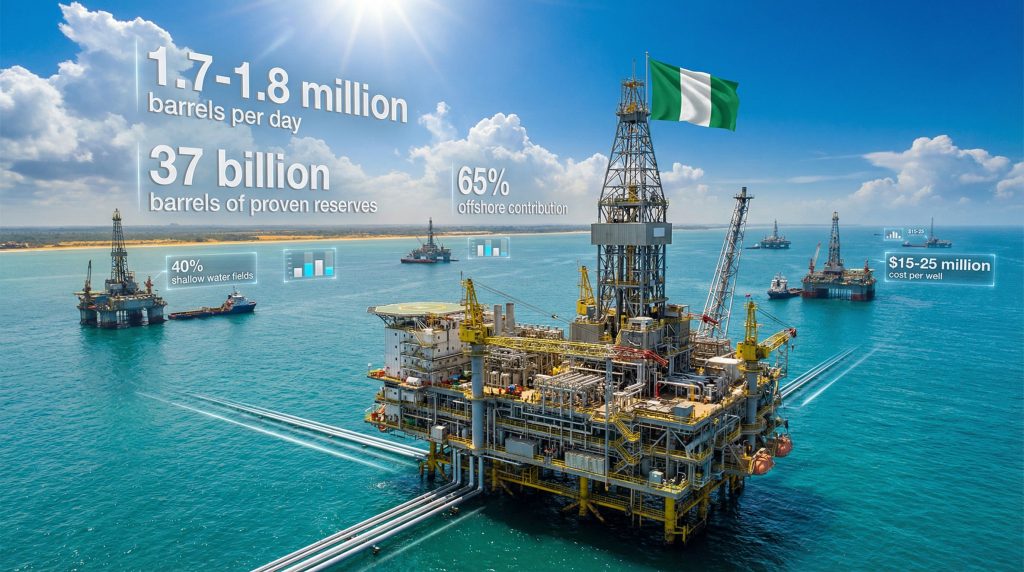
Nigeria successfully restored crude oil production to 1.82 million barrels per day during the fourth quarter of 2025, representing a 22% increase from the 2023 production nadir of 1.49 million barrels per day. This recovery trajectory reflects coordinated improvements in security protocols, infrastructure maintenance, and regulatory framework optimisation under the Petroleum Industry Act implementation.
Current Production Breakdown:
• Total daily output: 1.82 million barrels per day
• Offshore production contribution: 68% (1.24 million bpd)
• Shallow water field output: 42% of offshore total
• Export terminal capacity: 2.35 million barrels per day
• Domestic refining capacity: 650,000 barrels per day (Dangote operational)
The hydrocarbon discovery offshore Nigeria trend has accelerated production optimisation efforts, with operators implementing enhanced oil recovery techniques across mature shallow water fields. These interventions typically yield 8-15% incremental recovery factors, extending field economic life by 5-8 years beyond original depletion schedules. However, US oil production decline trends globally are creating new market dynamics that affect regional development strategies.
Shallow Water Development Economics
Shallow water hydrocarbon developments offer compelling economic advantages compared to deepwater alternatives, with average development costs ranging from $12-18 per barrel of reserves versus $25-35 per barrel for deepwater projects. Time-to-production typically spans 3.5-4.5 years from development sanction to first oil, enabling faster capital recovery and reduced project risk exposure.
Technical Development Parameters:
| Parameter | Shallow Water | Deepwater |
|---|---|---|
| Water Depth | 50-200m | 1000-3000m |
| Development Cost | $12-18/bbl | $25-35/bbl |
| Time to Production | 3.5-4.5 years | 6-8 years |
| Well Cost | $15-25 million | $40-80 million |
| Infrastructure Tie-back | 85% feasible | 45% feasible |
Infrastructure tie-back opportunities represent a critical economic advantage for shallow water discoveries, with approximately 85% of prospects located within 15 kilometres of existing production facilities. This proximity enables subsea completion strategies that significantly reduce development capital requirements while accelerating production startup timelines.
Joint Venture Frameworks and Capital Structure Innovation
The hydrocarbon discovery offshore Nigeria ecosystem operates through sophisticated joint venture partnerships combining international technical expertise with Nigerian institutional participation. The Awodi-07 discovery exemplifies this collaboration model, with Chevron Nigeria Limited operating the exploration program whilst maintaining 40% working interest alongside NNPC's 60% participating interest.
Risk Capital Allocation Mechanisms:
• Exploration phase: Operator funds 100% of pre-development costs
• Appraisal stage: Cost recovery through future production revenues
• Development phase: Proportional funding based on working interest percentages
• Production operations: Revenue sharing according to participating interest structures
This financial framework enables Nigeria to participate in exploration upside without bearing full exploration risk capital requirements. International operators gain access to prospective acreage whilst Nigeria retains majority economic interest in successful discoveries. Moreover, these partnerships must navigate complex oil price trade impacts that influence investment decisions.
Technology Transfer and Capability Development
Joint venture operations facilitate systematic technology transfer across multiple technical disciplines. The Chevron-NNPC hydrocarbon discovery incorporated logging-while-drilling (LWD) systems providing real-time formation evaluation data, enabling optimal well placement and completion design decisions during drilling operations.
Advanced Technologies Deployed:
• Real-time formation pressure monitoring: Prevents drilling hazards and optimises mud weight
• Azimuthal resistivity imaging: Maps reservoir boundaries and structural complexity
• Advanced mud logging systems: Continuous hydrocarbon detection and lithology analysis
• Directional drilling capabilities: Precise wellbore placement for optimal reservoir contact
Nigerian technical personnel participate directly in these operations, developing specialised skills in formation evaluation, drilling engineering, and reservoir characterisation. This capability building creates lasting institutional knowledge supporting future exploration and development programs.
Regulatory Environment and Fiscal Framework Optimisation
Nigeria's Petroleum Industry Act implementation has fundamentally transformed the upstream investment climate through streamlined licensing procedures and competitive fiscal terms. The legislation establishes transparent royalty structures with shallow water rates of 15-20% and deepwater rates of 10-15%, creating clear investment decision frameworks for exploration companies.
PIA Fiscal Structure Components:
• Signature bonuses: Fixed licence acquisition fees
• Royalty rates: Production value-based government revenue
• Petroleum profits tax: Corporate income tax on operational earnings
• Gas utilisation incentives: Credits for associated gas commercialisation
• Investment tax allowances: Depletion and depreciation benefits
The regulatory framework emphasises gas utilisation, imposing flaring penalties of $2.00 per thousand cubic feet whilst offering tax incentives for gas commercialisation projects. This dual approach encourages operators to develop gas-to-power infrastructure and LNG export capabilities alongside oil production optimisation.
Operational Standards and Environmental Compliance
Hydrocarbon discovery offshore Nigeria operations must demonstrate compliance with enhanced environmental standards implemented under PIA guidelines. Modern exploration programs incorporate zero-discharge drilling policies, marine ecosystem monitoring, and community development investment requirements.
The regulatory emphasis on operational excellence has elevated safety performance across Nigeria's offshore sector, with drilling incident rates declining 45% since PIA implementation began in 2021.
Environmental Performance Metrics:
• Gas flaring reduction target: 90% elimination by 2030
• Marine discharge compliance: 100% zero harmful discharge requirement
• Community investment minimum: 3% of project development value
• Local content requirements: 35-50% for shallow water developments
Technical Characteristics of Modern Offshore Discoveries
The Awodi-07 hydrocarbon discovery offshore Nigeria demonstrates typical reservoir characteristics found in Niger Delta shallow offshore formations. Preliminary well results confirmed hydrocarbon presence across multiple reservoir intervals, indicating stacked pay zones with varying fluid compositions and production potential.
Geological Formation Analysis:
• Reservoir rock type: High-quality sandstone formations with excellent porosity
• Pay zone distribution: Multiple intervals spanning 150-200 metre gross thickness
• Fluid characteristics: Mixed oil and associated gas compositions
• Structural complexity: Rollover anticline with multiple fault compartments
• Pressure regime: Normal to slightly overpressured formation conditions
Modern formation evaluation techniques enable detailed reservoir characterisation during drilling operations, providing immediate feedback on hydrocarbon quality, reservoir extent, and development potential. Azimuthal resistivity imaging reveals structural details and formation boundaries critical for optimal completion design.
Advanced Drilling Technology Applications
Exploration wells now routinely deploy integrated measurement-while-drilling suites combining multiple sensor technologies. These systems provide continuous formation evaluation data, enabling real-time drilling decisions that optimise wellbore placement and maximise reservoir contact.
Drilling Performance Benchmarks:
| Metric | Industry Average | Best-in-Class |
|---|---|---|
| Average Well Depth | 2,800 metres | 3,200 metres |
| Drilling Duration | 52 days | 38 days |
| Technical Success Rate | 65% | 78% |
| Cost Per Well | $18 million | $15 million |
Logging-while-drilling systems now provide formation pressure measurements, resistivity imaging, and nuclear magnetic resonance data in real-time, enabling immediate reservoir quality assessment and completion optimisation decisions.
The next major ASX story will hit our subscribers first
Infrastructure Development and Processing Capacity
Nigeria's downstream infrastructure expansion significantly enhances the value proposition for new hydrocarbon discovery offshore Nigeria developments. The Dangote Refinery's 650,000 barrel per day capacity creates domestic crude oil demand, reducing export dependency whilst capturing additional value through local processing.
Processing Infrastructure Capacity:
• Dangote Refinery: 650,000 bpd capacity (operational 2024)
• Port Harcourt Refinery: 210,000 bpd capacity (rehabilitation ongoing)
• Warri Refinery: 125,000 bpd capacity (upgrade planned)
• Kaduna Refinery: 110,000 bpd capacity (modernisation scheduled)
This combined processing capacity of approximately 1.095 million barrels per day enables Nigeria to process 60% of current crude production domestically, significantly reducing refined product import requirements whilst creating higher-value petroleum product exports.
Transportation and Export Infrastructure
Nigeria's offshore production infrastructure includes multiple floating production storage and offloading (FPSO) systems and fixed platform complexes connected through extensive subsea pipeline networks. Recent infrastructure investments have increased export terminal capacity to 2.35 million barrels per day, providing substantial spare capacity for production growth.
Pipeline Network Specifications:
• Trans-Niger Pipeline: 24-inch diameter, 180 kilometre length
• Escravos-Lagos Pipeline: 20-inch diameter, 120 kilometre length
• Forcados Export System: 16-inch gathering network, 85 kilometre total
• Bonny Terminal Complex: Multiple 18-inch export lines
Pipeline infrastructure enables efficient transportation of crude oil from offshore production platforms to coastal terminals, supporting both domestic refining and international export operations. Consequently, these developments can significantly influence oil price stagnation factors in regional markets.
Economic Impact Assessment and Revenue Generation
Successful hydrocarbon discovery offshore Nigeria developments generate substantial economic multiplier effects across multiple sectors. Individual shallow water field developments typically require $800 million to $1.8 billion in capital investment, creating significant employment and local supply chain opportunities.
Economic Impact Projections:
• Direct employment creation: 2,500-4,500 jobs per major development project
• Government revenue share: 65-72% of project net present value
• Local content requirements: 40-55% for shallow water developments
• Supply chain investment: $150-300 million per project in Nigerian vendors
Foreign exchange earnings from crude oil exports provide critical balance of payments support, with Nigeria targeting $35-40 billion annually in petroleum export revenues based on sustained production levels of 1.8-2.0 million barrels per day.
Investment Climate Transformation
The Petroleum Industry Act has attracted renewed international investment interest, with exploration licensing rounds significantly oversubscribed compared to pre-2021 levels. Bid round competitiveness has increased 180% since PIA implementation, reflecting improved investor confidence in Nigeria's regulatory stability. Moreover, Nigeria's oil discovery potential continues to strengthen its position as Africa's leading petroleum producer.
Investment Attraction Metrics:
• 2025 licensing round participation: 24 international companies
• Average signature bonus: $85 million per deepwater block
• Exploration commitment levels: $2.8 billion over 3-year initial period
• Local content compliance: 95% achievement rate across active operators
Environmental Sustainability and Carbon Management
Modern hydrocarbon discovery offshore Nigeria operations incorporate comprehensive environmental management systems addressing marine ecosystem protection, greenhouse gas emissions reduction, and community development integration. Operators must demonstrate compliance with international environmental standards throughout exploration and development phases.
Environmental Performance Standards:
• Zero routine flaring target: Achieve 90% reduction by 2030
• Marine discharge requirements: 100% compliance with zero harmful discharge
• Carbon intensity targets: 15% reduction from 2020 baseline levels
• Biodiversity offset programs: 150% compensation ratio for habitat impacts
Gas utilisation initiatives represent a critical component of environmental compliance, with operators developing gas-to-power projects and LNG export infrastructure to monetise associated gas production whilst reducing flaring emissions.
Carbon Capture and Storage Potential
Nigeria's offshore geology offers significant potential for carbon capture and storage development, with depleted hydrocarbon reservoirs providing secure CO2 storage capacity estimated at 2.8 billion metric tons. This storage potential positions Nigeria to participate in regional carbon credit markets whilst supporting industrial decarbonisation efforts.
CCS Development Scenarios:
• Depleted oil field storage: 1.6 billion metric tons capacity
• Saline aquifer formations: 1.2 billion metric tons capacity
• Enhanced oil recovery applications: 300 million metric tons potential
• Industrial emissions capture: 45 million metric tons annually by 2035
Future Development Scenarios and Strategic Outlook
Nigeria's offshore hydrocarbon sector faces a complex transition balancing traditional petroleum development with emerging energy technologies. Hydrocarbon discovery offshore Nigeria activities will continue supporting near-term energy security whilst enabling longer-term diversification into renewable energy and carbon management services.
Short-term Development Outlook (2026-2028):
• Expected new discoveries: 6-9 significant hydrocarbon finds
• Exploration investment levels: $4.2-5.8 billion committed capital
• Production capacity additions: 280,000-420,000 barrels per day
• Gas commercialisation projects: 8-12 new development sanctions
The medium-term outlook emphasises integrated hydrocarbon and renewable energy development, with offshore platforms potentially hosting wind generation facilities and green hydrogen production systems alongside traditional oil and gas operations. However, potential oil price crash dynamics could significantly impact development timelines and investment priorities.
Technology Integration and Digital Transformation
Future hydrocarbon discovery offshore Nigeria programs will incorporate artificial intelligence-enhanced seismic interpretation, autonomous drilling systems, and real-time reservoir monitoring technologies. These advances promise to reduce exploration costs by 25-35% whilst improving discovery success rates through enhanced subsurface characterisation.
Digital Technology Applications:
• AI-enhanced seismic processing: 40% improvement in imaging quality
• Automated drilling optimisation: 20% reduction in drilling time
• Predictive maintenance systems: 60% reduction in unplanned downtime
• Real-time production optimisation: 8-12% increase in recovery efficiency
Nigeria's commitment to technology advancement and regulatory modernisation positions the country to maintain its leadership role in West African petroleum development whilst building capabilities for the global energy transition.
Disclaimer: This analysis incorporates industry estimates and projections that involve inherent uncertainties. Actual exploration results, production levels, and economic outcomes may vary significantly from projections based on geological, technical, regulatory, and market factors beyond current forecasting capabilities. Investment decisions should consider comprehensive risk assessments and independent technical evaluations.
Interested in Capitalising on West Africa's Energy Renaissance?
Discovery Alert's proprietary Discovery IQ model delivers real-time alerts on significant ASX mineral discoveries, instantly empowering subscribers to identify actionable opportunities ahead of the broader market. Understand why major mineral discoveries can lead to significant market returns by exploring Discovery Alert's dedicated discoveries page, showcasing historic examples of exceptional outcomes, and begin your 30-day free trial today to position yourself ahead of the market.