June 4, 2026
Strategic Implications of Recent West African Energy Acquisitions
Energy markets across West Africa face unprecedented transformation as traditional exploration models yield to new partnership frameworks and geographic diversification strategies. The convergence of technical expertise, capital availability, and frontier basin exploration creates complex investment scenarios that reshape regional hydrocarbon development patterns. The Petrobras acquisition in São Tomé exemplifies how major international oil companies navigate regulatory environments, geological uncertainties, and strategic asset allocation in evolving African energy markets. Furthermore, these developments occur amid broader energy transition trends that influence investment priorities across the continent.
When big ASX news breaks, our subscribers know first
What Strategic Value Does São Tomé Block 3 Offer International Oil Companies?
Geological Advantages in Gulf of Guinea Exploration
The offshore basins surrounding São Tomé and Príncipe present compelling geological characteristics that mirror some of the most productive hydrocarbon systems globally. These deepwater formations share structural similarities with Brazil's pre-salt environment, where cumulative production exceeds 3.8 million barrels per day and represents over 40% of Brazilian oil output.
The Lula Field alone contains estimated reserves between 5 and 8 billion barrels of oil equivalent, demonstrating the productive potential of pre-salt geological systems. However, these developments must be considered alongside broader mining industry innovation trends affecting resource extraction methodologies.
Key geological factors include:
• Cretaceous rifting patterns creating comparable structural geometries
• Thick salt sequences overlying subsalt petroleum systems
• Proven source rock maturity and viable migration pathways
• Deepwater environments requiring specialised drilling techniques
• Extended reach drilling capabilities for complex formations
The Gulf of Guinea region benefits from established petroleum systems with demonstrated commercial viability in adjacent blocks. For instance, the Sunbird Field in Block 14, discovered in 2012, validated offshore exploration potential in São Tomé waters with commercially significant accumulations according to upstream industry reports.
Strategic Location Advantages for Global Markets
São Tomé and Príncipe's maritime position offers logistical benefits for international oil operations through proximity to established Atlantic shipping corridors. Approximately 30% of African oil exports transit through the Gulf of Guinea region, providing access to both regional markets and international trading hubs.
The geographic positioning enables:
• Direct access to Atlantic shipping routes connecting Africa, Europe, and the Americas
• Proximity to existing Gulf of Guinea supply chain infrastructure
• Reduced transportation costs compared to landlocked exploration areas
• Established maritime emergency response capabilities in the region
Political stability assessments indicate São Tomé and Príncipe maintains moderate governance scores compared to regional alternatives, with stable multi-party democratic institutions and peaceful power transitions.
Why Are Brazilian State Companies Expanding Into African Energy Markets?
Petrobras's Strategic Portfolio Diversification
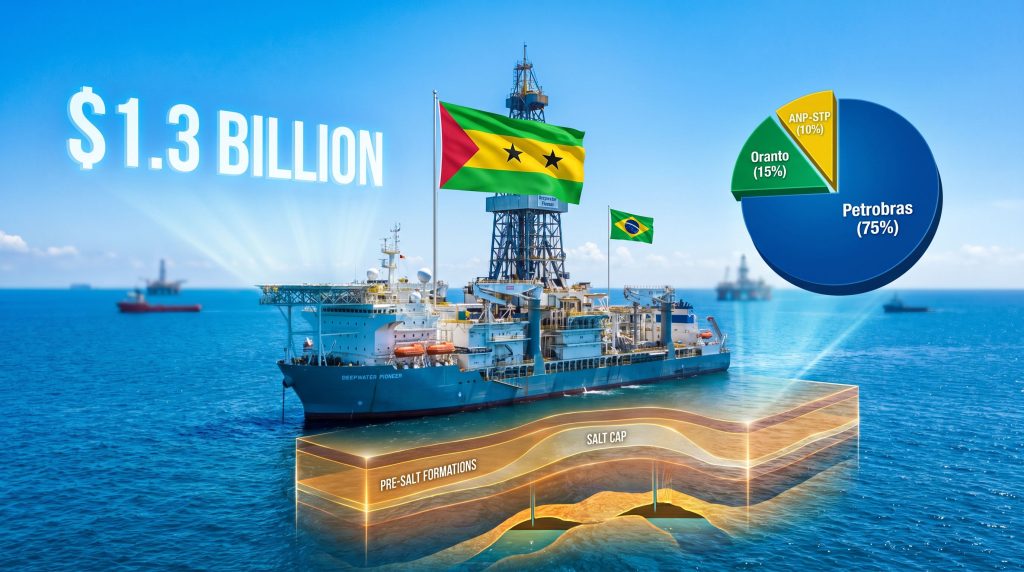
The Petrobras acquisition in São Tomé represents a calculated component of the company's international expansion strategy, allocating $1.3 billion for global exploration across 2026-2030. This investment framework addresses reserve replenishment requirements as domestic field production faces expected decline after 2030.
Current operational metrics demonstrate the strategic imperative:
• 11.4 billion barrels of proven reserves in oil equivalent
• Approximately 3 million barrels per day current production capacity
• Reserve replacement ratio requiring continuous new discoveries for sustained output
• 80% of production derived from deepwater operations
Petrobras returned to African operations in 2024 following reduced international activities during the early 2010s Car Wash investigation period. Consequently, the company has developed positions across the Gulf of Guinea, Namibia, and South Africa, leveraging geological similarities with Brazil's pre-salt basins.
Technical Expertise Transfer Advantages
Brazil's pre-salt development experience provides Petrobras with specialised capabilities applicable to similar geological environments in West Africa. The company operates as a global leader in subsalt exploration, having developed technical competencies in:
• Advanced seismic imaging for thick salt sequences
• Extended reach drilling in high-pressure subsurface conditions
• FPSO deployment and management in deepwater environments
• Complex structural interpretation for pre-salt formations
These technical capabilities reduce exploration risk in frontier basins by applying proven methodologies developed through decades of Brazilian offshore operations.
What Does This Transaction Reveal About African Oil Asset Valuations?
Ownership Structure Transformation Analysis
The São Tomé Block 3 transaction demonstrates strategic repositioning characteristic of frontier exploration assets transitioning between development phases. The ownership evolution reflects capital allocation priorities and risk distribution strategies common in deepwater development projects.
| Ownership Phase | Oranto Petroleum | ANP-STP | Petrobras |
|---|---|---|---|
| Pre-Transaction | 90% | 10% | 0% |
| Post-Transaction | 15% | 10% | 75% |
| Change | -75 percentage points | No change | +75 percentage points |
Oranto's stake reduction from 90% to 15% enables capital realisation while maintaining discovery upside participation. This structure protects minority stakeholders from funding shortfalls during capital-intensive development phases, while ANP-STP's maintained 10% ensures national participation requirements.
Risk Distribution in Deepwater Development
Deepwater field development typically requires $5-15 billion in capital expenditure over 5-10 years for first production. Frontier exploration projects often demand $500 million to $2 billion in cumulative exploration spending before development decisions materialise.
Partnership benefits include:
• Proportional risk exposure reduction for early-stage participants
• Technical operator expertise for complex drilling operations
• Financial capacity for sustained exploration programmes
• Operational experience in comparable geological environments
How Do Partnership Models Affect African Energy Development?
Technical Operator Selection Criteria
The transition from Oranto's majority control to Petrobras operatorship reflects evaluation criteria prioritising technical capability and financial capacity. Operatorship conveys decision-making authority for Authorisation for Expenditure approval, operational management responsibilities, and primary liability for cost overruns and schedule performance.
Operator selection factors:
• Deepwater drilling experience in comparable geological settings
• Financial capacity for sustained exploration funding
• Regulatory compliance track record in African jurisdictions
• Technical infrastructure for complex subsalt operations
Oranto's Pan-African Strategy Challenges
Arthur Eze's Oranto Petroleum has encountered regulatory complications across multiple West African jurisdictions, highlighting partnership risks in frontier exploration markets. Recent challenges include licence management issues that demonstrate the complexity of maintaining compliance across diverse regulatory frameworks.
In Senegal, regulatory authorities revoked an offshore exploration licence citing failure to meet financial guarantees and limited exploration activity over several years. This reflects increasingly stringent enforcement of licence compliance requirements across the region.
In addition, in Equatorial Guinea, an Oranto affiliate lost its stake in an offshore block following funding obligation disputes with operator Chevron. These incidents underscore the financial challenges minority partners face in capital-intensive deepwater projects.
What Regulatory Challenges Face International Oil Companies in West Africa?
Licence Compliance Intensification
Governments across the Gulf of Guinea region have implemented stricter oversight mechanisms for exploration licence holders, emphasising financial guarantee requirements and exploration commitment fulfilment. This regulatory evolution affects international companies' operational planning and capital allocation strategies.
Regulatory risk assessment factors:
• Financial guarantee enforcement for exploration programmes
• Local content participation requirements varying by jurisdiction
• Government oversight intensification for strategic projects
• Licence renewal criteria incorporating performance metrics
Jurisdictional Risk Evaluation Framework
| Country | Political Stability | Licence Security | Local Content Requirements |
|---|---|---|---|
| São Tomé & Príncipe | Moderate stability | Stable framework | 10% state participation |
| Senegal | High governance scores | Variable enforcement | Strict compliance monitoring |
| Equatorial Guinea | Moderate oversight | Operator-dependent | Partnership obligations |
The regulatory approval process for the Petrobras acquisition in São Tomé requires governmental authorisation from São Tomé and Príncipe authorities, representing standard procedures for foreign investment in strategic sectors.
The next major ASX story will hit our subscribers first
How Will This Acquisition Impact Regional Competition?
International Operator Positioning
Major international oil companies face intensifying competition for remaining frontier blocks in the Gulf of Guinea as geological understanding improves and infrastructure develops. The Petrobras entry adds technical expertise to the regional competitive landscape while potentially influencing asset valuations for comparable exploration opportunities.
Competitive dynamics include:
• Increased competition for proven geological areas
• Rising asset valuations in successful exploration regions
• Pressure for accelerated exploration timelines
• Technical expertise differentiation among operators
Moreover, these developments occur amid broader market volatility, including the recent oil price rally affecting investment decisions across the sector.
Chinese State Enterprise Activity
Chinese national oil companies maintain active exploration programmes across West Africa, creating additional competitive pressure for block acquisitions and partnership opportunities. This international competition influences partnership structures and technical collaboration frameworks, particularly as trade war impacts reshape global investment flows.
What Investment Risks Should Stakeholders Consider?
Technical and Operational Challenges
Deepwater exploration in frontier basins presents multiple technical risks that affect project economics and development timelines. These challenges require specialised expertise and substantial financial resources for successful navigation.
Primary risk factors:
• Deepwater drilling complexity in unexplored formations
• Infrastructure development requirements for remote locations
• Environmental compliance standards for offshore operations
• Weather and operational window constraints
• Supply chain logistics for specialised equipment
Financial and Political Considerations
Currency fluctuation impacts on project economics represent significant variables for international investments in African exploration projects. São Tomé and Príncipe's economic stability and foreign exchange management affect long-term project viability.
Investment risk assessment:
• Currency volatility affecting capital expenditure calculations
• Changing government policies on foreign investment participation
• Regional security considerations for offshore operations
• Commodity price volatility impacts on project economics
How Does This Transaction Fit Broader Energy Transition Trends?
Portfolio Optimisation During Market Transition
International oil companies adapt investment strategies to balance traditional hydrocarbon development with energy transition requirements. Geographic diversification provides risk management benefits while maintaining reserve replacement capabilities during declining global oil demand scenarios.
Strategic adaptation elements:
• Lower-cost exploration opportunities in frontier regions
• Technical expertise leverage across similar geological environments
• Portfolio geographic distribution for risk management
• Reserve base sustainability during energy transition
Furthermore, these investments must be evaluated against OPEC production impact decisions that influence global supply dynamics.
Long-term Market Positioning
The São Tomé acquisition demonstrates strategic asset accumulation during market transition periods when valuations may offer attractive entry opportunities. Companies position for sustained competitiveness in evolving energy markets through calculated frontier exploration investments.
What Are the Financial Implications for All Parties?
Petrobras Investment Rationale
The acquisition supports reserve replacement at potentially competitive costs compared to alternative exploration opportunities. Petrobras leverages proven deepwater expertise in geological environments similar to successful Brazilian operations, reducing technical risk relative to unfamiliar formations.
Strategic financial benefits:
• Reserve addition potential at frontier exploration costs
• Geographic diversification reducing domestic market dependence
• Technical competency application in proven geological analogues
• Portfolio risk distribution across multiple basins
Oranto Strategic Repositioning
The transaction enables Oranto to monetise early-stage exploration investment while maintaining minority participation in potential discoveries. This capital realisation supports continued exploration activities across the company's pan-African portfolio.
Transaction benefits for Oranto:
• Capital recovery from initial exploration investment
• Retained 15% upside exposure to potential discoveries
• Risk reduction through partnership with established operator
• Continued African portfolio development capabilities
Understanding São Tomé Oil Block Development
What geological factors make São Tomé attractive for oil exploration?
The offshore blocks contain pre-salt geological formations similar to Brazil's highly productive basins, offering significant hydrocarbon potential through proven structural analogues. These deepwater environments benefit from established petroleum systems with demonstrated commercial viability in regional operations.
Why did Oranto reduce its controlling stake in the block?
The transaction allows Oranto to realise capital from early-stage exploration investment while partnering with a technically capable operator for complex deepwater development. This strategy reduces financial exposure during capital-intensive phases while preserving discovery participation rights.
How does this acquisition support Petrobras's global strategy?
The São Tomé investment aligns with Petrobras's 2026-2030 international diversification plan, utilising $1.3 billion allocated for global exploration to replenish reserves as domestic fields mature. Geographic expansion leverages proven technical capabilities in comparable geological environments according to recent industry analysis.
What regulatory requirements affect transaction completion?
The ownership transfer requires governmental approval from São Tomé and Príncipe authorities before finalisation. Standard regulatory oversight ensures compliance with foreign investment frameworks and national participation requirements.
What primary risks affect deepwater exploration investments?
Key risks include technical challenges in frontier basin exploration, regulatory changes affecting foreign participation, currency fluctuation impacts on project economics, and inherent geological uncertainty in deepwater drilling operations.
Disclaimer: This analysis contains forward-looking statements and market projections that involve inherent uncertainty. Oil and gas exploration investments carry substantial risk, including total loss of investment. Readers should conduct independent research and consult qualified advisors before making investment decisions.
Ready to Capitalise on the Next Major Discovery?
Discovery Alert's proprietary Discovery IQ model delivers real-time alerts on significant ASX mineral discoveries, instantly empowering subscribers to identify actionable opportunities ahead of the broader market. Understand why major mineral discoveries can lead to significant market returns by exploring Discovery Alert's dedicated discoveries page, showcasing historic examples of exceptional outcomes, and begin your 14-day free trial today to position yourself ahead of the market.