July 30, 2026
West African mining sectors face unprecedented supply chain vulnerabilities as global commodity markets experience heightened volatility. Traditional import-dependent models for critical mining inputs create operational risks that extend beyond simple cost considerations, affecting production schedules, project timelines, and strategic planning capabilities. The establishment of domestic manufacturing capacity for essential mining materials represents a fundamental shift in how resource-rich nations approach industrial sovereignty, particularly as mining industry evolution continues to reshape operational frameworks.
Mali takes stake in China-backed explosives venture represents a paradigmatic example of this strategic transformation. This development occurs within broader regional realignment as Sahel nations seek greater control over mining value chains while reducing dependence on traditional Western supply networks.
How State-Controlled Manufacturing Transforms Mining Input Markets
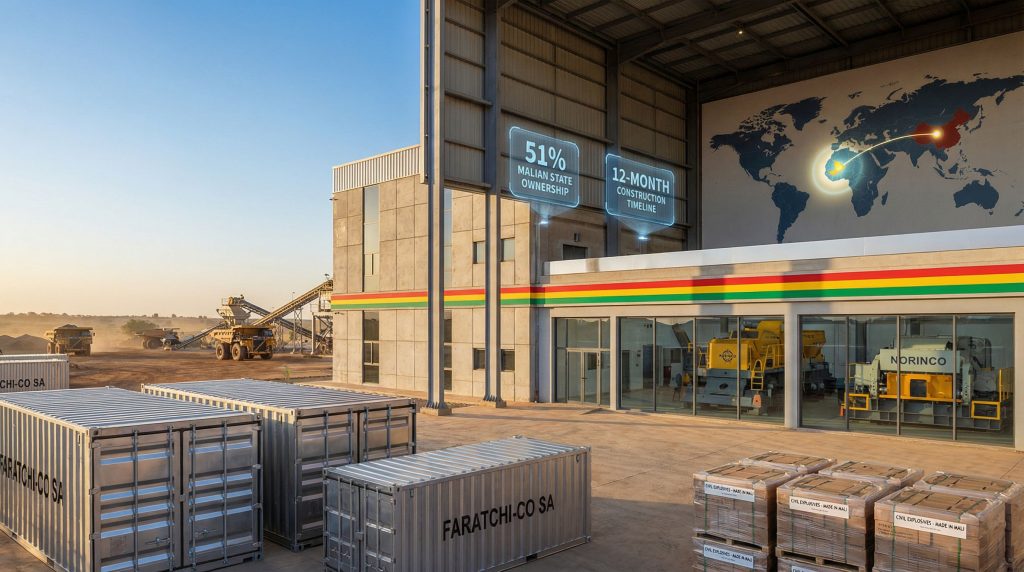
The FARATCHI-CO SA venture represents a paradigmatic shift in mining input supply strategies across the Sahel region. Mali's 51% ownership stake ensures alignment with national industrial policy while leveraging foreign technical capabilities through Chinese partner Auxin Chemical Technology. This ownership structure addresses critical supply chain vulnerabilities affecting the country's approximately 30 industrial gold operations, including 15 large-scale mining facilities, alongside two major lithium extraction projects and numerous quarrying operations.
The 12-month construction timeline indicates urgent strategic priority placement on domestic explosives production capacity. Current market conditions require Mali's mining sector to import 100% of explosive materials needed for ore extraction, creating cost pressures and supply security risks that affect operational efficiency across the sector.
Key Strategic Components:
• Domestic ownership majority ensuring policy control alignment
• Foreign technical partnership providing manufacturing expertise
• Full project financing eliminating capital barriers
• Integration with existing mining operations infrastructure
• Reduced transportation costs for hazardous materials
The partnership structure enables technology transfer while maintaining sovereign control over strategic industrial assets. Furthermore, this model differs significantly from traditional mining services agreements where international firms typically retain controlling interests and operational management authority.
When big ASX news breaks, our subscribers know first
China's Industrial Expansion Strategy Through African Partnerships
Auxin Chemical Technology's engagement in Mali extends China's industrial footprint across African mining sectors through a strategic subsidiary network. As part of China's NORINCO Group, Auxin currently supplies industrial explosives to six countries across Africa's rapidly expanding mining sector, though specific nations and supply volumes remain undisclosed in available documentation.
This expansion strategy reflects Zijin's global strategy and other Chinese state-directed investment priorities that combine technical expertise provision with infrastructure development objectives. The financing model eliminates host country capital requirements while creating revenue-sharing structures that align Chinese commercial interests with African development goals.
NORINCO's African Engagement Model:
| Component | Implementation Approach | Strategic Advantage |
|---|---|---|
| Ownership Structure | Minority equity with management participation | Political alignment with host governments |
| Financing Provision | Full project capital coverage | Eliminates host country funding barriers |
| Technical Transfer | Manufacturing expertise and quality systems | Builds local industrial capacity |
| Market Integration | Connection to broader Chinese supply networks | Leverages existing commercial relationships |
The partnership approach demonstrates Chinese willingness to engage with transitional governments in the Sahel region, where Western firms often face capital restrictions or policy uncertainty following recent political changes. In addition, this positioning creates competitive advantages in securing industrial cooperation agreements across strategic mineral-producing regions.
Regulatory Framework Evolution in Resource-Rich Nations
Mali's 2023 mining code reforms established the legal foundation for increased state participation in mining value chains, moving beyond traditional royalty collection models toward direct industrial involvement. These reforms raised state equity requirements in mining projects and strengthened local content mandates as part of comprehensive sectoral restructuring.
The regulatory transformation reflects broader Sahel trends toward enhanced government control over strategic resource extraction and processing activities. Moreover, military-led transitional governments in Mali, Burkina Faso, and Niger have implemented similar policy frameworks emphasizing national sovereignty over natural resource development.
Regulatory Evolution Elements:
• Enhanced state equity participation in new mining ventures
• Strengthened local content requirements for workforce and procurement
• Improved oversight mechanisms for strategic materials handling
• Integration of security considerations into industrial planning frameworks
• Technology transfer expectations in foreign partnership agreements
These policy changes create enabling environments for domestic industrial development while maintaining openness to foreign technical expertise and capital investment. Consequently, the explosives venture demonstrates practical implementation of these regulatory principles approximately two years after code promulgation.
Geopolitical Realignment and Mining Sector Partnerships
Mali takes stake in China-backed explosives venture occurs within broader geopolitical shifts affecting West African mining investment patterns. Mali, Burkina Faso, and Niger have all experienced recent military coups, leading to strategic pivots toward China and Russia for industrial and security cooperation. These changes have unsettled Western investors as new governments pursue alternative partnership models, reflecting broader US–China trade impacts across global markets.
Regional governments are advancing new gold-refining, security, and uranium deals with non-Western partners, reflecting post-colonial sovereignty concerns and strategic autonomy objectives. This realignment creates opportunities for Chinese industrial engagement while challenging traditional Western mining sector relationships.
Geopolitical Factors Influencing Partnership Selection:
| Factor | Western Approach | Chinese Approach | Impact on Mali's Decision |
|---|---|---|---|
| Political Conditions | Democracy requirements | Pragmatic engagement | Favors Chinese partnership |
| Ownership Models | International firm control | Host country majority | Aligns with sovereignty goals |
| Financing Structure | Commercial lending terms | State-directed investment | Reduces capital barriers |
| Technology Transfer | Limited capability sharing | Comprehensive technical cooperation | Builds local capacity |
The strategic pivot toward China reflects calculated decisions based on partnership terms rather than ideological alignment. However, Chinese willingness to engage with transitional governments creates competitive advantages in securing industrial cooperation agreements across the Sahel region.
Economic Impact Analysis of Domestic Explosives Production
Local explosives manufacturing addresses critical supply chain vulnerabilities while creating potential cost reduction opportunities across Mali's mining sector. Current import dependency exposes operations to transportation delays, regulatory compliance complexities, and currency fluctuation risks that affect project economics.
Mali's gold sector experienced a 23% production decline in 2025, reflecting various operational challenges including supply chain disruptions, security concerns, and regulatory transitions. For instance, domestic explosives production could enhance operational reliability by reducing external dependency for essential mining inputs, particularly as companies consider the pivot to critical minerals in their strategic planning.
Sector-Specific Economic Benefits:
| Mining Sector | Current Challenges | Local Production Advantages |
|---|---|---|
| Gold Operations | Import dependency, supply delays | Enhanced reliability, cost control |
| Lithium Extraction | Limited supply chain options | Dedicated service provision |
| Quarrying Activities | Regional supply constraints | Reduced transportation costs |
| Infrastructure Projects | Import licensing complexities | Streamlined procurement processes |
The economic impact extends beyond direct cost savings to include enhanced operational flexibility, improved project scheduling reliability, and reduced working capital requirements for inventory management. Furthermore, these advantages could prove particularly significant for smaller mining operations lacking sophisticated supply chain management capabilities.
Security Considerations in Strategic Materials Management
Mali's emphasis on strengthening management of civil-use explosives and enhancing oversight reflects security challenges facing Sahel mining operations. Domestic production enables improved control over explosive materials distribution while supporting legitimate mining activities amid regional instability.
The venture specifically targets civil-use explosives rather than military applications, maintaining compliance with international regulations governing hazardous materials production and trade. This distinction proves critical for regulatory approval and international partnership acceptance.
Security Framework Components:
• Enhanced tracking systems for explosive materials distribution
• Reduced cross-border transportation of dangerous goods
• Improved supply chain security for mining operations
• Integration with national security planning frameworks
• Compliance with international explosive materials protocols
Local production reduces security risks associated with long-distance transportation of hazardous materials while enabling more responsive supply adjustments based on operational requirements. Consequently, this approach aligns with international best practices for explosive materials management in conflict-affected regions.
The next major ASX story will hit our subscribers first
Chinese Financing Models and Technology Transfer Mechanisms
Auxin Chemical Technology's commitment to provide full project financing demonstrates Chinese state-directed investment approaches that prioritise long-term strategic relationships over immediate financial returns. This financing model reduces host country capital requirements while creating partnership structures extending beyond single-project cooperation.
The technology transfer component includes manufacturing expertise, quality control systems, and regulatory compliance protocols necessary for international-standard explosive materials production. In addition, this capability building creates foundation for potential expansion into related chemical manufacturing sectors.
Financing Structure Benefits:
| Component | Traditional Western Model | Chinese Partnership Model | Advantage for Mali |
|---|---|---|---|
| Capital Requirements | Host country co-financing | Full external financing | Eliminates funding barriers |
| Technology Access | Limited transfer | Comprehensive capability sharing | Builds industrial capacity |
| Ownership Control | Foreign majority | Host country majority | Maintains sovereignty |
| Revenue Distribution | Profit repatriation | Shared domestic benefits | Supports development goals |
The financing approach creates templates for future industrial cooperation across various mining-related sectors, from processing equipment manufacturing to mineral refining facilities. Moreover, this model may influence partnership structures throughout Africa's extractive industries as part of broader industry consolidation strategies.
Regional Supply Chain Development Potential
Mali takes stake in China-backed explosives venture could catalyse similar initiatives across the Sahel, potentially creating regional supply networks for mining inputs. Burkina Faso and Niger maintain expanding mining sectors that could benefit from proximate explosives supply sources, reducing dependency on distant international suppliers.
Regional Market Potential:
| Country | Mining Sector Scale | Partnership Alignment | Market Opportunity |
|---|---|---|---|
| Burkina Faso | 15+ gold operations | Strong geopolitical alignment | High demand potential |
| Niger | Uranium and gold production | Similar governance transitions | Strategic materials focus |
| Côte d'Ivoire | Expanding gold sector | Economic integration priorities | Growth market opportunity |
| Ghana | Established mining hub | Competitive market dynamics | Limited penetration potential |
Regional supply chain development could create economies of scale enabling competitive pricing while reducing transportation costs across multiple markets. Furthermore, this approach aligns with African Continental Free Trade Area objectives for enhanced intra-African industrial cooperation.
Partnership Model Implications for Future Resource Sector Agreements
The Mali-China explosives venture establishes partnership templates balancing foreign expertise with domestic control that may influence future agreements across mining-related industries. The 51% state ownership threshold creates precedent for other strategic industrial partnerships throughout the region.
Replicable Template Elements:
• Majority host country ownership ensuring policy alignment
• Foreign technical partnership providing specialised capabilities
• Rapid implementation timelines addressing urgent infrastructure needs
• Full external financing reducing capital barriers
• Integration with broader industrial development strategies
This partnership model could extend to mineral processing facilities, equipment manufacturing operations, and specialised services provision across Africa's extractive industries. However, the structure addresses both sovereignty concerns and technical capability requirements that affect resource sector development.
What Implementation Challenges Could Affect Success?
Despite strategic advantages, the explosives venture faces implementation risks including technical complexity, regulatory coordination requirements, and regional security challenges. Success depends on effective project management, continued political stability, and market demand sustainability.
Critical Risk Factors:
| Risk Category | Specific Challenges | Mitigation Approaches |
|---|---|---|
| Technical Implementation | Manufacturing complexity, quality control | Comprehensive training, technical support |
| Regulatory Compliance | Multi-jurisdictional requirements | Legal framework coordination |
| Security Environment | Regional instability | Enhanced facility protection |
| Market Demand | Mining sector fluctuations | Diversified end-user base |
The 12-month construction timeline requires careful project coordination to address technical complexity while maintaining safety standards appropriate for explosive materials manufacturing. Environmental compliance and worker safety protocols must align with international standards despite challenging regional conditions.
Technical complexity in explosive materials manufacturing requires specialised knowledge in chemical formulation, stability testing, and quality assurance procedures. In addition, the partnership must successfully transfer these capabilities to local technical personnel while maintaining production standards acceptable to mining sector clients.
Strategic Implications for African Industrial Development
Mali's explosives manufacturing initiative demonstrates how African nations are reshaping mining sector relationships through strategic partnerships that maintain sovereignty while accessing essential technical expertise. This approach may influence similar cooperation models across the continent as governments seek enhanced control over critical supply chains.
According to Mining Technology, Mali's strategic mineral sector continues attracting significant foreign investment, indicating sustained confidence in the country's resource development potential despite political transitions.
The venture's success could encourage comparable initiatives throughout the Sahel region, potentially creating industrial networks that reduce dependency on distant suppliers while building local manufacturing capacity. However, implementation success will determine whether this partnership model proves sustainable and broadly replicable.
Recent analysis by CNBC Africa suggests Mali takes stake in China-backed explosives venture represents a broader trend toward enhanced African control over strategic industrial assets, reflecting post-colonial sovereignty priorities across the continent.
This analysis is based on publicly available information and should not be considered investment advice. Readers interested in African mining sector developments and China-Africa industrial partnerships should consult multiple sources and professional advisors when making investment or policy decisions. The complex geopolitical environment in the Sahel region involves ongoing uncertainties that may affect project outcomes and regional stability.
Considering investments in West African mining operations?
Discovery Alert's proprietary Discovery IQ model delivers real-time alerts on significant ASX mineral discoveries across critical sectors including lithium and gold, instantly empowering subscribers to identify actionable opportunities ahead of the broader market. Begin your 30-day free trial today and secure your market-leading advantage in the evolving global mining landscape.