
June 4, 2026
Understanding Western Australia's Evolving Gas Market Dynamics
Western Australia operates within a unique isolated gas grid system that fundamentally shapes its energy market characteristics. This separation from the eastern Australian gas network creates distinct supply-demand dynamics and pricing mechanisms that differ markedly from interconnected markets elsewhere in the country. The western australia gas surplus represents a complex interplay of industrial transformation and project development timing that requires careful analysis.
Regional Energy Infrastructure Fundamentals
The state's gas infrastructure centers around major processing facilities connected through dedicated pipeline networks serving both domestic consumption and export terminals. Current domestic consumption patterns show baseline demand of approximately 1,085 TJ/d in 2026, with projections indicating growth to 1,295 TJ/d by 2030 according to the Australian Energy Market Operator's latest assessment.
This 19.3% increase over the five-year period reflects anticipated industrial expansion despite significant facility closures affecting traditional commodity sectors. The isolated grid configuration means that supply disruptions or demand fluctuations cannot be easily balanced through interstate gas flows, making local production planning critical for market stability.
Current Supply-Demand Balance Assessment
AEMO's 2025 Gas Statement of Opportunities reveals that both supply and demand projections have been revised downward compared to previous forecasts. However, demand revisions exceeded supply reductions, creating a net improvement in surplus projections for most years through 2030.
The market operator's analysis demonstrates temporal variations in balance, with significant surpluses projected for 2026 and 2029 at 54 TJ/d and 132 TJ/d respectively, while deficit conditions are expected in 2028 and 2030 with shortfalls of 89 TJ/d and 11 TJ/d.
When big ASX news breaks, our subscribers know first
What Factors Drive Western Australia's Projected Gas Surplus?
Supply-Side Transformation Drivers
Production capacity revisions reflect a complex interplay of project delays, technical challenges, and reserve reassessments across Western Australia's gas fields. Strike Energy's West Erregulla project exemplifies these dynamics, with the 87 TJ/d development delayed from 2026 to 2027-2028 following a rescheduled Final Investment Decision to July-December 2026.
Major field developments face interconnected challenges affecting output timing and volumes. The Scarborough and Pluto projects combined experienced production reductions of up to 24 TJ/d by 2030, while maintenance requirements and lower utilization at Gorgon contributed an additional 16 TJ/d reduction to forecasts.
Reserve downgrades at established fields compound these challenges. Walyering and Beharra Springs fields experienced reserve revisions that reduced supply forecasts by 5 TJ/d in 2026 and 23 TJ/d in 2029, demonstrating how geological reassessment impacts long-term production planning.
Demand-Side Market Shifts
Industrial restructuring represents the most significant factor reshaping demand patterns. Alcoa's permanent closure of its 2.2 million tonnes per annum Kwinana alumina refinery on September 30, 2025, removed substantial industrial gas consumption from the market. The facility had been paused in July 2024 before the permanent shutdown decision.
Key Insight: Industrial restructuring has created unexpected demand reductions, with nickel mining curtailments and alumina refinery closures removing significant gas consumption from the market.
Mining sector transitions further impact consumption patterns. IGO has paused its Forrestania and Cosmos nickel projects, reflecting broader challenges in traditional commodity sectors. However, critical minerals processing expansion from developers including Iluka Resources, Cobalt Blue, and RZ Resources is expected to offset some of these reductions through the forecast period.
The transition from energy-intensive alumina refining and nickel mining toward critical minerals processing represents a fundamental shift in the state's industrial energy profile, with implications for gas consumption intensity and demand patterns.
Which Projects Will Shape WA's Gas Supply Landscape?
Near-Term Production Additions (2025-2027)
Scarborough field development stands as the most significant near-term supply addition. Woodside Energy announced in November 2025 that the project targets early 2027 production, processing 7 million tonnes per year of LNG. However, AEMO's forecasts incorporate production revisions reflecting execution risks and technical performance variations.
West Erregulla development by Strike Energy represents a key domestic supply project with 87 TJ/d capacity equivalent to 2.3 million cubic meters per day. The delayed timeline from 2026 to 2027-2028 creates a 52 TJ/d reduction in 2027 forecasts and 63 TJ/d in 2028, demonstrating single project impacts on market balance.
Pluto expansion construction by Bechtel involves adding a 5 million tonnes per year LNG train processing 3 million tonnes annually from Pluto gas. Planned workforce strikes beginning January 6, 2026, following contract expiration highlight labor relations risks affecting project delivery schedules.
Mid-Term Supply Catalysts (2028-2030)
Table: Major WA Gas Projects Impact Analysis
| Project | Expected Start | Peak Production (TJ/d) | Market Impact |
|---|---|---|---|
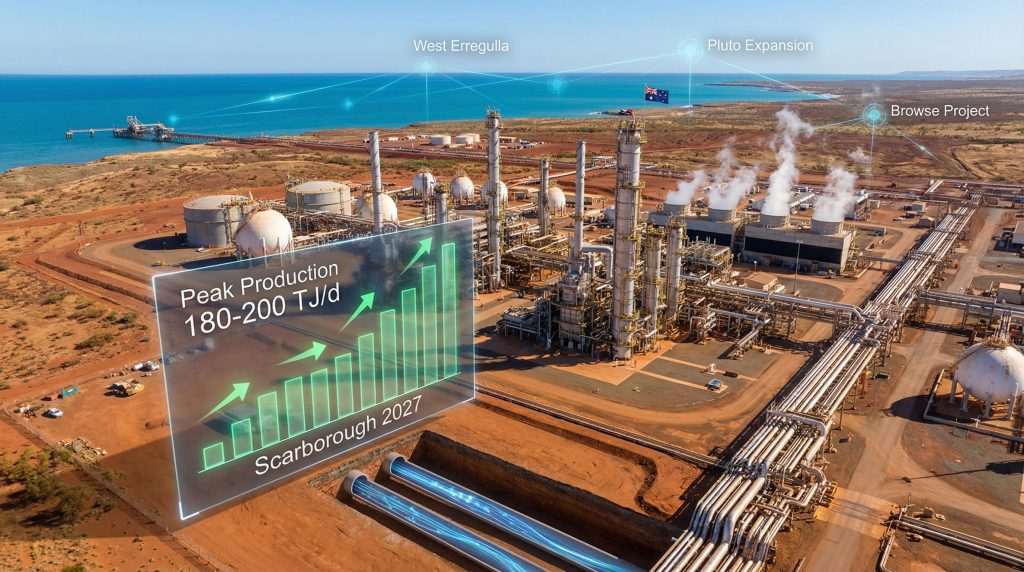
| Scarborough | 2027 | 180-200 | Export-focused |
| West Erregulla | 2027-2028 | 87 | Domestic supply |
| Pluto Expansion | 2027 | 150+ | Mixed allocation |
| Gorgon Modification | Ongoing | Maintenance optimization | Efficiency improvement |
Gorgon project modifications involve a $3 billion investment by owners including Chevron, ExxonMobil, Shell, Osaka Gas, Tokyo Gas, and Jera. The three-train terminal modification project announced in December 2025 indicates operator confidence in long-term field economics despite current utilization challenges.
Future developments including Browse project potential and Dorado field commercial assessments remain subject to investment decisions and regulatory approvals. Furthermore, Perth Basin exploration success factors continue influencing long-term supply outlook beyond the current forecast horizon.
How Do Market Fundamentals Compare Across Different Scenarios?
Surplus Magnitude Projections
AEMO's revised methodology demonstrates significant changes in market balance projections compared to previous assessments. The 2025 forecast shows dramatically different surplus patterns, with 2026 surplus increasing from 4 TJ/d to 54 TJ/d and 2029 surplus expanding from 5 TJ/d to 132 TJ/d compared to 2024 projections.
Conversely, constraint years show deteriorating conditions. The 2028 position worsened by 77 TJ/d, moving from a deficit of 12 TJ/d to 89 TJ/d, indicating specific bottleneck periods where supply additions lag demand growth.
Temporal Variations in Market Balance
Market dynamics reveal cyclical patterns rather than consistent surplus conditions. The 2028 deficit of 89 TJ/d represents approximately 7% of projected total demand, requiring significant storage utilisation, contract demand flexibility, or project acceleration to avoid supply disruption.
These temporal variations reflect the challenge of aligning project delivery schedules with demand growth. In addition, Scarborough's early 2027 expected start provides relief for that year, but production ramp-up timing relative to ongoing demand increases creates vulnerability in subsequent periods.
Price Implications and Market Signals
The isolated grid system means price formation mechanisms differ from interconnected markets. Years of significant surplus (2026, 2029) may create downward pressure on domestic gas pricing, while constraint periods (2028, 2030) could drive price volatility and contract renegotiation pressures. Understanding these natural gas price trends becomes essential for market participants navigating the western australia gas surplus cycles.
Industrial competitiveness factors become critical during deficit years, as gas-intensive manufacturing operations may face supply allocation decisions or elevated pricing affecting operational viability.
What Industrial Demand Changes Are Reshaping the Market?
Mining Sector Energy Requirements
Traditional commodity sectors face significant restructuring pressures affecting gas demand patterns. Alcoa's Kwinana refinery closure represents the largest quantifiable demand reduction, permanently removing a facility that operated for decades as a major industrial gas consumer before closure on September 30, 2025.
Critical minerals processing expansion offers offsetting demand growth potential. Developers including Iluka Resources, Cobalt Blue, and RZ Resources are advancing projects aligned with global energy transition requirements, though specific consumption profiles and timing remain subject to project development progress.
Manufacturing Base Transformation
The shift from mature commodity processing toward critical minerals represents a fundamental change in the state's industrial energy profile. Alumina refining and nickel mining involve different energy intensities compared to lithium, cobalt, and rare earth element processing, affecting overall gas consumption patterns.
Net demand growth of 210 TJ/d from 1,085 TJ/d in 2026 to 1,295 TJ/d in 2030 masks significant offsetting movements. Traditional sector reductions are being replaced by new processing capacity, creating a transition period with uncertain timing and consumption characteristics.
Power Generation Fuel Mix Evolution
Gas-fired power generation continues playing a critical role in grid stability services, particularly as renewable energy integration increases. The isolated grid system requires reliable backup capacity, maintaining gas demand for electricity generation even as industrial consumption patterns evolve.
Power generation fuel mix changes affect both demand patterns and grid stability requirements, with gas facilities providing essential services including frequency control and reserve capacity during renewable energy output variations.
How Will Export Dynamics Influence Domestic Availability?
LNG Export Capacity Utilisation
Export capacity expansion significantly influences domestic gas availability through resource allocation decisions. Scarborough processing 7 million tonnes per year and Pluto expansion adding 5 million tonnes annually represent substantial capacity increases affecting supply allocation between domestic and export markets. These developments create important LNG supply implications that extend beyond the domestic western australia gas surplus considerations.
Existing facility optimisation at Gorgon through the $3 billion three-train modification project indicates operators prioritise maintaining competitive export positions while managing domestic supply obligations.
Domestic Gas Policy Framework
Western Australia's domestic gas policy framework includes reservation mechanisms designed to ensure adequate local supply. However, specific allocation percentages and enforcement mechanisms affecting Scarborough, West Erregulla, and other developments require ongoing monitoring as projects advance to production.
Commercial Contract Structures
Long-term supply agreements increasingly incorporate flexible allocation mechanisms balancing export revenue optimisation with domestic supply security. West Erregulla's 87 TJ/d capacity designation as domestic supply contrasts with Scarborough's export focus, reflecting different commercial structures and policy applications.
Project financing and development economics influence these allocation decisions, as export pricing typically exceeds domestic contract values, creating tension between revenue maximisation and domestic supply objectives.
The next major ASX story will hit our subscribers first
What Are the Strategic Implications for Energy Security?
Supply Chain Resilience Assessment
The isolated grid system creates both vulnerabilities and opportunities for energy security. Geographic concentration of production facilities increases infrastructure interdependency risks, while isolation from eastern markets eliminates exposure to interstate supply disruptions.
Single project failures can significantly impact market balance, as demonstrated by West Erregulla's delay creating 52-63 TJ/d supply reductions across 2027-2028. This highlights the importance of diversified supply sources and emergency response capacity planning.
Economic Development Opportunities
Projected surplus years present opportunities for attracting energy-intensive manufacturing industries. The 54 TJ/d surplus in 2026 and 132 TJ/d in 2029 could support industrial development initiatives, provided contract mechanisms ensure reliable access during subsequent constraint periods. These opportunities connect directly to broader WA resources impact on regional economic development.
Regional employment implications vary significantly between traditional commodity sectors (alumina, nickel) and emerging critical minerals processing. These transitions affect workforce requirements and community economic dependencies.
Environmental and Social Considerations
Industrial transformation toward critical minerals processing aligns with global decarbonisation trends while maintaining regional economic activity. Carbon intensity benchmarking becomes increasingly important as environmental performance affects project approvals and commercial viability.
Community benefit distribution and traditional owner engagement frameworks require ongoing attention as new projects advance and existing operations transition or close.
Which Market Risks Could Disrupt Surplus Projections?
Project Execution Uncertainties
Construction delays represent persistent risks affecting supply timing. Pluto expansion faces immediate challenges with planned workforce strikes beginning January 6, 2026, while broader engineering complexity and resource availability continue influencing project delivery schedules across the sector.
Technical performance variations at existing facilities compound execution risks. Gorgon's maintenance requirements and utilisation challenges demonstrate how operational issues affect production forecasts and market balance calculations.
Demand Volatility Scenarios
Economic cycle sensitivity affects industrial demand patterns, particularly for energy-intensive manufacturing. Global commodity price cycles influence operational decisions at mining and processing facilities, creating uncertainty around consumption projections. These challenges contribute to broader energy export challenges that affect the western australia gas surplus outlook.
International trade disruptions could affect critical minerals processing expansion timelines, altering demand growth assumptions underlying current surplus projections.
Infrastructure Constraint Factors
Pipeline capacity limitations may emerge as bottlenecks during high-demand periods, particularly during deficit years when supply allocation efficiency becomes critical. Processing facility constraints at LNG terminals affect export capacity utilisation and domestic supply availability.
Storage and distribution infrastructure requires ongoing investment to manage temporal variations in supply-demand balance, especially during transition periods as new projects commence production.
How Should Stakeholders Prepare for Market Evolution?
Investment Decision Frameworks
Capital allocation optimisation requires understanding temporal market variations and project interdependencies. The cyclical nature of surplus and deficit periods demands flexible investment strategies accommodating changing market conditions.
Risk-adjusted return calculations must incorporate project execution uncertainties, regulatory approval timelines, and demand volatility scenarios. Portfolio diversification considerations include geographic spread and technology mix to manage concentration risks.
Policy Response Mechanisms
Regulatory adaptation requirements include monitoring mechanisms for domestic gas availability during constraint periods. Market intervention trigger points need definition before supply shortages materialise, ensuring adequate response time for corrective measures.
Furthermore, stakeholder consultation processes require regular updating to address changing industrial composition and community priorities as traditional sectors transition toward critical minerals processing.
Long-Term Planning Considerations
Energy transition pathway integration affects both supply and demand sides of the market. Technology development impacts include hydrogen production potential, carbon capture applications, and renewable energy integration requirements affecting gas demand patterns.
However, implementing effective market volatility strategies becomes essential for navigating the complex dynamics between surplus and deficit periods. Regional economic diversification strategies must balance energy security objectives with industrial competitiveness and environmental performance goals throughout the forecast period and beyond.
Navigating Western Australia's Gas Market Transformation
Key Takeaways for Market Participants
Western Australia's gas surplus outlook reflects complex interactions between industrial restructuring, project execution challenges, and evolving energy requirements. The 210 TJ/d demand growth from 2026 to 2030 occurs alongside significant surplus years (2026, 2029) and constraint periods (2028, 2030), requiring sophisticated planning and risk management approaches.
Critical success factors include project delivery schedule management, contract flexibility mechanisms, and regulatory framework adaptation to changing market conditions. The transition from traditional commodity processing toward critical minerals creates both opportunities and uncertainties requiring ongoing monitoring and strategic adjustment.
Monitoring Framework for Future Developments
Essential market indicators include project milestone achievements, industrial facility operational status, and demand pattern evolution across sectors. For instance, quarterly assessment checkpoints should track supply addition progress, consumption changes, and policy framework developments affecting market balance.
Early warning signals encompass project delay announcements, industrial facility closure decisions, and regulatory policy modifications. These indicators provide stakeholders with advance notice of potential market balance disruptions requiring strategic response. The WA government's domestic gas statement provides ongoing updates on these critical developments.
Consequently, understanding the western australia gas surplus requires ongoing analysis of multiple interconnected factors affecting both supply and demand dynamics throughout the forecast period.
Disclaimer: This analysis contains forward-looking statements and projections based on publicly available information. Actual market outcomes may vary significantly due to economic, technical, regulatory, and other factors. Stakeholders should conduct independent analysis before making investment or operational decisions.
Ready to Capitalise on Western Australia's Energy Market Opportunities?
Discovery Alert's proprietary Discovery IQ model delivers real-time alerts on significant ASX mineral discoveries and energy sector developments, instantly empowering subscribers to identify actionable opportunities ahead of the broader market. Begin your 30-day free trial today and secure your market-leading advantage in capitalising on WA's evolving gas surplus dynamics.