August 24, 2026
The Atlantic Pivot: Understanding the Resource, Energy, and Diplomatic Logic Behind Western Sahara's Rising Global Profile
Geopolitical realignments rarely announce themselves cleanly. They tend to accumulate through a series of seemingly unrelated events until, suddenly, a pattern becomes impossible to ignore. The late July to early August 2026 period produced exactly such a cluster around Western Sahara, a territory that most global investors had long filed under "perpetually disputed and therefore uninvestable." That perception is undergoing a fundamental revision, and the forces driving it stretch well beyond diplomatic optics.
The convergence of a renamed highway, a federally backed feasibility study, and a presidential letter to a monarch may appear ceremonial on the surface. Beneath it lies a restructuring of U.S.-Morocco ties over Western Sahara that carries concrete implications for energy markets, critical minerals demand, and Atlantic geopolitics for decades ahead.
When big ASX news breaks, our subscribers know first
From Neutral Broker to Economic Partner: Mapping the Policy Shift
Understanding where U.S.-Morocco ties over Western Sahara currently stand requires tracing a trajectory that unfolded across more than four decades. For most of that period, Washington's posture was one of carefully managed ambiguity: acknowledging Moroccan administrative control while refraining from any formal endorsement of sovereignty claims, and nominally supporting the UN-mediated negotiation process.
That equilibrium fractured in December 2020, when a presidential proclamation formally recognised Moroccan sovereignty over the entire territory, making the United States the first major Western power to break from international neutrality on the question. The move was structurally linked to Morocco's normalisation of relations with Israel under the Abraham Accords framework, embedding the Western Sahara recognition within a broader Middle East-North Africa diplomatic architecture.
| Period | U.S. Posture | Practical Effect |
|---|---|---|
| 1970s–2019 | Strategic neutrality; supported UN-led talks | Morocco remained a key security partner without formal sovereignty endorsement |
| December 2020 | Formal recognition of Moroccan sovereignty | First major Western power to break from neutrality; linked to Abraham Accords |
| 2021–2024 | Recognition maintained without reversal under Biden | Diplomatic continuity preserved without active reinforcement |
| April 2025 | State Department reaffirmed Moroccan sovereignty publicly | Recognition hardened into standing U.S. foreign policy doctrine |
| Mid-2026 | Recognition reaffirmed alongside new economic cooperation agenda | Policy transitions from diplomatic alignment to active economic partnership |
What makes the current moment qualitatively different from the 2020 proclamation is the addition of economic architecture to what had previously been a purely political statement. Recognition without investment is a declaration. Recognition paired with federal funding mechanisms, infrastructure symbolism, and a sectoral cooperation agenda is the beginning of an economic doctrine.
Why Western Sahara's Resource Profile Demands Closer Attention
Investors who have followed the territory only through its political lens may be underestimating the depth of its underlying resource endowment. Western Sahara spans approximately 266,000 square kilometres of Atlantic-facing desert terrain, and its strategic value operates across multiple dimensions simultaneously.
Phosphate reserves represent perhaps the least appreciated asset. Western Sahara holds some of the world's largest phosphate deposits, and Morocco as a whole controls an estimated 70% of global phosphate reserves when the territory is included. Phosphate is the foundational input for nitrogen-based fertilisers, making it indispensable to global food security. Morocco's state-owned OCP Group already operates extraction activities in the territory, and any expansion of international investment legitimacy could accelerate that trajectory.
Renewable energy solutions are what are drawing the most immediate commercial attention. The territory's combination of consistently high solar irradiance and strong Atlantic coastal wind corridors places it among the most cost-competitive locations globally for green hydrogen and derivative green ammonia production. Capacity factor projections for wind installations in the Dakhla coastal zone consistently exceed those achievable in most European and North American sites, which is the underlying physical logic for why a $4.5 billion green ammonia project is being proposed here rather than elsewhere.
Beyond energy, the territory's Atlantic maritime position matters considerably. Dakhla sits on a natural deep-water bay that Morocco has been developing as a major logistics hub, offering direct Atlantic access along transatlantic shipping corridors and positioning the territory as a potential gateway between Europe, West Africa, and North America.
The combination of phosphate, wind, solar, and Atlantic logistics access creates an unusually dense concentration of strategic assets in a single territory. Few disputed regions globally present this breadth of investable opportunity simultaneously.
Three Events That Collectively Signal a Strategic Inflection
The late July 2026 sequence was not coincidental in its timing. Each element reinforced the others, producing a cumulative signal larger than any individual announcement.
The Tiznit-Dakhla Expressway Naming
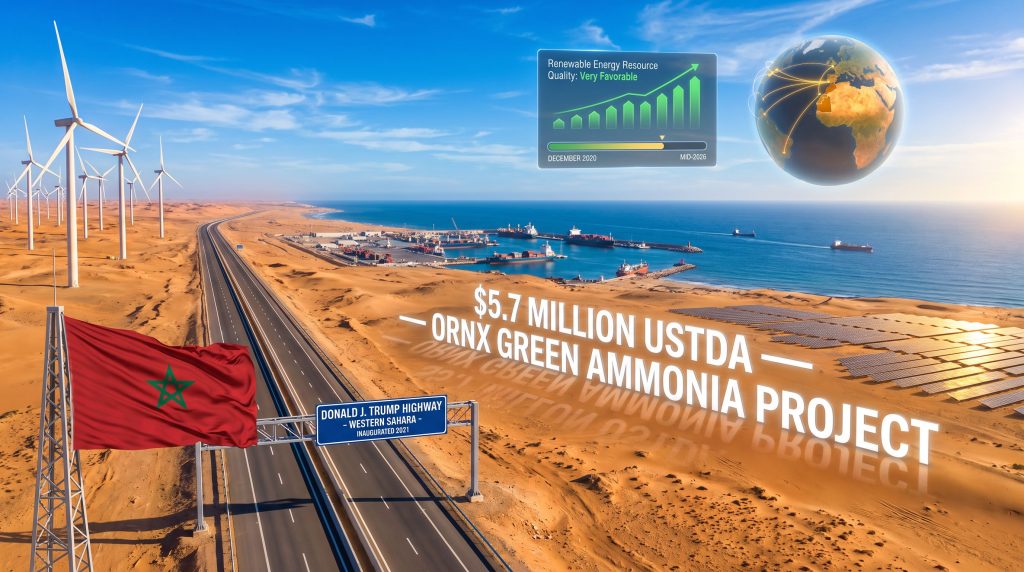
On July 27, 2026, King Mohammed VI announced that Morocco's 1,055-kilometre Tiznit-Dakhla Expressway, valued at approximately $1 billion, would be renamed the Donald J. Trump Highway. The route connects Tiznit in Morocco's south to Dakhla deep within Western Sahara, physically integrating the contested territory into Morocco's national road network.
The naming functions on two levels. Ceremonially, it is a diplomatic gesture of appreciation. Structurally, it embeds U.S. political capital into physical infrastructure that Morocco has spent decades building as a tool of administrative integration. Any future U.S. administration seeking to reverse the recognition would face the additional friction of disavowing infrastructure bearing a presidential name, making the diplomatic cost of reversal higher than it was before the announcement.
The ORNX Green Ammonia Feasibility Approval
On July 28, 2026, the U.S. Trade and Development Agency approved $5.7 million for a feasibility study supporting the proposed ORNX green ammonia project in Western Sahara. The consortium includes U.S.-based Ortus Climate Mitigation LLC alongside the Spanish-German joint venture Acciona-Nordex Green Hydrogen.
| Project Element | Detail |
|---|---|
| Funding approved | $5.7 million (USTDA feasibility study) |
| Total reported project scale | Approximately $4.5 billion |
| U.S. consortium partner | Ortus Climate Mitigation LLC |
| International partners | Acciona-Nordex Green Hydrogen (Spain-Germany JV) |
| Significance | First U.S. federal investment in a commercial project within Western Sahara |
USTDA funding is not development aid. The agency operates as a commercially oriented instrument specifically designed to open emerging markets for U.S. firms and to catalyse larger procurement and financing commitments. Its involvement signals that Washington has formally classified Western Sahara as a viable investment destination rather than a diplomatically off-limits zone.
USTDA feasibility approvals consistently precede larger capital deployments. The $5.7 million allocation should be read as a door-opening mechanism for what could eventually become one of the largest clean energy investments in Africa.
The Presidential Throne Day Message
On August 1, 2026, President Trump sent a formal message to King Mohammed VI marking Morocco's Throne Day, explicitly restating U.S.-Morocco ties over Western Sahara and outlining a forward economic agenda spanning energy, artificial intelligence, critical minerals, and defence technology. The framing was notably long-horizon, signalling intent to institutionalise, not merely maintain, the bilateral relationship across generational timeframes.
The Green Ammonia Opportunity: Strategic Logic and Market Dynamics
Green ammonia is produced by combining green hydrogen, itself generated through renewable energy-powered electrolysis of water, with nitrogen extracted from the atmosphere via the Haber-Bosch process. The result is a zero-carbon ammonia that can be used as a fertiliser feedstock, an industrial chemical, and increasingly as a maritime fuel and hydrogen carrier for long-distance energy transport.
Western Sahara's wind and solar resources address one of green hydrogen's core economic challenges: the levelised cost of electricity feeding the electrolysers. In locations where renewable capacity factors are low or intermittent, green hydrogen becomes prohibitively expensive. Along the Dakhla coast, consistent Atlantic trade winds and strong solar angles create conditions where electrolysers can operate at high utilisation rates, compressing the production cost curve toward commercial viability.
The strategic dimensions of this are not lost on Washington. Green ammonia produced in a U.S.-aligned Atlantic territory represents a potential supply chain alternative to fossil-fuel-derived ammonia, the production of which is heavily concentrated in Russia and the Middle East, as well as to green hydrogen supply chains currently dominated by Chinese technology and capital. The ORNX project, if it reaches financial close, would represent a meaningful step toward repositioning Atlantic-facing clean energy supply away from adversarial or volatile sources.
The Geopolitical Chessboard: Morocco, Algeria, and Great-Power Competition
The deepening of U.S.-Morocco ties over Western Sahara cannot be understood in isolation from the broader North African power contest. Algeria's sustained support for the Polisario Front is rooted in both historical solidarity with anti-colonial liberation movements and strategic self-interest. Furthermore, a U.S.-aligned Morocco that consolidates control over Western Sahara would represent a dominant force along the Maghreb's Atlantic and Mediterranean flanks, which Algiers views as a direct threat to its own regional influence.
Algeria severed diplomatic relations with Morocco in 2021, and the two countries have operated in a state of hostile rivalry ever since. Reports have indicated U.S. interest in mediating the rift, though no publicly confirmed breakthrough has occurred as of this writing. The rare earth geopolitics of the broader region add yet another layer of complexity to these already fraught relationships.
The great-power dimension adds further complexity, and consequently, the following dynamics are worth noting:
- China has maintained deliberate ambiguity on Western Sahara's status, preserving economic access to both Morocco and Algeria without formally antagonising either
- Russia has historically supported the Polisario Front's position, aligning with Algeria and using the dispute as one of several levers to complicate U.S. and European positioning in North Africa
- The European Union maintains contested fishing agreements covering Western Saharan waters, which have faced legal challenges before the European Court of Justice, creating an ongoing tension between commercial interests and the territory's non-self-governing classification under international law
- The African Union formally recognises the Sahrawi Arab Democratic Republic proclaimed by the Polisario Front as a member state, creating institutional friction with the U.S. position at multilateral levels
The practical effect of active U.S. economic engagement in Western Sahara is to accelerate the accumulation of facts on the ground that make the Polisario Front's leverage increasingly difficult to exercise. Infrastructure, investment, and international commercial presence create path dependencies that are politically harder to unwind than a diplomatic proclamation alone. The broader metals and mining geopolitics of the region reinforce why control of this territory matters so profoundly to so many competing powers.
The next major ASX story will hit our subscribers first
Risk-Adjusted Investment Framework for Western Sahara
For investors and businesses evaluating exposure to this territory, the opportunity set is real but the risk profile is asymmetric and administration-dependent.
| Risk Factor | Assessment | Risk Level |
|---|---|---|
| U.S. political backing | Formally recognised; reaffirmed in 2025 and 2026 | Low under current administration |
| Moroccan administrative stability | Effective control maintained for decades | Low to Medium |
| International legal ambiguity | Non-self-governing territory under UN classification | Medium to High |
| Polisario Front disruption capacity | Limited military capacity; 1991 ceasefire nominally holds | Medium |
| Renewable energy resource quality | Among highest globally for wind and solar | Very Favourable |
| Infrastructure connectivity | Improving via highway, port, and energy grid investments | Improving |
| Reputational risk | Some international bodies contest commercial activity in disputed territories | Medium |
| U.S. policy continuity risk | Recognition is executive-order based, not legislated | Medium (administration-dependent) |
The sectors currently attracting capital into Western Sahara span a meaningful range:
- Green hydrogen and ammonia driven by European decarbonisation demand and Atlantic export logistics
- Phosphate extraction via OCP Group's ongoing and expanding operations
- Atlantic fisheries though these remain legally contested under EU and international frameworks
- Tourism and film production with Christopher Nolan's The Odyssey having used the territory as a filming location, raising its global cultural profile
- Defence and security technology referenced explicitly in Trump's August 2026 Throne Day message as a cooperation pillar
Disclaimer: This article contains forward-looking analysis and scenario projections. Nothing herein constitutes financial or investment advice. Investors should conduct independent due diligence before making investment decisions related to assets, companies, or projects operating in contested territories.
Three Scenarios for the Decade Ahead
Scenario 1: Consolidation of the U.S.-Morocco Economic Axis. The ORNX project reaches financial close, additional U.S. agency involvement follows, and Morocco's autonomy proposal gains broader international endorsement as economic facts on the ground accumulate. The Polisario Front's leverage diminishes progressively.
Scenario 2: Productive Stalemate. International legal challenges to commercial projects in Western Sahara complicate financing timelines. Algeria deepens ties with China and Russia, sustaining Polisario Front capacity. Western Sahara becomes a permanently contested but economically active territory where investors extract returns despite, rather than because of, resolved sovereignty.
Scenario 3: Negotiated Framework. U.S. mediation between Morocco and Algeria produces an enhanced autonomy arrangement accepted by a broader coalition of states. Investment certainty improves significantly, accelerating capital deployment across all sectors and potentially unlocking multilateral financing mechanisms currently unavailable to the territory.
The most probable near-term trajectory sits between Scenarios 1 and 2. The durability of current U.S. policy posture and the pace of economic integration will be the primary determinants of which direction this resolves. What is no longer plausible is the previous decade's assumption that Western Sahara would remain a geopolitical abstraction rather than an active investment frontier. For a broader historical perspective on how this conflict evolved, the origins of the dispute illuminate why resolution remains so elusive.
Frequently Asked Questions
When did the U.S. first formally recognise Moroccan sovereignty over Western Sahara?
The United States issued a formal presidential proclamation of recognition on December 10, 2020, as part of a broader diplomatic arrangement that included Morocco's normalisation of relations with Israel under the Abraham Accords. This made Washington the first major Western government to break from the international position of neutrality that had prevailed since the 1970s.
What is the USTDA and why does its Western Sahara investment matter?
The U.S. Trade and Development Agency is a federal agency that funds feasibility studies and technical assistance to help U.S. firms access and develop emerging markets. Its $5.7 million allocation for the ORNX green ammonia feasibility study represents the first instance of U.S. federal funding directed toward a commercial project within the disputed territory, marking a material transition from political recognition to economic co-investment.
What is Morocco's autonomy proposal?
Morocco has proposed granting Western Sahara an autonomous governance structure under Moroccan sovereignty, including a locally elected legislature and executive authority over internal affairs, while stopping short of full independence. The U.S. has described this proposal as the only serious, credible, and realistic basis for a negotiated settlement.
Does U.S. recognition conflict with UN frameworks?
Yes. Western Sahara remains classified as a non-self-governing territory under the UN framework, and UN resolutions continue to support a negotiated solution that preserves the option of self-determination. The U.S. position that Morocco's autonomy plan is the only viable pathway effectively forecloses the referendum option that the Polisario Front and Algeria continue to advocate for.
What role does the Polisario Front play today?
The Polisario Front, backed politically and materially by Algeria, administers refugee camps in southwestern Algeria and continues to advocate for a UN-supervised self-determination referendum. It rejects U.S. recognition as illegitimate under international law and views commercial investment in the territory as a violation of the Sahrawi people's rights.
Want to Track the Next Major Resource Discovery Before the Market Does?
Western Sahara's emerging investment profile — spanning phosphate, green ammonia, and critical minerals — illustrates precisely why identifying significant resource discoveries early can be transformative for investors. Discovery Alert's proprietary Discovery IQ model instantly scans ASX announcements to deliver real-time alerts on major mineral discoveries, turning complex geological data into actionable opportunities; explore historic examples of what early discovery positioning can mean for returns, then start your 14-day free trial to ensure you're never last to act on the market's next defining find.