
June 18, 2026
Gold processing facilities across Australia face mounting pressure to optimise throughput while controlling escalating operational costs. The intersection of commodity price volatility and infrastructure constraints creates a complex decision matrix for mid-tier producers seeking sustainable growth pathways. Within this challenging landscape, the Westgold Resources Higginsville expansion represents critical inflection points that can reshape competitive positioning and financial performance trajectories.
Processing efficiency improvements through strategic capital deployment have emerged as a primary response to margin compression across the sector. Companies operating legacy infrastructure must balance immediate cash flow requirements against longer-term operational optimisation investments. Furthermore, the mathematics of throughput scaling, combined with unit cost reduction potential, forms the foundation for evaluating major expansion decisions in today's record‑high gold prices environment.
Understanding the Strategic Context Behind Major Processing Upgrades
Current market positioning reveals significant disparities in processing capabilities among Australian gold operations. The Westgold Resources Higginsville expansion represents a substantial commitment to addressing throughput bottlenecks that constrain production potential. With existing capacity at 1.6 million tonnes per annum (Mtpa), the facility operates below optimal scale for modern gold processing economics.
Current Market Positioning of Mid-Tier Gold Producers
Processing capacity constraints affect numerous Australian gold operations struggling to achieve competitive unit costs. The Higginsville Processing Hub currently processes 1.6 Mtpa, positioning it within the lower tier of significant Australian gold processing facilities. This throughput level creates fixed cost allocation challenges that impact overall cost competitiveness.
Mid-tier producers face particular pressure from rising input costs including energy, labour, and consumables. The differential between high-volume, low-cost operations and smaller processing facilities has widened substantially, creating strategic imperatives for capacity optimisation. However, processing costs exceeding A$35 per tonne indicate operational inefficiencies that expansion projects specifically target.
Technical Specifications of the Higginsville Processing Hub
Located within Western Australia's Southern Goldfields region, the Higginsville Processing Hub benefits from established infrastructure and regional mining activity. The facility's geographic positioning provides access to multiple ore sources while maintaining proximity to skilled labour markets and supply chains essential for continuous operations.
Existing infrastructure includes primary crushing systems, grinding circuits, and leaching facilities designed for 1.6 Mtpa throughput. The current configuration creates bottlenecks during peak production periods, limiting the facility's ability to process higher-grade ore sources efficiently. In addition, integration capabilities with the Beta Hunt mine feed supply demonstrate the hub's strategic importance within Westgold's operational network.
When big ASX news breaks, our subscribers know first
What Are the Key Technical Components of the Expansion Project?
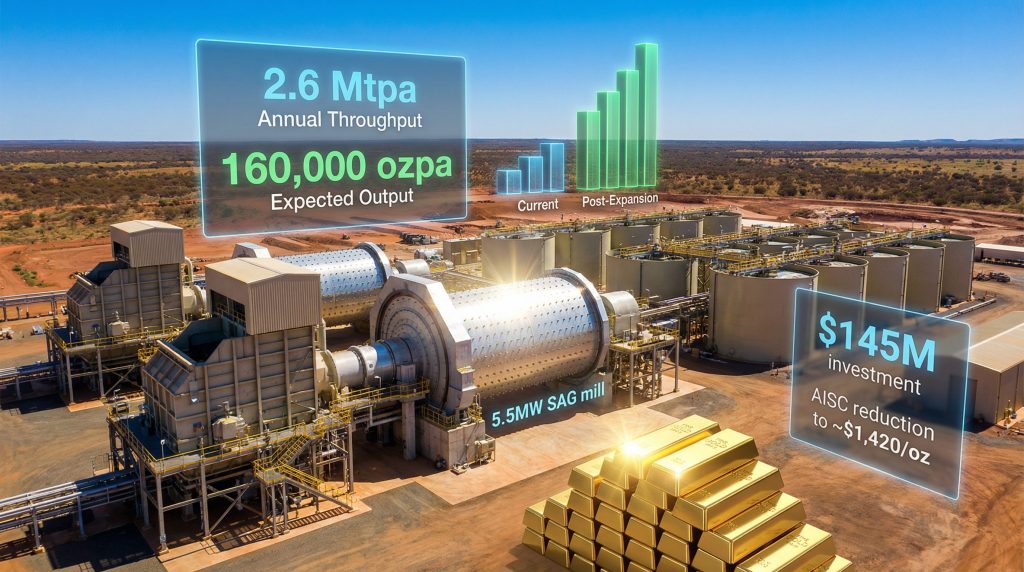
The A$145 million expansion focuses on eliminating processing bottlenecks through systematic infrastructure upgrades. Primary improvements target grinding capacity, leaching efficiency, and ore handling systems designed to achieve 2.6 Mtpa throughput upon completion.
Primary Processing Infrastructure Upgrades
New SAG mill installation represents the centrepiece of the expansion project, designed to increase grinding capacity significantly. The 5.5MW SAG mill provides enhanced grinding efficiency while reducing specific energy consumption per tonne processed. This equipment selection supports both immediate throughput targets and future expansion optionality.
Primary crushing system enhancements complement the SAG mill installation by improving ore preparation consistency. Pebble crusher integration addresses downstream processing challenges by optimising particle size distribution entering the grinding circuit. Consequently, these improvements reduce recirculating loads and enhance overall circuit efficiency.
Secondary Processing and Recovery Systems
Pre-leach thickener technology installation improves solid-liquid separation efficiency before gold extraction processes. This upgrade reduces water consumption while enhancing leaching performance through improved pulp density control. The thickener design incorporates modern automation systems for optimised operation consistency.
Additional leach tank capacity extends residence time for gold extraction, directly improving metallurgical recovery rates. The expanded leaching circuit accommodates higher throughput volumes while maintaining optimal extraction conditions. Furthermore, tank design specifications support residence time improvements that enhance overall gold recovery efficiency.
Key Technical Metrics:
Component Current Capacity Post-Expansion Improvement Annual Throughput 1.6 Mtpa 2.6 Mtpa +62.5% Processing Cost ~A$36/tonne A$34/tonne -5.6% Expected Output 87,000 ozpa 160,000 ozpa +84%
Future-proofing design elements enable potential scale-up to 4 Mtpa without major infrastructure replacement. Equipment selection criteria prioritise modular expansion capabilities, supporting staged capacity increases as ore reserves and market conditions warrant additional investment.
How Will This Expansion Impact Westgold's Operational Metrics?
Production volume scaling through the Westgold Resources Higginsville expansion delivers substantial output increases across multiple operational metrics. Southern Goldfields production advancement from 87,000 ounces annually to 160,000 ounces annually represents an 84% increase in regional output capacity.
Production Volume Scaling Analysis
The 62.5% throughput increase from 1.6 Mtpa to 2.6 Mtpa enables processing of additional ore sources while maintaining operational efficiency. Beta Hunt mine feed integration provides consistent ore supply supporting sustained high-capacity operations. This integration optimises haulage costs while ensuring feed grade consistency throughout processing campaigns.
Regional exploration upside potential at Fletcher Zone creates additional supply optionality for the expanded facility. Exploration success within economic haulage distance extends the facility's productive life while supporting capacity utilisation targets. For instance, the proximity of exploration targets reduces infrastructure requirements for future ore source development.
All-In Sustaining Cost (AISC) Reduction Framework
Current AISC benchmarking at A$2,871 per ounce in H1 FY26 reflects the cost pressures affecting mid-tier gold producers. The expansion targets midpoint AISC reduction to approximately A$1,420 per ounce, representing a 50.6% improvement in unit cost performance. This transformation positions the operation within competitive cost ranges for Australian gold production.
Fixed cost leverage through increased production volumes drives the majority of unit cost improvements. Processing cost reduction from approximately A$36 per tonne to A$34 per tonne provides additional savings while improved throughput distributes fixed costs across larger production volumes. Consequently, the combination creates substantial margin expansion potential at current gold price levels.
What Does the Financial Structure Reveal About Project Viability?
Capital allocation strategy for the A$145 million expansion demonstrates financial capacity while maintaining balance sheet flexibility. The FY27-FY28 construction timeline spreads capital deployment across two financial years, reducing immediate cash flow impact while supporting continuous operations during construction.
Capital Allocation and Funding Strategy
Treasury position analysis reveals A$550 million underlying liquidity as of H1 FY26, providing substantial funding capacity for the expansion project. Total available liquidity of A$614 million including A$250 million undrawn credit facility creates significant financial flexibility supporting project completion without external equity requirements.
Lakewood Mill divestment generating A$85 million in proceeds provides partial funding while optimising asset portfolio composition. This strategic divestment focuses capital allocation on core processing infrastructure while reducing non-core asset exposure. Furthermore, the divestment timing aligns with expansion capital requirements, supporting efficient cash management.
Return on Investment Calculations
Internal Rate of Return (IRR) projections demonstrate strong project economics across multiple gold price forecast scenarios. At current elevated gold prices near A$3,200 per ounce, the expansion generates 37% IRR with 2.1-year payback periods. Even at conservative A$2,400 per ounce scenarios, the project maintains 18% IRR with 3.5-year payback.
Free cash flow generation commencing mid-FY28 following commissioning provides immediate return on invested capital. The 12-21 month payback range depending on commodity pricing creates attractive risk-adjusted returns for shareholders. However, production ramp-up efficiency determines actual payback timing within this range.
Investment Returns Scenario Analysis:
Gold Price (AUD/oz) IRR Payback Period NPV Impact A$3,200 37% 2.1 years Strong positive A$2,800 28% 2.8 years Moderate positive A$2,400 18% 3.5 years Break-even plus
Why Is Timing Critical for This Expansion Decision?
Gold price environment provides favourable backdrop for major capital commitments in processing infrastructure. Australian dollar weakness enhances local gold price premiums while global demand patterns support sustained elevated pricing. The convergence creates optimal conditions for locking in expansion decisions.
Gold Price Environment and Currency Tailwinds
Current gold market performance reflects multiple supportive factors including central bank demand, inflation hedge positioning, and geopolitical uncertainty. Australian producers benefit doubly from global gold strength and currency weakness, creating enhanced local pricing conditions. The A$145 million commitment captures these favourable conditions through increased production capacity.
Long-term gold market outlook support expansion economics even under conservative scenarios. Institutional demand patterns suggest sustained higher price ranges compared to historical averages. Furthermore, the expansion timing positions Westgold to maximise production during anticipated continued strength in gold markets.
Construction and Commissioning Timeline Optimisation
Long-lead equipment procurement requires immediate commitment to achieve mid-FY28 commissioning targets. Equipment manufacturing schedules, particularly for specialised mining machinery, extend procurement timelines significantly. Early procurement decisions secure equipment availability while optimising construction scheduling.
Labour market considerations in Western Australian mining sector influence construction timeline planning. Skilled construction labour availability affects project completion schedules, making early contractor engagement essential. The FY27-FY28 construction timeline accommodates labour market realities while supporting operational continuity.
How Does This Position Westgold Among ASX Gold Producers?
Competitive landscape analysis positions the expanded Higginsville facility within mid-tier processing capacity ranges. Post-expansion 2.6 Mtpa throughput places Westgold among significant regional processing operations while maintaining cost competitiveness through efficiency improvements.
Competitive Landscape Analysis
Processing capacity rankings within ASX gold sector demonstrate the strategic importance of scale optimisation. Major producers including Northern Star Resources operate 10+ Mtpa across multiple sites, while Evolution Mining processes 8+ Mtpa combined operations. The Westgold expansion positions the company within competitive mid-tier capacity ranges.
Cost curve positioning post-expansion places Westgold operations within competitive ranges for Australian gold production. The projected A$1,420 per ounce AISC compares favourably with industry benchmarks while providing margin protection during commodity price volatility. This positioning supports sustained profitability across various price scenarios.
Growth Trajectory Comparison
Organic expansion strategies demonstrate management's preference for controlled growth through infrastructure optimisation rather than acquisition-driven scale increases. This approach reduces integration risks while focusing capital on proven operational improvements. The future-proofing to 4 Mtpa potential provides additional expansion optionality without immediate capital commitment.
Capital intensity benchmarks for similar processing upgrades support the A$145 million investment as reasonable for expected capacity increases. Comparable expansion projects in Australian gold sector demonstrate similar capital requirements per tonne of additional processing capacity. For instance, the investment level aligns with industry standards for comprehensive facility upgrades.
ASX Gold Producer Comparison:
Processing Capacity Tiers:
- Tier 1: Northern Star Resources (10+ Mtpa), Evolution Mining (8+ Mtpa)
- Tier 2: Westgold post-expansion (2.6 Mtpa), Regis Resources (~2.5 Mtpa)
- Tier 3: Smaller regional operators (<2 Mtpa)
The next major ASX story will hit our subscribers first
What Are the Key Risk Factors Investors Should Monitor?
Operational execution risks represent primary concerns for expansion project success. Construction timeline delays could push commissioning beyond mid-FY28 targets, affecting return calculations and cash flow projections. Cost overrun potential exists given current inflationary pressures in construction and equipment markets.
Operational Execution Risks
Commissioning complexity for integrated processing systems requires careful management of multiple equipment installations and system integration. Metallurgical recovery optimisation during ramp-up periods may temporarily reduce efficiency until operational parameters stabilise. Consequently, these factors could extend time to achieve full nameplate capacity.
Feed grade variability affects production calculations based on current reserve estimates. Exploration success at Fletcher Zone and other regional targets influences long-term capacity utilisation rates. However, ore supply consistency remains critical for maximising return on processing infrastructure investment.
Market and Commodity Price Sensitivity
Gold price volatility directly impacts project economics despite strong current pricing conditions. A$2,400 per ounce scenarios reduce IRR to 18% while maintaining project viability. Sustained price weakness below these levels would pressure expansion returns and potentially delay future capacity increases.
Australian dollar exchange rate fluctuations affect local gold pricing and input cost calculations. Currency strengthening reduces local gold price premiums while potential AUD weakness enhances profitability. Furthermore, input cost inflation for energy, labour, and consumables creates ongoing operational cost pressures.
Should Investors Consider WGX Following This Expansion Approval?
Investment thesis evaluation supports growth-oriented positioning within Australian gold sector exposure. The Westgold Resources Higginsville expansion creates substantial production increase catalyst with mid-FY28 earnings inflection potential. Balance sheet strength provides execution confidence while cost reduction targets enhance margin durability.
Investment Thesis Evaluation Framework
Growth-oriented positioning differentiates Westgold from dividend-focused gold producers prioritising current yield over expansion investment. The 84% production increase at Southern Goldfields represents significant growth catalyst unavailable from mature operations. However, two-year implementation timeline requires investor patience but provides clear catalyst timing.
Balance sheet strength assessment reveals A$614 million total liquidity supporting expansion funding without dilution concerns. The A$145 million commitment represents 23.6% of available liquidity, maintaining financial flexibility for operational requirements and potential additional investments.
Valuation Considerations and Entry Points
Current market capitalisation relative to expanded production profile suggests potential revaluation opportunity following successful commissioning. Price-to-reserves metrics may improve as processing capacity optimisation extends economic mine life through enhanced recovery efficiency.
Technical analysis considerations suggest strategic accumulation opportunities during market volatility periods. The A$6.45 current trading level reflects limited expansion premium, potentially creating attractive entry points for long-term investors supporting the growth strategy with investment strategies for gold.
Investment Decision Matrix:
Bullish Factors:
- Strong balance sheet (A$614M total liquidity)
- Clear production growth catalyst (mid-FY28)
- Significant cost reduction potential (50%+ AISC improvement)
- Future expansion optionality (4 Mtpa capability)
Risk Considerations:
- Two-year implementation timeline
- Current AISC above A$2,800/oz
- Commodity price dependency
- Construction execution risks
The Westgold Resources Higginsville expansion represents a transformational infrastructure investment designed to reposition the company within competitive cost curves while substantially increasing production capacity. Success depends on effective execution timing, sustained favourable gold market conditions, and achievement of projected operational efficiency improvements. Furthermore, the A$145 million expansion project demonstrates significant commitment to operational excellence and strategic growth positioning.
Disclaimer: This analysis is for informational purposes only and should not be considered as investment advice. Gold mining investments carry significant risks including commodity price volatility, operational challenges, and market fluctuations. Readers should conduct their own research and consult with qualified financial advisers before making investment decisions. All financial projections and operational targets mentioned are subject to change based on market conditions and operational performance.
Looking to Capitalise on Australia's Next Major Gold Discovery?
Discovery Alert's proprietary Discovery IQ model delivers instant notifications when significant ASX mineral discoveries are announced, helping investors identify actionable opportunities before the broader market catches up. Stay ahead of the competition by exploring how major mineral discoveries can generate substantial returns and begin your 14-day free trial today to secure your market advantage.