August 25, 2026
The discovery of white hydrogen discovery in Saskatchewan marks a transformative moment for Canada's energy landscape, where natural geological processes have created commercially viable hydrogen accumulations beneath the prairie surface. This groundbreaking development positions the province at the forefront of clean energy innovation, offering a pathway to low-cost hydrogen production that could reshape global energy markets.
Understanding Geological Hydrogen Formation in Subsurface Systems
The Earth's subsurface operates as a vast chemical laboratory where specific geological conditions enable natural hydrogen production through serpentinisation processes. This phenomenon occurs when iron-rich ultramafic rocks interact with circulating groundwater under precise temperature and pressure regimes, typically between 200-350°C. Saskatchewan's geological framework creates optimal conditions for these reactions, particularly where Precambrian basement formations interface with overlying sedimentary sequences.
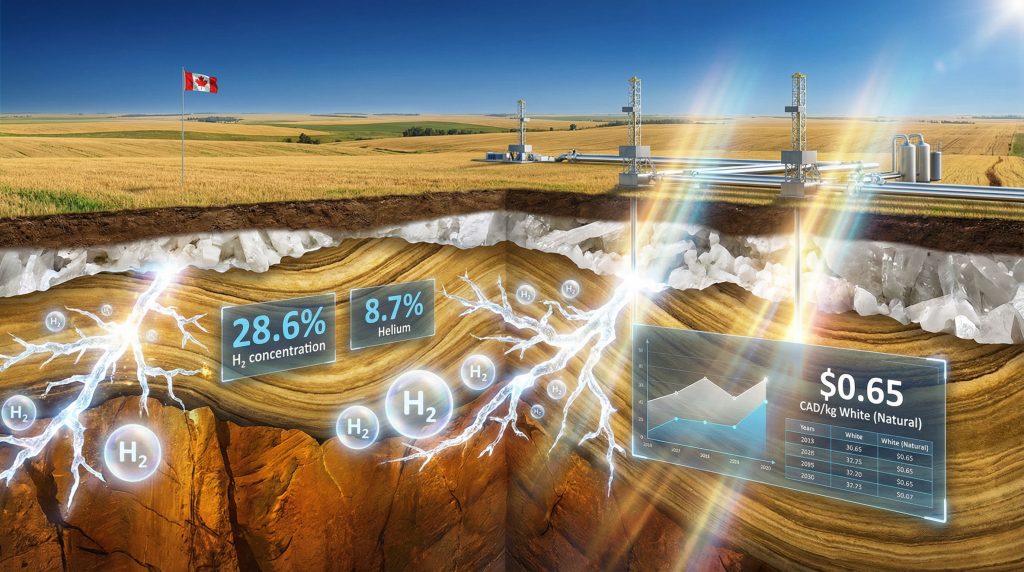
Recent analysis from the province's subsurface reveals that these natural processes can generate commercially significant hydrogen concentrations. The discovery at the Lawson site demonstrated hydrogen concentrations reaching 28.6% by volume, substantially exceeding typical trace amounts encountered in conventional hydrocarbon exploration. This breakthrough validates theoretical models suggesting that systematic geological hydrogen accumulation is achievable under specific structural and stratigraphic conditions.
The economic implications of natural hydrogen production represent a fundamental shift in clean energy economics. Current production cost estimates for geological hydrogen range from $0.50-0.65 per kilogram, compared to grey hydrogen at approximately $2.60 per kilogram, blue hydrogen exceeding $3.90 per kilogram, and green hydrogen reaching $7.80 per kilogram. These cost differentials emerge from the minimal processing infrastructure required and the absence of energy-intensive manufacturing processes.
The Serpentinisation Chemical Mechanism
Serpentinisation involves complex geochemical reactions where olivine and pyroxene minerals in ultramafic rocks encounter water under elevated temperature conditions. The fundamental reaction produces hydrogen gas, magnetite, and serpentine minerals through iron oxidation processes. In Saskatchewan's geological setting, Precambrian basement rocks containing abundant iron-bearing minerals provide the necessary reactive components.
Water circulation systems facilitate these reactions by maintaining contact between reactive minerals and fluids over geological timescales. Deep groundwater flow patterns, controlled by basement topography and structural features, determine reaction zone distribution and hydrogen generation rates. The thermal regime necessary for optimal serpentinisation occurs where geothermal gradients and groundwater circulation intersect favourably.
Migration pathways through fracture networks and porous rock formations enable hydrogen movement from generation zones to accumulation sites. The buoyancy-driven nature of hydrogen migration requires specific structural controls to prevent escape to the surface. Saskatchewan's geology provides both generation mechanisms and trapping configurations necessary for commercial accumulations.
Prairie Evaporite Sealing Characteristics
The Prairie Evaporite Formation functions as a primary sealing mechanism across southern Saskatchewan, with thickness ranging from 30-200 metres. This Devonian-age salt deposit provides exceptional sealing capacity through plastic deformation properties that maintain integrity under differential pressure conditions. The formation's lateral continuity extends across basin-scale areas, enabling regional exploration potential.
Salt formations exhibit self-sealing capabilities through ductile flow that eliminates fracture permeability over time. This characteristic proves crucial for long-term hydrogen storage, as conventional hydrocarbon seals may not maintain effectiveness against hydrogen's small molecular size and high diffusivity. Furthermore, the chemical stability of halite under hydrogen exposure enhances sealing performance compared to carbonate or shale caprock systems.
Structural controls on seal integrity include fault systems that may compromise regional continuity but also create local trapping mechanisms. The interaction between basement structure and overlying salt deposition determines optimal locations where both generation potential and sealing capacity coincide effectively.
Reservoir Engineering and Flow Characteristics
Natural hydrogen reservoirs operate under distinct pressure and temperature conditions compared to conventional gas systems. The Lawson discovery demonstrated sustained flow to surface under natural reservoir pressure, indicating adequate permeability and reservoir connectivity for commercial production rates. These characteristics suggest minimal artificial lift requirements and favourable production economics aligned with current energy transition strategies.
Porosity and permeability relationships in hydrogen-bearing formations require specialised analysis due to hydrogen's unique physical properties. The small molecular size enables flow through tight rock matrices that might not support conventional gas production. However, the same property increases the risk of loss through caprock systems not specifically adapted for hydrogen containment.
Pressure maintenance mechanisms in natural hydrogen systems differ from conventional reservoirs due to active generation processes. Unlike depleting hydrocarbon reservoirs, hydrogen systems may exhibit pressure support through ongoing serpentinisation reactions. Consequently, this characteristic could enable sustained production rates and extended field life compared to finite hydrocarbon accumulations.
Gas Composition and Processing Requirements
Laboratory analysis of Saskatchewan's natural hydrogen reveals compositions dominated by hydrogen-nitrogen mixtures without hydrogen sulphide contamination. This clean gas composition significantly reduces processing complexity compared to sour gas systems commonly encountered in conventional production. The absence of corrosive compounds simplifies material selection and reduces infrastructure costs.
Helium concentrations reaching 7-8.7% create valuable co-production opportunities in semiconductor manufacturing, medical imaging, and aerospace applications. Current helium pricing supports additional revenue streams that improve project economics beyond hydrogen production alone. In addition, the combination of hydrogen and helium production from single wells enhances the commercial viability of development projects.
Nitrogen separation represents the primary processing requirement for commercial hydrogen specifications. Cryogenic separation or pressure swing adsorption systems can achieve the purity levels required for industrial applications. The relatively simple two-component separation proves less complex than multi-component gas processing typical in conventional production.
Technical Development Infrastructure Requirements
Hydrogen-specific engineering considerations require specialised materials and design approaches throughout the production system. Hydrogen embrittlement affects conventional steel components, necessitating hydrogen-resistant alloys for wellhead equipment, pipelines, and processing facilities. These material requirements increase initial capital costs but prove essential for operational reliability within modern mining sustainability trends.
Compression systems for hydrogen service require higher compression ratios due to the gas's lower energy density compared to natural gas. However, the higher heating value per unit mass partially compensates for volumetric energy density disadvantages. Underground storage in salt caverns provides optimal containment for large-scale hydrogen inventory management.
Pipeline infrastructure modifications involve upgrading existing natural gas systems or constructing dedicated hydrogen transportation networks. Existing pipeline corridors across Saskatchewan provide established rights-of-way and regulatory precedents that could accelerate hydrogen infrastructure development compared to greenfield projects.
Environmental Monitoring and Safety Protocols
Natural hydrogen development requires comprehensive environmental oversight addressing potential subsurface and surface impacts. Groundwater protection protocols monitor for any changes in aquifer chemistry or flow patterns resulting from production activities. Baseline studies establish pre-development conditions for long-term environmental stewardship.
Surface emissions monitoring prevents atmospheric hydrogen releases that could affect local air quality or create safety hazards. Leak detection systems utilising specialised sensors designed for hydrogen's unique properties ensure operational safety and environmental protection. For instance, the lighter-than-air characteristics of hydrogen require modified emergency response procedures compared to conventional gas operations.
Seismic monitoring programmes track any induced seismicity from subsurface pressure changes during production. While natural hydrogen extraction typically involves lower pressure drawdown than conventional gas production, monitoring protocols ensure early detection of any geomechanical effects on regional stability.
Regional Geological Advantages and Exploration Potential
Saskatchewan's geological setting provides several competitive advantages for natural hydrogen development compared to international prospects. The extensive Prairie Evaporite Formation creates basin-scale sealing potential across approximately 300-mile trends, enabling systematic exploration programmes rather than isolated prospect testing. This represents a significant advancement in green transition materials discovery.
Existing energy infrastructure including pipeline networks, processing facilities, and skilled workforce reduces development timelines and capital requirements. The established regulatory framework for oil and gas operations provides precedents adaptable to hydrogen development, avoiding lengthy permitting delays common in emerging energy sectors.
Market access through existing transportation corridors connects Saskatchewan's hydrogen potential to North American demand centres in industrial regions. Max Power's recent success in natural hydrogen discovery demonstrates the proximity to established energy markets, which provides immediate commercial opportunities while international hydrogen trade develops over longer timeframes.
Basement Rock Reactivity Assessment
The Canadian Shield's Precambrian rocks underlying Saskatchewan contain essential iron-bearing minerals for serpentinisation processes. Archean greenstone belts provide high concentrations of ultramafic rocks with enhanced reactivity potential. Proterozoic intrusions contribute mafic sills and dykes containing reactive mineral assemblages.
Metamorphic complexes within the basement exhibit altered mineral compositions that may enhance hydrogen generation efficiency. The degree of alteration affects reaction kinetics and ultimate hydrogen yields from source rock systems. Furthermore, structural preparation of basement rocks through fracturing increases reactive surface area and fluid access to mineral reaction sites.
Regional geological mapping identifies favourable basement lithologies across extensive areas, suggesting repeatable exploration targets throughout southern Saskatchewan. The systematic distribution of reactive rock types supports basin-scale development potential rather than isolated discovery scenarios.
Commercial Development Timeline and Market Integration
Resource delineation activities through 2026-2027 focus on confirming the extent and characteristics of hydrogen accumulations across identified trends. Three-dimensional seismic surveys provide high-resolution imaging of subsurface structures controlling hydrogen migration and trapping. Confirmation drilling tests geological model predictions and establishes production parameters for commercial planning using advanced data-driven mining operations.
Pilot production phases during 2027-2028 demonstrate commercial viability through small-scale processing and market testing. Processing facility design incorporates lessons learned from initial discoveries while establishing offtake agreements with end-users. Regulatory approvals for commercial operations build on pilot project experience and environmental monitoring results.
Full-scale development beginning in 2028-2030 implements optimised field development strategies based on pilot results. Infrastructure expansion builds processing capacity and distribution networks connecting to regional hydrogen markets. Technology optimisation incorporates operational improvements and cost reductions identified during pilot operations.
What Makes This Discovery Unique?
The white hydrogen discovery in Saskatchewan distinguishes itself through several unprecedented characteristics. Unlike manufactured hydrogen requiring energy-intensive production processes, this natural occurrence provides direct access to hydrogen gas through conventional drilling techniques. The concentration levels discovered exceed theoretical predictions for natural hydrogen systems.
Economic viability emerges from minimal processing requirements and the absence of carbon dioxide emissions during production. This represents a paradigm shift from traditional hydrogen production methods requiring substantial energy inputs and complex manufacturing infrastructure.
Integration with Energy Transition Strategies
Natural hydrogen development strengthens Canada's energy security by reducing dependence on imported clean energy technologies and fuels. Domestic hydrogen production capabilities support national decarbonisation goals while creating export opportunities to international markets developing hydrogen economies. The technology leadership position established through early commercial development provides competitive advantages in global energy markets.
Industrial decarbonisation applications include steel production, petrochemical manufacturing, and refining operations requiring large volumes of hydrogen for process operations. Transportation sector integration supports hydrogen vehicle infrastructure and alternative fuel systems for heavy-duty applications. Power generation applications provide clean baseload capacity and grid balancing services complementing renewable energy solutions.
Regional economic development creates new industrial opportunities in Saskatchewan while leveraging existing energy sector expertise and infrastructure. The skilled workforce requirements align with transferable capabilities from conventional oil and gas operations, supporting employment transition in evolving energy markets. Consequently, this white hydrogen discovery in Saskatchewan positions the province as a global leader in clean energy innovation.
Disclaimer: The financial projections, cost estimates, and timeline predictions presented in this analysis are based on early-stage exploration results and industry estimates. Actual development costs, production rates, and market conditions may vary significantly from these preliminary assessments. Natural hydrogen development remains an emerging technology with limited commercial precedents, and investors should consider the speculative nature of these projections when evaluating investment opportunities.
Looking to Capitalise on Energy Transition Breakthroughs?
Discovery Alert's proprietary Discovery IQ model delivers real-time alerts on significant ASX mineral discoveries, instantly identifying companies advancing critical energy transition materials and clean technology projects. With Saskatchewan's white hydrogen breakthrough demonstrating the massive potential in emerging energy sectors, subscribers gain rapid insights into actionable trading and investment opportunities across commodities driving the global energy transformation.