May 10, 2026
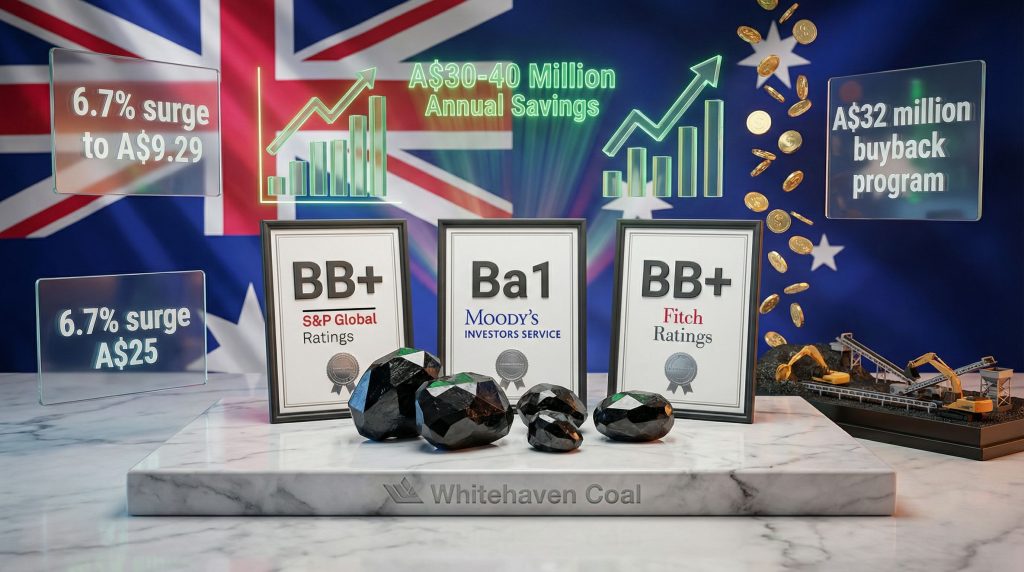
Whitehaven Coal's recent credit rating improvements represent a significant milestone for investors navigating the complex psychology of resource investing. The Whitehaven Coal credit rating boost from three major agencies signals enhanced financial flexibility during challenging commodity conditions, creating both opportunities and considerations for different investor profiles.
Mining companies face a unique psychological challenge when it comes to investor perception. Unlike stable sectors such as utilities or consumer goods, commodity-dependent businesses must constantly navigate the emotional rollercoaster of price volatility while maintaining investor confidence through operational excellence. This creates a complex dynamic where financial engineering often matters more than production statistics, particularly during commodity downturns.
For coal producers operating in today's ESG-conscious market environment, the psychology becomes even more intricate. Investors must weigh immediate financial returns against long-term structural headwinds, creating a tension between short-term opportunism and strategic positioning that defines modern resource investing. Furthermore, successful capital raising strategies become increasingly critical for maintaining competitive advantage.
Understanding the Financial Psychology Behind Credit Rating Improvements
Why Credit Ratings Drive Investor Sentiment in Mining Stocks
Credit ratings function as risk assessment tools that carry disproportionate psychological weight in volatile sectors. The three major rating agencies control approximately 95% of the global credit rating market, according to regulatory data from the Securities and Exchange Commission (SEC) and International Organisation of Securities Commissions (IOSCO). This concentrated influence means their assessments become self-fulfilling prophecies in capital markets.
Institutional versus retail psychology differs markedly in response to rating changes:
• Institutional investors operate under rigid mandates requiring minimum credit ratings for fixed-income allocations
• Pension funds typically maintain investment-grade-only policies affecting 30-40% of institutional capital
• Insurance companies face regulatory capital requirements that favour higher-rated securities
• Retail investors interpret rating upgrades as risk-reduction signals without necessarily understanding methodology
Mining companies receive specialised treatment from rating agencies due to their unique risk profile. Agencies apply sector-specific frameworks emphasising commodity price exposure, cost structure flexibility, reserve life indices, and debt maturity profiles aligned with commodity cycles. This differs substantially from evaluation criteria applied to non-cyclical industries.
The psychological impact extends beyond immediate pricing. When mining stocks achieve better credit ratings, they signal operational stability during periods of price uncertainty, creating a defensive appeal that attracts risk-averse capital typically allocated to more stable sectors. Moreover, understanding broader industry evolution insights helps contextualise these developments within sector-wide transformations.
The Refinancing Psychology: Why Cheaper Debt Matters More Than Revenue Growth
Fixed cost reduction creates immediate value that operates independently of commodity price movements. During commodity downturns, investors prioritise balance sheet improvements over production expansion because debt service obligations remain constant regardless of revenue fluctuations.
This psychological preference for cost reduction reflects a fundamental truth about mining economics: variable costs can be managed through production adjustments, but fixed financing costs must be met regardless of market conditions. Therefore, refinancing achievements provide tangible downside protection that revenue growth cannot offer during volatile periods.
The compounding effect of interest savings creates multiple layers of value:
- Direct earnings improvement through reduced interest expense
- Enhanced debt capacity for future capital allocation opportunities
- Improved credit metrics enabling further refinancing optimisation
- Increased financial flexibility during commodity price stress periods
Investors understand this mathematical relationship intuitively, explaining why markets often respond more positively to refinancing announcements than production updates during challenging commodity environments. Additionally, incorporating comprehensive investment strategy insights becomes essential for portfolio positioning.
When big ASX news breaks, our subscribers know first
How Do Triple Credit Rating Wins Impact Coal Stock Valuations?
Breaking Down the BB+/Ba1 Rating Achievement
The Whitehaven Coal credit rating boost encompasses improvements from all three major agencies, creating unprecedented access to capital markets for an Australian coal producer. This achievement stands out particularly given current ESG-driven market conditions affecting traditional energy sectors.
Whitehaven Coal's Credit Rating Matrix:
| Rating Agency | Corporate Rating | Outlook | Investment-Grade Instruments |
|---|---|---|---|
| S&P Global | BB+ | Stable | BBB- (specific debt) |
| Fitch | BB+ | Stable | BBB- (refinancing facilities) |
| Moody's | Ba1 | Stable | Investment-grade eligible |
The distinction between corporate credit ratings and specific instrument ratings creates operational advantages that many investors overlook. While Whitehaven's overall corporate rating remains speculative-grade, the investment-grade classification for refinancing instruments unlocks access to capital pools previously unavailable.
BBB- represents the critical threshold separating investment-grade from speculative-grade debt. This designation enables access to:
• Pension funds with investment-grade-only mandates
• Insurance companies with regulatory capital preferences
• European and Asian institutional investors with strict investment policies
• Corporate bond markets with investment-grade requirements
Historical context reveals that Australian coal companies rarely achieve investment-grade ratings during periods of commodity price weakness. Most ASX-listed coal producers operate at speculative-grade ratings, making Whitehaven's achievement particularly significant within current market conditions.
The A$30-40 Million Annual Interest Savings Calculation
Management guidance indicates refinancing could generate A$30-40 million in annual interest cost reductions. This figure reflects the mathematical impact of transitioning from speculative-grade to investment-grade debt pricing.
Refinancing at investment-grade rates could deliver substantial annual interest savings while extending debt maturity profiles and reducing refinancing risk premiums.
Interest Savings Sensitivity Analysis:
| Debt Balance | Current Rate | Refinanced Rate | Annual Savings |
|---|---|---|---|
| A$1.0B | 7.5% | 5.0% | A$25M |
| A$1.2B | 7.5% | 5.0% | A$30M |
| A$1.4B | 7.5% | 5.0% | A$35M |
| A$1.6B | 7.5% | 5.0% | A$40M |
This analysis demonstrates that the projected savings range reflects reasonable assumptions about debt balance and interest rate improvements. A 250 basis point reduction from investment-grade refinancing aligns with historical mining sector transactions during similar market conditions.
Comparison with peer refinancing achievements remains limited due to the scarcity of recent investment-grade coal sector transactions. Most Australian coal producers face structural ESG headwinds that prevent access to investment-grade capital markets, making direct comparisons challenging. However, Fitch's formal credit assessment provides detailed methodology behind these improvements.
Should Investors View This as a Buy Signal or Temporary Relief?
The Bull Case: Strategic Positioning During Coal Price Weakness
Credit improvements matter most during commodity downturns because they provide defensive characteristics that production metrics cannot offer. Fixed cost reduction operates independently of coal price movements, creating earnings stability during volatile periods.
The defensive value proposition includes several psychological and financial advantages:
• Immediate earnings improvement without requiring commodity price recovery
• Enhanced capital allocation flexibility through improved debt capacity
• Reduced refinancing risk during potentially challenging market conditions
• Signal of operational excellence during industry-wide ESG pressure
The Whitehaven Coal credit rating boost creates financial buffer zones that enable the company to maintain operations and capital return programs even when commodity prices fall below optimal levels. This protection becomes particularly valuable for investors seeking exposure to commodity upside with limited downside risk.
Furthermore, the company's positioning aligns with broader energy transition in mining trends, where operational efficiency becomes increasingly important during sector evolution.
The Bear Case: Structural Headwinds Remain Unchanged
ESG-driven divestment pressures continue despite operational improvements. According to UN Principles for Responsible Investment, over 1,500 institutional investors with combined assets exceeding US$60 trillion have committed to reducing thermal coal exposure.
Coal price volatility risks that credit ratings cannot eliminate:
| Scenario | Thermal Coal Price | Impact on Whitehaven | Investment Thesis |
|---|---|---|---|
| Current | A$120-140/tonne | Marginal profitability | Neutral |
| Downside | A$80-100/tonne | Below breakeven | Negative |
| Recovery | A$160-180/tonne | Strong margins | Positive |
The International Energy Agency forecasts continued decline in coal's share of global electricity generation, from approximately 33% in the 2020s to 20% by the 2040s under stated policy scenarios. This structural trend operates independently of individual company financial engineering.
Long-term demand deterioration creates a timing-dependent investment thesis where financial improvements may provide temporary relief rather than permanent value creation. Consequently, investors must carefully consider portfolio diversification strategies when evaluating coal exposure.
What Role Do Share Buybacks Play in This Investment Thesis?
Decoding Management's Capital Allocation Signals
Whitehaven's A$32 million buyback program through June 2026 signals management confidence in current valuations despite challenging operating conditions. This represents approximately 1-2% of market capitalisation, creating measurable per-share benefits.
Analysis of buyback execution psychology:
• Valuation signal – Management believes shares trade below intrinsic value
• Capital discipline – Returning cash rather than pursuing marginal growth investments
• Earnings enhancement – Reducing share count improves per-share metrics
• Flexibility demonstration – Maintaining capital returns during challenging periods
Buyback programs complement refinancing strategies by demonstrating financial flexibility while commodity prices remain suppressed. This dual approach addresses both cost structure optimisation and shareholder returns simultaneously.
The Mathematics of Share Count Reduction
Step-by-step calculation of buyback impact:
- Current market capitalisation (estimated): A$1.6-1.8 billion
- Buyback program size: A$32 million over 18 months
- Expected share reduction: 1.8-2.2% of outstanding shares
- Earnings per share improvement: Proportional to share count reduction
- Dividend yield enhancement: Higher yield on remaining shares
Historical effectiveness of mining company buybacks varies significantly based on commodity cycle timing. Programs initiated during price weakness often generate superior returns compared to those launched during price peaks, as management typically demonstrates better valuation discipline during challenging periods.
Dividend alternatives become less attractive during cash flow constraints because buybacks provide more flexibility. Unlike dividends, which create ongoing payment expectations, buybacks can be adjusted based on cash generation without negative signalling effects.
How Should Different Investor Types Approach Whitehaven Coal Now?
Risk Tolerance Framework for Coal Investment Decisions
Investor Profile Matching Matrix:
| Investor Type | Recommended Allocation | Key Considerations | Risk Factors |
|---|---|---|---|
| Conservative | 0-1% | ESG constraints, volatility | Coal transition risk |
| Moderate | 1-3% | Cyclical opportunity | Commodity price risk |
| Aggressive | 3-5% | Contrarian value play | Regulatory headwinds |
ESG consideration checklist for institutional investors:
• Thermal vs metallurgical coal exposure assessment
• Transition timeline compatibility with investment mandates
• Carbon intensity measurement and reporting requirements
• Divestment policy alignment with organisational commitments
Key Questions Every Whitehaven Investor Should Ask: Can I hold this investment through multiple commodity cycles? Do I understand the ESG implications? Am I comfortable with coal price volatility?
Technical Analysis: Entry Point Considerations
The 6.7% surge to A$9.29 following the credit rating announcement created new technical considerations for potential investors. Volume analysis indicates institutional interest above retail participation levels, suggesting professional money recognises the refinancing value proposition.
Support and resistance levels require monitoring around:
• A$8.50-8.80 – Previous consolidation range providing support
• A$9.50-9.80 – Resistance levels from recent trading highs
• A$10.20+ – Breakout levels requiring fundamental catalyst confirmation
Mining stock entries benefit from dollar-cost averaging approaches during volatile periods rather than single large positions. This strategy captures volatility while reducing timing risk inherent in commodity-dependent businesses.
What Are the Broader Implications for Australian Coal Stocks?
Sector-Wide Credit Rating Trends and Investor Implications
Whitehaven's achievement affects peer company valuations by demonstrating that operational excellence can overcome sector-wide ESG headwinds in credit markets. This precedent may influence investor expectations for other ASX coal producers pursuing similar refinancing strategies.
Recent analysis from Australian coal market performance indicates broader sector momentum supporting the Whitehaven Coal credit rating boost narrative across multiple producers.
Hypothetical scenario analysis suggests other coal producers with similar operational scale and cost structures might achieve comparable credit rating improvements under favourable conditions. However, individual company execution and market timing remain critical variables.
The role of operational scale in achieving investment-grade ratings becomes more important as ESG pressure increases. Larger operations with lower cost structures and longer reserve lives demonstrate better resilience during commodity downturns, supporting credit quality assessments.
Macroeconomic Context: Coal in the Global Energy Transition
Expert perspective indicates metallurgical coal demand remains more resilient than thermal coal due to steel production requirements, while geographic demand patterns continue supporting Australian coal exports despite global transition policies.
Geographic demand patterns supporting Australian exports:
• Asian steel production requiring metallurgical coal inputs
• Energy security concerns maintaining thermal coal demand
• Supply chain advantages from Australian operational proximity
• Quality premiums for Australian coal grades
Investment timeline considerations become critical for coal exposure strategies. Shorter investment horizons (1-3 years) may capture commodity cycle recoveries, while longer horizons (5-10 years) face greater transition risks requiring careful fundamental analysis.
The next major ASX story will hit our subscribers first
Risk Management Strategies for Whitehaven Coal Investors
Position Sizing and Portfolio Allocation Guidelines
Recommended Allocation Framework:
| Risk Tolerance | Base Allocation | Maximum Allocation | Portfolio Role |
|---|---|---|---|
| Low | 0.5% | 1.5% | Opportunistic |
| Moderate | 1.5% | 3.5% | Cyclical value |
| High | 2.5% | 5.0% | Contrarian core |
Correlation analysis with other ASX mining stocks reveals moderate positive correlation during commodity cycles but divergence during ESG-driven selling pressure. This suggests portfolio benefits from combining coal exposure with other mining sectors to reduce concentrated risks.
Hedging strategies using sector ETFs or commodity futures can provide downside protection while maintaining upside participation. Coal futures markets offer direct price hedging, while diversified mining ETFs provide sector-level risk reduction.
Monitoring Framework: Key Metrics to Track
Essential financial and operational indicators:
- Quarterly cash costs per tonne – Operating efficiency measurement
- Coal price realisations – Revenue quality assessment
- Debt-to-EBITDA ratios – Credit quality monitoring
- Refinancing milestone progress – Strategic execution tracking
- Buyback execution rates – Capital allocation effectiveness
Coal price thresholds impacting investment thesis validity:
• Above A$140/tonne – Strong fundamental support
• A$120-140/tonne – Neutral operating environment
• A$100-120/tonne – Margin pressure increasing
• Below A$100/tonne – Investment thesis challenged
Refinancing milestone tracking through 2026 should focus on timing, interest rate achievements, and debt maturity extension success. These operational metrics directly impact the investment thesis independent of commodity price movements.
Frequently Asked Questions About Whitehaven Coal's Credit Rating Boost
What Does BB+ Rating Mean for Long-term Investors?
BB+ ratings indicate speculative-grade credit quality with manageable financial risk profiles. For long-term investors, this represents improved access to capital markets while maintaining higher yields than investment-grade alternatives. The stable outlook suggests rating agencies expect consistent performance over 12-18 month periods.
How Quickly Will Interest Savings Impact Earnings?
Interest savings materialise immediately upon refinancing completion, expected by June 2026. The A$30-40 million annual benefit represents approximately 8-12% potential earnings improvement independent of coal price movements, providing immediate fundamental support.
Should ESG-Conscious Investors Avoid Despite Financial Improvements?
ESG-conscious investors must weigh financial performance against policy commitments. While credit improvements demonstrate operational excellence, thermal coal operations remain incompatible with many ESG mandates. Metallurgical coal exposure may offer compromise positioning for transition-aware strategies.
What Coal Price Levels Support Current Valuations?
Current valuations around A$9.29 require sustained thermal coal prices above A$120/tonne for fundamental support. Below A$100/tonne, even refinancing benefits cannot offset margin compression. Above A$150/tonne, valuations appear conservative relative to earnings potential.
Investors seeking deeper analysis of ASX mining sector opportunities and credit rating impacts should conduct thorough due diligence including commodity price sensitivity analysis and ESG policy alignment assessment. This analysis does not constitute personal financial advice and all investments carry risk of loss.
Want to Discover the Next Mining Investment Opportunity?
Discovery Alert provides instant notifications on significant ASX mineral discoveries, powered by its proprietary Discovery IQ model, helping investors identify actionable opportunities before the broader market reacts. Understand why historic discoveries like De Grey Mining and WA1 Resources generated exceptional returns by exploring Discovery Alert's dedicated discoveries page and begin your 14-day free trial today to position yourself ahead of the market.