
June 11, 2026
When Volume Falls and Price Rises: Understanding the Coal Producer's Dilemma
Few situations in commodity markets create more analytical confusion than when a major producer's output contracts at the same moment prices are surging upward. For investors accustomed to linear relationships between production and revenue, this dynamic can be deeply disorienting. Yet for seasoned mining sector analysts, it represents a well-documented structural phenomenon, one where operational reality and market pricing diverge sharply, creating both risk and opportunity simultaneously.
This is precisely the environment in which Whitehaven Coal (ASX: WHC) finds itself heading into the final quarter of FY26. With Whitehaven output falling 14% on a quarter-on-quarter basis while thermal coal benchmark prices stage a meaningful recovery, the company sits at a critical intersection of short-term operational headwinds and improving external pricing conditions. Understanding what is actually happening at each layer of this story requires separating the geological, meteorological, financial, and geopolitical threads that are all running concurrently.
When big ASX news breaks, our subscribers know first
The 9.5 Mt Result: Decoding What the Production Number Actually Means
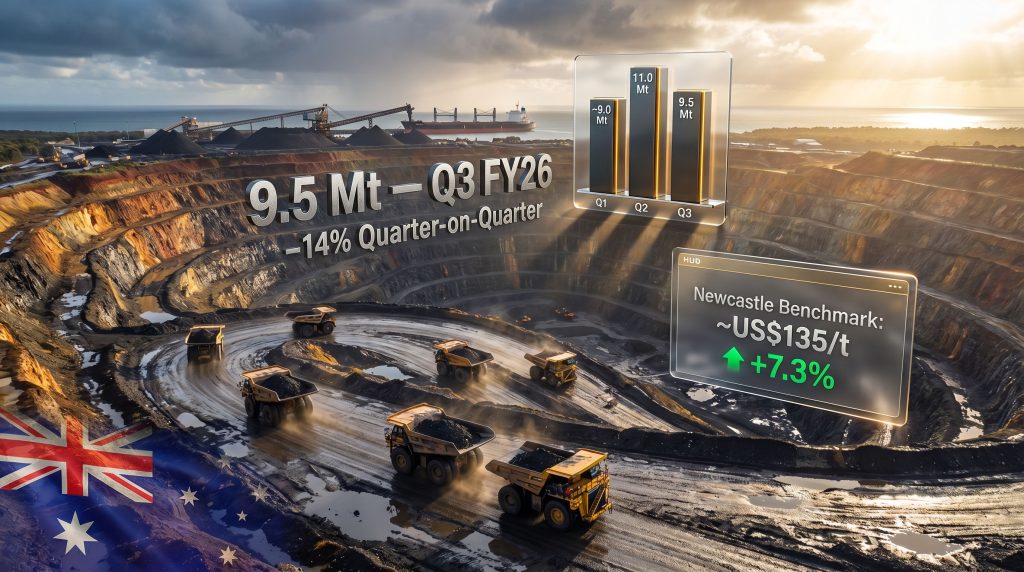
Whitehaven's Q3 FY26 managed run-of-mine (ROM) coal production was recorded at 9.5 million tonnes, representing a 14% decline from the prior quarter's 11.0 Mt result. To appreciate the significance of this figure, it helps to understand what ROM production actually measures in a mining context.
ROM coal refers to the raw material extracted directly from the mine before it undergoes any processing, washing, or quality sorting. It is a gross volume figure, not a measure of the refined, saleable product that ultimately reaches export markets. The gap between ROM production and saleable coal output depends heavily on the coal's raw quality and the efficiency of the preparation plant. For Whitehaven, which operates high-calorific-value (high-CV) thermal coal assets in New South Wales's Gunnedah Basin, this processing efficiency ratio is a key determinant of actual revenue-generating tonnage.
The distinction also matters when comparing equity-adjusted saleable coal production, which accounts for Whitehaven's ownership stakes in joint venture operations rather than the full managed production figure. This layering of metrics means that the headline 9.5 Mt figure tells only part of the story. Furthermore, understanding these coal supply challenges provides essential context for interpreting quarterly production swings.
The quarter-on-quarter reversal from 11.0 Mt to 9.5 Mt is particularly striking because Q2 FY26 itself represented a 21% improvement over the preceding quarter. In other words, Q3 wiped out a significant portion of the operational momentum that had been built through the October to December 2025 period.
Queensland's Wet Season: Why Open-Cut Mining Is Uniquely Vulnerable to Rainfall
The primary explanation for the Q3 production decline lies in weather disruptions affecting Whitehaven's Queensland coal operations. This is not simply a matter of inconvenient rain. The interaction between meteorological events and open-cut mining operations involves a set of engineering and logistical constraints that are poorly understood outside the sector.
Open-cut, or open-pit, coal mining involves the progressive removal of overlying rock and soil (known as overburden) to expose coal seams. Unlike underground mining, which occurs beneath the surface and retains some insulation from surface weather conditions, open-cut operations are entirely exposed to rainfall events. When heavy rain saturates the pit floor and haul roads, several cascading problems emerge:
- Pit floor instability: Waterlogged pit bases become structurally compromised, preventing the safe operation of heavy mining equipment including draglines, shovels, and haul trucks.
- Overburden movement suspension: Stripping operations must halt when wet conditions increase the risk of wall instability or equipment bogging.
- Coal quality degradation: Prolonged water exposure can alter the moisture content and handling properties of exposed coal seams, affecting product specifications.
- Haul road damage: Internal mine roads require significant remediation after flooding events, extending operational recovery timelines.
- Pump-out requirements: Large volumes of accumulated water in open pits must be actively pumped out before normal operations can resume, adding both cost and delay.
Queensland's Bowen Basin, where Whitehaven expanded its footprint through the acquisition of the BHP Daunia and Blackwater coal assets, sits within one of Australia's most climatically variable mining regions. The January to March period, which corresponds to Q3 of Whitehaven's fiscal year, falls squarely within the northern Queensland wet season. Historical rainfall data for the Bowen Basin during this window consistently records elevated precipitation events, making Q3 the structurally highest-risk quarter for Queensland open-cut operations.
| Production Factor | Queensland Open-Cut Assets | NSW Gunnedah Basin Assets |
|---|---|---|
| Weather Sensitivity | High, direct rainfall exposure | Moderate, underground buffer at key mines |
| Peak Risk Period | Q2 to Q3, wet season | Lower seasonal volatility overall |
| Operational Recovery Timeline | Typically 4 to 8 weeks post-event | Faster resumption capability |
| ROM Output Impact | Significant quarterly drag possible | Partial offset to Queensland disruptions |
| Overburden Stripping Risk | Elevated during saturation events | Reduced due to underground operations |
Whitehaven's NSW Gunnedah Basin operations, centred on the Maules Creek mine, provide a partial natural hedge against Queensland weather volatility. Underground and semi-surface mining techniques used across the Gunnedah Basin are considerably less exposed to surface rainfall events. However, this offset capability is not unlimited, as Queensland's expanded asset base now constitutes a meaningful proportion of Whitehaven's total managed production.
Thermal Coal Prices in 2026: The LNG Disruption Mechanism Explained
While Whitehaven's volumes were contracting, the global thermal coal pricing environment was moving sharply in the opposite direction. Newcastle benchmark futures, the primary pricing reference for Australia's energy exports to Asia, surged approximately 7.3% to around US$135 per tonne in early 2026. Understanding why requires a brief examination of how LNG and thermal coal markets are structurally linked.
Natural gas and coal occupy competing positions in the Asian electricity generation mix. When LNG supply is plentiful and prices are moderate, gas-fired power generation is preferred by utilities in Japan, South Korea, Taiwan, and increasingly Southeast Asian markets for its lower emissions profile. However, when LNG supply tightens or spot prices spike, the economics shift rapidly. Coal-fired generation becomes cost-competitive again, and Asian utilities accelerate spot coal procurement to ensure fuel security.
Geopolitical instability in the Middle East during early 2026 disrupted LNG supply flows, creating precisely this substitution dynamic. Qatar is one of the world's largest LNG exporters, supplying a substantial portion of Northeast Asia's gas requirements through long-term contracts. Any threat to Qatari LNG supply chains, whether from regional conflict or associated shipping route disruptions, sends Asian utility buyers into the spot coal market as a contingency measure.
This LNG-to-coal substitution mechanism is one of the most underappreciated pricing drivers in the thermal coal market. Because it operates through energy security logic rather than pure price comparison, it can trigger rapid procurement decisions by Asian utilities even when coal is not yet the cheapest option on a pure cost-per-megawatt-hour basis.
Australian thermal coal, and specifically the high-CV product exported through the Newcastle terminal under the gC NEWC benchmark, is the natural beneficiary of this substitution dynamic. Its proximity to Asian markets, well-established shipping logistics, and the quality premium associated with high-calorific-value coal make it the preferred swing supply source when Asian utilities need to act quickly.
Whitehaven's Price Realisation Position
Whitehaven's NSW operations recorded an average realised price of approximately A$163 per tonne in the first half of FY26, a period characterised by structurally weak benchmark prices. With the Newcastle benchmark now recovering toward US$135 per tonne, the company's H2 FY26 price realisation is expected to improve materially, though the exact magnitude depends on the proportion of sales conducted on spot terms versus existing contracted arrangements.
The high-CV quality profile of Whitehaven's Maules Creek coal is particularly valuable in a rising price environment. Higher calorific value coal generates more energy per tonne burned, making it worth more to utilities on an energy-equivalent basis. This quality premium insulates Whitehaven's revenue partially from downward pressure on lower-grade coal benchmarks, and amplifies upside when high-quality coal markets tighten. In addition, current metallurgical coal prices are also influencing broader investor sentiment across the sector.
Reading the Full-Year FY26 Production Story
To contextualise Q3's result properly, it is worth mapping the entire FY26 production trajectory to date.
| FY26 Quarter | ROM Production | Key Driver |
|---|---|---|
| Q1 FY26 (Jul to Sep 2025) | Approximately 9.0 Mt | Operational ramp-up phase |
| Q2 FY26 (Oct to Dec 2025) | 11.0 Mt | Strong operational performance |
| Q3 FY26 (Jan to Mar 2026) | 9.5 Mt | Queensland weather disruptions |
| Q4 FY26 (Apr to Jun 2026) | To be confirmed | Price recovery, seasonal improvement |
The first half of FY26 delivered managed ROM production of approximately 20.0 million tonnes, representing a 3% year-on-year increase, with equity saleable coal production reaching approximately 12.7 million tonnes, up 7% year-on-year. These H1 results demonstrated genuine operational improvement before Queensland's wet season intervened in Q3.
Management maintained full-year production guidance following the Q3 result, signalling confidence that Queensland operations would resume normal productivity rates as seasonal conditions improved through April and May 2026. Historical precedent from Whitehaven's operational record suggests that recovery from weather-driven disruptions is typically achievable within one to two quarters, provided no equipment damage occurred during the weather events.
Cost Management as the Margin Protector
One of the less-discussed but critically important aspects of Whitehaven's Q3 FY26 position is the role of cost discipline in preserving margin integrity during a volume-down quarter. Whitehaven's H1 FY26 managed cost position was approximately A$135 per tonne, with the flagship Maules Creek mine targeting a unit cost of approximately A$57 per tonne, which would represent an exceptional cost position for a large-scale Australian thermal coal operation.
When production volumes fall, unit costs naturally tend to rise as fixed costs are spread across fewer tonnes. The degree to which Whitehaven can contain this cost pressure in Q3 will be a key determinant of margin performance in the quarterly result. Producers with tight cost structures and high-quality assets have historically demonstrated superior resilience in volume-constrained quarters compared to higher-cost peers.
The Financial Architecture Behind the Numbers
The H1 FY26 financial results provided important context for understanding Whitehaven's current position. The company recorded an underlying net loss of approximately A$19 million for the half, driven primarily by a 19% decline in average coal prices to approximately A$189 per tonne and a revenue reduction of approximately 28% to A$2.48 billion. These figures reflect a period when benchmark prices were structurally depressed, not a period of operational dysfunction.
Critically, Whitehaven deployed the cash flow generated during this difficult pricing period to accelerate balance sheet repair. The company cleared approximately A$853 million in debt obligations during FY26, a deleveraging achievement that materially strengthens its financial position as prices recover. A company with reduced debt enters a price recovery cycle with significantly higher earnings leverage, as a greater proportion of incremental revenue flows directly to profit rather than debt service.
The market's reaction to Whitehaven's various announcements during this period illustrated an interesting investor psychology dynamic. The H1 loss announcement triggered an approximately 6% share price decline to around A$7.92, reflecting the immediate earnings disappointment. However, positive production update communications subsequently generated an approximately 10.5% share price recovery, suggesting that investors were already looking through the earnings trough and pricing in the anticipated H2 price recovery.
This divergence between earnings-driven sell-offs and production-update-driven recoveries is characteristic of commodity producers at pricing inflection points. The market is effectively saying that the current earnings figure is less relevant than the trajectory of the pricing environment and the operational capacity to capture it.
The next major ASX story will hit our subscribers first
Whitehaven's Position Within Australia's Thermal Coal Export System
Australia's structural role as the dominant thermal coal supplier to Northeast Asia is a function of geography, geology, and decades of infrastructure investment. Japan, South Korea, and Taiwan collectively import tens of millions of tonnes of Australian thermal coal annually, with supply relationships underpinned by long-term offtake agreements, established shipping routes, and well-developed port infrastructure on both sides of the Pacific.
The Maules Creek mine contributes an annualised production rate of approximately 8.5 million tonnes to Whitehaven's total output, making it the cornerstone asset of the company's NSW operations. Its location within the Gunnedah Basin provides access to export infrastructure through the Port of Newcastle, the world's largest coal export terminal by throughput capacity. This logistical advantage reduces freight costs and delivery lead times compared to coal exported from more remote inland operations.
Whitehaven's expanded Queensland presence following the Daunia and Blackwater acquisition added significant metallurgical coal exposure to what had historically been a predominantly thermal coal portfolio. Metallurgical coal, used in steel production rather than power generation, commands a separate and often higher price benchmark. Furthermore, the broader steel market dynamics currently unfolding across Asia are adding another layer of complexity to how Whitehaven's diversified portfolio is valued by investors. This diversification changes Whitehaven's revenue sensitivity profile, creating exposure to steel demand cycles in addition to electricity generation demand, whilst also increasing weather-related operational risk given Queensland's climatic characteristics.
Scenario Pathways Into Q4 FY26
The range of outcomes for Whitehaven's Q4 FY26 and full-year FY26 result spans meaningfully depending on how two independent variables, price sustainability and production recovery, interact.
Scenario 1: Price Holds, Production Recovers
Queensland operations return to full capacity as wet season conditions ease through April and May 2026. Newcastle benchmark pricing sustains above US$130 per tonne through the quarter. In this scenario, Whitehaven's full-year guidance is achievable, H2 FY26 delivers a meaningful earnings recovery relative to H1, and the share price has a credible pathway toward re-rating above A$9.00.
Scenario 2: Price Holds, Production Remains Constrained
Extended rainfall events or equipment remediation requirements delay Queensland's recovery beyond May 2026. Revenue improvement is driven entirely by per-unit price gains rather than volume recovery. Full-year production guidance requires downward revision, intensifying investor scrutiny on management's operational risk management framework.
Scenario 3: Price Retreats, Production Underperforms
Middle East tensions de-escalate, LNG supply disruptions normalise, and the coal price recovery momentum fades back toward US$115 to US$120 per tonne. Queensland output remains below 10 Mt in Q4. In this scenario, the balance sheet strength achieved through debt reduction becomes the primary stabilising factor, preventing a financial crisis whilst earnings recovery is deferred to FY27.
Structural Factors Supporting a Positive Outlook
Several structural dynamics support a more optimistic base case for Whitehaven heading into Q4 FY26 and beyond:
- Asian energy security investment is driving sustained long-term thermal coal demand commitments from Northeast Asian utilities, many of which are extending coal-fired generation operational lifespans beyond previously announced retirement dates.
- Whitehaven's high-CV product quality insulates it from the more aggressive price pressure affecting lower-grade thermal coal, which faces greater competition from domestic coal production in importing nations.
- The company's cost reduction initiatives, particularly the Maules Creek unit cost targeting programme, create margin expansion potential in a recovering price environment that was not available during the previous price cycle.
- Significant debt reduction achieved through FY26 means that earnings-to-shareholder returns conversion improves materially in a higher-price environment compared to prior cycles.
Frequently Asked Questions: Whitehaven Coal Q3 FY26
Why Did Whitehaven Output Fall 14% in Q3 FY26?
The ROM production decline to 9.5 Mt was primarily attributable to adverse weather events in Queensland during the January to March 2026 quarter. Open-cut mining operations are highly sensitive to heavy rainfall, which prevents safe equipment operation and requires pit dewatering before production can resume. The Q3 period corresponds to Queensland's peak wet season, making this quarter structurally the highest-risk window for the company's Queensland asset base.
Why Are Coal Prices Rising While Whitehaven's Production Volumes Are Falling?
Global thermal coal prices respond to international supply and demand dynamics, not to the output decisions of individual producers. The price surge in early 2026 was triggered by LNG supply disruptions linked to Middle East geopolitical instability, which caused Asian utility buyers to substitute coal for LNG in power generation, increasing spot coal demand independently of Whitehaven's domestic production performance.
Is Whitehaven Still on Track to Meet FY26 Production Guidance?
Management maintained full-year guidance following the Q3 result, expressing confidence that Queensland operations would return to normal productivity rates as seasonal conditions improved through Q4. Historical precedent from prior weather disruption events at Queensland coal operations suggests that recovery within one quarter is achievable, though this depends on the absence of further significant rainfall events.
What Does the H1 FY26 Underlying Net Loss Mean for Investors?
The approximately A$19 million underlying net loss in H1 FY26 reflected a period of structurally depressed benchmark coal prices rather than any fundamental operational failure. With prices recovering toward US$135 per tonne on the Newcastle benchmark and approximately A$853 million in debt obligations cleared during the year, Whitehaven's financial position entering H2 FY26 is considerably stronger than the H1 result in isolation would suggest. Consequently, how commodity prices and miners interact during recovery phases becomes critical to reading the investment case accurately.
How Significant Is the Newcastle Benchmark Price Surge for Whitehaven's Revenue?
The approximately 7.3% move in Newcastle futures to around US$135 per tonne is directly material to Whitehaven's export revenue realisation. Every sustained US$10 per tonne improvement in benchmark pricing translates to substantial additional revenue across the company's annual export tonnage. With Whitehaven's H1 FY26 NSW realised price at approximately A$163 per tonne, a sustained benchmark recovery provides meaningful H2 upside. For further detail on Whitehaven's sales and cost performance, third-party analysis offers additional perspective on these dynamics.
Production Volatility as a Structural Feature of Australian Coal Economics
The Q3 FY26 result ultimately illustrates a broader truth about large-scale open-cut coal operations in Australia: quarterly output volatility is an embedded feature of the business model, not a sign of management failure. The combination of vast open pits, exposure to tropical weather systems, and the logistical complexity of maintaining production continuity across multiple large sites makes quarter-to-quarter production smoothness structurally difficult to achieve.
For investors evaluating Whitehaven and comparable ASX-listed coal producers, the relevant analytical framework is not whether quarterly volumes are perfectly consistent, but whether the company's price leverage, cost structure, balance sheet resilience, and asset quality position it to generate superior returns across a full commodity cycle. On those measures, the Q3 FY26 result, whilst operationally disappointing, does not fundamentally alter the investment thesis for shareholders who are positioned for coal price recovery through the second half of FY26.
The geopolitical premium now embedded in thermal coal pricing, driven by repeated LNG supply disruptions and Asian energy security concerns, represents a meaningful structural shift from the pricing dynamics of 2023 and 2024. Whether this premium proves durable through FY27 is the central question for the Australian thermal coal sector, and Whitehaven's Q4 FY26 performance will provide an important early read on how effectively the industry can convert improving price signals into actual earnings recovery.
This article contains forward-looking statements, scenario analyses, and financial projections based on publicly available information. These do not constitute financial advice. Investors should conduct their own due diligence and seek professional financial guidance before making investment decisions related to ASX-listed securities.
Want to Catch the Next Major ASX Mineral Discovery Before the Broader Market?
Discovery Alert's proprietary Discovery IQ model delivers real-time alerts on significant ASX mineral discoveries, transforming complex geological and commodity data into actionable investment insights for both short-term traders and long-term investors — start your 14-day free trial today, or explore how historic discoveries have generated extraordinary returns to understand the full magnitude of opportunity these moments can represent.