August 20, 2026
When Volume Records Mean Little: The Price-Driven Reality of Coal Cycle Investing
There is a persistent misconception among investors entering commodity markets for the first time: that producing more automatically means earning more. In mature, seaborne-traded commodities like coal, this logic breaks down quickly. Whitehaven Coal record production and coal price slump in FY26 illustrates precisely how higher output can dilute per-unit margins, accelerate inventory buildup, and send a confusing signal to markets that interprets growth as desperation rather than discipline.
Understanding how this tension plays out requires more than a glance at headline numbers. It demands a close reading of cost structures, product mix, pricing benchmarks, and the strategic decisions that determine whether a miner exits a down-cycle stronger or more exposed than when it entered. Furthermore, broader coal supply challenges across the Australian sector added further complexity to an already difficult operating environment.
When big ASX news breaks, our subscribers know first
FY26 at a Glance: The Numbers Behind the Headlines
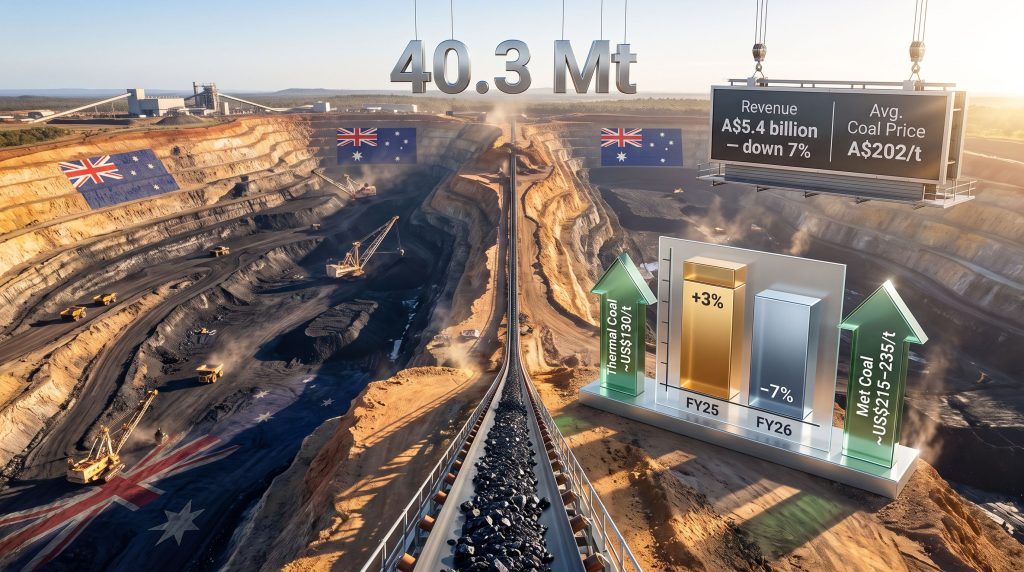
The full picture of Whitehaven's FY26 performance is one of operational excellence colliding with unfavourable market conditions. The company set a new managed run-of-mine production record of 40.3 million tonnes (Mt), split almost equally between its two major operating regions.
| Metric | FY26 Result | FY25 Comparison | Movement |
|---|---|---|---|
| Managed ROM Production | 40.3 Mt | ~39.1 Mt | +3% (record) |
| Queensland Production | 20.1 Mt | — | — |
| NSW Production | 20.2 Mt | — | — |
| Managed Sales (Produced Coal) | 32.7 Mt | — | +8% |
| Revenue | A$5.4 billion | Higher | -7% |
| Average Achieved Coal Price | A$202/t | ~A$215/t | -6% |
| Underlying NPAT | A$227 million | — | — |
| Underlying EBITDA | A$1.3 billion | — | — |
| Coal Unit Costs | A$132/t | A$139/t | Improved |
| Operating Cash Flow | A$1.1 billion | — | — |
| Net Debt | A$1.3 billion | — | — |
| Available Liquidity | A$959 million | — | — |
| TRIFR (Safety Rate) | 3.3 | 4.6 | Improved (record) |
The Whitehaven Coal record production and coal price slump dynamic visible in these figures is a textbook commodity cycle case study: an 8% rise in managed sales volume failed to prevent a 7% revenue decline, because the average achieved price of A$202/t was insufficient to absorb the pricing deterioration embedded in global benchmark movements.
What makes this result instructive beyond the company's own performance is what it reveals about the structural mechanics of the seaborne coal market. When multiple producers simultaneously push for volume, the collective effect on benchmark pricing can be self-defeating.
How Coal Price Benchmarks Work and Why They Matter
To understand why Whitehaven's revenue fell despite record output, it helps to understand how coal pricing actually functions in the seaborne market. Unlike oil, which trades on liquid futures exchanges with near-instantaneous price discovery, coal pricing relies heavily on benchmark indices such as the GlobalCOAL Newcastle (gC NEWC) for thermal coal and various assessed indices for metallurgical coal grades.
The gC NEWC index reflects the spot price of 6,000 kcal/kg NAR thermal coal loaded at the Port of Newcastle, New South Wales, and is the primary reference point for Australian thermal coal exports across the Asia-Pacific basin. Furthermore, metallurgical coal prices are determined through quarterly contract negotiations between miners and steel mills, with spot pricing increasingly influential as contract structures have loosened over the past decade.
Thermal Coal Benchmark Weakness Through FY26
The gC NEWC benchmark averaged approximately US$110 per tonne in July 2025, establishing a soft pricing floor at the outset of FY26. Several forces converged to keep thermal coal prices subdued across much of the year:
- Demand softness from key Asian import markets, including South Korea and Taiwan, where mild weather reduced power sector consumption
- Increased competition from liquefied natural gas (LNG) in certain Asian electricity markets during periods of low gas pricing
- A stronger Australian dollar amplifying the negative impact of US dollar-denominated price weakness on AUD-denominated revenue
- Structural overcapacity in Indonesian thermal coal supply adding persistent downward pressure to benchmark prices
The AUD/USD currency dynamic deserves particular attention because it operates as a multiplier on price outcomes. When the Australian dollar strengthens against the US dollar, every US dollar earned from coal exports translates into fewer Australian dollars on conversion, effectively compounding the impact of weaker USD benchmark prices on domestic financial results.
Metallurgical Coal: The Dominant Revenue Driver Under Pressure
Metallurgical coal, also called coking coal, represented 57% of Whitehaven's sales volume in FY26 and is the more valuable product in the company's portfolio. This coal type is used primarily in blast furnace steelmaking, where its coking properties and carbon content are essential to the chemical reduction of iron ore into pig iron.
Whitehaven's BMA acquisition brought Queensland-based metallurgical coal assets into the portfolio that produce high-quality hard coking coal. However, the timing coincided with a period of meaningful met coal price compression. Pricing for premium hard coking coal fell from cycle peaks above US$300/t in 2022 to the US$180-190/t range at the start of FY26, representing roughly a 40% decline from those extraordinary highs.
The first half of FY26 was particularly punishing, with Whitehaven's average achieved price falling approximately 19% year-on-year to A$189/t in 1H. This sharp mid-year deterioration illustrates how the pricing environment improved marginally through the second half but remained structurally weak across the full year.
Market participants responded to the full-year results with scepticism. Whitehaven's shares declined approximately 3.9% following the FY26 results release, reflecting investor focus on pricing weakness and capital spending commitments rather than the operational record that management had emphasised.
How Whitehaven Defended Margins Through Operational Discipline
In commodity cycles where price is beyond a producer's control, operational efficiency becomes the primary competitive differentiator. Whitehaven's FY26 result demonstrated a meaningful commitment to managing the variables it could influence. Consequently, the commodity price impact on earnings was meaningfully cushioned by disciplined cost management across both operating regions.
Cost Reduction as the Key Defensive Lever
Coal unit costs fell from A$139/t in FY25 to A$132/t in FY26, a reduction of approximately 5%. Both unit costs and capital expenditure finished at the low end of FY26 guidance, signalling genuine execution rather than aspirational target-setting. This cost improvement, while meaningful, was insufficient to fully offset the pricing decline, but it did prevent the revenue drop from translating into a more severe earnings contraction.
The distinction between structural cost reduction and cyclical cost management is important here. From Whitehaven's disclosed metrics, the combination of higher sales volumes, lower unit costs, and record TRIFR performance suggests the cost improvements are at least partially structural in nature.
The Dual-Basin Platform and Its Strategic Logic
One of the less-discussed strategic attributes of Whitehaven's current operational footprint is its near-equal production split across two distinct geological and regulatory environments. The 20.1 Mt from Queensland and 20.2 Mt from New South Wales reflects deliberate portfolio construction following the BMA acquisition.
Queensland's Bowen Basin metallurgical coal operations and New South Wales's Gunnedah Basin thermal coal mines operate under different state regulatory frameworks, have different weather exposure profiles, and serve partially differentiated customer bases. This geographic diversification reduces single-basin operational risk but, as FY26 demonstrated, provides no protection against the global price cycle that affects both product types simultaneously.
Shareholder Returns Under Balance Sheet Pressure
Despite carrying net debt of A$1.3 billion following the second US$500 million deferred BMA acquisition payment made in April 2026, Whitehaven maintained a shareholder return commitment. The company announced a fully franked final dividend of 6 cents per share alongside an equivalent on-market share buyback, combining for a total return package of up to A$159 million.
With a further US$100 million deferred BMA payment due in April 2027 and a coal-price contingent payment due in July 2027, capital allocation decisions through FY27 will require careful sequencing against debt reduction priorities.
Sector-Wide Dynamics: Record Production Across Australian Coal
Whitehaven's production record did not occur in isolation. Yancoal simultaneously reported a record first-half attributable saleable production of 19.8 Mt, representing a 5% increase over the prior corresponding period. When multiple major producers expand throughput in the same pricing environment, the cumulative effect on seaborne supply can work against benchmark price recovery.
This supply-side dynamic is one of the structural challenges inherent in the Australian coal sector's export-focused model. Unlike domestic energy markets where a producer can influence local pricing through capacity decisions, Australian coal miners are price-takers in the seaborne market.
Whitehaven's unit cost of A$132/t against an average achieved price of A$202/t implies a per-unit operating margin that, whilst compressed relative to prior cycle peaks, remains comfortably positive. In addition, the trade impacts on bulk commodities highlight how geopolitical and tariff dynamics can further complicate pricing outcomes for Australian exporters.
Safety as an Operational and ESG Indicator
The improvement in Whitehaven's Total Recordable Injury Frequency Rate from 4.6 to 3.3 deserves attention beyond its humanitarian significance. In operational terms, TRIFR improvement often correlates with reductions in unplanned downtime, lower insurance costs, and higher workforce productivity.
For a coal producer facing structural headwinds from energy transition narratives, maintaining strong safety and governance metrics can influence the cost of capital by keeping the company accessible to a broader pool of institutional investors who might otherwise screen the sector entirely.
FY27 Outlook: Price Recovery and Margin Expansion Potential
The pricing environment heading into FY27 shifted materially, offering a more constructive backdrop for revenue generation.
| Coal Type | July 2025 Benchmark | July 2026 Benchmark | Change |
|---|---|---|---|
| Thermal Coal (gC NEWC) | ~US$110/t | ~US$130/t | +~18% |
| Metallurgical Coal | ~US$180–190/t | ~US$215–235/t | +~20–25% |
Whether this represents a durable recovery or a seasonal uplift driven by Northern Hemisphere restocking cycles is a question that investors should approach with discipline. Several structural demand drivers could support sustained higher prices:
- India's expanding blast furnace steelmaking capacity, which relies on imported coking coal and has been growing its met coal import volumes consistently
- Asian infrastructure investment cycles, particularly in Southeast Asia, where steel demand growth continues to outpace domestic production capacity
- Supply disruptions from competing exporters, including periodic weather and logistical constraints affecting Colombian and Mozambican thermal coal shipments
However, meaningful risks to the recovery thesis persist. China steel demand remains subdued due to ongoing weakness in the property sector, which has suppressed domestic steel demand and reduced Chinese mills' appetite for imported coking coal volumes. Chinese steel production trends remain the single most important demand variable for global metallurgical coal pricing.
Structural Initiatives Supporting FY27 Performance
Beyond pricing, Whitehaven has identified several operational and financial levers that should support margin improvement in FY27:
- New rail contracts expected to reduce logistics costs and improve export reliability from both Queensland and NSW operations
- Debt refinancing forecast to deliver annualised interest savings of approximately A$50-55 million, a material improvement to net profit outcomes at the current earnings scale
- Continued unit cost discipline carrying forward the improvements achieved through FY26
The next major ASX story will hit our subscribers first
Key Risk Factors Investors Should Monitor
This section involves forward-looking analysis and should not be construed as financial advice. All commodity price forecasts carry inherent uncertainty.
Macro and Market Risks
- Chinese property sector trajectory: A continued downturn in Chinese residential construction would suppress rebar demand, reducing steel mill operating rates and met coal consumption
- Currency exposure: AUD appreciation against the USD compounds the impact of any US dollar price weakness on realised Australian dollar revenues
- Energy transition acceleration: Whilst thermal coal demand in Asia remains robust in the near term, longer-dated demand projections face structural pressure from renewable energy deployment and efficiency improvements
Operational and Balance Sheet Risks
- Integration and performance optimisation of the BMA assets within a unified operational framework remains an ongoing management priority
- Weather disruptions in Queensland and NSW, particularly cyclone seasons and flooding events, can cause significant short-term production interruptions with outsized effects on quarterly results
- Rail and port infrastructure constraints at key export terminals, including Newcastle and Dalrymple Bay, can limit the ability to convert production records into sales volume
Regulatory and ESG Headwinds
- Evolving emissions disclosure requirements at both the Australian federal and state levels are increasing the compliance burden for coal producers
- Institutional investor ESG screening continues to narrow the pool of natural capital allocators for coal equities, which can elevate the cost of equity capital over time
- Carbon pricing mechanisms, whether implemented domestically or through trading partner border adjustment schemes, represent a longer-term competitive risk to thermal coal economics
Frequently Asked Questions: Whitehaven Coal Record Production and Coal Price Slump
What was Whitehaven Coal's production record in FY26?
Whitehaven achieved managed run-of-mine production of 40.3 million tonnes in FY26, comprising 20.1 Mt from Queensland operations and 20.2 Mt from New South Wales, representing a record for the expanded business.
Why did Whitehaven's revenue fall despite record production?
Revenue declined approximately 7% to A$5.4 billion because the average achieved coal price fell 6% to A$202 per tonne. Higher sales volumes were insufficient to offset the earnings impact of weaker commodity prices across both thermal and metallurgical coal benchmarks.
How did Whitehaven's shares respond to its FY26 results?
Whitehaven's share price declined approximately 3.9% following the FY26 results announcement, as investors responded to softer realised coal prices, elevated capital commitments, and the company's ongoing acquisition payment obligations. The December 2025 quarterly report had already signalled building volume momentum ahead of the full-year result.
What is the FY27 coal price outlook?
Heading into FY27, metallurgical coal prices were trading at approximately US$215-235/t, compared to US$180-190/t at the start of FY26. Thermal coal benchmarks improved from around US$110/t in July 2025 to approximately US$130/t in July 2026.
How did Whitehaven manage costs through the downturn?
The company reduced coal unit costs from A$139/t in FY25 to A$132/t in FY26, with both unit costs and capital expenditure finishing at the low end of full-year guidance.
What shareholder returns did Whitehaven announce for FY26?
Whitehaven announced returns of up to A$159 million, comprising a fully franked final dividend of 6 cents per share and an equivalent amount through an on-market share buyback programme.
Key Takeaways: The Volume-Price Paradox in Australian Coal
The Whitehaven Coal record production and coal price slump story of FY26 offers several enduring lessons for commodity cycle investors:
- Record production volumes are a genuine operational achievement but cannot compensate for sustained commodity price deterioration at the revenue line
- Cost discipline and unit cost reduction remain the most controllable defensive mechanisms available to producers in a down-cycle
- The near-equal Queensland and NSW production split provides geographic and product diversification without insulating the business from global pricing cycles
- Early FY27 price improvements across both metallurgical and thermal benchmarks create a more constructive earnings environment, but the durability of this recovery depends heavily on Chinese steel sector dynamics
- Ongoing BMA acquisition payment obligations will continue shaping capital allocation decisions through mid-2027, limiting financial flexibility despite strong operating cash generation
- The relationship between safety performance improvement and operational efficiency is an often-overlooked connection that supports both margin defence and institutional investor accessibility
Readers seeking additional context on Australian coal market dynamics and commodity cycle analysis can explore related reporting and industry data published by Australian Mining at australianmining.com.au, which provides ongoing coverage of coal sector developments across Queensland and New South Wales operations.
Want to Track the Next Major ASX Commodity Discovery Before the Market Moves?
Discovery Alert's proprietary Discovery IQ model scans ASX announcements in real time, instantly identifying high-potential mineral discoveries across 30+ commodities — including the coal and resources sector — and delivering actionable insights directly to subscribers. Explore historic discoveries and their exceptional returns, then begin your 14-day free trial to position yourself ahead of the broader market.