
June 19, 2026
The Invisible Wall Between Sophisticated Wealth and Gold
Most financial assets carry a biography that institutional frameworks can read fluently. Equities have earnings. Bonds have yields. Real estate has rental income. Each of these fits neatly into the analytical infrastructure that modern portfolio management was built to process. Gold carries none of those identifiers, and that single incompatibility has done more to explain chronic institutional underallocation than any rational assessment of the metal's performance ever could.
Understanding why family offices don't own gold requires examining three distinct but reinforcing layers: the psychological architecture of how professional allocators make decisions, the structural systems that filter out unconventional assets before they reach a vote, and the monetary mechanics that operate independently of whether any institutional committee chooses to believe in them.
When big ASX news breaks, our subscribers know first
A Statistic That Functions as a Diagnosis
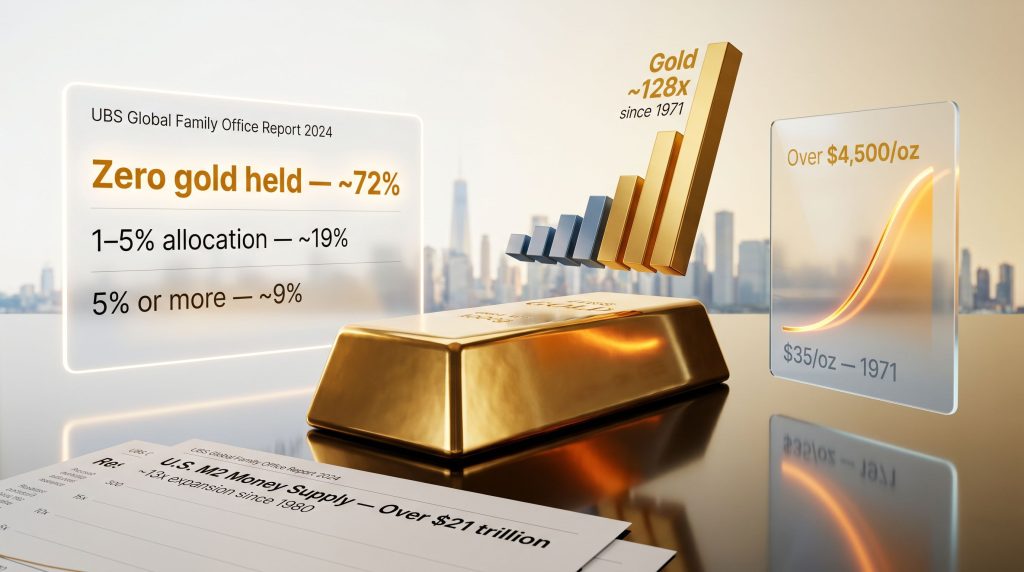
The UBS Global Family Office Report 2024 surveyed approximately 320 family offices collectively managing over $600 billion in assets. The central finding is striking: roughly 72% of those firms hold no gold at all [UBS Global Family Office Report 2024]. These are not retail investors working from intuition. They are professionally staffed private investment arms of the world's wealthiest families, employing economists, risk managers, and research teams with access to every asset class on the planet.
The allocation breakdown tells a complete picture:
| Gold Allocation Tier | Share of Family Offices Surveyed |
|---|---|
| Zero gold held | ~72% |
| 1–5% allocation | ~19% |
| 5% or more | ~9% |
Sources: UBS Global Family Office Report 2024; Campden Wealth Research 2025
The temptation is to read that 72% figure as expert consensus validating a zero-gold position. The more rigorous interpretation is the opposite: when three-quarters of the most analytically resourced investors on earth systematically arrive at the same underallocation to a metal with a five-thousand-year monetary track record, the explanation is more likely found in the decision-making systems those institutions use than in any objective flaw in the asset itself.
The investigation, therefore, begins not with gold's properties but with the architecture of institutional thought.
Layer One: The Cognitive Barriers Built Into Professional Finance
How Modern Portfolio Theory Left Gold Without a Home
Modern portfolio theory, developed largely between 1952 and the early 1980s, was built around assets that produce measurable income streams. Equities generate dividends and earnings. Bonds produce coupon payments. Each can be modelled through discounted cash flow analysis and slotted into mean-variance optimisation frameworks. Gold produces none of these inputs. It pays no dividend, reports no earnings, and generates no yield.
This is not evidence that gold lacks value. It is evidence that the dominant framework was never designed to capture the kind of value gold represents. The period during which MPT was developed happened to coincide almost exactly with the systematic dismantling of gold in the monetary system, culminating in the end of the dollar-gold link in 1971. The framework did not exclude gold through analytical rigour. It excluded gold because the assumptions baked into its construction had no category for a monetary store of value that functions outside the income-generating paradigm.
The practical consequence is institutional invisibility. When a framework has no natural home for an asset, that asset rarely surfaces in the allocation conversation at all, regardless of its real-world behaviour.
Career Risk Bias: The Rational Force Behind Irrational Allocation
Career risk bias is one of the most powerful and least discussed forces in institutional finance. It describes the tendency for professional allocators to favour portfolio positions that are defensible to peers, committees, and clients over positions that are analytically optimal for the portfolio itself.
The asymmetry operates like this:
- When equities fall 30%, an allocator can explain the decline using shared institutional language: rate sensitivity, macro headwinds, earnings compression. The entire financial services industry provides cover. The allocator retains credibility.
- When a gold allocation underperforms, the allocator stands alone. There is no consensus apparatus behind a contrarian position. The reputational cost is personal and visible.
- The result: the rational response to an irrational incentive structure is to stay inside consensus boundaries, regardless of what independent analysis suggests.
Gold's brutal 28% price decline in 2013 [London Bullion Market Association] crystallised this dynamic for an entire generation of allocators. The senior decision-makers now running family offices were mid-career professionals during the 2011–2015 bear market. Their professional memory of gold is defined by that period, not by the metal's five-decade purchasing power record. This matters enormously, because gut-level reference points drive far more institutional behaviour than formal models do.
Three conditions make career risk bias most powerful:
- When an asset sits outside consensus frameworks and lacks institutional language to describe its thesis
- When underperformance is visible, attributable, and personally associated with one decision-maker
- When peer benchmarking dominates performance evaluation across the firm
Gold satisfies all three conditions simultaneously.
Recency Bias and the Distortion of Institutional Memory
Gold reached approximately $1,920 per troy ounce in September 2011 [London Bullion Market Association] before entering a multi-year decline that brought it to roughly $1,050 by late 2015 [London Bullion Market Association]. Anyone who allocated at the peak watched a purported store of value lose nearly half its purchasing power against equities that nearly doubled over the same window.
That experience created a durable cognitive anchor. Recency bias, the tendency to assign disproportionate predictive weight to recent experience when forming forward expectations, means that the 2011–2015 bear market functions as the primary reference point for many institutional allocators today, even as gold has since climbed to over $4,500 per ounce [London Bullion Market Association].
The contrast with equities reinforces the distortion. The S&P 500 bull market running from March 2009 through 2021 created an equally powerful but opposite recency effect: equities feel like the natural default because they have delivered consistent gains across the most formative professional years of current decision-makers.
The 50-year purchasing power record and the 4-year bear market are both real. Only one of them dominates most institutional allocation conversations today.
Layer Two: The Structural Systems That Filter Gold Out Before the Vote
Investment Policy Statements and the Classification Trap
Even when individual allocators privately acknowledge gold's monetary properties, the institutional structures they operate within frequently prevent that acknowledgement from reaching a portfolio decision. Most family office investment policy statements organise capital into defined buckets: global equities, fixed income, private markets, real assets, and cash equivalents.
Gold, when it appears in these documents at all, is typically classified as a commodity, grouped alongside crude oil, natural gas, and agricultural products. This classification is institutionally convenient but analytically imprecise in a way that has material consequences.
Consider the physical reality:
- Approximately 212,000 metric tons of gold have been extracted throughout recorded human history [World Gold Council Gold Demand Trends 2024]
- Approximately 208,000 metric tons of that total remain above ground in vaults, jewellery, and electronics
- Oil is combusted. Wheat is consumed. Copper corrodes. Gold endures with near-permanent above-ground supply that grows at roughly 1–2% per year through new mining
Classifying gold alongside consumable raw materials strips it of the one property that defines its monetary role: the fact that its supply is cumulative rather than depleting, and that virtually every major civilisation across five millennia treated it as money precisely because of that permanence.
Once the classification is made, however, everything downstream follows from it. Allocation discussions treat gold as speculative and short-term. Risk frameworks benchmark it against industrial metals. The protection it was intended to provide never materialises in practice because the analysis never reaches the right starting point.
The Complexity Trap: Why Simple Solutions Lose in Sophisticated Institutions
Family offices sit at the top of the alternative investment ecosystem. Their portfolios typically span private equity, venture capital, direct lending, structured credit, real estate syndications, hedge funds, and increasingly digital assets. Each of these requires sophisticated analysis, legal infrastructure, ongoing monitoring, and specialist expertise. That complexity justifies the institution's cost structure and validates its reason for existing.
Gold's investment thesis, by contrast, requires none of that infrastructure. The core argument is straightforward: central banks have systematically expanded money supply for decades; this metal has maintained purchasing power through every prior episode of monetary expansion; therefore, holding a portion of savings in gold provides protection against continued debasement. No deal memo. No management team evaluation. No quarterly GP update. No margin expansion narrative.
Furthermore, this simplicity creates a subtle but powerful institutional disadvantage. An asset that does not require the skills an organisation has spent years building tends to be unconsciously devalued by that organisation. The complexity trap is the institutional equivalent of Maslow's hammer: when the primary analytical tool is sophisticated financial modelling, simple solutions feel inadequate regardless of their effectiveness. As one industry specialist notes, there is much that advisers routinely fail to explain about physical gold ownership, which compounds the institutional blind spot further.
The Opportunity Cost Illusion in Institutional Benchmarking
Comparing gold's return profile directly against private equity creates a fundamentally false equivalence because the two assets serve entirely different portfolio functions. One compounds capital through operational leverage. The other preserves it across monetary regimes.
The practical distortion looks like this:
| Market Scenario | Private Equity / Equities | Gold (Historical Behaviour) |
|---|---|---|
| Sustained bull market | High returns | Moderate to lagging |
| Moderate market correction | Significant drawdown | Stable to rising |
| Severe financial crisis | Major losses | Strong positive divergence |
| Inflationary monetary expansion | Mixed results | Historically positive |
Illustrative framework based on multi-decade historical patterns. Past performance does not guarantee future results.
When private equity mandates target 20%+ IRR and venture portfolios carry the potential for ten-fold returns on individual positions, gold's compound annual growth rate of approximately 8–12% over the past two decades [London Bullion Market Association] reads as dead weight. However, this framing misunderstands what diversification is for.
Diversification is not about maximising the return on every dollar in every market environment. It is about managing how the entire portfolio behaves across a wide range of scenarios, including the scenarios that define long-term financial outcomes. Gold does not earn its allocation by beating private equity in a bull market. It earns its allocation by behaving differently when financial assets fall hardest simultaneously, a pattern documented across multiple market cycles over the past five decades [World Gold Council Gold Demand Trends 2024; Bank for International Settlements Annual Economic Report 2024].
Layer Three: The Monetary Mechanics That Need No Institutional Endorsement
Currency Debasement as a Published, Quantified, Ongoing Process
The monetary mechanism that underpins the long-term case for gold does not require institutional consensus to function. It operates through the basic arithmetic of money supply expansion and its effect on purchasing power, a process documented, measured, and published by the very institutions executing it.
The scale of that expansion over recent decades is difficult to overstate:
| Metric | Baseline | Current Level | Change |
|---|---|---|---|
| U.S. M2 Money Supply | ~$1.6 trillion (1980) | Over $21 trillion | ~13x expansion |
| Gold Price | $35/oz (1971) | Over $4,500/oz | ~128x increase |
| Dollar Purchasing Power | 1980 baseline | Down ~75% | -75% |
| U.S. National Debt | Historical baseline | Over $36 trillion | Accelerating |
Sources: Federal Reserve H.6 Money Stock Measures; U.S. Bureau of Labor Statistics CPI; London Bullion Market Association; U.S. Treasury Fiscal Data
Since the formal dollar-gold convertibility ended in 1971, gold has appreciated from $35 per ounce to over $4,500, while the dollar has lost approximately three-quarters of its purchasing power [BLS CPI; LBMA]. These figures are not coincidental. They reflect a structural relationship between monetary expansion and the preserved scarcity value of an asset that no central bank can manufacture.
Central banks themselves are among the largest accumulators of gold reserves globally, a behavioural signal that reflects an institutional acknowledgement of currency risk that rarely surfaces in public communications [World Gold Council Gold Demand Trends 2024].
That last point carries particular analytical weight. The institutions responsible for executing monetary expansion are simultaneously accumulating the asset that has historically preserved value against it. Furthermore, central bank gold demand has accelerated in recent years, offering a compelling signal that retail and family office investors who dismiss gold on the basis that it lacks institutional endorsement may be looking at the wrong institutional behaviour.
What a 5–10% Allocation Actually Achieves in Portfolio Mathematics
Most sound money frameworks recommend a 5–10% gold allocation as the starting threshold for meaningful portfolio protection. The purpose is not to maximise returns but to introduce an asset that behaves asymmetrically when the rest of the portfolio is under simultaneous pressure.
The mathematics of preservation are different from the mathematics of growth:
- A portfolio that avoids a 40% drawdown requires a 67% subsequent gain to return to its prior peak
- A portfolio that suffers only a 30% drawdown through diversification requires a 43% gain to recover
- The difference in recovery time can span years or decades, compounding the value of the initial protection
Yet even among family offices that do allocate to gold, the majority hold 1–5%, below the threshold most frameworks consider sufficient [Campden Wealth Research 2025]. UBS data shows that precious metals allocations among family offices globally rose from approximately 1% in 2023 to 2% in 2024, with U.S. family offices remaining below 1% on average. Family offices in countries with established bullion traditions, including Australia, Canada, Switzerland, the United Kingdom, and South Africa, tend to carry higher-than-average exposure.
The Same Biases, Different Clothes: How Individual Investors Mirror Institutional Patterns
The psychological and structural barriers that keep family offices underallocated to gold do not disappear for individual investors. They simply present in different forms.
- Career risk bias becomes social pressure. Explaining a gold allocation to peers who are discussing equity gains carries a real social cost, even when the financial cost of skipping gold is larger over the long term.
- Recency bias operates identically. Investors who entered markets seriously during the 2010s carry a decade-long mental model in which equities produced consistent gains and gold produced frustration.
- The complexity inversion is notable: institutions avoid gold because it is too simple for their analytical infrastructure; individual investors often avoid it because physical ownership, storage, custody, and insurance considerations feel operationally complex. Consequently, understanding the difference between physical gold vs ETFs can help investors identify the most practical entry point for their circumstances. Both groups are ultimately solving for the wrong problem.
- The opportunity cost trap is universal. In years when index funds return 25% and gold returns 8%, holding gold feels like a mistake. However, the years when gold gains 20% and equities fall 40% are the years that determine whether long-term financial outcomes are preserved or destroyed.
The relevant question is never what gold would have returned in a favourable year. The more important question is what happens to the portfolio in the years when gold is absent and everything else falls at once.
The next major ASX story will hit our subscribers first
Frequently Asked Questions: Why Family Offices Don't Own Gold
Why do most family offices hold zero gold?
The primary drivers are psychological and structural rather than analytical. Most institutional allocators were trained within frameworks where gold has no natural classification. Career risk bias reinforces consensus positioning. Investment policy statements categorise gold as a commodity, stripping it of its monetary properties before any allocation discussion begins [UBS Global Family Office Report 2024; Campden Wealth Research 2025].
Is gold a commodity or a monetary asset?
Gold occupies a category that most institutional frameworks fail to capture accurately. Unlike true commodities, gold is not consumed in meaningful quantities. Approximately 208,000 of the estimated 212,000 metric tons ever mined remain above ground [World Gold Council Gold Demand Trends 2024]. Its supply is cumulative. Every major civilisation across five millennia used it as a monetary store of value. Classifying it alongside consumable raw materials is institutionally convenient but analytically imprecise.
What percentage of a portfolio should be in gold?
Most sound money frameworks suggest 5–10% as a meaningful starting threshold. The purpose is not to maximise return but to provide asymmetric resilience when other portfolio assets decline simultaneously. In addition, gold's safe-haven role means that even modest allocations can deliver disproportionate protection during severe equity drawdowns [World Gold Council Gold Demand Trends 2024].
How has gold performed against the U.S. dollar long term?
Since 1971, gold has risen from $35 per ounce to over $4,500, while the U.S. M2 money supply expanded from approximately $1.6 trillion in 1980 to over $21 trillion today, and the dollar's purchasing power declined by roughly 75% [Federal Reserve H.6; BLS CPI; LBMA]. The relationship reflects the monetary mechanism that makes gold a durable store of value across sustained periods of currency expansion.
Do family office gold allocations vary by region?
Yes, significantly. Family offices in countries with established bullion traditions, including Australia, Canada, Switzerland, the United Kingdom, and South Africa, tend to carry higher-than-average precious metals exposure. U.S. family offices have historically maintained among the lowest gold allocations globally, remaining below 1% on average even as global averages have risen [UBS Global Family Office Report 2024]. For those exploring dedicated SMSF and family office services, specialist providers can offer structured exposure tailored to these institutional requirements.
Reading the 72% Underallocation as a Forward Signal, Not a Consensus Endorsement
When three-quarters of the world's most analytically resourced investors remain absent from an asset during a period when monetary debasement is accelerating rather than moderating, the correct interpretation is not that the asset is unnecessary. The correct interpretation is that the decision-making systems those investors use are producing a systematic blind spot.
The family offices that do hold gold have not necessarily conducted more sophisticated analysis. They have cleared the psychological and structural barriers that prevent most institutional analysis from reaching an honest conclusion about monetary risk. For instance, gold as a strategic investment becomes considerably more compelling once those barriers are examined honestly and set aside.
A useful evaluative framework involves three sequential steps:
- Separate gold's portfolio function from its return profile. It is not a growth asset competing with private equity. It is a monetary hedge whose value proposition operates on a different axis entirely.
- Assess existing portfolio exposure to currency debasement risk. Equities, bonds, and cash are all denominated in fiat currencies. A portfolio concentrated in these assets is a portfolio with concentrated monetary risk, whether or not that risk is explicitly named.
- Ask the asymmetric question. Not what makes gold a good investment in a favourable environment, but what mechanism would make gold an ineffective store of value over the next 20 years, and whether that mechanism is currently observable in monetary policy trajectories, fiscal data, or central bank reserve behaviour.
Investors who work through those three steps honestly, examining M2 expansion rates, sovereign debt trajectories, and the reserve accumulation behaviour of the institutions that create the currencies gold is measured against, tend to arrive at similar conclusions. Furthermore, research covering family offices turning to metals confirms that inflation and uncertainty are increasingly driving a reassessment of what belongs in a long-term portfolio.
The 72% statistic is not a reassurance. For investors willing to look past the consensus, it represents the scale of an allocation gap that monetary mechanics will eventually force the market to price.
Disclaimer: This article is for informational and educational purposes only. It does not constitute financial or investment advice. All investment decisions should be made in consultation with a qualified financial adviser. Past performance of any asset, including gold, does not guarantee future results. All historical figures and price data are subject to change and should be verified against current primary sources before making any investment decision.
Want to Know When the Next Major ASX Mineral Discovery Hits?
Discovery Alert's proprietary Discovery IQ model scans ASX announcements in real time, instantly identifying significant mineral discoveries and turning complex data into actionable insights for investors at every level — explore historic discoveries and the substantial returns they generated, then begin your 14-day free trial to position yourself ahead of the broader market.