June 30, 2026
The Broken Heuristic: Why Conflict No Longer Automatically Lifts Gold
For most of modern financial history, the relationship between geopolitical crisis and gold prices was treated as axiomatic. Conflict in a major oil-producing region meant energy disruption, inflation fears, currency uncertainty, and a reflexive rotation into hard assets. Textbooks reinforced it. Trading desks built models around it. Retail investors internalised it as gospel.
That framework is now producing the wrong answers, and understanding precisely why gold fell despite Iran war escalation is one of the most instructive analytical exercises available to investors navigating precious metals markets in mid-2026. The answer lies not in the headlines, but in the transmission mechanism sitting beneath them.
When big ASX news breaks, our subscribers know first
What the Market Actually Did When the Missiles Flew
Over the weekend of late June 2026, the United States and Iran exchanged military strikes. Iran fired missiles at American facilities in Kuwait and Bahrain. Shipping through the Strait of Hormuz was disrupted again. By any conventional reading of geopolitical risk, this was a genuine escalation — not a rumour, not a proxy skirmish, but direct military exchange involving Gulf state territory.
Gold did not rise. It fell.
The US Dollar Index actually moved lower on the day gold declined, which would historically have provided a tailwind for metals pricing. Instead, gold dropped more than $50 from its recent corrective high near $4,100, silver followed lower, and mining equities confirmed the broader weakness. Equity markets, meanwhile, moved higher, confirming this was not a generalised risk-off episode dragging all assets down simultaneously.
The table below captures how comprehensively the market defied conventional safe-haven logic:
| Market Signal | Expected Reaction (Safe-Haven Logic) | Actual Reaction |
|---|---|---|
| US-Iran military strikes | Gold surges | Gold declined |
| Strait of Hormuz disruption | Oil spike, inflation fear, gold rally | Oil modest gain, gold fell |
| Soft US Dollar Index | Gold supported | Gold fell regardless |
| Equity markets | Risk-off selloff | Stocks rose |
| Silver and mining equities | Rally alongside gold | Broad metals decline |
The fact that gold declined on a day when the dollar was also softer is analytically significant. In prior bullish gold environments, dollar softness reliably provided support to metals. The decoupling observed here suggests the selling pressure is internally driven within the precious metals complex, rather than being imposed by currency dynamics. Furthermore, this breakdown in the gold and silver price impact across the broader metals complex reinforces the view that something structural has shifted in market behaviour.
The Rate Channel: How a Gulf Conflict Becomes a Bearish Gold Catalyst
The mechanism connecting Middle East military escalation to lower gold prices is counterintuitive but logically coherent once the transmission pathway is mapped out clearly.
Step-by-Step: How the Iran Escalation Became Bearish for Gold
- Military escalation disrupts Gulf shipping lanes and raises oil supply risk
- Oil prices tick higher, introducing renewed inflationary pressure into the market
- Inflation expectations rise, pushing the Federal Reserve's rate-cut timeline further out
- Rate hike probability increases, lifting real yields across the curve
- Higher real yields increase the opportunity cost of holding non-yielding assets like gold
- Dollar strengthens on rate differential expectations, making gold more expensive in foreign currency terms
- Gold sells off, not because fear is absent, but because the monetary policy transmission channel dominates the fear channel
As Morgan Stanley's analysts have noted, gold's response to conflict depends entirely on the type of risk being generated. When conflict primarily raises inflation expectations through energy prices rather than triggering systemic financial panic, the rate channel dominates and can push gold materially lower.
This is the core insight that separates sophisticated analysis from headline-driven trading. Conflict in an oil-producing region that feeds inflation rather than banking system stress does not restore gold's safe-haven premium. It actively works against it. The gold and bond dynamics at play here further underscore how monetary policy expectations can override traditional safe-haven flows.
Why Oil's Muted Reaction Made Everything Worse for Gold
Crude oil's response to the escalation was notably restrained, with prices ticking modestly higher and settling near $70 per barrel — a historically modest reaction given the involvement of Gulf state military infrastructure.
The explanation lies in the current global supply environment:
- Strategic petroleum reserve releases have bolstered available supply buffers
- Tanker rerouting through alternative passages reduced the impact of Strait disruption fears
- OPEC+ spare capacity provides an additional backstop against sustained price spikes
- Market participants have grown more calibrated in their Gulf risk pricing after repeated cycles of escalation and de-escalation
The significance for gold is substantial. The one scenario that might have overridden the rate-channel headwinds was a sharp oil price spike severe enough to generate a genuine systemic inflation shock — the kind that raises stagflation fears and triggers a flight to hard assets regardless of monetary policy. That scenario did not materialise.
Without an amplified inflation scare, gold lost even the conditional support that might have stemmed the decline. A market unable to attract a bid under these conditions is communicating its directional bias clearly.
Fed Policy as Gold's Structural Ceiling in 2026
The macroeconomic backdrop reinforcing the rate channel's dominance is straightforward but unforgiving for gold investors.
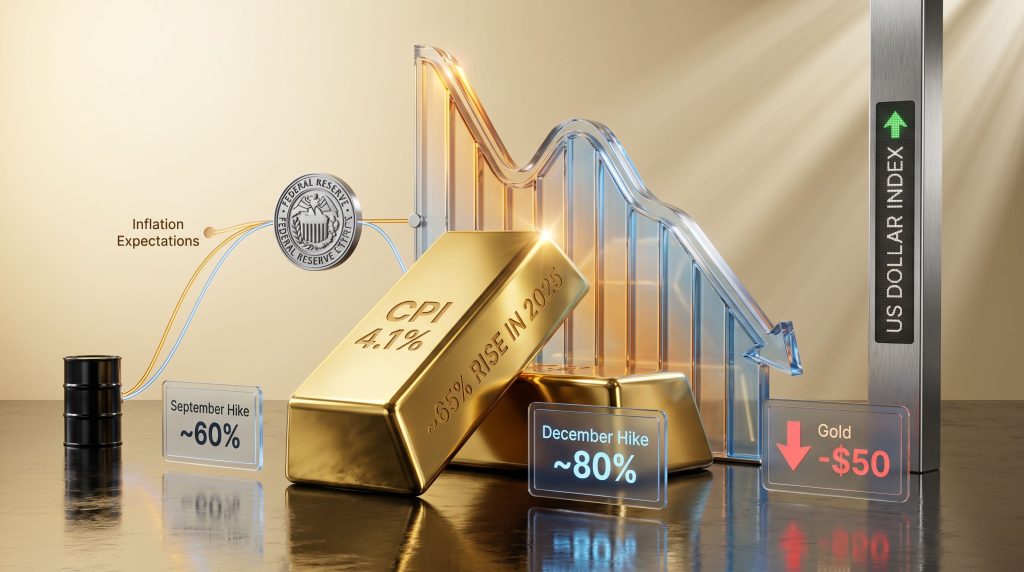
Headline CPI printed at 4.1% in the most recent reading, and the Federal Reserve responded by lifting its own inflation projections rather than signalling any softening in its policy trajectory. The new Fed Chair has explicitly prioritised inflation reduction over growth support, eliminating speculation that political pressure could prompt premature rate cuts.
| Fed Policy Metric | Current Reading | Gold Market Implication |
|---|---|---|
| Headline CPI | 4.1% | Reinforces hawkish policy bias |
| Probability of September rate hike | ~60% | Sustained real yield pressure |
| Probability of December rate hike | ~80% | Extended bearish environment |
| Fed's revised inflation projections | Lifted higher | No pivot signal on the horizon |
| New Fed Chair's stated priority | Inflation reduction first | Rate cut hopes effectively removed |
Market pricing currently incorporates three rate hikes for 2026, a profile that keeps real yields elevated and the opportunity cost of owning gold persistently high. The confirmed breakout in the Dollar Index adds a compounding headwind, as dollar strength simultaneously reduces the purchasing power equivalence of gold for international buyers and signals the rate differential story has further to run.
Furthermore, with central banks influencing gold through their policy signalling, the removal of any credible rate-cut narrative has proven particularly damaging to metals sentiment. When a central bank explicitly signals that price stability takes precedence over growth support and backs that signal with revised inflation forecasts, the market removes the probability of emergency rate cuts. For gold, which thrives on falling real yields and easing expectations, this environment is fundamentally hostile.
The Dollar Decoupling: A Technically Significant Warning Signal
One of the clearest diagnostic signals in the current gold market is the breakdown of the traditional inverse relationship between dollar moves and gold pricing.
Historically, a softening dollar provided reliable support for gold by reducing the cost of the metal in foreign currency terms and signalling a loosening of dollar liquidity conditions. During the prior corrective episodes in May 2025 and early August 2025, the dollar sold off sharply and quickly reversed, with steep V-shaped recoveries that reasserted dollar strength.
The current dollar pullback is shallow by comparison, consistent with a post-breakout consolidation phase rather than a genuine trend reversal. More importantly, gold is declining through that period of dollar softness rather than being lifted by it.
This technical decoupling has a straightforward interpretation: the selling pressure in gold is originating from within the precious metals complex itself, driven by position unwinding and the rate-channel thesis rather than being externally imposed by currency movements.
The next major ASX story will hit our subscribers first
Why Gold's 65% Rally in 2025 Created the Setup for This Decline
Understanding the current selloff also requires acknowledging the structural positioning legacy of gold's extraordinary appreciation through 2025. A ~65% price gain over that period created an unusually large pool of unrealised profits sitting in leveraged long positions across the futures and ETF markets.
When investors in other asset classes face margin calls or need to restore liquidity, profitable gold positions become a natural funding source. This dynamic — sometimes called a flight to liquidity rather than a flight to quality — is technically distinct from a fundamental reassessment of gold's intrinsic value but produces identical downward price pressure.
Key characteristics of this dynamic include:
- Profitable gold longs are liquidated to cover losses in other positions, not because of changed gold fundamentals
- The selling pressure is mechanical and portfolio-driven rather than thesis-driven
- However, when combined with genuine macro headwinds such as rising rates and dollar strength, the liquidation pressure becomes self-reinforcing
- The larger the prior appreciation, the larger the available pool of longs to unwind, extending the corrective phase
This context also explains why gold has now logged four consecutive monthly losses. Corrective phases after extended bull runs of this magnitude tend to be deeper and longer than investors anchored to recent price highs expect.
Reading the Failed Bounce: Corrective Relief vs. Genuine Reversal
The two-day bounce that took gold back toward $4,100 before reversing lower exhibited all the characteristics of a corrective relief rally rather than a genuine trend change. The distinction matters for positioning.
| Feature | Corrective Bounce | Genuine Trend Reversal |
|---|---|---|
| Duration | 1 to 3 sessions | Sustained multi-week recovery |
| Volume profile | Low, declining | Rising on recovery days |
| Breadth | Narrow (gold only) | Broad (gold, silver, miners) |
| Dollar relationship | Temporary dip | Structural dollar weakening |
| Macro catalyst | Absent | Fed pivot signal or CPI miss |
| Follow-through | Fails quickly | Builds momentum |
The bounce that preceded the current decline failed on every measure. Silver's participation was minimal. Mining equities did not confirm. No macro catalyst shifted the rate outlook. The dollar's pullback was shallow. Each of these characteristics individually might be dismissed, but taken together they defined the move as corrective compression within a larger downtrend rather than the beginning of a recovery.
A bounce that cannot hold when the dollar softens, and that fails to broaden into silver and mining equities, is not a bottom. It functions as a pressure-relief mechanism within a larger directional move.
The Geopolitical Landscape and What Future Escalations Will Likely Mean
The two sides agreed to stand down following the weekend exchange and arranged technical talks in Doha focused on managing Strait access. The immediate ceasefire, however, rests on unresolved structural disputes: Israel's continued presence in southern Lebanon, Iran's claims over Strait transit control, and competing positions on proposed toll arrangements that Oman and the United States have rejected.
These fault lines mean future escalations remain plausible. The question for gold investors is not whether conflict will recur but how it will transmit to prices when it does. As reported by Euronews, the fading of traditional safe-haven demand represents a meaningful structural shift in how precious metals respond to regional conflict.
| Escalation Scenario | Oil Market Impact | Inflation Implication | Expected Gold Response |
|---|---|---|---|
| Partial Strait closure | Moderate price spike | Elevated inflation fears | Bearish via rate channel |
| Full Strait closure | Sharp price spike | Severe inflation shock | Ambiguous, Fed response dependent |
| Broader regional war | Severe disruption | Stagflation risk | Potentially bullish if systemic panic |
| Diplomatic resolution | Oil softens | Inflation fears ease | Neutral to mildly bullish |
The scenario that would restore the gold safe-haven role requires an escalation severe enough to trigger systemic financial panic rather than inflationary pressure. Short of that threshold, each successive Gulf flare-up is more likely to reinforce the rate-channel bearish case than to generate a sustained safe-haven bid.
What Would Actually Need to Change for Gold to Recover
Identifying the conditions required for a structural gold recovery is as important as understanding the current headwinds. A single soft data point does not constitute a macro turning point.
Conditions required for a genuine structural recovery in gold:
- Federal Reserve signals a credible pause or pivot in the rate-hiking cycle
- CPI prints materially below consensus expectations for two or more consecutive months
- Dollar Index breaks its confirmed uptrend on sustained volume, not a shallow pullback
- Real yields (measured by 10-year TIPS) decline meaningfully and persistently
- Systemic financial stress emerges, distinct from geopolitical commodity disruption
- Leveraged long positions complete their unwinding phase through capitulation volume
The nearest-term scheduled catalyst is the upcoming jobs report. A weaker-than-expected employment number could temporarily reduce rate hike probability and provide short-term support. However, in the current macro configuration, such a response would most likely represent another corrective bounce within the dominant downtrend rather than a fundamental inflection point.
The July 4 holiday compresses the trading calendar, reducing liquidity and potentially amplifying price moves in either direction around the data release — a factor worth monitoring for tactical positioning. Additionally, gold-silver ratio insights continue to reflect the broader weakness in precious metals sentiment, with the ratio remaining elevated as silver underperforms relative to historical norms.
FAQ: Why Gold Fell Despite Iran War Escalation
Does geopolitical conflict always push gold higher?
No. Gold's response to conflict depends on the type of risk generated. When conflict raises inflation expectations through energy prices rather than triggering systemic financial panic, the rate channel can dominate and produce lower gold prices.
What is the rate channel for gold?
The rate channel describes how geopolitical events transmit to gold prices through monetary policy expectations. Conflict raises oil prices, which feeds inflation, which reinforces Fed tightening, which lifts real yields, which increases the opportunity cost of holding non-yielding gold.
Why does dollar strength hurt gold?
Gold is priced globally in US dollars. A stronger dollar makes gold more expensive for international buyers, reducing demand. Dollar strength also typically coincides with higher real yields, compounding the opportunity cost pressure on the metal.
Why did silver and mining stocks also fall?
Silver and mining equities tend to amplify gold's directional moves. Simultaneous declines across the precious metals complex confirm the selling pressure is broad-based rather than isolated, functioning as a bearish confirmation signal for the overall trend.
Is gold's safe-haven status permanently damaged?
Not permanently. Safe-haven demand for gold reasserts most powerfully during systemic financial crises involving banking failures, credit freezes, or currency collapses rather than geopolitical events that primarily affect commodity prices and inflation dynamics.
The Framework That Replaces the Old Heuristic
The shorthand rule that war equals buy gold was never precisely accurate, but it functioned well enough in low-rate, dollar-neutral environments where the safe-haven channel could operate without the counterforce of rising real yields. That environment no longer exists.
| Factor | Direction | Gold Impact |
|---|---|---|
| Fed rate expectations | Hawkish (3 hikes priced) | Bearish |
| US Dollar Index | Confirmed uptrend | Bearish |
| Real yields (TIPS) | Rising | Bearish |
| Geopolitical conflict (oil-driven) | Inflationary | Bearish via rate channel |
| Investor positioning | Unwinding extended longs | Bearish |
| Equity markets | Rising (risk-on) | Neutral to bearish for gold |
Sophisticated investors in this environment are not watching headlines about troop movements or missile exchanges as primary gold signals. They are watching real yield curves, dollar index breakout levels, Fed communication nuance, and CPI composition for signs that the dominant transmission mechanism is shifting.
Until the rate channel loses its structural grip on gold pricing, geopolitical escalation in oil-producing regions is more likely to function as a bearish catalyst than the safe-haven trigger that decades of market lore might suggest. Consequently, why gold fell despite Iran war escalation is a question that reveals far more about modern monetary transmission mechanisms than it does about any temporary shift in geopolitical sentiment.
This article is intended for informational and educational purposes only and does not constitute financial advice. Precious metals markets involve significant risk, and past price behaviour is not indicative of future results. Readers should conduct their own research and consult a qualified financial adviser before making investment decisions. All market data and probability figures referenced reflect conditions as reported in late June 2026.
Want to Stay Ahead of the Next Major Mineral Discovery on the ASX?
While macroeconomic forces reshape how traditional assets like gold respond to global events, Discovery Alert's proprietary Discovery IQ model cuts through the noise by delivering real-time alerts on significant ASX mineral discoveries — translating complex data across 30+ commodities into clear, actionable insights for both traders and long-term investors. Explore historic discoveries and the returns they generated, then start your 14-day free trial at Discovery Alert to position yourself ahead of the market.