July 22, 2026
When Geography Becomes Destiny: Oil Chokepoints and the Price of Conflict
Every barrel of crude oil that leaves the Persian Gulf carries with it an invisible surcharge that no refinery or pipeline can remove: the cost of geography. The world's most productive oil fields sit behind a pair of narrow maritime corridors that can, under the right circumstances, be closed by a single regional actor. When the political temperature around those corridors rises sharply, as it has during the current U.S.-Iran military exchange, energy markets do not wait for physical disruption to begin repricing. They act on probability, and right now, the probability of disruption is climbing fast.
Understanding why oil prices rise after US strikes on Iran requires more than tracking headlines. It demands a framework for how geography, military posture, financial markets, and diplomatic timelines interact under pressure. Furthermore, the crude oil price trends we are witnessing in 2025 provide essential context for understanding the current market dynamics.
When big ASX news breaks, our subscribers know first
The Mechanics of Fear: How Military Action Gets Priced Into Crude Futures
Commodity markets operate on anticipated reality rather than confirmed reality. When a military strike occurs near the Persian Gulf, traders do not ask whether oil has already stopped flowing. They ask what probability should now be assigned to a scenario where it does. That probability shift, however small, moves prices immediately because futures contracts are, by design, instruments for trading future states of the world.
This phenomenon is known as the geopolitical risk premium, and it has a measurable history. During the Gulf War in 1990 and 1991, Brent crude nearly doubled in the weeks surrounding Iraq's invasion of Kuwait before the physical supply picture had fundamentally changed. The 2019 drone strikes on Saudi Aramco's Abqaiq and Khurais facilities produced a single-day Brent spike of roughly 15%, the largest intraday move in decades, despite production recovering within weeks.
The January 2020 killing of Iranian General Qasem Soleimani pushed Brent above $70 per barrel on fears of retaliatory escalation that never fully materialised. As Al Jazeera reports, oil prices surged as US strikes on Iran reversed falls to pre-war levels, demonstrating just how swiftly markets respond to military developments in the region.
What distinguishes the current cycle from those earlier episodes is structural: the conflict is not a single event but an ongoing exchange now entering its eleventh consecutive night of U.S. strikes on Iranian military targets. Markets are not pricing a single shock. They are pricing a sustained escalation arc with no visible diplomatic off-ramp.
A risk premium built on a single event tends to decay within days as traders reassess. A risk premium built on a continuous, multi-week military exchange with expanding geographic reach is structurally stickier and far harder to arbitrage away.
Two Straits, One Crisis: Understanding the Chokepoint Architecture of Global Oil Supply
To grasp the full weight of the current supply-disruption risk, it helps to understand that global seaborne oil trade is not spread evenly across dozens of routes. It is funnelled through a small number of geographic chokepoints, two of which are now directly implicated in the U.S.-Iran conflict. In addition, the geopolitical oil price factors at play extend well beyond the immediate military exchanges.
The Strait of Hormuz: The World's Most Consequential 33 Kilometres
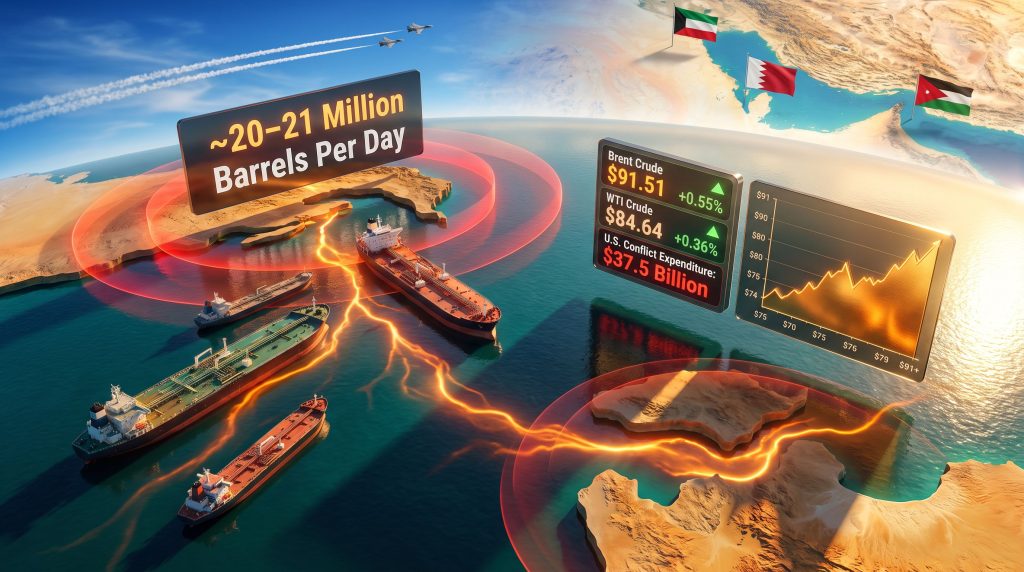
The Strait of Hormuz sits between Iran to the north and Oman and the UAE to the south. At its narrowest navigable point, it spans roughly 33 kilometres. Through this corridor passes approximately 20 to 21 million barrels of crude oil and petroleum products every single day, representing around one-fifth of all seaborne oil trade globally.
| Metric | Detail |
|---|---|
| Daily oil throughput | ~20-21 million barrels per day |
| Share of global seaborne oil trade | ~20-21% |
| Primary exporting nations | Saudi Arabia, UAE, Iraq, Kuwait, Iran |
| Alternative routing capacity | Very limited; Saudi East-West Pipeline partially offsets |
| Navigable lane width | Two 3.2 km lanes for inbound and outbound traffic |
What makes Hormuz uniquely dangerous is that Iran has both the geographic position and the demonstrated military doctrine to disrupt transit. Iranian naval forces and the Islamic Revolutionary Guard Corps Navy operate extensively in and around the strait. Iranian officials have repeatedly, over multiple decades, referenced the possibility of closing Hormuz as a strategic lever in negotiations.
Critically, traffic through the Strait of Hormuz has already fallen sharply following the collapse of the earlier U.S.-Iran ceasefire, according to maritime intelligence monitoring the region. That decline in vessel movements represents a de facto partial disruption, with tanker operators already rerouting, delaying, or holding position rather than transiting the strait under current threat conditions.
Bab el-Mandeb: The Emerging Secondary Pressure Point
As Hormuz traffic thinned, Saudi Arabia and other Gulf exporters began leaning more heavily on an alternative corridor: the Bab el-Mandeb Strait, which connects the Red Sea to the Gulf of Aden at Yemen's southwestern tip. This 29-kilometre-wide waterway serves as the southern gateway to the Suez Canal and has become an increasingly vital export route for Saudi crude.
The Houthi movement, aligned with Iran and operating from Yemen, has now announced a naval blockade of Saudi Arabia and explicitly threatened to target Saudi crude-carrying vessels transiting this waterway. This is not an idle threat. Between late 2023 and mid-2024, Houthi forces demonstrated a credible capability to strike commercial shipping with anti-ship missiles and drone boats, forcing dozens of major shipping lines to reroute around Africa's Cape of Good Hope at enormous cost.
If both Hormuz and Bab el-Mandeb face simultaneous partial disruption, the global oil market would confront its most severe routing crisis since the 1973 Arab oil embargo. Vessels forced around the Cape of Good Hope add roughly two to three weeks to journey times and substantial freight cost premiums that ultimately reach consumers.
This dual chokepoint exposure is the central scenario that energy market participants are stress-testing right now, and it is a primary driver of why oil prices rise after US strikes on Iran with greater velocity than in prior episodes.
Where Prices Stand: Reading the Market's Current Risk Assessment
The price action in crude markets provides a real-time thermometer of conflict risk perception. As of Wednesday's early session following the announcement of the eleventh consecutive night of strikes, the numbers told a clear story.
| Benchmark | Price | Change | Percentage Move | Session Context |
|---|---|---|---|---|
| Brent Crude Futures | $91.51 | +$0.50 | +0.55% | Early Wednesday, low volume |
| WTI Crude Futures | $84.64 | +$0.30 | +0.36% | Low volume, pre-EIA release |
| Brent (conflict escalation peak) | ~$78.02 | Multi-session move | +5%+ | Reported at peak conflict news |
Tuesday's session had already seen crude settle at a five-week high following confirmed U.S. strikes on targets in southern and western Iran, with Iran simultaneously launching drone attacks against U.S. facilities in Bahrain, Kuwait, and Jordan. Kuwait's military activation of air defence systems to intercept Iranian drones marked a significant geographic expansion of the exchange into Gulf Cooperation Council territory.
The relatively modest percentage moves in Wednesday's low-volume early session should not be misread as complacency. Low-volume early trading often understates true market conviction, particularly when participants are waiting on catalysts — in this case, the U.S. Energy Information Administration's weekly inventory report and any further developments on the military front. The oil price rally context from earlier in 2025 further illustrates how sensitive markets have become to external shocks.
The Sanctions Layer: A Supply Constraint That Operates Independently of Bombs
Separate from the conflict itself, the U.S. decision to revoke a sanctions waiver on Iranian crude exports has added a structurally independent supply-tightening mechanism to the market equation. This policy action does not require any physical infrastructure damage to reduce global supply. It removes Iranian barrels from accessible markets through financial and legal architecture.
Iran's crude production capacity is estimated at roughly 3.5 to 4 million barrels per day under full operating conditions, though sanctioned export volumes have historically been significantly lower. The removal of a sanctions waiver constricts the channels through which Iranian barrels can reach buyers, particularly in Asia, where several refiners had continued to absorb discounted Iranian crude under previous waiver arrangements.
This creates a dual-catalyst environment: the conflict drives a fear premium into futures, while the sanctions layer simultaneously removes physical barrels from the market. The two mechanisms reinforce each other and compound the upward price pressure. Consequently, the trade war impact on oil markets has been significant in shaping the broader supply and demand picture heading into this conflict period.
Inventory Data: What Domestic Supply Signals Are Saying
The American Petroleum Institute's latest weekly snapshot added nuance to the price picture:
- U.S. crude inventories: Rose week-on-week, a moderately bearish signal suggesting domestic supply adequacy
- Distillate inventories: Also increased, pointing to softening demand in the industrial and transportation sectors
- Gasoline stockpiles: Declined, a bullish signal consistent with continued consumer demand for motor fuel
- EIA official data: Due for Wednesday release, providing the market's formal confirmation or revision of API estimates
The mixed nature of this inventory picture is analytically important. Rising crude and distillate stocks would, in a geopolitically neutral environment, exert downward pressure on prices. The fact that prices are rising despite these bearish inventory signals confirms that the geopolitical risk premium is the dominant price driver, not a surge in physical demand. This matters for scenario analysis: a rally driven by fear, rather than fundamentals, can reverse rapidly if the fear catalyst diminishes.
The next major ASX story will hit our subscribers first
The $37.5 Billion Signal: What War Expenditure Tells Markets About Duration
U.S. Defense Secretary Pete Hegseth's public disclosure that the conflict with Iran has cost the United States $37.5 billion to date — an increase of approximately $8 billion from the most recent prior public estimate — carries a message that financial markets are decoding carefully.
Military conflicts of this expenditure magnitude do not end quickly. The rate of cost escalation, nearly $8 billion added in the period since the last public figure, implies an ongoing operational tempo that is resource-intensive and sustained. For energy markets, this translates directly: a protracted military engagement keeps the geopolitical risk premium elevated for longer, makes a rapid ceasefire less probable, and sustains the conditions under which Hormuz closure scenarios remain on the pricing table.
Moreover, OPEC's market influence adds another layer of complexity, as the cartel navigates production decisions against a backdrop of extraordinary geopolitical uncertainty and volatile demand signals.
Scenario Pathways: Three Ways This Resolves for Oil Prices
Scenario 1: Escalation Deepens
If U.S. strikes expand to Iranian energy infrastructure, naval mining operations begin in Hormuz, or Houthi interdiction of tankers at Bab el-Mandeb becomes operationally effective, Brent crude could test the $95 to $105 per barrel range. This scenario would trigger emergency releases from strategic petroleum reserves across the IEA member nations, but SPR drawdowns are a delay mechanism, not a solution.
Scenario 2: Conflict Plateau
Military exchanges continue at current intensity without physically disrupting export infrastructure. GCC nations maintain production and export capacity. U.S. inventory builds provide a partial price ceiling. In this scenario, Brent likely consolidates in the $88 to $93 per barrel range with elevated volatility and a persistent but stable risk premium.
Scenario 3: Diplomatic Breakthrough
A credible ceasefire or renewed diplomatic framework reduces Hormuz closure probability and opens the door to partial sanctions relief. The fear premium unwinds quickly. Brent likely retraces toward $80 to $85 per barrel, with WTI tracking into the mid-$70s. However, as the BBC notes, the path to any diplomatic resolution remains deeply uncertain given the current military posture of both sides. This scenario's probability is further constrained by the current $37.5 billion war expenditure, which signals entrenched positions on both sides.
Disclaimer: The price scenarios above represent analytical projections based on current market conditions and historical precedent. They are not financial advice and should not be relied upon for investment decisions. Oil markets are subject to rapid and unpredictable changes driven by geopolitical, macroeconomic, and weather-related factors.
Broader Economic Consequences: Beyond the Trading Screens
The economic footprint of sustained crude prices above $90 per barrel extends well beyond energy sector balance sheets.
For inflation and central banks: Energy costs feed directly into transportation, logistics, and manufactured goods pricing. Central banks in economies where post-pandemic inflation has only recently been brought under control face a renewed dilemma if crude-driven energy costs re-accelerate headline consumer price indices. The European Central Bank and Bank of England are particularly exposed given European dependence on seaborne crude imports.
For emerging markets: Large oil-importing economies across South Asia, Southeast Asia, and sub-Saharan Africa face acute balance-of-payments pressure when crude prices spike. India, the world's third-largest oil importer, is structurally exposed to Persian Gulf supply routes given that the vast majority of its crude imports transit Hormuz or pass through Indian Ocean corridors linked to it.
For equity markets: Higher oil prices create a divergent response across sectors. Energy producers benefit directly. Airlines, shipping companies, industrials, and consumer discretionary businesses face margin compression. Broader risk-off sentiment triggered by geopolitical uncertainty compounds this by weighing on equity indices independently of the oil price channel.
Frequently Asked Questions
Why do oil prices rise specifically when the U.S. strikes Iran?
Iran's geographic position alongside the Strait of Hormuz gives it the capability to threaten or disrupt the transit of roughly one-fifth of globally traded seaborne oil. Military strikes on Iranian territory raise the probability that Iran will exercise that capability in response, prompting traders to embed a higher risk premium into futures prices before any physical disruption occurs.
What makes this escalation cycle different from previous U.S.-Iran tensions?
The current cycle is characterised by continuous, multi-night military exchanges rather than a single incident, conflict expansion into GCC territory including Kuwait and Bahrain, the opening of a second front through Houthi threats at Bab el-Mandeb, and a confirmed war expenditure figure of $37.5 billion that signals no near-term resolution. The combination of these factors creates a structurally more durable risk premium than prior single-event episodes.
How quickly could oil prices fall if a ceasefire is announced?
Geopolitical risk premiums can unwind extremely rapidly. A credible ceasefire with verifiable compliance mechanisms could see Brent retrace $8 to $12 per barrel within days of announcement, particularly given that the current rally is driven primarily by fear pricing rather than a fundamental demand surge. However, durability of any agreement would be assessed carefully before the full premium is removed.
What role do U.S. strategic petroleum reserves play in this scenario?
The U.S. Strategic Petroleum Reserve, along with coordinated IEA member releases, represents the primary short-term buffer against physical supply disruption. However, SPR drawdowns are finite and politically constrained. They function as a bridging mechanism in a supply shock — buying time for diplomatic resolution or alternative supply rerouting — rather than a permanent substitute for disrupted volumes. Understanding why oil prices rise after US strikes on Iran ultimately comes down to this tension between finite buffers and potentially prolonged disruption scenarios.
Want to Know Which ASX Energy and Resources Companies Are Positioned for Major Discoveries?
Discovery Alert's proprietary Discovery IQ model delivers real-time alerts the moment significant mineral discoveries hit the ASX, translating complex data across 30+ commodities into clear, actionable insights — explore the historic returns major discoveries have generated and begin your 14-day free trial to gain a market-leading edge before the broader market reacts.