June 9, 2026
The Industrial Crossroads: Why the Race to Own Whyalla Is About Far More Than Steel
Few industrial transactions in Australian history carry the weight of what is now unfolding at Whyalla. The convergence of decarbonisation imperatives, sovereign capability concerns, and a once-in-a-generation shift in global steelmaking technology has turned a regional South Australian facility into one of the most closely watched asset sales in the country. With the Whyalla Steelworks bidders shortlisted down to two final contenders, the question is no longer whether the facility survives but what form its future takes and who will shape it.
Understanding why this sale matters requires stepping back from the immediate transaction and examining the structural forces rewriting the economics of steelmaking worldwide. The industry is at an inflection point driven by three simultaneous pressures: tightening carbon regulations in major export markets, the accelerating cost competitiveness of green iron production, and a geopolitical reassessment of supply chain resilience that is pushing governments to reconsider offshore dependency for essential industrial outputs. Whyalla sits squarely at the intersection of all three.
When big ASX news breaks, our subscribers know first
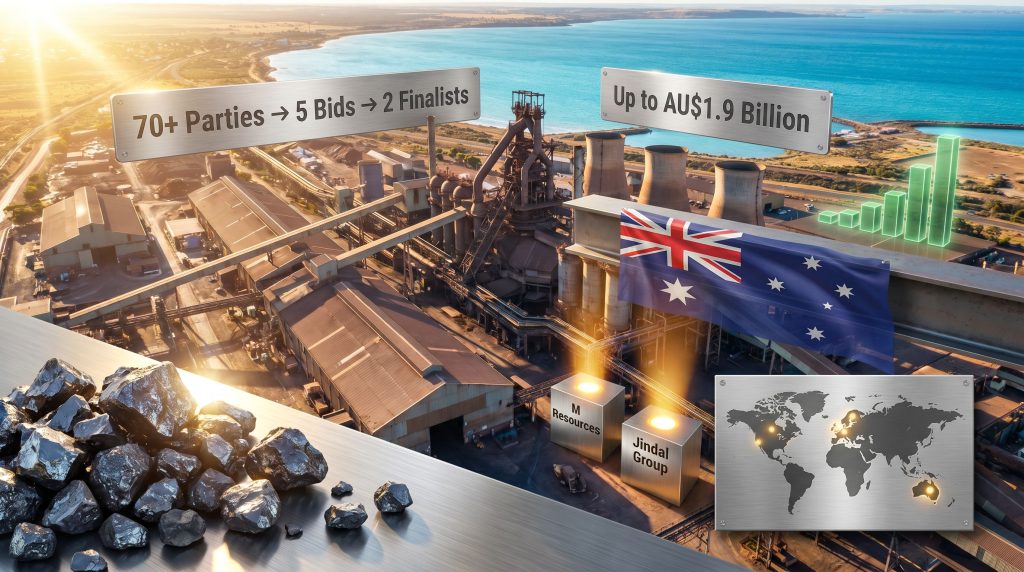
From 70 Parties to Two: How the Sale Process Unfolded
The competitive process that has now produced a final shortlist began with remarkable global interest. More than 70 parties from around the world submitted initial expressions of interest after the South Australian government moved the facility's former owner into administration in 2025. That intervention was designed to preserve the steelworks as a going concern rather than allow it to wind down under the weight of its financial obligations.
The field was progressively evaluated against a combination of strategic, financial, and technical criteria before being condensed to five binding bids earlier in 2026. Those five formal submissions were then subjected to further due diligence before the governments confirmed the final shortlist.
| Phase | Participating Parties | Outcome |
|---|---|---|
| Initial Expressions of Interest | 70+ global parties | Field narrowed to binding bid candidates |
| Binding Bid Submissions | 5 formal bids | Evaluated against strategic and financial criteria |
| Final Shortlist | 2 bidders | Invited to submit final funding proposals |
The speed and depth of international interest reflects a broader truth about what Whyalla actually represents: an integrated, pit-to-port steelmaking asset with direct access to world-class raw material inputs and significant optionality for low-emissions transformation. That combination is increasingly rare globally.
Who Are the Two Shortlisted Bidders?
M Resources: Domestic Roots and Steelmaking Experience
M Resources is an Australian-based resources trading and steelmaking operator with established experience in the domestic industry. Its positioning as a locally grounded player carries political and operational advantages in a transaction where sovereign considerations carry significant weight. A domestic operator brings continuity of industrial knowledge and an existing understanding of the regulatory, workforce, and supply chain dynamics that govern Australian steelmaking.
Jindal Group: Global Scale and Decarbonisation Credentials
The Jindal Group represents one of India's most significant integrated steel producers, with a global footprint that spans manufacturing, energy, and infrastructure. The group has articulated pathways toward low-emission steelmaking as part of its broader strategic direction, making it a credible contender against the decarbonisation benchmarks that both governments have embedded into the co-investment framework. Jindal's international scale also brings financial depth and the potential for export-oriented production strategies that could position Whyalla steel within Asian supply chains.
BlueScope's Right of Last Offer: A Silent Variable
Notably, BlueScope Steel, Australia's largest listed steelmaker, was not among the final bidders shortlisted for the sale. However, BlueScope retains a contractual right of last offer under the sale framework. This structural feature preserves the company's ability to re-enter the equation at the final decision stage under specific conditions, meaning the transaction is not fully resolved even once a preferred bidder is identified.
BlueScope's right of last offer introduces a layer of optionality into the final phase that neither shortlisted bidder can entirely discount. In competitive sale processes, such mechanisms are designed to protect the seller's ability to extract maximum value while preserving a strategic fallback.
| Criteria | M Resources | Jindal Group |
|---|---|---|
| Operational Background | Australian-based resources trading and steelmaking | Global integrated steel producer with Indian origins |
| Green Steel Alignment | Under evaluation | Has articulated low-emission transition pathways |
| Strategic Rationale | Domestic supply chain integration | Export-oriented and green steel transition |
| Geographic Advantage | Local regulatory and workforce familiarity | International capital and scale |
The AU$1.9 Billion Co-Investment: What the Money Is Actually For
The combined federal and South Australian government commitment of up to AU$1.9 billion is perhaps the most scrutinised element of the entire transaction. It is critical to understand what this funding is and is not designed to do.
The co-investment is structured around modernisation and decarbonisation objectives. It is not a subsidy for legacy blast furnace operations running at status quo. The capital is explicitly tied to transforming the site toward low-emissions steelmaking, capitalising on the Upper Spencer Gulf's magnetite resource endowment and the region's renewable energy potential.
Separately, both governments have been jointly covering administration costs throughout the sale process to maintain safe operations, ensure wages and supplier obligations are met, and fund critical preparatory works. This ongoing exposure adds financial urgency to reaching a final decision quickly, with each additional week of administration incrementally increasing cumulative taxpayer liability.
Key objectives the co-investment is designed to address include:
- Transitioning the facility away from carbon-intensive blast furnace operations toward lower-emission alternatives
- Upgrading critical infrastructure to modern operational standards
- Supporting workforce continuity and retraining through the technological transition
- Enabling the incoming owner to begin production under financially viable conditions
- Unlocking the long-term value embedded in the Upper Spencer Gulf magnetite deposits
The Magnetite Advantage: Why This Asset Is Geologically Exceptional
One of the least appreciated dimensions of the Whyalla investment thesis is the quality of the raw material resource sitting beneath and around the Upper Spencer Gulf region. The area hosts magnetite iron ore deposits recognised as being among the highest-grade globally, and this geological reality reshapes the economics of what the site can become. Understanding iron ore types and deposits helps contextualise why this distinction matters so significantly to the investment case.
Magnetite is fundamentally different from the hematite ore that dominates Australia's iron ore export sector. While hematite requires relatively straightforward crushing and screening, magnetite demands beneficiation processing to upgrade its iron content. The reward for that additional processing effort is a product with iron grades typically exceeding 67-68% Fe after concentration, compared to the 57-62% Fe range common in direct-shipping hematite products. Furthermore, the unique magnetite properties and composition make it particularly well-suited to advanced reduction processes.
High-grade magnetite concentrate is precisely the feedstock that next-generation green steelmaking processes prefer. Direct reduction iron (DRI) technology, which is central to hydrogen iron ore reduction, performs most efficiently with iron ore pellets produced from beneficiated magnetite concentrate. This creates a direct technological alignment between what the Upper Spencer Gulf can produce and where global steelmaking is heading.
This is not a speculative connection. The world's leading green steel projects, including HYBRIT in Sweden and the hydrogen-based DRI transitions underway at ThyssenKrupp in Germany, are specifically designed around high-grade iron inputs. Whyalla's geological endowment positions it as a natural supplier to these processes, both domestically and potentially as an export product.
How Australia's Green Steel Ambitions Compare Globally
Australia is not alone in its efforts to decarbonise steelmaking, but the combination of assets at Whyalla creates a distinctive value proposition compared to analogous government-supported transitions elsewhere. In addition, South Australia green iron initiatives more broadly reinforce the region's strategic positioning within the global low-emissions steelmaking transition.
| Country | Facility/Initiative | Government Support | Decarbonisation Method |
|---|---|---|---|
| Australia | Whyalla Steelworks | Up to AU$1.9B co-investment | Magnetite DRI + renewables pathway |
| Sweden | HYBRIT (SSAB) | Government grants and EU funding | Hydrogen direct reduction |
| Germany | ThyssenKrupp | €2B+ federal support | Hydrogen-based DRI |
| United Kingdom | Tata Steel Port Talbot | £500M government package | Electric arc furnace transition |
What distinguishes the Australian case is the co-location of the raw material resource, the steelmaking facility, and access to renewable energy potential within a relatively compact geographic footprint. European green steel projects largely face a separation between their iron ore supply chains and their production facilities, requiring complex logistics for imported high-grade feedstocks. Whyalla's pit-to-port model eliminates much of that structural disadvantage.
The next major ASX story will hit our subscribers first
The Blast Furnace Problem: Operational Urgency and Restart Complexity
A factor adding acute pressure to the sale timeline is the status of the facility's blast furnace, which was shut down in April. Restarting an integrated blast furnace is not a simple switch-on exercise. The process involves a technically complex relining and heat-up sequence that takes months and requires significant capital outlay before a single tonne of steel is produced.
The longer the furnace remains cold, the greater the risk of deterioration to refractory linings and associated infrastructure, potentially increasing the capital requirement for restart. Every additional month without production also erodes the commercial relationships with downstream customers that any incoming owner will need to rebuild quickly.
Key operational challenges facing the incoming owner include:
- Executing a technically complex blast furnace restart under time and capital pressure
- Rebuilding customer relationships and order books disrupted by the administration period
- Restoring confidence among the existing workforce and retaining specialist technical knowledge
- Managing supplier relationships that may have been strained during administration
- Sequencing the long-term green steel transition alongside near-term production requirements
The Future Made in Australia Policy Context
Federal Industry Minister Tim Ayres has positioned the Whyalla transaction as central to the government's Future Made in Australia agenda. The policy framework reflects a broader shift in how Australian industrial policy is being conceived, with an emphasis on converting the country's raw material abundance into higher-value downstream products rather than simply exporting unprocessed minerals.
South Australian Premier Peter Malinauskas has similarly emphasised that the shortlisted bidders are well-resourced and aligned with the long-term vision for a modern, low-emission steelmaking operation built around the opportunities presented by the Upper Spencer Gulf's magnetite resource.
The political alignment between state and federal governments on this transaction is notable. Divergence between jurisdictional interests has complicated major industrial policy decisions in Australia before. In this case, the joint funding of administration costs and the shared co-investment framework signal a degree of coordinated commitment that provides incoming bidders with greater certainty about the policy environment they would be operating within.
What Happens Next in the Sale Process
With the Whyalla Steelworks bidders shortlisted to two parties, the process has entered its most commercially sensitive and consequential phase. Both M Resources and Jindal Group have now been invited to submit final funding proposals, which will be evaluated against the governments' strategic and financial criteria before a preferred buyer is selected. Local community reaction to the shortlisting has added further public interest to this already closely watched process.
The sequence of remaining steps includes:
- Final funding proposal submissions from both shortlisted bidders
- Government evaluation of proposals against decarbonisation, financial, and operational criteria
- Selection of a preferred bidder and commencement of exclusive negotiations
- BlueScope's right of last offer potentially activated depending on the framework conditions
- Execution of binding transaction documents subject to regulatory and environmental approvals
- Transition of ownership and commencement of the co-investment deployment program
The timeline for completing this sequence has not been publicly confirmed, but the financial pressure created by ongoing administration costs provides a powerful incentive to move decisively.
Frequently Asked Questions: Whyalla Steelworks Bidders Shortlisted
Who are the two shortlisted bidders for the Whyalla Steelworks?
The two parties shortlisted to acquire the Whyalla Steelworks are M Resources and Jindal Group. Both have been invited to submit final funding proposals as the sale process moves into its concluding phase.
How many parties originally expressed interest in buying Whyalla?
More than 70 parties from around the world submitted initial expressions of interest. This was progressively reduced to five binding bids before being narrowed to the current shortlist of two.
How much government co-investment is committed to the transaction?
The federal and South Australian governments have committed up to AU$1.9 billion in co-investment structured around modernisation and decarbonisation objectives. Both governments are also jointly funding ongoing administration costs during the sale process.
Is BlueScope Steel still part of the process?
BlueScope was not shortlisted among the final two bidders but retains a contractual right of last offer, which could allow it to re-enter the process at the final decision stage under specific conditions.
Why are Whyalla's magnetite resources significant?
The Upper Spencer Gulf's magnetite iron ore deposits produce high-grade concentrate after beneficiation, typically exceeding 67% Fe. This grade profile is particularly well-suited to direct reduction ironmaking processes that form the foundation of green steel production, giving the site long-term strategic relevance as global steelmaking decarbonises.
What is the current status of the blast furnace?
The blast furnace was shut down in April, creating a production gap that the incoming owner will need to address as a priority. Restarting the furnace is a capital-intensive and technically complex process that adds urgency to finalising the sale quickly.
Key Takeaways
- 70+ initial parties narrowed to 5 binding bids, now reduced to 2 final shortlisted bidders: M Resources and Jindal Group
- Government co-investment of up to AU$1.9 billion is tied explicitly to modernisation and decarbonisation, not legacy operations
- The blast furnace has been shut down since April, creating operational urgency and increasing capital requirements for the incoming owner
- BlueScope retains a right of last offer, introducing a final-stage wildcard into the transaction
- Whyalla's Upper Spencer Gulf magnetite deposits produce high-grade iron concentrate ideally suited to next-generation green steelmaking processes
- The transaction sits at the convergence of industrial policy, sovereign capability, green transition, and geological opportunity
- The pit-to-port asset model gives Whyalla a structural advantage over European green steel projects that face separated raw material and production geographies
This article is informational in nature and does not constitute financial or investment advice. Forward-looking statements regarding the sale process, government commitments, and bidder capabilities involve uncertainty and should not be relied upon as guarantees of future outcomes. Readers should conduct their own due diligence before making any investment or commercial decisions.
Want to Stay Ahead of the Next Major Resource Discovery?
Discovery Alert's proprietary Discovery IQ model delivers real-time alerts on significant ASX mineral discoveries the moment they hit the market, transforming complex resource data into clear, actionable investment insights — explore historic discoveries and their returns to understand the opportunity, then begin your 14-day free trial at Discovery Alert to position yourself ahead of the broader market.