June 5, 2026
The Hidden Cost of Deferred Maintenance in Heavy Industry
When a steel facility built in the 1960s struggles to maintain continuous operation in 2026, the problem is rarely mechanical in isolation. It is the cumulative consequence of decisions made across decades, ownership cycles, and investment regimes that prioritised short-term cost reduction over long-term asset integrity. Heavy industrial equipment does not fail suddenly; it deteriorates progressively, and each deferred maintenance cycle compounds the risk of the next.
This dynamic sits at the centre of the unfolding crisis at one of Australia's most strategically important industrial sites, where the Whyalla steelworks blast furnace shutdown has placed the future of domestic steel manufacturing under an unprecedented level of scrutiny.
When big ASX news breaks, our subscribers know first
Why the Whyalla Steelworks Blast Furnace Shutdown Matters Beyond Regional Economics
Sovereign Manufacturing and the Fragility of a Single Asset
Australia's capacity to produce steel domestically rests on a remarkably narrow foundation. The integrated steelworks at Whyalla represents one of only two locations in the country where raw iron ore is converted into finished steel products, making the site's operational continuity a matter of national industrial significance rather than simply a regional employment issue.
The Whyalla steelworks blast furnace shutdown, which has been ongoing since early April 2026, has exposed how precarious that foundation is. As of early May 2026, the furnace had been offline for approximately one month, with administrators KordaMentha having initially targeted a mid-May restart. No confirmed revised timeline has been provided.
What makes this shutdown particularly consequential is that it is not an isolated event. The furnace experienced comparable shutdowns in the years preceding administration, establishing a documented pattern of chronic operational instability. This is not a story about a single component failure; it is a story about what happens when critical infrastructure approaches the end of its engineered working life without adequate capital reinvestment.
The Accumulated Weight of Maintenance Debt
The concept of maintenance debt is not widely discussed outside engineering and industrial finance circles, but it is central to understanding the Whyalla situation. Maintenance debt refers to the accumulated cost of deferred upkeep: every inspection skipped, every component allowed to wear beyond its replacement threshold, every upgrade postponed in favour of short-term operational expenditure savings.
The Whyalla blast furnace was originally commissioned in the 1960s, making it more than six decades old. South Australian Premier Peter Malinauskas publicly characterised the furnace as an asset that had been allowed to deteriorate significantly under the stewardship of prior owner GFG Alliance, describing it as machinery that had been run down and inadequately maintained, creating extreme difficulty in sustaining reliable output.
Each shutdown-and-restart cycle on a furnace of this age carries elevated technical and safety risk. The restart process itself, as Premier Malinauskas acknowledged, is a risky operational undertaking, not a routine procedure. This risk profile compounds with each cycle, as thermal stress, refractory lining wear, and structural fatigue accumulate in ways that cannot be fully reversed through standard maintenance interventions.
Industry Insight: In blast furnace metallurgy, the refractory lining that protects the furnace shell from extreme heat has a finite operational lifespan, typically measured in campaign years. Once a lining approaches exhaustion, operators face a binary choice: reline the furnace at substantial cost and with extended downtime, or continue operating with increasing safety and reliability risk. For a furnace of Whyalla's age, relining may no longer be economically rational when weighed against the capital cost of replacement technology.
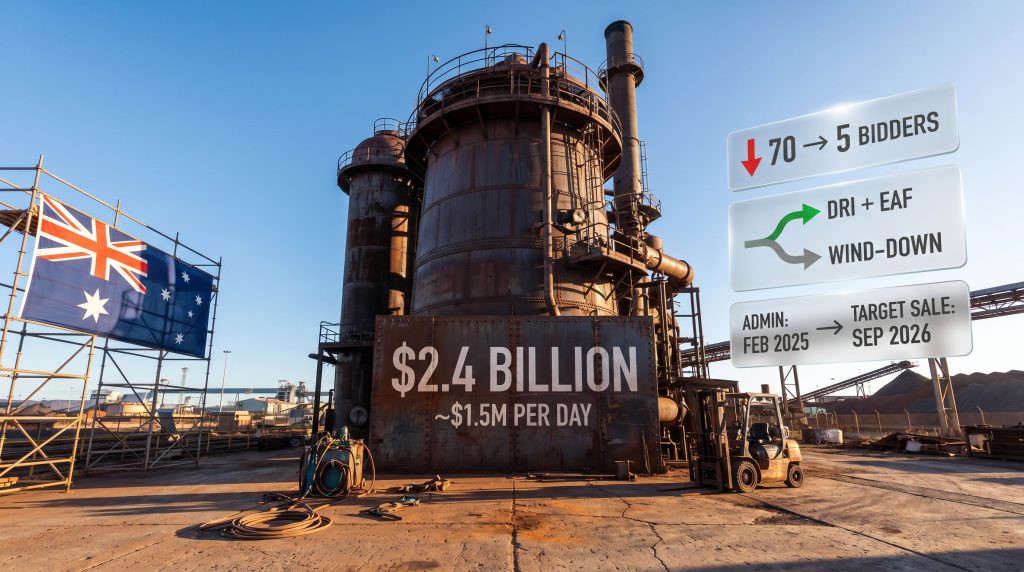
The financial consequences of downtime are significant. Operational losses during shutdown periods are estimated at approximately $1.5 million per day, a figure that accumulates rapidly across weeks of inactivity and directly increases the financial pressure on administrators managing the sale process.
Administration Timeline and the Narrowing Bidder Field
From Seventy Expressions of Interest to Five Shortlisted Consortia
The Whyalla steelworks entered administration in February 2025, when the South Australian government intervened following the collapse of GFG Alliance's ownership. The administrator, KordaMentha, initiated a formal sale process that initially attracted approximately 70 expressions of interest, reflecting the significant strategic value attached to the asset despite its operational challenges.
That field has since narrowed to five shortlisted consortia, with a further reduction to two preferred bidders expected during May 2026. The target completion date for the sale is September 2026, giving the process a defined commercial deadline that is now directly affected by the ongoing blast furnace outage.
The most prominent publicly identified participant is BlueScope Steel, Australia's largest steelmaker, which is leading a consortium of international steel producers in the bidding process. BlueScope CEO Tania Archibald has been candid about the conditions under which any acquisition would need to proceed, stating that a purchase must ultimately demonstrate commercial viability for shareholders and that significant obstacles remain before any final decision can be made.
It is worth noting that this is the second time within a decade that the Whyalla steelworks has entered administration, a history that any prospective buyer must incorporate into their risk assessment and acquisition pricing.
The Financial Architecture Supporting the Sale
The combined federal and South Australian government financial commitment to the Whyalla sale process stands at $2.4 billion, designed to underpin a commercially viable outcome and provide prospective buyers with certainty about the transition funding environment. An earlier South Australian state budget contingency allocation of $384 million preceded this broader package and was deployed to sustain operations during the administration period.
The financial context for any buyer includes navigating a debt burden of approximately $1.3 billion that accompanied the asset into administration. The South Australian government has explicitly ruled out acquiring the steelworks itself, framing its role as a facilitator of a commercially sustainable private sector outcome rather than a prospective owner.
| Financial Metric | Figure |
|---|---|
| Combined government rescue package | $2.4 billion |
| State budget contingency allocation | $384 million |
| Total debt at administration entry | ~$1.3 billion |
| Estimated daily operational losses during downtime | ~$1.5 million |
| Administration commencement | February 2025 |
| Target sale completion | September 2026 |
What the Blast Furnace Shutdown Means for Whyalla Workers
Employment Uncertainty in a Single-Industry Region
Whyalla is a city of approximately 20,000 people located around four hours' drive from Adelaide, and its economic identity is inseparable from the steelworks. The facility underpins not only direct steelmaking employment but also associated iron ore mining and port operations, creating a web of economic dependence that extends through local businesses, services, and community institutions.
Premier Malinauskas has maintained a position of public reassurance regarding employment, emphasising that the government's priority is preserving jobs at the steelworks. However, he simultaneously acknowledged that the transition period carries genuine employment risk, conceding that some form of workforce impact is a realistic possibility depending on how the sale process resolves and which technology pathway a new owner pursues.
The Premier framed this uncertainty honestly: the timing of the blast furnace's end-of-life transition was always going to present challenges, and the current outage has simply brought those challenges into sharper focus ahead of a final commercial decision being made.
Workforce Implications of a Technology Transition
The shift from a blast furnace model to an electric arc furnace and Direct Reduction Iron configuration carries meaningful implications for workforce composition that are not always well understood by observers outside the steel industry.
A traditional coal-fired blast furnace operation requires a specific and substantial workforce configuration, including ironmaking crews, coke plant operators, and associated maintenance specialists. An electric arc furnace, by contrast, is generally less labour-intensive in raw operational terms, though it creates demand for different technical skills including electrical systems engineering, scrap processing expertise, and process control technology management.
If the transition to DRI-based production proceeds, the workforce impact timeline will be directly linked to the pace of infrastructure deployment, which is unlikely to result in operational DRI output before the early 2030s given infrastructure lead times for facilities of this scale.
Policy Watch: Until a buyer is confirmed and a technology pathway is formally committed to, workforce certainty at Whyalla remains contingent on commercial decisions that have not yet been made. Any transition support programmes would need to be structured around the specific technology choice of the incoming owner, making early programme design difficult.
The Technology Question: What Replaces a Sixty-Year-Old Blast Furnace?
Direct Reduction Iron and the Green Steel Pathway
The long-term vision for Whyalla, as articulated by both government and the leading bidder consortium, centres on transitioning from coal-fired blast furnace ironmaking to a Direct Reduction Iron and electric arc furnace configuration. Understanding what this means in practice is essential to assessing the commercial and operational outlook.
In a conventional blast furnace, iron ore is smelted using metallurgical coal as both a fuel and a chemical reductant, producing liquid iron (hot metal) that is then processed into steel. This is a carbon-intensive process that has been the global standard for more than 150 years.
Direct Reduction Iron production instead uses natural gas (or, in future scenarios, hydrogen iron ore reduction) as the reductant, converting iron ore into a solid metallic iron product known as DRI or sponge iron without reaching the molten stage. This DRI is then fed into an electric arc furnace, which uses electrical energy to melt and refine the material into finished steel. The resulting production chain is substantially lower in carbon intensity compared to the conventional blast furnace route, particularly where the electricity input comes from renewable sources.
Whyalla's high-quality magnetite iron ore deposits are particularly well-suited to DRI production, as magnetite concentrates can achieve the high iron grades required for efficient DRI operation. This is a genuine input advantage that distinguishes Whyalla from many other potential DRI sites globally. Furthermore, the broader push for green iron production across the industry means Whyalla's transition aligns with international decarbonisation trends rather than running against them.
Gas Supply as the Critical Commercial Variable
BlueScope CEO Tania Archibald quantified the gas requirements for DRI-based steelmaking at Whyalla as approximately 15 to 20 million gigajoules per annum, an enormous volume that immediately identifies gas price as the central commercial variable in any business case.
The competitive pressure is formidable. A DRI operation at Whyalla would be competing against:
- Subsidised, marginal blast furnace producers operating out of the China steel and iron ore market, where state support compresses effective production costs well below market rates
- Ultra-low-cost gas DRI hubs concentrated in the Middle East, particularly in Saudi Arabia and the UAE, where structural gas prices are significantly below what is achievable in Australia under any foreseeable supply scenario
The South Australian government has responded to this challenge by securing key terms with Santos to establish what it describes as the South Australian Strategic Gas Reserve. Under this arrangement, Santos will supply 20 petajoules of gas per annum at a competitive long-term price for 10 years commencing in 2030, providing a foundation of supply certainty for prospective buyers during the transition period.
South Australian Mining and Energy Minister Tom Koutsantonis has stated that the government has long understood that reliable and competitively priced gas is essential to the transformation of steelmaking at Whyalla, and that the Santos agreement is specifically designed to provide buyer certainty as the sale process progresses.
| Gas Supply Parameter | Detail |
|---|---|
| Estimated DRI gas requirement | 15 to 20 million GJ per annum |
| Santos Strategic Reserve supply volume | 20 petajoules per annum |
| Agreement duration | 10 years |
| Supply commencement | 2030 |
| Price structure | Competitive long-term fixed terms |
Technical Note: One petajoule equals approximately one million gigajoules. The Santos commitment of 20 petajoules per annum therefore sits at the lower boundary of the estimated 15 to 20 million GJ annual requirement, meaning supplementary gas sources or demand efficiency improvements would likely be needed to fully support DRI operations at commercial scale.
Assessing Commercial Viability: Three Possible Futures for Whyalla
The Investor's Dilemma: Strategic Value Versus Execution Risk
Any prospective acquirer of the Whyalla steelworks is not simply buying a steel plant; they are making a capital allocation decision with multiple interdependent risk variables. The asset carries genuine strategic value: proximity to high-quality magnetite iron ore, existing port infrastructure capable of supporting export operations, and a substantial government financial commitment designed to bridge the transition period.
Against these advantages sits a set of execution risks that BlueScope's own CEO has characterised with notable candour. The capital requirement for a full DRI and electric arc furnace transition is described as very large and currently undefined, two characteristics that create significant challenge for investment committee approvals in any publicly listed company.
The ongoing Whyalla steelworks blast furnace shutdown adds a further layer of complexity: each additional week of lost production increases the asset's financial distress, potentially affecting acquisition pricing and the confidence of bidders who must model restart or decommissioning costs into their offers.
Scenario Analysis: Three Pathways Forward
Scenario 1: Full Green Steel Transition
A well-capitalised consortium acquires the steelworks and commits to a complete technology transition, deploying DRI and electric arc furnace infrastructure with the Santos gas agreement as the supply foundation. Green steel pricing dynamics will play a critical role in whether this scenario generates acceptable returns over the investment horizon. Government funding bridges the capital gap across the construction period, and Whyalla emerges as a functioning green steel production site in the early 2030s. This scenario delivers the highest strategic outcome but carries the greatest capital risk and longest timeline to positive returns.
Scenario 2: Scaled-Back EAF Operation Using Scrap
A buyer acquires the steelworks but elects to defer the full DRI transition, instead deploying a scrap-fed electric arc furnace as a lower-capital interim solution. Blast furnace operations are wound down progressively, reducing but not eliminating the workforce impact. Whyalla retains a steel industry presence at reduced scale, with the DRI pathway preserved as a future option subject to capital availability and gas price competitiveness.
Scenario 3: Partial Wind-Down
No commercially viable bid emerges by the September 2026 deadline, or the terms offered are insufficient to proceed. Steelmaking operations are wound down in an orderly fashion, while iron ore mining and port operations continue under separate ownership arrangements. This scenario would represent a significant regional economic contraction for Whyalla and would mark the end of integrated steelmaking at the site.
Investor Note: The blast furnace shutdown in April and May 2026 has compressed the effective decision timeline for all parties. Administrators, bidders, and government stakeholders are now operating with heightened urgency, as each week of continued downtime increases financial losses and narrows the window for a commercially attractive transaction.
The next major ASX story will hit our subscribers first
Global Context: How Whyalla Compares to International Steel Transitions
Precedents From Other Legacy Facilities
The challenge facing Whyalla is not unique in global terms, though the specific combination of factors makes it particularly complex. Tata Steel's transition at its Port Talbot facility in Wales provides a relevant comparison: a similarly aged, integrated steelworks undergoing a planned transition to electric arc furnace technology, accompanied by significant workforce restructuring and government co-investment. The Port Talbot experience demonstrated that technology transitions of this scale take years to execute and carry substantial human and financial costs that are difficult to fully anticipate at the outset.
ArcelorMittal's decarbonisation investment programme across its European facilities provides a benchmark for the capital intensity involved. The company has committed billions of euros to transitioning individual facilities toward DRI-based production, with individual site investments running into multiple billions and construction timelines spanning several years before operational output begins.
The Middle Eastern comparison is structurally important and frequently underappreciated. Gulf state DRI producers operate with gas prices that are structurally anchored by domestic energy pricing policies rather than international market rates, giving them a persistent cost advantage that no Australian producer can replicate through negotiation alone. This is not a temporary market condition; it reflects a fundamental difference in energy economics between hydrocarbon-endowed economies and industrialised nations that must source gas at market rates.
What Distinguishes Whyalla From a Generic Legacy Steel Site
Despite the competitive headwinds, Whyalla possesses characteristics that justify serious consideration from strategic investors. In addition, the emerging opportunity around South Australian green iron positions the state as a potential leader in lower-carbon steelmaking across the Asia-Pacific region. Specifically, Whyalla offers:
- High-quality magnetite iron ore deposits in close proximity to the processing facility, reducing logistics costs and providing a premium input for DRI production
- Existing deep-water port infrastructure capable of handling both raw material imports and finished product exports, representing capital that would cost significantly more to replicate from greenfield
- A government financial commitment at a scale that is genuinely unusual in comparable international transitions, reducing the risk profile for private capital
- Australia's geographic position as a potential supplier of green steel to Asian markets, where demand for lower-carbon manufactured products is growing as industrial decarbonisation policies intensify across Japan, South Korea, and increasingly China
The Four Conditions That Determine Whyalla's Future
The path to a commercially sustainable outcome at Whyalla is navigable, but it requires simultaneous fulfilment of several conditions that are not yet locked in:
- A committed, well-capitalised acquirer with both the technical capability and the balance sheet to execute a multi-billion-dollar technology transition, not merely sustain legacy operations through the next operational cycle
- Gas price certainty beyond the Santos agreement horizon, since the 10-year supply commitment from 2030 provides a foundation but does not address the long-term investment horizon required to justify DRI infrastructure at the scale needed
- Effective deployment of the government financial package, with clear milestones tied to commercial performance rather than political optics, ensuring public capital is directed toward genuinely productive infrastructure
- A credible workforce transition strategy developed in collaboration with unions, workers, and state employment agencies, designed to manage the shift from blast furnace to electric arc furnace skill requirements without triggering a broader regional economic crisis
The outcome at Whyalla will carry implications well beyond the city itself. It will establish a reference point for how Australia manages the transition of legacy heavy industry assets in the face of global decarbonisation pressure, sovereign manufacturing priorities, and the commercial realities of competing in capital-intensive industries against structurally advantaged international competitors.
Frequently Asked Questions: Whyalla Steelworks Blast Furnace Shutdown
Why Has the Whyalla Blast Furnace Been Shut Down?
The furnace has been offline since early April 2026 due to maintenance requirements on infrastructure that is more than six decades old and has experienced chronic underinvestment across multiple ownership periods. The shutdown reflects accumulated maintenance debt rather than an isolated mechanical failure, and each restart cycle on equipment of this age carries elevated safety and operational risk.
How Long Has the Blast Furnace Been Offline?
As of early May 2026, the furnace has been offline for approximately one month. Administrators had initially targeted a mid-May restart, but no confirmed revised timeline has been provided as of the date of available reporting.
Will Workers Lose Their Jobs?
The South Australian Premier has acknowledged that some workforce impact is a realistic possibility during the transition period, with the extent dependent on which buyer acquires the steelworks and what technology pathway they select. No specific redundancy numbers have been announced.
What Technology Is Planned to Replace the Blast Furnace?
The long-term plan involves a transition to Direct Reduction Iron production paired with an electric arc furnace, a lower-carbon configuration that uses natural gas rather than metallurgical coal as the primary process input.
How Much Government Funding Has Been Committed?
Combined federal and South Australian government support totals approximately $2.4 billion, with an earlier state contingency allocation of $384 million also in place to sustain operations during the administration period.
When Will the Sale Be Finalised?
The target completion date is September 2026. The bidder shortlist is expected to narrow from five to two preferred parties during May 2026.
What Is the Santos Gas Supply Agreement?
The South Australian government has secured an agreement with Santos to supply 20 petajoules of gas per year for 10 years from 2030, specifically to support the transition to lower-carbon steelmaking and to provide prospective buyers with supply certainty during the sale process.
This article is based on publicly available reporting and official statements. Forward-looking scenarios and commercial assessments represent analytical frameworks rather than confirmed outcomes. Readers should not rely on this content as financial or investment advice. The Whyalla steelworks sale process is ongoing, and material developments may occur after the date of publication.
Want to Stay Ahead of the Next Major Australian Resource Discovery?
While the future of Whyalla's steelmaking hinges on critical decisions around iron ore, gas supply, and green steel infrastructure, Discovery Alert's proprietary Discovery IQ model delivers real-time alerts on significant ASX mineral discoveries — instantly translating complex resource data into actionable investment insights for both traders and long-term investors. Explore historic discoveries and the returns they generated, then begin your 14-day free trial at Discovery Alert to position yourself ahead of the market on the next major find.