May 23, 2026
Strategic Resource Security Through Domestic Production Capabilities
Australia's industrial sovereignty increasingly depends on maintaining strategic production capabilities within sectors considered critical to national security. Steel manufacturing represents one such cornerstone industry, where supply chain disruptions or international dependencies can create vulnerabilities across defence, infrastructure, and manufacturing sectors. The global pandemic demonstrated how quickly international supply chains could fragment, leaving nations exposed when domestic alternatives remained underdeveloped or financially unsupported.
Within this context, magnetite-based steel production offers Australia unique competitive positioning. Unlike many international facilities dependent on imported raw materials, integrated operations that combine mining, concentration, and steel production within single geographic regions provide substantial resilience against external supply shocks and currency fluctuations.
When big ASX news breaks, our subscribers know first
What Makes the Whyalla Steelworks Expansion Strategically Critical for Australia?
Unique Industrial Asset Positioning in Global Steel Markets
The Whyalla steelworks expansion represents a rare convergence of geological advantage and industrial integration. Located approximately 56 kilometres from the Iron Duke magnetite mining operations in South Australia's Middleback Ranges, this facility operates as an integrated complex combining magnetite extraction, concentration, pelletising, and steelmaking within a unified supply chain framework.
This geographic integration provides significant cost advantages compared to facilities requiring imported feedstock. Transportation costs remain minimal, currency exposure is eliminated, and supply chain timing becomes predictable rather than subject to international shipping variables or port congestion issues. Furthermore, these Australian iron ore advantages position the facility competitively against global competitors.
The Magnetite Expansion Project Phase 1 (MEP1) is designed to facilitate production of up to 2.5 million tonnes of magnetite annually, according to backing Whyalla's future expansion. This production capacity supports long-term supply certainty while extending operational life by more than 20 years, providing substantial security for downstream steel production planning.
Strategic Resource Security Through Domestic Supply Chains
Australia's steel production capabilities face ongoing challenges from import dependency despite the nation's world-class iron ore resources. The Middleback Ranges magnetite deposits offer estimated reserves supporting decades of continuous operation, providing feedstock security that insulates operations from iron ore price trends and international commodity price volatility.
Key Resource Advantages:
- Estimated 21-year mine life extension through MEP1 development
- Direct control over quality specifications and delivery timing
- Protection against international supply chain disruptions
- Reduced exposure to currency fluctuations on raw material costs
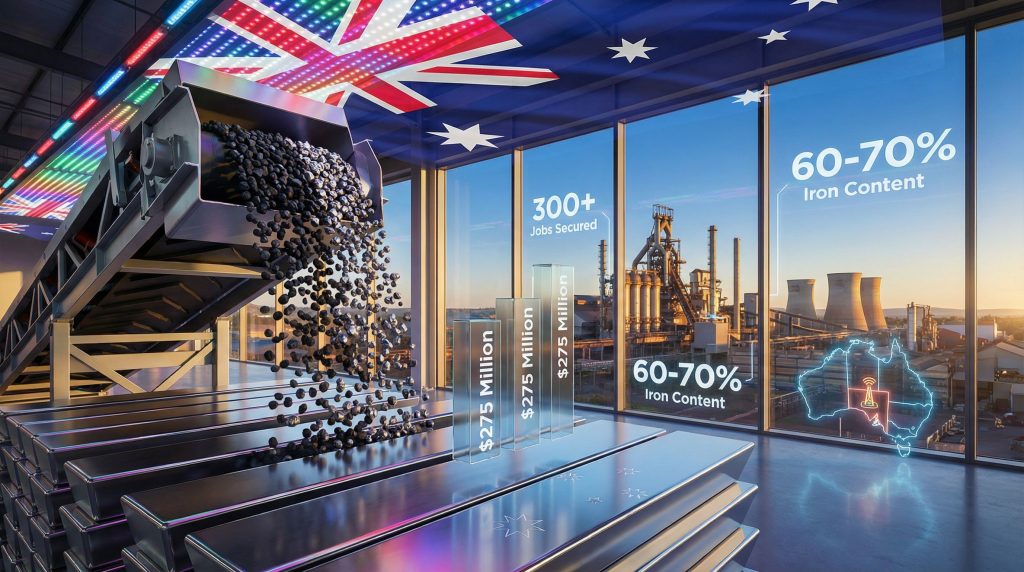
Federal Industry and Innovation Minister Tim Ayres emphasised the strategic importance of this resource base, stating that the project leverages a world-class magnetite resource with an estimated 21-year mine life while supporting more than 300 jobs and the transition to low-emissions iron and steelmaking in South Australia.
How Does the $275 Million Government Investment Framework Support Industrial Transformation?
Joint Federal-State Funding Architecture
The $275 million government funding package announced in July 2025 demonstrates unprecedented coordination between federal and state authorities in supporting heavy industry transformation. This bipartisan commitment includes a $20 million loan for magnetite expansion early works, with costs shared equally between Australian and South Australian governments.
The funding framework extends beyond immediate operational support to encompass broader industrial ecosystem stabilisation. Following GFG Alliance's placement into administration in early 2025, governments jointly funded a $2.4 billion support package, including assistance for local suppliers affected by operational disruptions.
Funding Package Components:
- Early works development funding for geotechnical drilling and construction planning
- Infrastructure modernisation support for facility upgrades
- Workforce development initiatives ensuring skills continuity
- Technology transition assistance supporting green steel capabilities
Employment Stabilisation and Regional Economic Impact
The Whyalla steelworks expansion directly secures more than 300 regional jobs while supporting broader supply chain employment across South Australia's industrial corridor. This employment base represents critical skilled workforce retention in regional areas where alternative industrial employment opportunities remain limited.
Regional economic modelling suggests significant multiplier effects, where each steelworks position supports additional employment in related industries including logistics, maintenance services, engineering support, and local commercial activities. Consequently, the preservation of this employment base becomes particularly important given the specialised nature of steelmaking skills and the long training periods required for workforce replacement.
What Role Does Magnetite Play in Australia's Green Steel Transition Strategy?
Technical Advantages of Magnetite in Low-Emission Steel Production
Magnetite ore contains significantly higher iron content compared to hematite alternatives, typically ranging from 60-70% iron concentration. This characteristic becomes crucial for direct reduced iron (DRI) production methods that form the foundation of green steel manufacturing processes.
DRI technology reduces iron oxides using hydrogen or carbon monoxide at temperatures lower than traditional blast furnace operations, thereby reducing carbon intensity. The higher iron content in magnetite ore improves efficiency metrics in these processes, requiring less energy input per unit of steel produced and reducing overall emissions profiles. Additionally, renewable energy transformations in the mining sector support these low-emission production goals.
South Australian Energy and Mining Minister Tom Koutsantonis highlighted magnetite's strategic role, noting that magnetite serves as a critical input for lower-emissions steel and green iron production, while South Australia holds some of the world's largest magnetite resources.
Competitive Positioning Against International Green Steel Projects
Comparative Analysis of Green Steel Development:
| Facility Advantage | Whyalla Expansion | International Competitors |
|---|---|---|
| Raw Material Access | On-site magnetite mining | Imported ore dependency |
| Infrastructure Integration | Existing rail and port facilities | Greenfield development required |
| Skilled Workforce | Established training programs | New workforce development needed |
| Government Support | $275M bipartisan commitment | Variable policy support levels |
| Renewable Energy Access | South Australia's renewable corridor | Mixed energy profile regions |
International green steel projects in Europe and Asia often require substantial infrastructure development and face ongoing uncertainty regarding raw material supply chains. However, the Whyalla steelworks expansion leverages existing infrastructure while maintaining direct control over feedstock quality and availability.
How Do Current Ownership Dynamics Affect Long-Term Strategic Positioning?
Administration Process and Strategic Buyer Analysis
The sale process for Whyalla steelworks has attracted significant international interest, with five domestic and international industrial groups shortlisted for binding bids following initial interest from more than 70 parties worldwide. More than 10 international delegations from Japan, Korea, India, Vietnam, and Europe have conducted site visits during due diligence processes.
This level of international interest demonstrates confidence in the facility's long-term viability and strategic importance within global steel markets. Binding bids are expected within months, according to steelworks bidders revealed, suggesting resolution of ownership uncertainty in the near term.
Technology Transfer and Modernisation Opportunities
Potential acquisition by established international steel producers could accelerate technology adoption, particularly in green hydrogen integration and advanced manufacturing processes. Strategic partnerships with Asian steel groups offer pathways to advanced production methodologies and access to established export markets.
Japanese and Korean steel companies bring particular expertise in efficiency optimisation and quality control systems, while Indian industrial groups offer experience in cost-effective production scaling. In addition, European interest may provide access to cutting-edge decarbonisation technologies and certification frameworks for green steel products.
What Are the Long-Term Supply Chain Implications for Australian Manufacturing?
Domestic Steel Security and Import Dependency Reduction
Australia faces ongoing challenges in steel supply security despite possessing world-class iron ore resources for export. Expanded Whyalla production capacity could significantly reduce import dependency while supporting domestic manufacturing competitiveness across construction, automotive, and infrastructure sectors. These iron ore demand insights highlight the strategic importance of domestic production capabilities.
Domestic steel production provides several strategic advantages beyond cost considerations:
- Shorter delivery timelines for urgent projects
- Custom specification capabilities for specialised applications
- Reduced exposure to international trade disputes or tariff changes
- Enhanced security for defence and critical infrastructure projects
Integration with Renewable Energy Infrastructure
South Australia's renewable energy abundance positions Whyalla advantageously for green hydrogen production, essential for future low-emission steel manufacturing. The state achieved 65% renewable electricity generation in recent years, with significant wind and solar capacity providing stable, low-cost clean energy input for hydrogen production processes.
This renewable energy integration becomes increasingly valuable as international markets implement carbon border adjustment mechanisms and green steel certification requirements. For instance, early adoption of hydrogen-based production methods could provide competitive advantages in export markets prioritising low-carbon steel products.
The next major ASX story will hit our subscribers first
How Does This Expansion Compare to Global Steel Industry Transformation Trends?
International Benchmarking and Competitive Analysis
Global steel producers are investing heavily in decarbonisation technologies, with European Union facilities leading green steel transition efforts through substantial government support programs. Asian producers, particularly in Japan and South Korea, are developing hydrogen-based direct reduction technologies while maintaining cost competitiveness.
The Whyalla steelworks expansion aligns with these international trends while leveraging Australia's unique resource and energy advantages. Unlike European facilities dependent on imported hydrogen or Asian operations facing air quality constraints, South Australia's combination of magnetite resources and renewable energy provides integrated competitive positioning. However, the US-China trade war impact continues to influence global steel market dynamics.
Market Positioning for Future Steel Demand
Projected Demand Scenarios for Australian Steel Production:
- Infrastructure development requirements supporting population growth and urbanisation
- Renewable energy equipment manufacturing for domestic and export markets
- Export opportunities to Asia-Pacific construction and manufacturing sectors
- Defence and strategic industry applications requiring supply chain security
- Premium pricing opportunities for certified low-carbon steel products
Government infrastructure spending commitments and renewable energy transition requirements suggest sustained domestic demand growth, while international carbon pricing mechanisms may create export opportunities for low-emission Australian steel products.
What Risks and Opportunities Define the Project's Success Probability?
Technical and Operational Risk Assessment
Key operational risks include magnetite processing complexity, skilled workforce availability, and integration challenges between mining and steel production operations. However, existing infrastructure and proven reserves significantly mitigate these concerns compared to greenfield development alternatives.
Magnetite beneficiation requires specialised flotation and magnetic separation processes, demanding technical expertise and consistent operational performance. Consequently, the expansion builds on existing capabilities rather than requiring completely new technology implementation, reducing technical execution risks.
Risk Mitigation Factors:
- Established operational history at both mining and steelmaking facilities
- Government funding support reducing financial execution risks
- Experienced workforce base with transferable skills
- Proven geological resources with established quality characteristics
Market and Economic Opportunity Analysis
Growing demand for low-emission steel products creates premium pricing opportunities as international carbon pricing mechanisms expand. European Union carbon border adjustments and similar policies in development worldwide may provide competitive advantages for Australian low-carbon steel exports.
Domestic market protection through buy-Australian policies and infrastructure spending commitments provide stable revenue foundations while export opportunities develop. Furthermore, the combination of resource security, renewable energy access, and government support creates favourable conditions for long-term profitability.
Market Opportunity Indicators:
- International green steel certification premiums ranging 10-30% above conventional steel
- Australian government infrastructure spending commitments exceeding $100 billion
- Asia-Pacific construction market growth projections of 4-6% annually
- Defence sector requirements for supply chain security and local content
Strategic Risk Scenarios and Mitigation Frameworks
Technology Transition Uncertainty
The shift toward hydrogen-based steel production involves technological risks that could affect investment returns and operational efficiency. While direct reduced iron technology using hydrogen is proven at pilot scale, commercial implementation at full production scale requires substantial capital investment and operational optimisation.
Mitigation strategies include phased technology adoption, maintaining flexibility for multiple reduction pathways, and leveraging government research and development support programs. In addition, the existing blast furnace infrastructure provides operational continuity during transition periods.
International Competition and Trade Policy Dynamics
Global steel markets face ongoing volatility from trade disputes, dumping allegations, and shifting international demand patterns. Australian steel production must remain competitive against subsidised international producers while maintaining quality and delivery reliability.
Strategic positioning through vertical integration, quality differentiation, and specialised product development can reduce exposure to commodity steel price competition. However, focus on high-value applications and certified green steel products may provide sustainable competitive advantages.
Disclaimer: This analysis involves forward-looking projections and market assessments that are inherently uncertain. Investment decisions should consider comprehensive due diligence including technical feasibility studies, financial modelling, and independent market analysis. Government funding commitments and policy support may change based on political developments and budgetary constraints.
The Whyalla steelworks expansion represents a convergence of strategic resource advantage, technological opportunity, and policy support that positions Australia favourably within global steel market transformation. Success depends on effective coordination between government support, private investment efficiency, and technological advancement within an increasingly competitive international framework.
Ready to Capitalise on Australia's Strategic Resource Opportunities?
The Whyalla steelworks expansion highlights Australia's unique positioning in strategic resource sectors, where government support and geological advantages create substantial investment opportunities. Discovery Alert's proprietary Discovery IQ model delivers real-time alerts on significant ASX mineral discoveries, instantly empowering subscribers to identify actionable opportunities in steel, magnetite, and critical minerals ahead of the broader market. Begin your 14-day free trial today to position yourself ahead of Australia's strategic resource transformation.