June 16, 2026
Africa's Next Major Gold Discovery Is Already in the Ground
The global gold industry has spent decades grappling with a structural challenge that rarely makes front-page news: the cost and difficulty of finding new ounces. According to industry research published by S&P Global Market Intelligence, the average cost of discovering an ounce of gold through greenfield exploration has risen dramatically over the past two decades, with many analysts placing the industry average somewhere between US$30 and US$60 per ounce when accounting for total exploration expenditure relative to resources delineated. Against that backdrop, a discovery cost of less than US$3 per ounce is not merely impressive. It reframes the entire investment case for a project.
That is precisely the context in which the WIA Gold Kokoseb project in Namibia deserves to be evaluated. Not as a speculative junior mining story, but as a data-driven argument for capital efficiency in one of Africa's most stable mining jurisdictions. Furthermore, the numbers, the geology, and the development timeline all point in the same direction.
When big ASX news breaks, our subscribers know first
The Damaran Belt: A Geological Host That Has Been Hiding in Plain Sight
Why Namibia's Structural Architecture Matters for Gold Scale
Investors and geologists alike have long understood that the most productive gold systems on earth are not random. They follow structure. The Damaran Belt in Namibia is a Neoproterozoic orogenic belt that experienced multiple phases of deformation, metamorphism, and fluid migration — precisely the conditions that concentrate gold into economically viable deposits.
The WIA Gold Kokoseb project sits within approximately 2,700 km² of tenure in this belt, located in the Erongo Region roughly 320 km by road from Windhoek, Namibia's capital. What makes the Damaran Belt particularly compelling from a discovery standpoint is that it has historically attracted far less systematic modern exploration than comparable belts in West Africa or Australia's Yilgarn Craton. That gap between geological prospectivity and exploration intensity is exactly where discoveries of outsized scale tend to emerge. Consequently, gold exploration trends in underexplored belts like this one are drawing increasing institutional attention.
Orogenic gold systems hosted in metamorphic belts share a key characteristic: mineralisation tends to repeat at depth and along structural corridors, meaning surface resources often represent only a fraction of the system's total endowment.
Namibia as a Mining Jurisdiction: Underappreciated by the Market
Namibia has an established track record in large-scale mining. The Rössing and Husab uranium operations rank among the world's most significant, and Andrada Mining's Lithium Ridge project in the same Erongo Region has drawn considerable investor attention. However, Namibia's gold endowment remains comparatively underexplored, making Kokoseb's emergence as a multi-million-ounce system a genuinely significant development for the sector.
The country's mining governance framework, anchored by the Minerals (Prospecting and Mining) Act, provides a relatively transparent and predictable regulatory environment. The involvement of Epangelo Mining Company, Namibia's state-owned mining entity, as a 20% joint venture partner alongside WIA Gold's 80% interest under Exploration Licence EPL 4818, reflects the standard state-participation model used across Namibia's mining sector. This structure is a common feature of Namibian resource projects and does not constitute any form of project-specific government support or preferential treatment.
Decoding the 2.93 Million Ounce Resource: Grade, Cut-Off, and Economic Significance
The Resource in Numbers
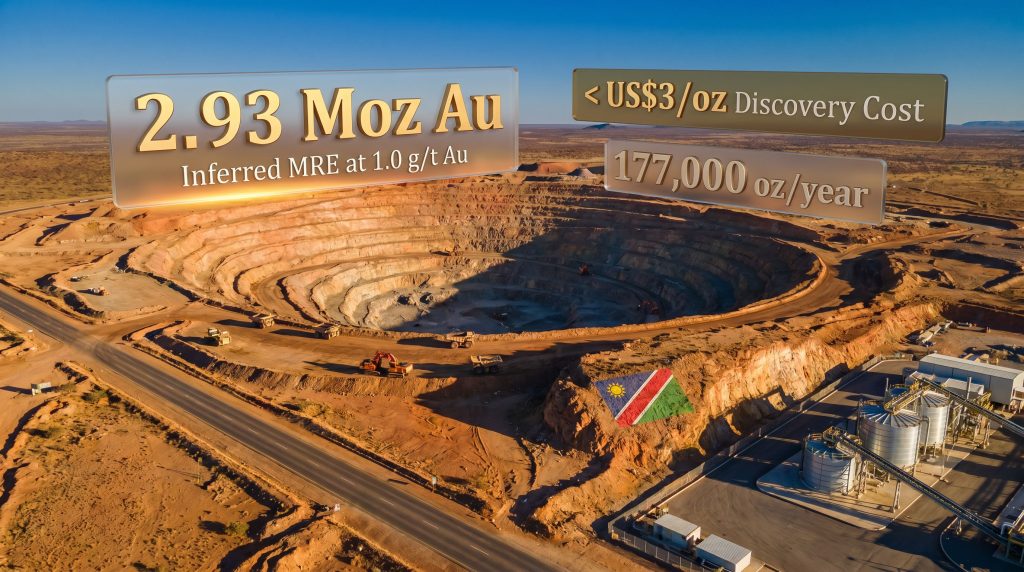
The April 2024 Inferred Mineral Resource Estimate for the WIA Gold Kokoseb project established a total resource of 2.93 million ounces of gold at an average grade of 1.0 g/t Au, using a cut-off grade of 0.5 g/t. Within that broader resource sits a higher-grade subset of considerable economic importance:
| Resource Category | Gold Ounces | Grade | Cut-Off Grade |
|---|---|---|---|
| Total Inferred MRE | 2.93 Moz | 1.0 g/t Au | 0.5 g/t |
| Higher-Grade Component | 1.53 Moz | 1.4 g/t Au | 0.80 g/t |
The distinction between these two subsets matters operationally. Open-pit gold mining economics at current gold prices, which have remained elevated above US$2,000 per ounce through 2024 and into 2025, are generally viable at grades of 0.8 g/t and above for large-scale operations with low strip ratios. Understanding cut-off grade economics is therefore central to evaluating whether a 1.0 g/t average across a 2.93 Moz resource sits comfortably within the economic range for conventional open-pit extraction — and in this case, it does.
The Sub-US$3/oz Discovery Cost: What It Really Means
In exploration economics, discovery cost is calculated by dividing the total exploration expenditure on a project by the number of resource ounces delineated. For Kokoseb, that figure sits at less than US$3 per ounce, a level that is extraordinary by any global benchmark.
To contextualise this:
- The global average discovery cost for gold has risen consistently since the early 2000s, driven by deeper drilling requirements, more complex geology, and higher operating costs
- S&P Global Market Intelligence data has repeatedly shown that the majority of recent major gold discoveries cost US$30 to US$60 per ounce or more to delineate
- Projects achieving discovery costs below US$10 per ounce are considered exceptional by institutional standards
- Sub-US$3/oz discovery cost implies that significant mineralisation was encountered early and efficiently, often a sign of a large, structurally coherent system rather than isolated pods of ore
A low discovery cost does not guarantee project economics, but it dramatically improves the risk-adjusted return profile for early-stage investors. It signals that capital has not been wasted chasing mineralisation that did not deliver at scale.
The New Deep Target: What 19,819 Metres of Drilling Revealed
A Structurally Distinct Mineralised Zone Below the Open-Pit Envelope
The most consequential recent development at the WIA Gold Kokoseb project is the identification of a new deep target sitting beneath the existing open-pit resource envelope. This emerged from a drilling programme totalling 19,819 metres, for which assay results have now been reported.
In geological terms, describing mineralisation as open along strike and at depth carries significant resource implications. It means that systematic drilling in both lateral and vertical directions has encountered gold mineralisation at the edge of the drilled area, with no defined boundary to the system yet established. For investors, this translates directly into resource upside that is not yet reflected in the current 2.93 Moz estimate.
Sub-Parallel Zones and Multi-Phase Gold Systems
The structural geology significance of the Damaran Belt's architecture is characterised by repeated deformation phases that created multiple fault and shear zones capable of channelling gold-bearing fluids. At Kokoseb, the identification of sub-parallel mineralised zones at depth is consistent with this geological model and is a positive indicator for system scale.
| Parameter | Open-Pit Resource | Deep Target (Emerging) |
|---|---|---|
| Resource Status | Inferred MRE (2.93 Moz) | Exploration Target |
| Grade Profile | 1.0 to 1.4 g/t Au | Higher-grade intercepts reported |
| Mining Method | Conventional open-pit | Potential underground extraction |
| Development Timeline | DFS underway (mid-2026) | Ongoing delineation drilling |
The practical implication of a deep, higher-grade underground target is significant. In the African gold sector, several operations have successfully transitioned from open-pit to combined open-pit and underground extraction, using the higher-grade underground ore to blend with lower-grade surface material, effectively improving the overall mill feed grade and extending mine life.
From Scoping Study to Mine: The Development Milestone Sequence
A Step-by-Step Pathway to Production
The WIA Gold Kokoseb project has advanced through a clearly defined series of technical and regulatory milestones:
- Scoping Study Completion completed September 2025, confirming technical and economic viability at project scale
- Mining Licence Application submitted to Namibia's Ministry of Industries, Mines and Energy on 10 October 2025
- Environmental and Social Impact Assessment (ESIA) in progress, with final determination pending from the Ministry of Environment, Forestry and Tourism
- Definitive Feasibility Study (DFS) targeted for completion in mid-2026
- Execution Readiness and Early Works funded through a completed A$92 million capital raise in May 2026
This sequential completion of scoping, licence application, and DFS preparation places Kokoseb among the most advanced pre-production gold projects currently active in sub-Saharan Africa. In addition, a definitive feasibility study at this stage of development provides institutional investors with a level of technical confidence rarely available at the junior end of the market.
Operational Architecture: What the Mine Will Look Like
Processing Plant Design and Recovery Metallurgy
The planned processing facility at Kokoseb is a 5.25 million tonnes per annum (Mtpa) Carbon-in-Leach (CIL) plant incorporating a three-stage metallurgical circuit designed to achieve gold recovery rates exceeding 90%:
- Stage 1: Gravity concentration to capture coarse free gold early in the process
- Stage 2: Intensive leaching of the gravity concentrate to maximise coarse gold recovery
- Stage 3: Carbon-in-Leach adsorption to recover fine gold from the leached slurry
This circuit configuration is well-proven in the African gold sector and is used at operations including AngloGold Ashanti's Geita mine in Tanzania and Kinross Gold's Tasiast operation in Mauritania. The CIL process is particularly effective for oxide and transition ores common in near-surface African gold deposits.
Production Profile Across the Mine Life
| Period | Annual Gold Production |
|---|---|
| First 5 Years (Peak Phase) | ~177,000 oz/year |
| Full Mine Life Average | ~146,000 oz/year |
| Total Mine Life | ~11.4 years |
The front-loaded production profile, with 177,000 oz/year during the first five years, reflects deliberate mine sequencing to prioritise the highest-grade ore early in the mine life. This approach maximises early cash flow, improves project NPV, and accelerates capital payback — all standard practices in open-pit mine planning.
Equipment Scale and Mining Method
The operation will use conventional open-pit drill-and-blast, load-and-haul methodology at a peak mining rate of 45 Mtpa of total material movement. The equipment fleet centres on 200-tonne-class excavators and 90-tonne haul trucks, consistent with mid-tier open-pit operations across the African continent. This fleet specification is large enough to achieve economies of scale but not so oversized as to require bespoke logistics or specialist contractors unavailable in the region.
The next major ASX story will hit our subscribers first
Infrastructure Strategy: The Road, Water, and Power Challenge
The 12.7 km Access Corridor
A dedicated 12.7 km access road connecting the mine site to the C36 Omaruru-Uis road is planned as part of the project's infrastructure package. Purpose-built mine access roads are a standard component of remote mining project development and serve a dual function: reducing daily haulage costs during operations and providing a reliable supply corridor for construction equipment and consumables during the build phase.
Water and Power in an Arid Environment
The Erongo Region presents genuine logistical challenges that are less visible in project announcements but carry material cost implications:
- Water sourcing in an arid environment typically requires either long-distance pipeline infrastructure, on-site storage and recycling systems, or desalination, each carrying different capital and operating cost profiles
- Power supply for a 5.25 Mtpa processing operation in a remote location may require dedicated grid connection, diesel generation, or hybrid renewable systems, with the chosen solution significantly affecting All-In Sustaining Cost (AISC)
- These infrastructure requirements are addressed through the ESIA process and will be detailed in the DFS expected in mid-2026
Capital Structure: The A$92 Million Raise and Its Implications
How the Funding Was Structured
WIA Gold completed an A$92 million placement in May 2026, issuing approximately 200 million new shares at A$0.46 per share. The allocation of proceeds targets several parallel workstreams:
| Use of Proceeds | Purpose |
|---|---|
| Execution Readiness and Early Works | Pre-construction site preparation and contractor engagement |
| Pre-Production Capital Expenditure | Long-lead equipment, earthworks, and plant infrastructure |
| DFS Completion and Permitting | Technical studies, regulatory submissions, and licence advancement |
| Regional Exploration | Continued drilling across the broader 2,700 km² Damaran Belt tenure |
The allocation of capital to continued regional exploration while simultaneously advancing the DFS reflects a deliberate strategy to grow the resource base in parallel with development, potentially improving the project's economics before final investment decision. Furthermore, with the gold price outlook remaining supportive, this dual-track approach positions Kokoseb to capture additional value before committing to full-scale construction.
The A$0.46 share price for the placement, combined with the scale of the raise, indicates that institutional investors were prepared to commit capital ahead of DFS completion — a signal of conviction in the project's technical and economic fundamentals at a time when gold prices remain elevated globally.
Resource Growth Upside and the Underground Opportunity
Why 2.93 Moz Is a Floor, Not a Ceiling
Several geological and technical indicators suggest the current Inferred MRE understates Kokoseb's ultimate resource potential:
- Mineralisation confirmed as open along strike and at depth, meaning no closed boundary has been defined
- Sub-parallel zones identified during the 19,819-metre drilling campaign suggest a structurally complex, multi-corridor system
- The newly identified deep target represents an independent mineralised zone that has not yet been incorporated into the existing resource estimate
- The Damaran Belt's known structural architecture supports the possibility of additional parallel systems within the 2,700 km² tenure package
A Proven Strategy: Staged Underground Development
At comparable African gold operations, staged underground development post-open-pit establishment has proven effective at extending mine life and improving economics. If the deep target at Kokoseb yields sufficient grade and continuity through ongoing delineation drilling, it could support an underground operation that blends premium-grade ore with the open-pit feed, extending the current 11.4-year mine life beyond current projections.
This remains speculative at this stage and would require a standalone underground feasibility assessment before any investment decision could be made. However, the structural geology of the Damaran Belt and the grade profile of the initial deep intercepts make this a technically credible development pathway worth monitoring. Detailed technical documentation, including the scoping study presentation, provides further insight into how management is modelling these scenarios.
What Kokoseb Means for Namibia's Economy
Employment, Foreign Exchange, and Regional Development
At peak production of 177,000 oz/year, the WIA Gold Kokoseb project would represent a meaningful addition to Namibia's gold export base. Direct employment across construction and operational phases would generate income and skills in the Erongo Region, while the foreign exchange earnings from gold exports at sustained production rates contribute to national reserve stability.
The broader infrastructure investment — including the dedicated access road and potential power and water infrastructure — creates spillover benefits for the region that extend beyond the mine boundary. This multiplier effect is a consistent feature of large-scale mining projects in developing economies and is one of the factors that makes resource development politically durable in Namibia's stable democratic environment.
Frequently Asked Questions: WIA Gold Kokoseb Project
What is the total gold resource at the Kokoseb project?
The project holds an Inferred Mineral Resource Estimate of 2.93 million ounces of gold at 1.0 g/t Au, with a higher-grade subset of 1.53 Moz at 1.4 g/t Au, as reported in April 2024.
What is the new deep target identified at Kokoseb?
Recent drilling across 19,819 metres has delineated a structurally distinct mineralised zone beneath the existing open-pit resource envelope, representing a potential high-grade underground target that remains open at depth and along strike.
When is the Definitive Feasibility Study expected to be completed?
The DFS is targeted for completion in mid-2026, following the scoping study finalised in September 2025 and the mining licence application submitted in October 2025.
How much gold will Kokoseb produce annually?
The planned 5.25 Mtpa CIL processing plant is designed to produce approximately 177,000 oz/year during the first five years of operation, averaging 146,000 oz/year across an 11.4-year mine life.
How was the Kokoseb project funded for its next development phase?
WIA Gold completed an A$92 million ASX placement in May 2026, issuing approximately 200 million shares at A$0.46 each to fund DFS completion, early works, pre-production capital, and continued exploration.
What makes Kokoseb's discovery cost significant?
At less than US$3 per ounce, Kokoseb's discovery cost is substantially below the global industry average of US$30 to US$60 per ounce, reflecting the scale of mineralisation relative to exploration capital deployed and a key metric for assessing project capital efficiency.
This article contains forward-looking statements and projections based on information available at the time of writing. Mining project development timelines, production estimates, and resource figures are subject to change. Readers should conduct independent due diligence before making any investment decisions. This article does not constitute financial advice.
Want to Know When the Next Major Gold Discovery Hits the ASX?
Discovery Alert's proprietary Discovery IQ model scans ASX announcements in real time, instantly identifying significant mineral discoveries like the kinds of capital-efficient, high-grade systems explored in this article — converting complex geological data into clear, actionable investment insights. Explore historic discoveries and their returns to understand the scale of opportunity, then begin your 14-day free trial at Discovery Alert to position yourself ahead of the broader market.