August 14, 2026
Understanding Winter Infrastructure Economics Through Supply Chain Vulnerabilities
North America's winter road maintenance infrastructure depends on a complex network of salt suppliers, distributors, and logistics providers that has remained largely unchanged for decades. This interconnected system moves approximately 40 million tonnes of de-icing materials annually across the continent, yet operates with increasing strain as aging production facilities, environmental constraints, and geopolitical supply chain risks converge. Furthermore, examining tariff impact insights reveals how Atlas Salt de-icing supply strategies must navigate broader economic pressures affecting North American commodity flows.
Recent market dynamics illustrate these underlying tensions. Municipal procurement departments typically negotiate annual contracts during summer months, locking in volumes and base pricing before winter demand materializes. However, supply disruptions or early-season weather events can trigger force majeure clauses or supplementary spot purchases at significantly higher prices. The December 2025 pricing action by American Rock Salt represents this dynamic in practice, as early winter weather compressed the typical procurement timeline and reduced inventory buffers across the distribution network.
Continental Demand Patterns and Import Dependencies
North American de-icing salt consumption exhibits strong geographic concentration along transportation corridors and population centers in northern climate zones. The United States consumes approximately 29 million tonnes annually, while Canada accounts for an additional 10 million tonnes, creating total continental demand of roughly 39 million tonnes per year according to industry estimates. This consumption occurs primarily between December and March, requiring sophisticated storage and distribution networks.
Consequently, market volatility trends significantly impact seasonal demand peaks that can exceed 3-4 million tonnes per month during severe weather periods. Import dependency has grown substantially over the past two decades as domestic production capacity failed to keep pace with demand growth.
Current import volumes range between 13-16 million tonnes annually, representing approximately 35-40% of total North American consumption. The United States Geological Survey documents 67.5 million tonnes of salt imported from 2020 through 2023, with source country distribution revealing concerning geographic concentration. Chile supplies 27%, Canada 29%, Mexico 14%, Egypt 8%, and other sources comprise 22% of total imports.
This import reliance creates multiple vulnerability points. South American suppliers require 14+ days ocean transit to reach eastern seaboard ports, compared to 3-4 days from Atlantic Canadian sources. Currency fluctuations impact landed costs, while international shipping rates have demonstrated extreme volatility during recent logistics disruptions. The extended supply chains also require larger inventory investments from distributors and municipalities, increasing working capital requirements and storage costs.
Legacy Infrastructure Constraints and Closure Risk
The North American salt production landscape reflects decades of underinvestment in new capacity development. American Rock Salt's New York facility, which commenced operations in 2001, represents the most recent major salt mine opening in over two decades. No comparable new production has since come online despite steady demand growth and aging infrastructure concerns at existing operations.
Facility closures compound supply tightness. Cargill's Avery Island operation in Louisiana, which produced salt continuously since the mid-1800s, ceased operations in 2021, removing 2.5 million tonnes of annual capacity from domestic supply chains. The company's remaining New York and Cleveland salt assets have remained unsold since 2023 due to environmental concerns, potentially threatening an additional 2 million tonnes of production capacity.
These closures represent approximately 4.5 million tonnes of domestic capacity at risk, equivalent to roughly 11% of total North American demand. Environmental regulations increasingly constrain existing operations. Salt mining involves solution mining techniques that can impact groundwater systems, while surface operations face restrictions related to waste management and habitat protection.
In addition, industry evolution trends indicate that legacy facilities often lack modern environmental controls, making compliance upgrades economically challenging compared to closure and import substitution.
When big ASX news breaks, our subscribers know first
Strategic Positioning Through Geographic and Operational Advantages
Atlas Salt's Great Atlantic Salt Project leverages multiple competitive advantages that address structural weaknesses in North America's current supply architecture. The project's Newfoundland location provides direct access to eastern seaboard markets whilst utilizing established port infrastructure, transportation networks, and clean electricity generation. Moreover, this positioning enables cost-effective market penetration in regions currently dependent on international imports with extended supply chains and higher logistics costs.
Logistics Economics and Transportation Cost Optimisation
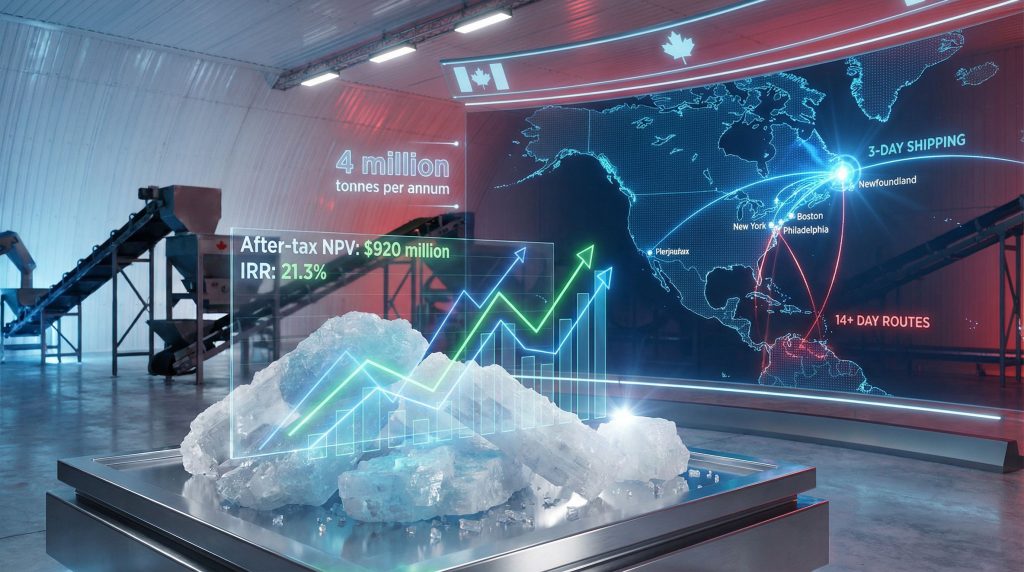
Transportation represents a significant component of delivered salt costs, particularly for bulk commodity applications where margins remain compressed. The Great Atlantic Salt Project's location enables 3-day shipping to major eastern markets including Boston, New York, and Philadelphia, compared to 14+ days required from Chilean or Egyptian suppliers. This proximity advantage translates to estimated transportation cost savings of $10-15 per tonne whilst reducing carbon footprint and inventory carrying costs for municipal customers.
Port access through established Newfoundland facilities eliminates infrastructure development requirements that would otherwise add millions to project capital costs. The province's existing bulk cargo handling capabilities, developed through decades of mining and forestry exports, provide immediate operational readiness without bottlenecks common at newer or smaller port facilities. Road and rail connectivity enable efficient inland distribution across Atlantic Canada and northeastern United States markets.
Clean hydroelectric power availability provides additional operational advantages. Newfoundland's hydroelectric grid, anchored by facilities like Muskrat Falls, enables all-electric mining operations with greenhouse gas intensity of just 950 tonnes CO2 equivalent per million tonnes of production. This compares favourably to industry averages exceeding 40,000 tonnes CO2e for gold operations and 80,000 tonnes CO2e for base metals mining, positioning the operation among the lowest carbon intensity mines globally.
Resource Quality and Extraction Economics
The Great Atlantic deposit contains 95 million tonnes of Probable Reserves grading 95.9% sodium chloride, with an additional 868 million tonnes of Inferred resources averaging 95.2% NaCl. This high-purity resource requires only physical screening and sizing, eliminating chemical processing costs that burden lower-grade deposits. The homogeneous geology with average thickness of 200 metres supports efficient room-and-pillar mining with minimal grade variability across the orebody.
Shallow depth access at approximately 180 metres enables decline-based extraction rather than expensive shaft sinking. Shaft development for comparable operations typically requires $1-2 million per 100 metres of depth, whilst decline access provides equivalent functionality at substantially lower capital intensity. Legacy North American salt operations typically access deposits at 350-1,000 metres below surface, requiring sophisticated hoisting systems and ventilation infrastructure that add operational complexity and maintenance costs.
Resource modelling indicates tremendous continuity across the deposit, with significant concentrations of high-grade reserves exceeding 98% NaCl concentrated around geological pillow structures within the broader salt horizons. This geological consistency enables long-term production planning with predictable extraction sequences and minimal development waste, supporting efficient capital allocation and operational optimisation over the 24.3-year mine life.
Updated Economic Framework and Investment Returns
Atlas Salt's September 2025 Updated Feasibility Study substantially improved project economics compared to the 2023 baseline analysis through engineering optimisation, production profile enhancement, and conservative pricing assumptions. The updated study demonstrates after-tax net present value (NPV8) of $920 million and internal rate of return (IRR) of 21.3%, with average annual cash flow of $188 million post-tax over a 24.3-year mine life based on 4 million tonnes per annum production capacity.
Capital Requirements and Operating Cost Structure
Pre-production capital requirements total $589 million, with additional life-of-mine sustaining capital of $609 million distributed across the 24.3-year operating period. The capital estimate reflects current market conditions including equipment price inflation, supply chain constraints, and labour cost increases that have affected mining project development costs across North America. Engineering partnerships with established suppliers like Sandvik provide equipment cost visibility and reduce procurement risk during the construction phase.
| Financial Metric | Value | Unit |
|---|---|---|
| After-tax NPV8 | $920 | Million |
| Internal Rate of Return | 21.3% | Percent |
| Average Annual Cash Flow | $188 | Million |
| All-in Sustaining Cost | $34.90 | Per tonne FOB |
| Mine Life | 24.3 | Years |
| Payback Period | 4.2 | Years |
Operating costs of $28.20 per tonne shipped benefit from the shallow deposit depth, established infrastructure access, and clean hydroelectric power availability. All-in sustaining costs (AISC) of $34.90 per tonne FOB Turf Point compare favourably to industry benchmarks whilst providing substantial margins at current pricing levels. The cost structure reflects physical processing requirements without chemical treatment, reducing both operating costs and environmental compliance complexity.
Base-case pricing assumptions of $81.67 per tonne provide conservative economic modelling relative to current market conditions. Recent pricing actions by American Rock Salt, including a $25 per tonne increase in December 2025, support higher realisations than feasibility study assumptions. The conservative pricing approach creates downside protection whilst demonstrating robust economics even at below-market assumptions.
Price Sensitivity and Operating Leverage
Atlas Salt's economic model demonstrates significant operating leverage to commodity price movements above base-case assumptions. Each $10 per tonne increase above the $81.67 base case adds approximately $200-250 million to after-tax NPV, whilst after-tax NPV reaches $1.5 billion at $89.84 per tonne pricing scenarios with IRR expanding to 25.0%. This price sensitivity reflects the high-margin nature of salt production once fixed costs are absorbed, with incremental revenue flowing directly to cash flow and returns.
| Price Scenario | After-tax NPV8 | IRR | Price Premium |
|---|---|---|---|
| Base Case ($81.67) | $920 million | 21.3% | – |
| +10% ($89.84) | $1.5 billion | 25.0% | +$580 million NPV |
| Current Spot (Est. $90+) | >$1.5 billion | >25.0% | >+$600 million NPV |
The operating leverage characteristics support potential re-rating as salt prices respond to supply constraints and demand growth. However, US economic pressures suggest base-case assumptions may prove conservative, particularly as import dependency increases and legacy capacity faces closure risk. Price volatility in commodity markets can create both upside opportunity and downside risk, though salt's essential infrastructure role provides demand stability compared to discretionary industrial minerals.
Strategic Partnerships and Commercial Validation
Atlas Salt has established partnerships with industry leaders that validate commercial viability whilst reducing execution and market risk. These relationships provide technical expertise, equipment financing, and market access that de-risk project development across multiple functional areas. The partnership structure also demonstrates third-party confidence in the project's technical and commercial merits from organisations with significant industry experience and capital at risk.
Offtake Agreement and Market Access
The August 2024 Memorandum of Understanding with Scotwood Industries LLC targets offtake volumes of 1.25-1.5 million tonnes per annum, representing 31-38% of planned production capacity. Scotwood, the largest distributor of packaged retail de-icing salt in the United States, provides immediate market access across both bulk municipal and higher-margin retail distribution channels. This partnership validates market demand whilst providing revenue visibility that supports project financing efforts.
Scotwood's distribution network spans major northeastern and southeastern U.S. markets through relationships with retailers including Home Depot, Lowe's, and regional hardware chains. The company's scale provides efficient market penetration without Atlas Salt requiring substantial investment in distribution infrastructure or customer development. Revenue per tonne through retail channels typically exceeds bulk municipal sales by $15-25 per tonne, improving project economics whilst diversifying end-market exposure.
The offtake arrangement structure allows participation in both commodity bulk sales and value-added retail packaging, optimising revenue capture across market segments. Scotwood's existing relationships with municipal procurement departments also provide potential expansion beyond the initial MOU volumes as production capacity ramps and market penetration increases. Additional offtake agreements remain under negotiation to secure remaining production volumes.
Equipment Supply and Engineering Support
Equipment supply arrangements with Sandvik, announced in September 2024, cover $73 million worth of mining equipment and engineering support. The partnership includes provision of battery electric vehicles for underground operations, supporting Atlas Salt's all-electric mine design powered by clean Newfoundland hydroelectricity. Sandvik brings extensive experience in underground hard rock and soft rock mining operations globally, with proven track record in large-scale equipment supply and technical support.
The battery electric vehicle integration positions the operation among the most environmentally advanced mining operations in North America. Electric equipment reduces ventilation requirements, noise levels, and maintenance costs whilst eliminating diesel particulate emissions in underground environments. Power supply from Newfoundland's hydroelectric grid ensures the electric equipment operation maintains minimal carbon intensity throughout the mining process.
Engineering partnership with Hatch Ltd., formalised in November 2025, provides critical detailed engineering expertise as the project transitions toward construction readiness. Hatch maintains proven experience delivering large-scale soft-rock mining operations and existing presence in Newfoundland through other mining projects. The relationship provides continuity from feasibility study through construction and commissioning, reducing execution risk and maintaining technical consistency across development phases.
Market Dynamics and Competitive Landscape Analysis
Recent transaction activity demonstrates institutional appetite for salt assets whilst providing valuation benchmarks for development-stage projects. Industry consolidation reflects recognition of salt's essential infrastructure role, long-term demand stability, and barriers to new capacity development. Private equity involvement suggests sophisticated capital views salt assets as attractive risk-adjusted investments with predictable cash flows and inflation protection characteristics.
Transaction Multiples and Strategic Value Recognition
German-based K+S sold its Americas salt business, including Morton and Windsor Salt brands, to Stone Canyon Industries Holdings for $3.2 billion in 2020, representing 12.5 times 2019 EBITDA. This transaction multiple suggests significant value creation potential for new, long-life salt operations with favourable cost structures and strategic positioning. Stone Canyon subsequently consolidated additional North American capacity through acquisitions including the Kissner Group, demonstrating continued private equity appetite for scale development in the sector.
The 12.5x EBITDA multiple reflects several factors: predictable cash flows from essential infrastructure demand, limited competition from new capacity development, and inflation protection through pricing mechanisms linked to municipal budgets. These characteristics distinguish salt assets from cyclical mining operations exposed to industrial demand volatility and commodity price cycles. Strategic buyers recognise salt's non-discretionary demand profile and barriers to entry that support sustainable competitive advantages.
Stone Canyon's consolidation strategy positions the private equity-backed company as a dominant regional producer whilst highlighting the strategic value of salt assets with long reserve life and competitive operating costs. The consolidation trend suggests scale advantages in marketing, distribution, and operational efficiency that benefit larger producers at the expense of smaller, higher-cost operations.
Regulatory Environment and Development Certainty
Newfoundland's regulatory framework provides development certainty through established permitting processes and mining-friendly policies. The Fraser Institute ranked Newfoundland and Labrador as the 9th best mining jurisdiction globally in 2025 based on mineral potential and government policy alignment. This ranking reflects political stability, regulatory predictability, and infrastructure availability that reduce development risk compared to emerging or unstable jurisdictions.
For instance, US-Canada tariff effects demonstrate how Atlas Salt successfully navigated environmental assessment processes, receiving project approval with conditions in April 2024 after approximately two months of review. The streamlined timeline reflects both project design quality and regulatory efficiency in Newfoundland's established mining sector.
Environmental conditions address standard concerns including groundwater protection, waste management, and habitat preservation without imposing unusual or costly operational constraints. The province hosts active development projects from major mining companies including Equinox Gold's Valentine Gold Project and FireFly Metals following substantial institutional financing. This established mining infrastructure provides access to skilled labour, equipment supply chains, and technical services that reduce operational costs and development complexity.
Investment Risk Assessment and Value Creation Catalysts
Atlas Salt presents a compelling risk-reward profile for investors seeking exposure to North America's structurally undersupplied de-icing salt market through a strategically positioned development asset with demonstrated economics and established partnerships. The investment thesis combines multiple value creation catalysts with manageable execution risks, supported by experienced management and favourable market fundamentals.
Primary Value Creation Catalysts
Project Financing Completion represents the most immediate catalyst, with Endeavour Financial engaged to secure the $589 million pre-production capital requirement through debt and strategic equity partnerships. Successful financing at favourable terms would validate third-party assessment of project economics whilst providing development certainty and construction timeline visibility. The combination of established partnerships, completed feasibility study, and regulatory approvals positions the project favourably for financing completion.
Additional Offtake Agreements beyond the existing Scotwood arrangement would further de-risk market exposure whilst potentially improving pricing terms through competitive negotiations. The company continues discussions with additional distributors and municipal customers, with potential to secure majority production volumes under long-term agreements that provide revenue stability and financing support.
Construction Commencement would mark the transition from development-stage speculation to active project execution with defined milestones and completion timeline. Early works activities including site preparation, access road development, and utility connections provide visible progress indicators whilst building momentum toward production readiness by 2030.
Market Price Momentum continues supporting project economics as supply constraints and demand growth drive salt pricing above feasibility study assumptions. Each sustained price increase directly improves project returns through operating leverage, whilst demonstrating market validation of the supply-demand imbalance that Atlas Salt de-icing supply addresses.
Risk Factors and Mitigation Strategies
Construction Cost Overruns beyond the $589 million pre-production budget represent the primary execution risk, particularly given current inflation pressures affecting mining project development costs globally. Risk mitigation includes experienced management with proven mine development expertise, engineering partnership with Hatch providing detailed cost estimation, and equipment partnerships with Sandvik offering cost certainty for major equipment packages.
Financing Completion Challenges could delay development timeline or require equity dilution at unfavourable valuations. Strategic partnerships with established industry participants demonstrate project credibility whilst providing potential co-investment or equipment financing alternatives. The company's engagement with Endeavour Financial provides specialised project financing expertise in the mining sector.
Commodity Price Volatility below base-case assumptions would reduce project returns, though salt's essential infrastructure role provides demand stability compared to cyclical industrial minerals. Conservative feasibility study pricing of $81.67 per tonne provides downside protection relative to current market levels, whilst recent price increases support higher realisation expectations.
Operational Execution Challenges during mine ramp-up to nameplate capacity remain possible, particularly for management teams without salt-specific operational experience. Risk mitigation includes Director Rowland Howe's proven salt industry expertise, having led Compass Minerals' Goderich mine to record production levels, combined with engineering support from Hatch and equipment partnerships with Sandvik.
The next major ASX story will hit our subscribers first
Long-term Market Outlook and Strategic Positioning
North America's de-icing salt market faces long-term structural deficits as aging infrastructure, environmental constraints, and lack of new production capacity intersect with steady demand growth and increased weather volatility. This convergence creates favourable conditions for new, strategically positioned production that can capture market share during supply-constrained periods whilst building long-term customer relationships through reliable supply and competitive pricing.
Structural Supply Deficit Trends
Industry forecasts suggest continued growth in de-icing salt demand driven by infrastructure investment, urbanisation in northern climate zones, and increased focus on transportation safety and emergency preparedness. Municipal budgets increasingly prioritise winter road maintenance as economic disruption from weather events receives greater recognition in budget planning processes. Climate change paradoxically supports demand through increased weather volatility and extreme winter events requiring enhanced road treatment protocols.
Supply additions remain limited despite growing demand. No major new salt mines have opened in North America since 2001, whilst multiple legacy operations face operational challenges, environmental constraints, and closure risk. The capital intensity and technical complexity of salt mine development, combined with long permitting timelines and environmental requirements, create substantial barriers to entry that protect existing and new production from competitive pressure.
Import dependency will likely continue growing as domestic production capacity fails to match demand expansion. However, international supply chains face increasing cost pressures from transportation, insurance, and regulatory compliance requirements. Carbon pricing mechanisms and supply chain sustainability requirements may further disadvantage distant suppliers relative to domestic production with clean electricity and minimal transportation requirements.
Strategic Value Creation Through Market Leadership
Atlas Salt's development timeline positions the company to capture significant market share during a period of supply constraint and industry consolidation. Production commencement by 2030 would establish North America's first new salt mine in three decades, providing competitive advantages through modern infrastructure, efficient operations, and strategic location. The 24.3-year mine life based on current reserves provides operational stability whilst potential resource expansion enables production growth as mining progresses.
The project's resource base excludes 868 million tonnes of Inferred resources averaging 95.2% NaCl, providing potential for life extension and production expansion through continued exploration and resource definition. Additional drilling and geological modelling could convert Inferred resources to higher-confidence categories, supporting mine life extension beyond the current 24.3-year projection whilst enabling production capacity increases above the planned 4 million tonnes per annum.
Market positioning in eastern North America provides access to the continent's highest-density salt consumption markets whilst competing directly against international imports with inferior logistics and higher carbon intensity. The combination of cost advantages, supply reliability, and environmental benefits creates sustainable competitive positioning that supports premium pricing and customer loyalty over extended operating periods.
Key Investment Considerations for Atlas Salt De-icing Supply
What market opportunity does Atlas Salt's de-icing supply strategy address in North America?
Atlas Salt targets North America's 13-16 million tonne annual import dependency for de-icing salt, addressing supply vulnerabilities created by aging domestic infrastructure and three decades without new mine development. The project's 4 million tonne annual capacity could capture approximately 10% of the continental market whilst reducing reliance on distant international suppliers with extended shipping times and higher logistics costs.
How do Atlas Salt's logistics advantages translate to competitive positioning in de-icing supply?
The Newfoundland location enables 3-day shipping to major eastern markets versus 14+ days from Chilean or Egyptian sources, reducing transportation costs by $10-15 per tonne whilst minimising carbon footprint and inventory requirements for municipal customers. This proximity advantage provides sustainable competitive differentiation in commodity markets where transportation represents significant cost components and supply reliability affects customer operations.
What financial returns does the Atlas Salt de-icing supply project offer investors?
The September 2025 feasibility study demonstrates after-tax NPV of $920 million with 21.3% IRR based on conservative $81.67 per tonne pricing assumptions. Current enterprise value of approximately $65.5 million represents 0.07x feasibility study NPV, suggesting significant re-rating potential as the project advances through development milestones toward 2030 production, particularly given recent salt price increases above base-case assumptions.
How does Atlas Salt mitigate development and market risks in the de-icing supply sector?
Risk mitigation includes strategic partnerships with Scotwood Industries for offtake, Sandvik for equipment supply, and Hatch for engineering support, experienced management with proven mine development expertise, conservative financial modelling below current market pricing, and phased development approach enabling optimised capital deployment. The company's regulatory approvals and financing partnerships further reduce execution risk compared to earlier-stage development projects.
What role do recent salt price increases play in Atlas Salt's de-icing supply project economics?
American Rock Salt's December 2025 price increase of $25 per tonne demonstrates market tightness supporting Atlas Salt's base-case assumptions whilst providing upside potential. Each $10 per tonne increase above the $81.67 base case adds approximately $200-250 million to after-tax NPV, with IRR expanding to 25.0% at $89.84 per tonne pricing scenarios. This highlights the project's operating leverage to continued price strength in North America's supply-constrained de-icing salt market, particularly given comprehensive information available in the Atlas Salt investor presentation that details these favourable market dynamics for Atlas Salt de-icing supply opportunities.
Ready to Profit from North America's Supply-Constrained Salt Market?
Atlas Salt's strategic positioning in North America's structurally undersupplied de-icing market demonstrates the powerful returns possible when essential infrastructure commodities face supply constraints and new capacity development. Discovery Alert's proprietary Discovery IQ model delivers real-time notifications on significant ASX mineral discoveries, empowering subscribers to identify similar actionable opportunities ahead of the broader market and capitalise on transformative discoveries as they're announced.