July 20, 2026
Understanding the Strategic Foundation of World-Class Copper Operations
The mining industry's most successful operations emerge not from single advantages, but from the convergence of geological endowments, technological innovation, and operational excellence spanning multiple decades. This convergence creates competitive moats that transform regional mining projects into global supply chain anchors, fundamentally altering market dynamics and establishing benchmarks for industry standards. The Escondida copper mine anniversary represents a milestone that exemplifies these principles in action.
Large-scale copper operations demonstrate how strategic infrastructure investments, when combined with exceptional resource bases, generate sustainable competitive advantages that extend far beyond simple production metrics. These advantages manifest through integrated operational frameworks that encompass everything from autonomous technology deployment to comprehensive sustainability initiatives.
Geological Advantages That Define Market Dominance
The foundation of world-class copper operations rests on exceptional geological characteristics that provide both scale and longevity advantages. Operations with substantial resource bases, such as those containing 26 billion tonnes of mineral resources, establish production stability that can weather multiple market cycles while maintaining consistent supply capabilities.
Geological positioning in favourable climatic zones significantly impacts operational efficiency through reduced weather-related disruptions and enhanced equipment longevity. Desert environments, while presenting water sourcing challenges, offer operational advantages through minimal precipitation interference and stable working conditions year-round.
Resource Quality Metrics:
- High-grade ore concentrations reducing processing requirements
- Consistent mineral distribution enabling predictable extraction planning
- Minimal overburden ratios optimising operational costs
- Strategic location proximity to export infrastructure
The combination of massive resource scale with favourable extraction conditions creates operational frameworks that can sustain production levels exceeding 1 million tonnes annually while maintaining economic viability across varying commodity price environments. Furthermore, understanding major copper system dynamics becomes crucial for investors evaluating similar opportunities globally.
Infrastructure Integration as Competitive Moat
Integrated operational models establish significant barriers to competition through comprehensive infrastructure networks that competitors cannot easily replicate. These networks encompass multiple processing streams, dedicated transportation corridors, and specialised export facilities that create operational synergies unavailable to smaller-scale operations.
Integrated Infrastructure Components:
| Infrastructure Element | Operational Impact | Strategic Advantage |
|---|---|---|
| Dual Mining Operations | Risk diversification across extraction sites | Operational continuity during maintenance cycles |
| Multiple Processing Plants | 460 ktpd combined capacity across three units | Production flexibility and redundancy |
| Autonomous Technology | 100% implementation in designated areas | Enhanced safety and operational efficiency |
| Export Terminal Integration | 2,400+ annual shipments direct to market | Reduced logistics costs and delivery control |
The development of 100% autonomous haulage systems in designated mining areas represents industry-leading technological advancement that delivers measurable productivity improvements while establishing safety benchmarks that influence sector-wide adoption patterns.
Desalination infrastructure providing complete operational water independence demonstrates how strategic capital allocation addresses resource constraints while creating long-term operational stability. This infrastructure eliminates dependence on regional water supplies, ensuring production continuity regardless of climatic variations.
When big ASX news breaks, our subscribers know first
How Do Scale Economics Transform Regional Mining Into Global Supply Chain Anchors?
Scale economics in copper mining transcend simple production volume metrics, creating market influence mechanisms that position major operations as supply stabilisation factors during periods of global demand growth or supply disruption. Operations achieving significant market share develop pricing influence and customer dependency relationships that extend their strategic importance beyond immediate production capabilities.
Production Volume Impact on Market Dynamics
Market Position Analysis:
| Production Metric | Scale Achievement | Global Impact |
|---|---|---|
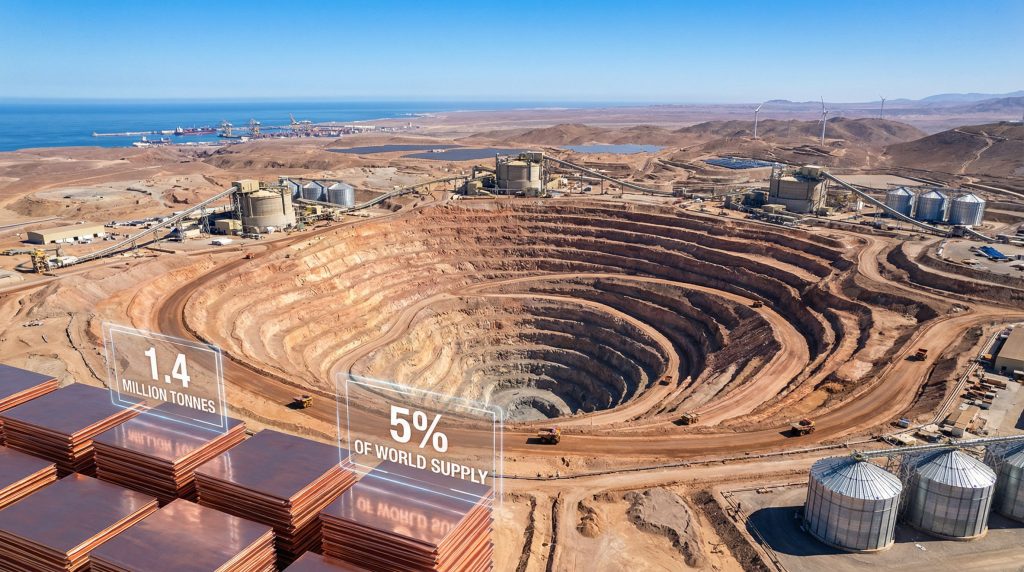
| Annual Output | Approximately 1.4 million tonnes | 5% of world copper supply |
| National Contribution | 20% of Chile's copper production | Strategic economic asset status |
| Cumulative Production | 34+ million tonnes over 35 years | Generational supply contribution |
| GDP Integration | 2.5% of national GDP | Macroeconomic significance |
The achievement of 5% global market share creates supply influence that extends beyond immediate customer relationships, positioning major operations as market stabilisation mechanisms during supply chain disruptions or demand surges associated with electrification trends.
Long-term production consistency over 35-year operational periods demonstrates supply reliability that becomes integral to customer planning across automotive, construction, and renewable energy sectors. This reliability creates customer dependency relationships that strengthen during periods of supply constraint. However, investors should also consider the global copper supply forecast when evaluating future market dynamics.
Resource Longevity and Future Supply Security
Operations with substantial resource bases spanning multiple decades provide strategic supply security alignment with global electrification demand projections. The transition to electric vehicles, renewable energy infrastructure, and grid modernisation creates copper demand growth scenarios that favour operations with proven long-term production capabilities.
Electrification Demand Drivers:
- Electric vehicle adoption requiring 180-200 kg copper per vehicle
- Wind turbine installations demanding 3-5 tonnes copper per MW capacity
- Solar panel infrastructure incorporating substantial copper wiring requirements
- Grid modernisation projects requiring enhanced transmission capacity
Resource management strategies that preserve production capability across changing demand patterns position major operations as strategic suppliers during the energy transition period. This positioning creates premium pricing opportunities and preferential customer relationships that enhance long-term value creation.
The ability to maintain production flexibility during market volatility while preserving resource base for future demand growth represents a critical strategic advantage that smaller operations cannot replicate through operational efficiency improvements alone. Furthermore, understanding ASX copper stocks impact provides valuable context for regional investment considerations.
What Operational Excellence Models Can Other Mining Operations Replicate?
Operational excellence in large-scale mining emerges through the systematic integration of advanced technologies, comprehensive safety frameworks, and cultural transformation initiatives that create sustainable performance improvements across multiple operational dimensions.
Technology Integration Framework
The implementation of 100% autonomous haulage systems demonstrates how strategic technology adoption creates operational efficiency gains while establishing industry benchmarks for safety performance and productivity optimisation. Autonomous truck deployment eliminates operator fatigue variables, reduces safety incidents, and enables continuous operation capabilities that traditional mining methods cannot achieve.
Key Operational Insight: Autonomous technology deployment represents industry-leading operational efficiency advancement through elimination of human error factors and optimisation of equipment utilisation rates.
Technology Implementation Metrics:
| Technology Component | Implementation Scope | Operational Impact |
|---|---|---|
| Autonomous Haulage | 100% deployment in designated pit | Enhanced safety, continuous operation capability |
| Desalination Plants | Two operational facilities | Complete freshwater independence |
| Processing Integration | 460 ktpd across three plants | Production flexibility and redundancy |
| Renewable Energy | 100% operational power | Carbon footprint reduction, cost stability |
Desalination technology achieving complete seawater dependence demonstrates how infrastructure investments address resource constraints while creating competitive advantages through operational independence. This technology eliminates regional drought risk while preserving freshwater resources for community use.
Workforce Transformation Metrics
Cultural transformation through diversity and inclusion initiatives creates operational advantages that extend beyond compliance requirements into tangible performance improvements and innovation capabilities.
Diversity Performance Indicators:
- 44.3% female workforce participation – establishing industry benchmark performance
- 11.9% indigenous community representation – demonstrating local integration success
- 2.9% disability inclusion rate – advancing accessibility and inclusion frameworks
- Generational knowledge transfer systems – preserving institutional expertise
These metrics represent more than demographic achievements; they demonstrate how diverse perspectives contribute to problem-solving capabilities and operational innovation that homogeneous workforce structures cannot generate.
Long-term employee retention patterns, exemplified by workers maintaining 30+ year tenure, create institutional knowledge preservation that supports operational excellence through crisis management, equipment optimisation, and safety protocol development.
The integration of safety culture as an operational foundation generates performance improvements that cascade through productivity metrics, equipment longevity, and regulatory compliance achievements that create competitive advantages beyond immediate safety benefits.
How Does Sustainability Infrastructure Position Mining for Future Regulations?
Sustainability infrastructure development in mining operations creates regulatory positioning advantages that anticipate future compliance requirements while generating immediate operational benefits through resource security and cost optimisation.
Water Security Through Desalination Technology
Complete elimination of freshwater dependence through desalination infrastructure positions operations ahead of increasingly restrictive water use regulations while creating operational independence from regional climate variations and competing water demands.
Water Security Framework:
| Water Management Component | Implementation Status | Regulatory Advantage |
|---|---|---|
| Freshwater Independence | 100% desalinated seawater | Eliminates regional water competition conflicts |
| Processing Water Supply | Two desalination plants | Ensures production continuity during drought periods |
| Environmental Impact | Reduced freshwater consumption | Anticipates water use restriction regulations |
Desalination technology provides operational cost predictability through elimination of freshwater pricing volatility while creating positive environmental impact through preservation of regional freshwater resources for community and agricultural use.
The strategic positioning achieved through water independence creates competitive advantages during regulatory transitions toward stricter water use limitations, particularly in arid regions where mining operations compete with agricultural and municipal water demands.
Energy Transition Alignment
100% renewable energy operational models position mining operations ahead of carbon reduction regulations while creating cost hedging advantages against fossil fuel price volatility. This positioning anticipates regulatory frameworks that will increasingly penalise carbon-intensive operations through taxation or emissions trading requirements.
Renewable energy integration generates operational benefits beyond regulatory compliance through:
- Cost stability elimination of fossil fuel price volatility
- Enhanced corporate customer appeal for sustainability-focused procurement
- Carbon offset generation potential for additional revenue streams
- Regulatory approval acceleration for expansion projects
Carbon footprint reduction achievements create strategic positioning for participation in carbon trading markets while establishing competitive advantages during customer procurement processes that increasingly prioritise low-carbon suppliers. Additionally, developing comprehensive copper investment strategies requires understanding these sustainability trends.
The alignment of operational sustainability with regulatory trend anticipation creates long-term competitive moats that competitors using traditional energy sources cannot quickly replicate due to infrastructure investment requirements and implementation timeframes.
What Economic Multiplier Effects Define World-Class Mining Operations?
Large-scale mining operations generate economic multiplier effects that extend far beyond immediate production value, creating regional development catalysts and national economic integration that amplifies their strategic importance beyond commodity market participation.
National Economic Integration Analysis
Operations contributing 2.5% of national GDP demonstrate economic integration levels that create strategic asset classification and political stability through economic interdependence. This integration generates policy support frameworks that protect operational continuity during political transitions and regulatory changes.
Economic Contribution Framework:
- Direct employment generation across multiple skill levels
- Indirect employment through supplier and service provider networks
- Export revenue generation supporting national trade balance
- Infrastructure development benefiting regional communities
- Technology transfer advancing national mining capabilities
The cumulative production of 34+ million tonnes over 35 years represents sustained economic contribution that creates institutional relationships with government entities, educational institutions, and community organisations that strengthen operational stability.
Regional development catalyst effects emerge through infrastructure investments that benefit communities beyond immediate operational requirements, creating social licence advantages that facilitate expansion approvals and regulatory cooperation.
Global Supply Chain Positioning
Strategic positioning within global supply chains creates customer dependency relationships that enhance pricing power and contract negotiation advantages during commodity market volatility. Operations supplying 5% of world copper demand develop strategic supplier status that customers cannot easily replace through alternative sourcing.
Supply Chain Influence Mechanisms:
- Price discovery participation through substantial market volume
- Customer strategic planning integration through supply reliability
- Market stabilisation function during supply disruption periods
- Demand fulfilment capacity during electrification growth phases
The ability to maintain consistent supply during competitor disruptions creates premium pricing opportunities and preferential contract terms that generate enhanced returns beyond commodity price appreciation.
Export infrastructure handling 2,400+ annual shipments demonstrates logistical capabilities that create customer service advantages through delivery reliability and flexibility that smaller operations cannot provide.
Which Strategic Lessons Apply to Next-Generation Mining Developments?
Strategic analysis of successful large-scale mining operations reveals replicable frameworks for next-generation developments, particularly regarding infrastructure integration timing, technology adoption strategies, and sustainability positioning for regulatory anticipation.
Scalable Infrastructure Investment Principles
Integrated operational design from project inception creates cost advantages and operational synergies that retrofit approaches cannot achieve. The development of comprehensive processing, transportation, and export infrastructure as unified systems generates efficiency gains that justify substantial upfront capital investment.
Infrastructure Integration Benefits:
- Operational redundancy reducing production disruption risks
- Processing flexibility enabling grade optimisation strategies
- Transportation cost optimisation through dedicated corridors
- Export capacity matching production planning requirements
Technology adoption timing requires balancing proven performance with competitive advantage generation. Early adoption of autonomous systems and sustainability infrastructure creates operational advantages while establishing industry leadership positioning that influences customer relationships and regulatory treatment.
Sustainability integration from operational inception avoids retrofit costs while creating regulatory positioning advantages that become increasingly valuable as environmental regulations strengthen across global mining jurisdictions.
Human Capital Development Framework
Generational knowledge transfer systems create competitive advantages through institutional expertise preservation that supports operational optimisation, safety performance, and crisis management capabilities that new operations require decades to develop.
Knowledge Transfer Components:
- Mentorship programmes pairing experienced workers with new hires
- Documentation systems preserving operational best practices
- Safety protocol evolution based on historical incident analysis
- Equipment optimisation insights accumulated through operational experience
Diversity as an operational excellence driver generates problem-solving capabilities and innovation perspectives that homogeneous workforces cannot provide. The achievement of 44.3% female workforce participation demonstrates measurable performance benefits that justify comprehensive diversity initiatives.
Cultural transformation toward safety excellence creates operational stability foundations that support productivity optimisation and regulatory compliance achievements essential for long-term operational success.
The next major ASX story will hit our subscribers first
How Do Long-Term Mining Operations Navigate Market Volatility and Technological Disruption?
Long-term operational success in mining requires adaptive capacity frameworks that enable production optimisation during commodity price cycles while maintaining technological competitiveness through equipment upgrade integration and process innovation adoption.
Adaptive Capacity Through Operational Flexibility
Production scaling mechanisms enable operational optimisation during market cycles through processing plant utilisation adjustment, workforce flexibility, and maintenance scheduling optimisation that maintains cost competitiveness during low-price environments.
The ability to maintain production consistency while adjusting operational intensity creates cash flow stability that supports capital investment timing optimisation and debt service capabilities during extended commodity price downturns.
Market Cycle Navigation Strategies:
- Processing plant utilisation optimisation during demand variations
- Workforce scheduling flexibility maintaining core expertise retention
- Maintenance timing coordination minimising production impact
- Capital expenditure timing aligned with commodity price recovery
Technology upgrade integration without operational disruption requires systematic planning and phased implementation strategies that maintain production consistency while advancing operational capabilities.
Future-Proofing Through Strategic Planning
Electrification trend positioning creates long-term demand security through alignment with copper consumption growth driven by electric vehicle adoption, renewable energy infrastructure development, and grid modernisation requirements.
Critical mineral designation implications provide strategic positioning advantages through government policy support, accelerated permitting processes, and infrastructure development assistance that reduce operational risks and development timelines.
Geopolitical supply chain security considerations create strategic value through customer preferencing for politically stable supply sources, particularly during international tension periods that threaten supply chain reliability.
The ability to maintain production capabilities across changing geopolitical environments while preserving market access creates competitive advantages that transcend commodity price considerations and generate premium pricing opportunities. In addition, effective copper & uranium investment approaches must consider these geopolitical factors.
What Investment and Development Insights Emerge From Escondida's Success Model?
Investment analysis of successful large-scale mining operations reveals capital allocation efficiency patterns and risk management frameworks that generate sustainable returns across multiple commodity price cycles while maintaining operational excellence standards.
Capital Allocation Efficiency Analysis
Infrastructure investment returns over 35-year operational periods demonstrate how comprehensive initial capital deployment creates competitive advantages that justify substantial upfront investment through operational efficiency gains and market positioning benefits.
Technology upgrade ROI patterns indicate that systematic modernisation investment generates productivity improvements and safety enhancements that exceed capital costs through operational optimisation and regulatory compliance advantages.
Investment Efficiency Metrics:
- Initial infrastructure investment creating multi-decade competitive advantages
- Technology upgrade timing optimisation for maximum ROI generation
- Expansion capital allocation aligned with demand growth projections
- Sustainability infrastructure investment anticipating regulatory requirements
Expansion timing optimisation strategies balance capacity growth with market demand evolution while maintaining operational flexibility to adjust production levels during commodity price volatility periods.
Risk Management Through Operational Excellence
Safety performance as an operational stability indicator demonstrates how comprehensive safety culture development creates productivity advantages, regulatory compliance benefits, and workforce retention that support consistent operational performance.
Environmental compliance as regulatory risk mitigation positions operations ahead of regulatory requirement evolution while creating competitive advantages through customer preference for sustainable suppliers and community relations enhancement.
Community relations as social licence maintenance create operational stability through stakeholder support that facilitates expansion approvals, regulatory cooperation, and workforce recruitment from local communities.
Risk Mitigation Framework:
- Safety culture development supporting operational consistency
- Environmental compliance anticipating regulatory evolution
- Community engagement creating stakeholder support networks
- Technology investment maintaining competitive positioning
The integration of operational excellence across safety, environmental, and community dimensions creates sustainable competitive advantages that support long-term value creation beyond immediate commodity price considerations.
Strategic Framework for Sustainable Copper Production Leadership
Replicable Success Factors for Global Mining Operations
Integration of scale, technology, and sustainability creates operational frameworks that generate competitive advantages across multiple performance dimensions while positioning operations for long-term success during industry evolution and regulatory transition periods.
Long-term resource management principles require balancing current production optimisation with resource preservation for future demand growth, particularly during electrification-driven copper demand expansion phases anticipated through 2050 and beyond.
Stakeholder value creation through operational excellence encompasses shareholder returns, employee development, community benefits, and environmental stewardship that creates sustainable business models supporting multi-decade operational success.
Industry Evolution Implications
Benchmark establishment for future developments demonstrates how successful operations influence industry standards through technology adoption, safety performance, sustainability practices, and community engagement frameworks that become regulatory expectations and customer requirements.
Technology adoption acceleration across the sector emerges through successful implementation demonstration that reduces perceived risks and implementation costs for other operations considering similar technology investments.
Sustainability standard elevation industry-wide results from competitive pressure to match performance benchmarks in environmental compliance, community relations, and operational efficiency that successful operations establish through comprehensive sustainability integration.
The strategic lessons emerging from world-class mining operations provide frameworks for next-generation developments while demonstrating how exceptional geological resources, when combined with operational excellence and strategic positioning, create sustainable competitive advantages that transcend commodity market cycles and generate long-term stakeholder value creation.
According to BHP's official announcement, the Escondida copper mine anniversary milestone represents more than just operational longevity; it demonstrates the successful execution of integrated mining excellence across multiple decades. Moreover, detailed information about Escondida confirms its position as the world's largest copper mine by production volume.
Disclaimer: This analysis is based on publicly available information and industry research. Mining investments involve significant risks including commodity price volatility, operational challenges, environmental regulations, and geopolitical factors. Readers should conduct independent research and consult qualified professionals before making investment decisions. Past performance does not guarantee future results, and all mining operations face inherent risks that may impact financial performance and operational continuity.
Want to Capitalise on Copper Market Opportunities?
Discovery Alert instantly identifies significant ASX mineral discoveries using its proprietary Discovery IQ model, helping investors spot actionable opportunities in copper and other commodities before the broader market catches on. Explore Discovery Alert's comprehensive discoveries page to understand how major mineral discoveries have generated substantial historical returns, and begin your 14-day free trial today to position yourself ahead of the next market-moving announcement.