June 23, 2026
Worley's position in the global energy transition landscape presents compelling investment opportunities as multiple technology pathways converge toward commercial deployment. The critical minerals energy transition accelerates demand for specialized engineering services across battery materials processing, carbon capture systems, and hydrogen infrastructure. Furthermore, advances in battery recycling breakthrough technologies create additional revenue streams for companies with integrated project delivery capabilities.
Strategic Market Positioning Through Technology Portfolio Diversification
Worley energy transition 2026 positioning reflects a calculated approach to capturing value across multiple decarbonization pathways while maintaining exposure to traditional energy infrastructure markets. The company's financial performance through FY25 demonstrates operational resilience, with revenue reaching AUD $12.1 billion representing 4% year-on-year growth, while EBITDA expanded 10% to AUD $823 million. These results indicate successful execution despite broader market uncertainty affecting investor sentiment across the engineering services sector.
Sustainability-related projects now comprise approximately 60% of total revenue, positioning the company to benefit from accelerating energy transition investment while retaining capabilities in conventional energy infrastructure. This balanced portfolio approach provides revenue stability during transition periods while capturing growth opportunities in emerging technology segments.
Three Scenario Pathways for Market Evolution
Accelerated Deployment Scenario (35% probability): Policy-driven investment acceleration could drive 15-20% revenue growth, with sustainability projects reaching 80% of total revenue mix. This pathway assumes coordinated global climate policies create substantial infrastructure investment, supporting premium pricing for specialized transition technology services.
| Growth Driver | Revenue Impact | Margin Enhancement |
|---|---|---|
| Carbon capture scaling | 10-15% premium pricing | 200-300 basis points |
| Hydrogen infrastructure | Volume growth 25-30% | Learning curve benefits |
| Battery materials facilities | Geographic expansion | Reduced execution risk |
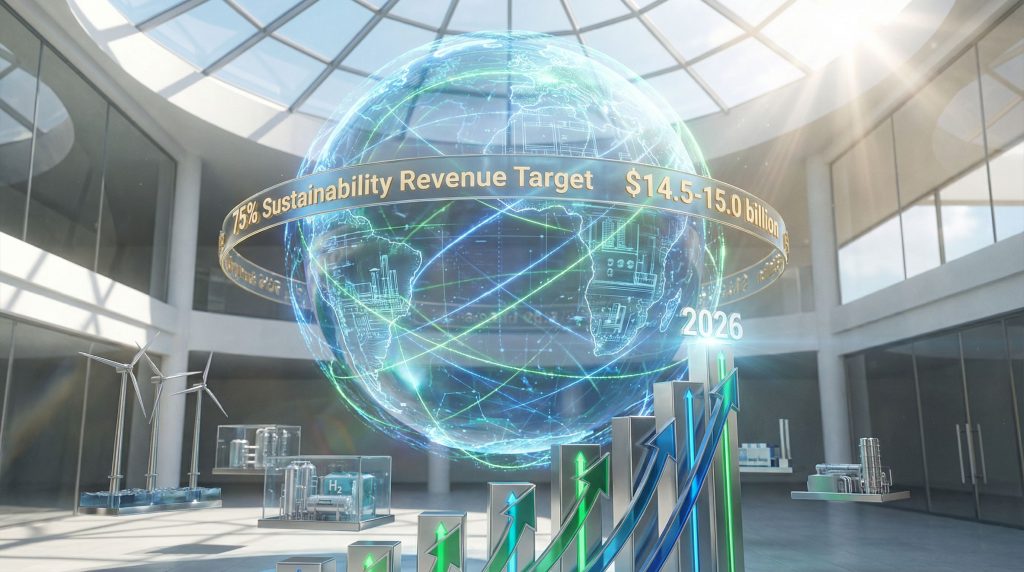
Steady Evolution Scenario (45% probability): Measured transition investment maintains 5-7% annual growth while achieving the 75% sustainability revenue target. This moderate pathway balances portfolio optimization with maintained traditional energy capabilities, providing geographic and technology risk diversification.
Transition Delay Scenario (20% probability): Economic pressures or policy uncertainty could slow clean energy deployment, requiring enhanced operational efficiency and strategic flexibility. Risk mitigation focuses on maintaining competitive advantages in traditional energy markets while preserving transition technology capabilities.
When big ASX news breaks, our subscribers know first
Technology Capability Development Through Strategic Investment
The three-year organic growth investment strategy targets four critical technology areas positioned to benefit across multiple market scenarios. Carbon capture and storage capabilities address the estimated global requirement for industrial-scale CO2 processing, transport infrastructure, and subsurface storage engineering. Market estimates suggest substantial investment requirements through 2050, creating sustained demand for specialized engineering services.
Lower-carbon hydrogen infrastructure development encompasses electrolysis facility design, hydrogen storage systems, and industrial integration projects. The technology maturation timeline indicates commercial viability scaling through 2025-2027, requiring engineering capabilities across the production, storage, and distribution value chain.
Battery Materials Processing Expansion
Critical minerals processing capabilities address lithium, cobalt, and nickel facility engineering as supply chains localize to reduce geopolitical risks. Environmental impact mitigation and recycling technology integration create additional service opportunities as circular economy principles gain regulatory support.
Lower-carbon fuels technology applications include:
- Sustainable aviation fuel production facilities
- Renewable diesel processing infrastructure
- Ammonia production for energy storage and transport
- Synthetic fuel development projects
These technology areas provide portfolio diversification while addressing regulatory requirements for reduced carbon intensity across transportation and industrial sectors. In addition, implementing renewable energy solutions across mining operations demonstrates the integration of sustainable practices throughout resource extraction processes.
Competitive Advantages Supporting Market Share Expansion
Integrated service delivery capabilities spanning front-end engineering design through construction management and operations support create competitive barriers for specialized competitors. This end-to-end project approach reduces client coordination requirements while capturing value across project lifecycles.
Geographic market penetration provides risk diversification while accessing regional policy incentives and resource advantages:
North America: LNG infrastructure with integrated decarbonization technologies benefits from energy transition workforce reskilling policies and natural gas abundance.
Europe: Offshore wind and carbon capture projects align with Green Deal implementation timelines and emission reduction targets.
Asia-Pacific: Critical minerals processing and LNG infrastructure support supply chain localization and energy transition goals.
Middle East: Carbon management and energy diversification projects leverage hydrocarbon revenues for economic transformation.
Technology Partnership Ecosystem
Strategic alliances enhance capability development while reducing technology risk. Capital efficiency strategies become increasingly important for sustainable growth across transition technology deployments.
Digital automation partnerships integrate control systems and optimization technologies into traditional engineering services. Renewable hydrogen technology collaborations accelerate commercial deployment readiness through research institution partnerships. Integrated energy project delivery combines engineering services with energy company expertise for complex transition projects.
Major Project Portfolio Supporting Revenue Visibility
CP2 LNG Terminal Development
The 20 million tonnes per annum capacity project represents significant revenue opportunity through integrated decarbonization technology implementation. Phase 1 development targets 10 million tonnes per annum initial capacity, with final investment decision timeline supporting 2025-2026 revenue contribution. Decarbonization technology integration differentiates this project from conventional LNG infrastructure, requiring specialized engineering capabilities.
Estimated annual revenue contribution: AUD $200-300 million
PPF Redevelopment Project
ConocoPhillips Norway's Ekofisk Complex topside modifications demonstrate capability in extending field life through enhanced recovery technology. The project timeline spanning January 2026 through Autumn 2028 provides multi-year revenue visibility while showcasing expertise in complex offshore engineering.
Project characteristics:
- Extended field life optimization
- Enhanced recovery technology implementation
- Offshore engineering complexity
- Estimated contract value: AUD $150-200 million
Global Hydrogen Project Diversification
Geographic diversification across hydrogen projects reduces execution and regulatory risks:
Tarfaya Green Ammonia (Morocco): Renewable energy integration with ammonia production for export markets.
Shell HH1 (Rotterdam): Industrial-scale hydrogen production serving European industrial demand.
ExxonMobil Low-Carbon Hydrogen (United States): Integration with existing refinery infrastructure and carbon capture systems.
Combined revenue potential from hydrogen project portfolio: AUD $400-500 million through 2027, demonstrating technology capability development and market positioning success. Moreover, developments in sustainable iron production showcase similar engineering expertise applicable across industrial decarbonization projects.
Risk Assessment and Mitigation Strategies
Project Execution Challenges
Cost management on large-scale transition technology projects requires enhanced project management methodologies due to technology complexity and limited precedent experience. Learning curve effects from repeated project execution can improve margins over time, but initial projects may face execution challenges.
Skilled workforce availability across emerging technology areas creates labor cost pressure and potential project delays. Workforce development programs and strategic hiring initiatives address capability gaps while building competitive advantages through specialized expertise.
Supply chain disruption impacts affect project timelines and costs, particularly for specialized equipment required in transition technology applications. Geographic diversification of suppliers and strategic partnership development provide risk mitigation while maintaining cost competitiveness.
Macroeconomic Pressure Points
Interest rate volatility affects project financing availability and investment decision timing for capital-intensive infrastructure projects. Higher financing costs can delay final investment decisions or reduce project economics, particularly for emerging technology deployments requiring substantial upfront investment.
Commodity price fluctuations influence client investment priorities and project timing across traditional and transition technology segments. Diversified exposure across multiple commodity and energy markets provides portfolio stability during price volatility periods.
Geopolitical tensions can disrupt international project development and cross-border technology transfer, particularly affecting hydrogen export projects and critical minerals processing facilities. Geographic diversification and local partnership strategies reduce exposure to single-country political risks.
Investment Evaluation Framework for 2026 Performance
Financial Performance Metrics
Revenue growth indicators focus on sustainability project percentage progression toward the 75% target, combined with backlog quality measurement and geographic diversification assessment. Analyst consensus forecasts project FY26 revenue of AUD $12.7 billion with EBITDA reaching AUD $1.05 billion, representing continued margin expansion from operational efficiency improvements.
Current valuation metrics provide context for investment assessment:
- EV/EBITDA: 7.5x (FY26 basis)
- P/E Ratio: 13.9x (consensus forecasts)
- PEG Ratio: 1.5x (incorporating growth expectations)
- Mean 12-month price target: AUD $16.64
Technology Integration Value Measurement
New technology service adoption rates indicate successful capability development and market positioning. Premium pricing capture on transition technology projects demonstrates competitive differentiation and specialized expertise value.
Operational leverage benefits emerge as project volumes scale across similar technology platforms, reducing per-project development costs while improving execution efficiency. Learning curve advantages create competitive barriers for late-entering competitors. Additionally, implementing data-driven operations enhances project delivery efficiency and risk management capabilities.
The next major ASX story will hit our subscribers first
Strategic Investment Approaches for Different Investor Profiles
Growth-Oriented Investment Perspective
Energy transition acceleration creates sustained demand for specialized engineering services across multiple technology pathways. The integrated service delivery model provides competitive advantages through reduced client coordination requirements and value capture across project lifecycles.
Geographic diversification reduces single-market regulatory and economic risks while accessing regional policy incentives supporting transition technology deployment. Technology partnership development enhances capability acquisition while sharing development costs and risks.
Value-Focused Risk Assessment
Current valuation levels reflect moderate growth expectations rather than optimistic transition technology deployment scenarios. The dividend yield provides income generation during market uncertainty periods while maintaining exposure to potential upside from successful strategy execution.
Traditional energy project exposure maintains earnings stability during transition technology market development phases. Diversified portfolio construction reduces dependence on any single technology or geographic market for growth achievement.
Sustainability-Aligned Investment Criteria
Environmental impact alignment through 75% sustainability revenue target achievement demonstrates commitment to climate transition goals. Net-zero operational targets by 2030 align with institutional investor requirements for portfolio carbon footprint management.
Critical minerals and clean energy infrastructure focus supports supply chain localisation and renewable energy deployment goals. Scope 3 emissions reduction commitments address indirect environmental impacts through client project delivery optimisation.
Disclaimer: This analysis contains forward-looking statements regarding Worley energy transition 2026 performance based on current market conditions and management guidance. Actual results may vary due to market volatility, regulatory changes, project execution risks, and macroeconomic factors. Investment decisions should consider individual risk tolerance and portfolio diversification requirements.
The convergence of multiple transition technologies approaching commercial viability creates unique positioning opportunities for engineering services firms with integrated capabilities. Worley energy transition 2026 strategy balances portfolio diversification with capability development across carbon capture, hydrogen, battery materials, and renewable fuels to capture value across multiple deployment scenarios while maintaining operational flexibility during market uncertainty periods.
Looking for exposure to the critical minerals powering tomorrow's technology?
Discovery Alert's proprietary Discovery IQ model provides instant notifications on significant ASX mineral discoveries, transforming complex geological data into actionable investment opportunities for both short-term traders and long-term investors. Visit Discovery Alert's discoveries page to understand how major mineral discoveries have generated substantial returns historically, then begin your 30-day free trial to position yourself ahead of the next breakthrough announcement.