June 21, 2026
The global automotive industry stands at a technological crossroads where engineering optimisation converges with geopolitical risk management. While permanent magnet synchronous motors have dominated electric vehicle design through superior power density and efficiency characteristics, their dependence on rare earth materials creates strategic vulnerabilities that extend far beyond traditional performance metrics. This supply chain reality has catalysed renewed interest in alternative motor architectures, particularly wound rotor synchronous motors in electric vehicles, which eliminate rare earth dependencies while maintaining competitive operational characteristics across diverse driving conditions.
The electromagnetic complexity underlying modern electric vehicle propulsion extends beyond simple motor selection into fundamental questions of materials security, manufacturing scalability, and long-term technological sovereignty. As EV production volumes continue their exponential growth trajectory, the strategic implications of motor architecture decisions now influence corporate planning cycles, government policy frameworks, and investor risk assessment models across multiple industrial sectors. Furthermore, understanding critical minerals and energy security becomes crucial as manufacturers evaluate alternative motor technologies.
Understanding Wound Rotor Motor Architecture and Design Principles
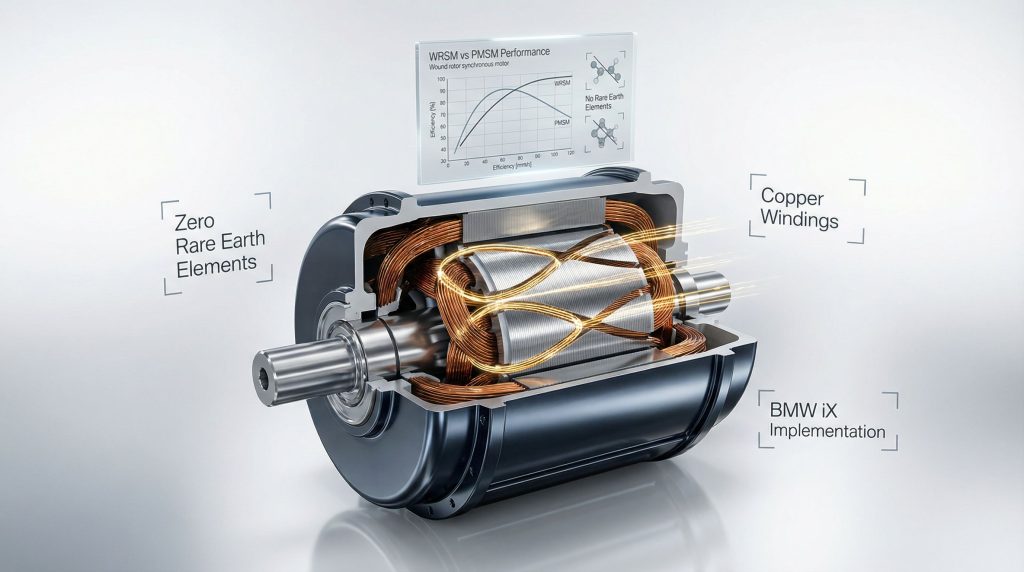
Wound rotor synchronous motors in electric vehicles represent a sophisticated electromagnetic approach that replaces permanent magnet systems with electrically controlled rotor windings. These motors utilise three-phase stator configurations combined with laminated steel core construction, where DC-excited rotor windings generate controllable magnetic fields without requiring any permanent magnet materials. The fundamental difference lies in the electromagnetic field generation mechanism: rather than relying on fixed magnetic properties of rare earth elements, WRSMs create variable magnetic flux through precisely controlled copper winding excitation.
Core Component Architecture Comparison
The systematic review conducted by researchers at Fırat University, spanning nearly two decades of EV motor development from 2006-2025, demonstrates that wound rotor synchronous motors in electric vehicles utilise fundamentally different electromagnetic principles compared to their permanent magnet counterparts (Orhan et al., DUJE Vol. 16, Issue 4, 2025). The research methodology incorporated comprehensive analysis across IEEE Xplore, Scopus, ScienceDirect, and Google Scholar databases, establishing a robust foundation for comparative motor architecture assessment.
| Motor Type | Rotor Construction | Magnetic Field Source | Rare Earth Dependency |
|---|---|---|---|
| WRSM | Copper windings | Electrically excited | Zero |
| PMSM | Permanent magnets | Neodymium-dysprosium | High |
| Induction | Copper/aluminium bars | Induced current | Zero |
| BLDC | Permanent magnets | Neodymium-based | High |
Alternative Terminology in Industrial Applications
Industry professionals frequently encounter wound rotor synchronous motors in electric vehicles under several alternative designations. Wound-field synchronous motors (WFSM) represent the most common alternative terminology, while externally excited synchronous motors (EESM) classification emphasises the external power source requirement for rotor field generation. These naming conventions vary across manufacturers and geographic regions, though the underlying electromagnetic principles remain consistent regardless of terminology.
When big ASX news breaks, our subscribers know first
Material Independence and Supply Chain Diversification
The elimination of rare earth dependencies represents the most significant strategic advantage of wound rotor synchronous motors in electric vehicles. China maintains dominant control over downstream rare earth processing and chemical separation for neodymium and dysprosium, the critical materials required for permanent magnet motor construction. This geographic concentration creates structural vulnerabilities that become increasingly problematic as global EV production scales toward mass market adoption.
Raw Material Composition Analysis
Wound rotor synchronous motors in electric vehicles achieve complete rare earth independence through copper winding systems that replace neodymium-dysprosium magnet assemblies. The motor architecture utilises steel lamination structures for magnetic flux pathways, combined with traditional copper conductors for both stator and rotor windings. This material substitution strategy eliminates exposure to rare earth price volatility while enabling geographic diversification of raw material sourcing across multiple supplier networks.
The research findings indicate that PMSMs lock EV production into supply chains where China maintains processing dominance, creating structural vulnerabilities as production volumes increase (Orhan et al., 2025). Conversely, copper & uranium investments for WRSM construction can be diversified across multiple geographic regions, including established mining operations in Chile, Peru, the United States, and Australia, reducing single-point-of-failure risks inherent in rare earth supply chains.
Strategic Material Security Benefits
Long-term price stability advantages emerge from copper-based motor architectures due to the mature, globally distributed nature of copper mining and processing infrastructure. Unlike rare earth elements, copper markets operate with established futures trading mechanisms, transparent pricing structures, and multiple supplier relationships that automotive manufacturers can leverage for supply security. The elimination of rare earth dependencies also reduces exposure to potential export restrictions or trade policy changes that could disrupt permanent magnet motor production.
Performance Characteristics and Operational Advantages
Wound rotor synchronous motors in electric vehicles demonstrate distinctive performance profiles that optimise efficiency across specific operating conditions rather than delivering peak power density. The Fırat University research confirms that while PMSMs achieve superior power-to-weight ratios typically ranging from 2-3 kW/kg, WRSMs deliver competitive real-world efficiency particularly in urban, fleet, and commercial applications where driving cycles emphasise variable load conditions rather than maximum performance output (Orhan et al., 2025).
Efficiency Optimisation Across Drive Cycles
The study reveals that wound rotor synchronous motors in electric vehicles exhibit particular advantages in medium-speed cruising scenarios where their field-weakening capabilities enable wide speed range operation with maintained efficiency. Unlike permanent magnet motors that operate with fixed magnetic flux, WRSMs allow dynamic optimisation of magnetic field strength through real-time excitation current adjustment, creating operational flexibility particularly valuable in commercial vehicle applications.
Key performance characteristics include:
• Variable magnetic flux control enabling extended constant-power operating envelopes
• High thermal tolerance under variable load conditions
• Excellent field-weakening capability for wide speed ranges
• Competitive efficiency over complete driving cycles rather than peak measurements
Field-Weakening Technology Implementation
The controllable nature of electromagnetic field generation in wound rotor synchronous motors in electric vehicles enables sophisticated field-weakening strategies that expand operational flexibility beyond permanent magnet limitations. Through precise excitation current modulation, these motors can optimise magnetic flux for specific speed and torque requirements, delivering enhanced efficiency across diverse driving conditions while maintaining robust performance characteristics.
Automotive Industry Implementation and Adoption Patterns
Current deployment of wound rotor synchronous motors in electric vehicles remains concentrated among European manufacturers pursuing supply chain diversification strategies. The research confirms WRSM implementation in the Renault Zoe platform and notes broader original equipment manufacturer interest including BMW's exploration of alternative motor architectures (Orhan et al., 2025). However, commercial adoption remains limited compared to permanent magnet motor dominance across most EV segments.
European Manufacturer Strategic Positioning
BMW's investigation of wound rotor synchronous motors in electric vehicles reflects broader European automotive industry concerns regarding rare earth supply security. The eDrive platform development programmes incorporate WRSM technology evaluation alongside traditional permanent magnet solutions, positioning these manufacturers to respond rapidly to supply chain disruptions or rare earth price volatility. Renault's Zoe implementation demonstrates practical deployment capabilities, though production volumes remain modest compared to PMSM-equipped vehicles.
The study highlights that commercial adoption of WRSMs remains limited, requiring continued innovation for mass-market EV scaling (Orhan et al., 2025). This limitation reflects ongoing technical challenges in thermal management, control system complexity, and manufacturing scale-up rather than fundamental technological barriers. Additionally, mining industry innovations continue to address material supply constraints affecting motor technologies.
Supplier Ecosystem Development
Tier-1 supplier networks are gradually developing wound rotor synchronous motors in electric vehicles capabilities, though investment levels lag significantly behind permanent magnet motor development programmes. Japanese suppliers maintain particular interest in WRSM technology as a hedge against rare earth supply disruptions, while European supplier ecosystems focus on meeting local OEM demand for alternative motor architectures.
Current supplier engagement includes:
• Research partnerships with automotive OEMs for WRSM development
• Technology validation programmes for commercial vehicle applications
• Manufacturing process optimisation for copper winding systems
• Control system integration development for dual-loop architectures
Comparative Analysis: WRSM versus Permanent Magnet Motors
Direct performance comparisons between wound rotor synchronous motors in electric vehicles and permanent magnet alternatives reveal nuanced trade-offs that extend beyond simple efficiency measurements. The comprehensive review confirms that PMSMs maintain advantages in peak power density and maximum efficiency scenarios, achieving power-to-weight ratios of approximately 2-3 kW/kg that establish benchmark performance for mid-range and high-performance EV applications (Orhan et al., 2025).
Torque Density and Power Output Characteristics
Wound rotor synchronous motors in electric vehicles typically exhibit lower peak torque density compared to permanent magnet motors due to the electromagnetic limitations of copper windings versus rare earth magnet strength. However, the controllable nature of field excitation enables optimised torque delivery across broader operating ranges, particularly beneficial for commercial vehicle duty cycles that emphasise consistent performance rather than maximum acceleration capability.
The research demonstrates that Tesla Model 3 exemplifies how PMSMs combine strong acceleration with relatively modest energy consumption, representing the efficiency benchmark for passenger vehicle applications (Orhan et al., 2025). Conversely, WRSM implementations focus on applications where supply chain security outweighs peak performance requirements. Furthermore, advancements in self-excited wound rotor synchronous motors for electric vehicles continue to address performance optimization challenges.
Real-World Efficiency Mapping
Efficiency comparisons between wound rotor synchronous motors in electric vehicles and permanent magnet alternatives must account for complete driving cycle performance rather than laboratory test conditions. The study confirms that WRSMs deliver competitive real-world efficiency over full driving cycles, particularly in urban, fleet, and commercial use cases where variable load conditions favour dynamic field control capabilities (Orhan et al., 2025).
| Operating Condition | WRSM Efficiency | PMSM Efficiency | Advantage |
|---|---|---|---|
| Urban stop-and-go | Competitive | High | Field control flexibility |
| Highway cruising | High | Very High | PMSM peak efficiency |
| Variable commercial loads | High | Variable | WRSM thermal tolerance |
| Low-speed, high-torque | Moderate | Excellent | PMSM torque density |
Technical Implementation Challenges and Solutions
Wound rotor synchronous motors in electric vehicles face distinct engineering challenges that require sophisticated solutions for commercial viability. The research acknowledges ongoing constraints in cooling systems, excitation losses, and control complexity that represent important barriers to widespread adoption (Orhan et al., 2025). These challenges reflect the inherent complexity of electrically excited systems compared to passive permanent magnet approaches.
Thermal Management Requirements
Copper loss heat generation in rotating rotor assemblies creates unique thermal management challenges for wound rotor synchronous motors in electric vehicles. Unlike permanent magnet motors where heat generation occurs primarily in stationary stator windings, WRSMs must dissipate heat from both stator and rotor copper windings while maintaining electrical isolation for the excitation system. This requirement necessitates sophisticated cooling system designs that can manage heat transfer from rotating assemblies.
Thermal management considerations include:
• Advanced cooling system integration for rotating assemblies
• Temperature monitoring systems for both stator and rotor windings
• Thermal cycling durability under variable load conditions
• Heat dissipation strategies for high-power applications
Excitation System Design Alternatives
Traditional slip ring and brush configurations for rotor excitation in wound rotor synchronous motors in electric vehicles create maintenance requirements that automotive applications seek to minimise. The study notes that emerging brushless excitation designs address these concerns through auxiliary machine configurations or contactless power transfer technologies, though implementation complexity increases accordingly (Orhan et al., 2025).
Brushless excitation systems eliminate physical contact between stationary and rotating components, reducing maintenance requirements while increasing control system sophistication. These approaches utilise auxiliary generators or wireless power transfer mechanisms to supply rotor excitation current without mechanical contact points that could wear over vehicle operational lifetimes.
The next major ASX story will hit our subscribers first
Advanced Control Systems and Motor Management
Control complexity represents a significant challenge for wound rotor synchronous motors in electric vehicles, as acknowledged in the research findings (Orhan et al., 2025). Unlike permanent magnet motors that operate with fixed magnetic flux, WRSMs require dual-loop control architectures that simultaneously manage torque-producing current and field excitation current to optimise performance across variable operating conditions.
Dual-Loop Control Architecture Requirements
Wound rotor synchronous motors in electric vehicles necessitate sophisticated control systems that coordinate both stator current control for torque production and rotor excitation current control for magnetic field optimisation. This dual-loop architecture requires advanced inverter designs capable of managing multiple power electronic switches while maintaining precise timing coordination between stator and rotor electrical systems.
Real-time field optimisation algorithms must process vehicle speed, torque demand, and efficiency targets to determine optimal excitation current levels. These calculations occur thousands of times per second, requiring substantial computational power within motor control units while maintaining robust operation under automotive environmental conditions.
Integration with Vehicle Systems
Wound rotor synchronous motors in electric vehicles require enhanced integration with battery management systems to optimise energy distribution between motor operation and field excitation requirements. This coordination becomes particularly important during regenerative braking scenarios where field control can optimise energy recovery efficiency while maintaining vehicle stability and driver expectations for deceleration characteristics.
Control system integration encompasses:
• Predictive field current adjustment based on driving patterns
• Coordination with regenerative braking optimisation
• Integration with thermal management system controls
• Communication with vehicle stability and traction control systems
Manufacturing Processes and Production Considerations
Production scaling for wound rotor synchronous motors in electric vehicles presents unique manufacturing challenges compared to permanent magnet motor assembly. The research indicates that commercial adoption remains limited, suggesting that scaling into mass-market EVs will require continued innovation in manufacturing processes and automation systems (Orhan et al., 2025).
Rotor Assembly Complexity and Quality Control
Wound rotor synchronous motors in electric vehicles require precise winding insertion and insulation processes for rotor construction that exceed the complexity of permanent magnet rotor assembly. Copper windings must be installed within rotor slots with exact positioning and insulation integrity, followed by precise balancing procedures to ensure smooth rotation at high speeds without vibration or electromagnetic interference.
Quality control protocols for electrical connections between rotor windings and excitation systems demand sophisticated testing procedures that verify both electrical continuity and insulation integrity under operational stress conditions. These requirements increase manufacturing complexity and potentially extend production cycle times compared to permanent magnet rotor assembly processes.
Automation and Production Scaling
Manufacturing equipment for wound rotor synchronous motors in electric vehicles must accommodate the additional complexity of rotor winding processes while maintaining automotive industry quality standards and production rates. Assembly line integration requires specialised tooling for winding insertion, automated testing systems for electrical verification, and precision balancing equipment for rotor assemblies.
Production considerations include:
• Specialised winding machinery for rotor assembly
• Automated electrical testing for complex winding configurations
• Precision balancing systems for rotating assemblies
• Quality assurance protocols for excitation system integrity
Strategic Market Positioning and Future Applications
Wound rotor synchronous motors in electric vehicles occupy a specialised market position that prioritises supply chain security over peak performance optimisation. The research confirms that WRSMs offer a viable alternative aligned with sustainability goals and geopolitical risk reduction, though not serving as a universal replacement for PMSMs across all vehicle applications (Orhan et al., 2025).
Commercial Vehicle and Fleet Optimisation
Long-haul efficiency advantages of wound rotor synchronous motors in electric vehicles become particularly relevant for commercial vehicle applications where duty cycles emphasise consistent performance over maximum acceleration capability. Fleet operators prioritise total cost of ownership considerations that include maintenance scheduling, parts availability, and operational reliability over multi-year service intervals.
The high thermal tolerance characteristics of WRSMs align well with commercial vehicle operational requirements that involve sustained high-power operation under variable load conditions. These applications benefit from the dynamic field control capabilities that optimise efficiency across diverse operating scenarios common in freight transportation and delivery services. Additionally, battery metals investment strategies continue evolving to support alternative motor technologies.
Technology Evolution and Market Positioning
Motor architecture selection has evolved beyond pure engineering optimisation to encompass supply-chain and geopolitical considerations, as confirmed by the research findings (Orhan et al., 2025). Wound rotor synchronous motors in electric vehicles represent one element of this strategic shift, positioning automotive manufacturers to respond to potential supply disruptions or trade policy changes affecting rare earth availability.
The study captures a shift already underway in the EV industry where motor selection has become a strategic choice driven by supply-chain considerations alongside performance metrics (Orhan et al., 2025). This evolution suggests that future motor technology development will incorporate materials security as a fundamental design parameter rather than an secondary consideration.
Investment Trends and Industry Development
Research activity in wound rotor synchronous motors in electric vehicles demonstrates sustained academic and industrial interest, as evidenced by the comprehensive review spanning 2006-2025 across multiple technical databases (Orhan et al., 2025). This sustained attention reflects industry recognition that alternative motor architectures may become strategically necessary regardless of current performance trade-offs.
Research and Development Focus Areas
Investment patterns in wound rotor synchronous motors in electric vehicles concentrate on addressing the technical challenges that limit current commercial adoption. Research programmes focus on thermal management optimisation, control system simplification, and manufacturing process improvement to achieve cost and performance parity with permanent magnet alternatives.
For automakers, investors, and policymakers, the study confirms that EV motor future development will be shaped as much by materials security as by performance specifications (Orhan et al., 2025). This reality drives continued investment in WRSM technology despite current limitations, positioning these systems as insurance against supply chain disruptions. Moreover, developments in regions like greenland's critical minerals may influence future supply security considerations.
Market Development Timeline
The transition toward broader wound rotor synchronous motors in electric vehicles adoption will likely follow a graduated path beginning with commercial vehicle applications where supply chain security outweighs peak performance requirements. Passenger vehicle adoption may accelerate if rare earth supply constraints or price volatility create competitive advantages for alternative motor architectures.
Development milestones anticipated include:
• Improved thermal management solutions reducing cooling system complexity
• Advanced control systems simplifying dual-loop architecture requirements
• Manufacturing automation reducing production cost differentials
• Commercial vehicle fleet demonstration programmes proving operational reliability
Frequently Asked Questions About Motor Technology Implementation
Performance and Efficiency Considerations
Do wound rotor synchronous motors in electric vehicles achieve comparable range to permanent magnet motors? Range performance depends on complete vehicle optimisation rather than motor architecture alone. WRSMs deliver competitive real-world efficiency particularly in urban, fleet, and commercial applications where variable load conditions favour their dynamic field control capabilities (Orhan et al., 2025). Highway efficiency may favour PMSMs due to their superior peak efficiency characteristics.
How does efficiency vary with driving conditions? Wound rotor synchronous motors in electric vehicles optimise performance through variable magnetic flux control that adapts to specific operating requirements. Urban stop-and-go conditions benefit from field control flexibility, while sustained highway cruising may favour the peak efficiency characteristics of permanent magnet motors.
Implementation and Cost Analysis
Are wound rotor synchronous motors in electric vehicles more expensive to manufacture? Current production costs reflect limited manufacturing scale rather than inherent cost disadvantages. Copper winding systems require more complex assembly processes than permanent magnet installation, though material costs may favour WRSMs if rare earth prices increase or supply constraints develop.
Which vehicle segments benefit most from WRSM technology? Commercial vehicles, fleet applications, and urban delivery vehicles represent the most promising segments for wound rotor synchronous motors in electric vehicles due to their operational patterns that emphasise consistency over peak performance while benefiting from supply chain security. Research into permanent magnet supply risks continues to influence strategic motor selection decisions.
Technology Maturation and Strategic Implications
Wound rotor synchronous motors in electric vehicles represent a maturing technology that addresses strategic concerns beyond traditional performance optimisation. Current development status indicates commercial viability for specific applications, though widespread adoption requires continued innovation in thermal management, control systems, and manufacturing processes.
Market Readiness Assessment
The research confirms that WRSMs face remaining technical challenges including cooling, excitation losses, and control complexity that require continued innovation (Orhan et al., 2025). However, these constraints represent engineering challenges rather than fundamental technological barriers, suggesting that focused development efforts can address current limitations while maintaining the strategic advantages of rare earth independence.
Timeline for widespread adoption will depend on the intersection of technical improvement and market pressures related to rare earth supply security. Commercial vehicle applications may drive initial market development, creating production scale economies that enable passenger vehicle cost competitiveness.
Long-term Industry Impact
The shift toward wound rotor synchronous motors in electric vehicles reflects broader industry evolution where motor architecture decisions incorporate geopolitical risk assessment alongside technical performance criteria. This change suggests that future automotive powertrain development will prioritise supply chain diversification as a fundamental design parameter rather than an afterthought to engineering optimisation.
Supply chain diversification benefits extend beyond individual manufacturer risk management to encompass industry-wide resilience against potential rare earth supply disruptions. Early adopters of WRSM technology may gain competitive advantages through reduced exposure to rare earth price volatility while contributing to broader supply chain independence for the electric vehicle industry.
The implications for rare earth mining demand could be significant if WRSM adoption accelerates, potentially reducing pressure on rare earth mining expansion while supporting the growth of alternative materials industries. This shift would represent a fundamental change in the resource requirements underlying electric vehicle production scaling.
Disclaimer: This analysis presents current research findings and industry trends related to electric vehicle motor technologies. Future market developments, technological improvements, and supply chain conditions may differ from current projections. Investment decisions should incorporate comprehensive risk assessment and professional consultation.
Want to Stay Ahead of the Critical Minerals Revolution?
Discover why major mineral discoveries can lead to exceptional market returns by exploring the resources powering tomorrow's electric vehicle technologies. Discovery Alert's proprietary Discovery IQ model delivers instant notifications on significant ASX mineral discoveries, empowering subscribers with actionable insights across copper, rare earths, and battery minerals essential for automotive electrification trends. Begin your 30-day free trial today to position yourself ahead of the market in this rapidly evolving supply chain landscape.