August 5, 2026
The current market phenomenon where crude oil benchmarks have defied traditional pricing relationships reflects a complex interplay of geopolitical tensions, supply chain vulnerabilities, and evolving risk assessment frameworks. Understanding why has the WTI oil price surpassed Brent requires examining multiple market dynamics that extend far beyond simple supply and demand fundamentals. Furthermore, this pricing inversion signals potential structural changes in how global energy markets operate and price risk across different regional benchmarks.
Understanding the Historic Price Inversion Between WTI and Brent Crude
The crude oil market operates on established pricing relationships that have persisted for decades, making current market conditions particularly noteworthy for energy analysts and investors. West Texas Intermediate traditionally trades at a discount to Brent crude due to geographic and logistical factors that favor the international benchmark's global accessibility.
Traditional Market Structure vs. Current Anomaly
Historical data from the U.S. Energy Information Administration shows that Brent typically maintains a $2-5 premium over WTI during normal market conditions. This relationship stems from Brent's position as a seaborne blend that offers greater flexibility for global refinery delivery compared to WTI's landlocked Cushing, Oklahoma delivery point.
The geographic arbitrage fundamentals that normally favor Brent pricing include:
- Seaborne cargo flexibility allowing redirection to highest-bidding refineries
- Broader refinery compatibility across European and Asian markets
- Lower transportation costs for international delivery
- Established trading infrastructure supporting paper market liquidity
Current market conditions have inverted this relationship, with market strategists noting that WTI has become the primary vehicle for traders positioning on North American geopolitical developments. This shift represents a fundamental change in how regional crude benchmarks reflect different risk premiums.
Key Market Metrics Driving the Reversal
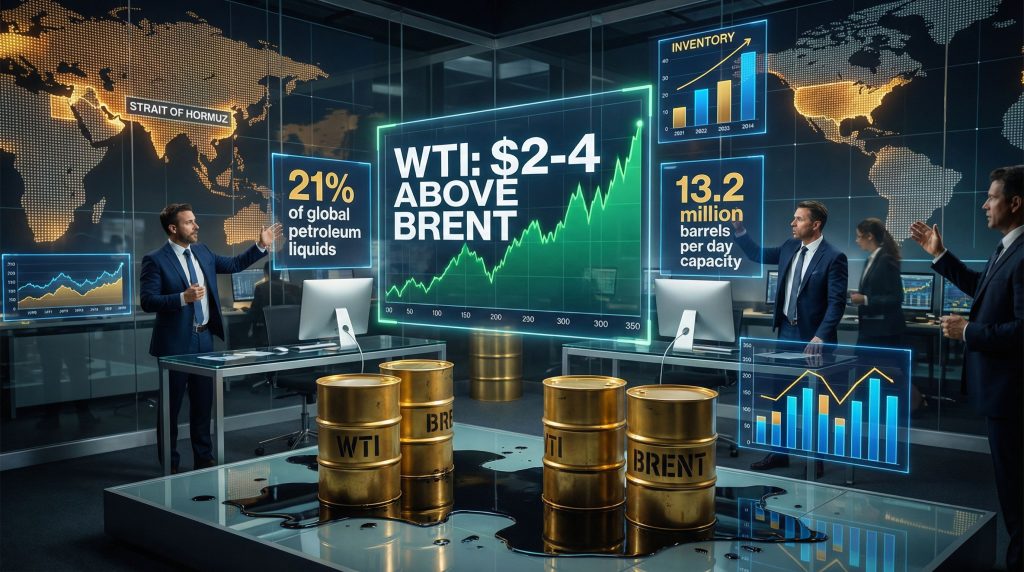
Recent trading data reveals WTI commanding a $2-4 premium over Brent, marking a significant departure from historical norms. This inversion coincides with extreme backwardation in WTI futures markets, where near-term contracts trade substantially higher than longer-dated positions.
The backwardation phenomenon occurs when immediate supply constraints drive spot prices above future delivery contracts. Senior market analysts observe record levels of this condition in WTI markets, indicating unprecedented short-term supply tightness relative to expected future availability.
Volume and open interest patterns show increased speculative activity as traders position for extended geopolitical uncertainty. The shift in trading behavior reflects growing recognition that North American crude benchmarks may offer better insulation from global supply disruptions than traditionally internationally-exposed alternatives.
When big ASX news breaks, our subscribers know first
How Do Geopolitical Risk Premiums Affect Regional Oil Benchmarks?
Geopolitical risk premiums in energy markets operate through complex mechanisms that differentiate regional crude benchmarks based on their exposure to international supply chain vulnerabilities. However, understanding why has the WTI oil price surpassed Brent requires analysing how geographic and infrastructure advantages can suddenly become decisive factors during crisis periods.
Middle East Supply Chain Vulnerabilities
The Strait of Hormuz represents a critical chokepoint for global petroleum flows, handling approximately 21% of global petroleum liquids according to energy infrastructure analysis. This narrow waterway's strategic importance cannot be overstated, as any disruption immediately affects international crude availability and pricing relationships.
Iranian production capacity, estimated at 4.2 million barrels per day, represents a significant portion of global supply that can be affected by regional conflicts. The combination of domestic production and transit route control gives Middle Eastern geopolitical developments outsized influence on international energy markets.
Regional crude quality specifications add another layer of complexity, as different refinery configurations favour specific crude grades. Middle Eastern crudes typically require specialised refining infrastructure, creating additional vulnerabilities when supply chains face disruption.
Market strategists emphasise that uncertainty regarding conflict duration has eliminated clear timelines for supply normalisation. When geopolitical developments offer no clear resolution pathway, traders increasingly favour crude benchmarks with stronger domestic supply foundations.
North American Energy Security Positioning
The United States' domestic production capacity of approximately 13.2 million barrels per day provides fundamental support for WTI pricing during international supply disruptions. This production level represents one of the world's largest crude oil outputs, offering significant buffer capacity against external supply shocks.
Strategic Petroleum Reserve utilisation patterns during previous crises demonstrate how domestic inventory management can stabilise regional markets. The reserve system provides additional flexibility for maintaining supply continuity when international sources face disruption.
Pipeline infrastructure advantages for WTI distribution include:
- Extensive domestic pipeline networks connecting production areas to refineries
- Reduced reliance on international shipping for domestic market supply
- Established storage facilities at key distribution hubs
- Flexible transportation options including rail and truck capacity
These infrastructure advantages become particularly valuable during periods when international transportation routes face elevated risks or actual disruptions.
What Role Does Inventory Management Play in Price Differentials?
Inventory levels serve as crucial shock absorbers in global energy markets, but their protective capacity operates within finite limits that become critical during supply disruptions. The relationship between stock levels and pricing mechanisms helps explain why has the WTI oil price surpassed Brent during current market conditions.
Critical Stock Level Analysis
Current global commercial crude inventory data reveals concerning proximity to operational minimums that could trigger significant market adjustments:
| Region | Current Stocks (Million Barrels) | Days of Cover | Operational Minimum |
|---|---|---|---|
| OECD Total | 968 | 27 days | 30 days |
| US Commercial | 421 | 22 days | 25 days |
| Europe | 347 | 31 days | 28 days |
These figures demonstrate that global inventory buffers have reached critically low levels, with OECD commercial stocks sitting uncomfortably close to the 30-day operational minimum. Commodities strategists warn that inventory levels below this threshold fundamentally alter market dynamics, shifting primary balancing mechanisms from stock draws to price-driven demand destruction.
The operational minimum represents more than an arbitrary benchmark. Below approximately 24 days of forward cover (the engineering minimum), the petroleum supply system begins experiencing severe logistical strain and practical breakdowns in market liquidity. At these levels, physical delivery constraints can create extreme price volatility as supply chain coordination becomes increasingly difficult.
Inventory Drawdown Acceleration Patterns
Monthly depletion rates during supply disruptions follow predictable patterns that intensify as available stock levels approach critical thresholds. Energy market analysts project OECD commercial crude inventories could decline by approximately 166 million barrels during peak disruption periods, followed by additional draws of 67 million barrels in subsequent months.
These projected drawdown rates would push total inventory levels toward the operational minimum of 842 million barrels, at which point the market system transitions from absorbing shocks through stock reductions to implementing forced demand rationing through price mechanisms.
Floating storage dynamics mask true availability in several important ways:
- Timing lags between actual consumption and reported inventory changes
- Regional distribution imbalances affecting local market access
- Quality mismatches between available stocks and refinery requirements
- Commercial vs. strategic inventory classifications creating reporting inconsistencies
Understanding these factors is essential for accurately assessing market tightness and predicting price movements across different regional benchmarks.
Why Are Traders Positioning Differently in WTI vs. Brent Markets?
Trading behaviour patterns reveal fundamental shifts in how market participants assess risk and opportunity across different crude oil benchmarks. The divergence in positioning between WTI and Brent markets reflects deeper changes in global energy security perceptions and investment strategy frameworks.
Speculative Flow Analysis
Hedge fund positioning data shows significant net long exposure preferences for WTI compared to Brent during current market conditions. This positioning shift reflects traders' assessment that North American crude benchmarks offer superior risk-adjusted returns during periods of international supply uncertainty.
Commodity Trading Advisor (CTA) algorithmic strategies have adapted their models to account for changing correlation patterns between regional benchmarks. Traditional statistical relationships that guided automated trading systems for years have broken down, forcing algorithmic updates that favour domestically-backed crude futures.
Risk-on and risk-off sentiment patterns now drive benchmark selection more significantly than historical price relationships. During risk-off periods, traders increasingly prefer crude exposure through vehicles with stronger domestic supply foundations rather than internationally-dependent alternatives.
Physical vs. Paper Market Dynamics
The Dated Brent to futures spread has expanded to over $10 premium, compared to less than $1 during normal market conditions. This dramatic widening indicates severe physical market tightness that paper markets have not yet fully recognised or reflected in futures pricing.
WTI delivery point advantages become particularly valuable during supply constraints because:
- Domestic refinery access reduces international transportation risks
- Established storage infrastructure provides flexibility for timing optimisation
- Local demand sources offer alternative market outlets
- Reduced currency exposure through dollar-denominated domestic transactions
Refinery run rates and crack spread optimisation favour crude sources with reliable delivery schedules and predictable quality specifications. During international supply disruptions, refineries often accept higher crude costs in exchange for reduced logistics uncertainty.
How Do Federal Reserve Policies Impact Oil Price Relationships?
Monetary policy transmission mechanisms affect crude oil markets through multiple channels that can alter regional benchmark relationships in unexpected ways. Understanding these connections helps explain why has the WTI oil price surpassed Brent beyond simple supply and demand fundamentals.
Dollar Strength and Commodity Pricing
The Dollar Index (DXY) correlation with Brent demonstrates higher sensitivity to currency movements compared to WTI, which benefits from reduced international exchange rate exposure through domestic demand sources. When dollar strength pressures commodity prices generally, benchmarks with stronger domestic foundations often show greater resilience.
WTI's reduced currency exposure operates through several mechanisms:
- Domestic pricing transactions in dollars reduce exchange rate sensitivity
- Local refinery demand provides dollar-based price support
- Reduced international arbitrage limiting currency-driven trading flows
- Strategic reserve operations conducted in domestic currency
Interest rate expectations affect storage economics differently across regional markets. Higher rates increase the carrying costs for stored crude, but domestic storage facilities often offer more predictable financing terms than international alternatives.
Monetary Policy Transmission Mechanisms
Quantitative tightening effects on commodity financing create differential impacts across crude benchmarks based on their financing infrastructure and participant base. Markets with stronger domestic banking relationships often maintain better access to credit facilities during monetary tightening cycles.
Credit availability for oil trading operations varies significantly between domestic and international markets. WTI trading benefits from established relationships with U.S. financial institutions that may maintain more stable lending criteria during policy transitions.
Forward curve shape implications for investment decisions favour benchmarks with clearer regulatory frameworks and more predictable policy environments. Domestic crude markets often benefit from greater policy transparency and more stable institutional frameworks.
What Are the Long-Term Implications for Global Energy Markets?
Current market developments signal potential structural changes in how global energy markets operate and price risk across different regional benchmarks. These shifts could have lasting implications for investment strategies, infrastructure development, and energy security policies worldwide.
Structural Market Evolution
Benchmark pricing power shifts between regions reflect changing geopolitical realities and evolving supply chain vulnerabilities. The relative strengthening of domestically-backed crude benchmarks suggests a potential long-term rebalancing of global energy market influence away from traditionally international centres.
Infrastructure investment patterns are already responding to supply security concerns through:
- Enhanced domestic pipeline capacity development projects
- Strategic storage facility expansion initiatives
- Renewable energy acceleration as supply security hedge
- Cross-border energy cooperation agreements with trusted partners
Energy transition timeline adjustments due to supply volatility may accelerate adoption of domestic energy sources while simultaneously increasing short-term reliance on regional crude production as bridge fuels during transition periods.
Moreover, the oil price rally has intensified as geopolitical tensions create uncertainty about long-term supply stability. Additionally, concerns about the US-China trade war continue to influence market sentiment and trading patterns across both benchmarks.
Investment Strategy Considerations
Portfolio diversification across crude oil benchmarks has become more important as traditional correlation relationships break down. Investors must now consider regional supply security factors alongside traditional financial metrics when building energy exposure.
Upstream capital allocation responding to price signals increasingly favours projects with strong domestic market access and reduced international transportation exposure. This shift may accelerate development of previously marginal domestic resources while potentially reducing investment in international projects with complex logistics.
Furthermore, understanding the OPEC production impact on global supply becomes crucial for long-term planning. Consequently, the US oil production impact remains a key factor in determining future price relationships between regional benchmarks.
Downstream refinery optimisation for changing crude slates requires increased flexibility and adaptability. Refineries with access to multiple crude sources and flexible processing capabilities are likely to command premium valuations in the current environment.
The next major ASX story will hit our subscribers first
Frequently Asked Questions About WTI-Brent Price Dynamics
Will WTI Continue Trading Above Brent?
Scenario analysis for various conflict duration and intensity levels suggests that WTI's premium over Brent could persist as long as international supply chain vulnerabilities remain elevated. Historical precedents for sustained price inversions typically resolve once the underlying supply security concerns are addressed through either conflict resolution or alternative supply development.
Market rebalancing mechanisms include:
- Alternative supply route development reducing chokepoint dependencies
- Strategic reserve releases providing temporary supply buffers
- Demand destruction at higher price levels
- Production increases from less affected regions
Timeline expectations for normalisation depend heavily on geopolitical developments that remain highly uncertain and difficult to predict with confidence.
How Should Energy Investors Respond to This Shift?
Sector rotation opportunities within oil and gas equities favour companies with strong domestic production assets and reduced international exposure. Integrated companies with balanced portfolios across multiple regions may offer more stable returns during volatile periods.
Commodity exposure strategies should consider:
- Regional benchmark diversification to capture different risk premiums
- Infrastructure and storage investments as supply security plays
- Currency hedging for international energy investments
- Time horizon matching between investment duration and expected volatility periods
Risk management approaches for energy-dependent industries require enhanced scenario planning and supply chain diversification strategies to maintain operational continuity during market disruptions.
For instance, the ongoing oil price trade war dynamics necessitate careful monitoring of how trade policies affect regional benchmark pricing. Furthermore, according to industry experts at Barron's, geopolitical tensions could drive oil prices significantly higher. Moreover, market analysts at Rigzone provide detailed analysis of the technical factors behind this historic price inversion.
Conclusion: Navigating the New Oil Market Paradigm
Key Takeaways for Market Participants
The current inversion where why has the WTI oil price surpassed Brent represents more than a temporary market anomaly. Supply security premiums are fundamentally reshaping traditional pricing relationships, creating new frameworks for evaluating crude oil investments and energy security strategies.
Inventory management has evolved from a routine operational consideration to a critical competitive advantage. Companies and countries with superior storage capabilities and inventory optimisation strategies are demonstrating enhanced resilience during supply disruptions.
Geopolitical risk assessment requires enhanced sophistication as traditional hedging strategies prove insufficient for managing complex, multi-regional supply chain vulnerabilities. Market participants must develop more nuanced frameworks for evaluating and pricing geopolitical risks across different energy benchmarks.
Strategic Positioning for Continued Volatility
Diversification across crude oil benchmarks and geographies has become essential for maintaining stable energy exposure during periods of elevated international uncertainty. Traditional concentration strategies that relied on single benchmark exposure may prove inadequate in the current environment.
Enhanced scenario planning for supply disruption events should incorporate multiple variables including conflict duration, alternative supply availability, demand elasticity, and policy responses. Single-point forecasting models are likely to prove insufficient for navigating complex, interconnected disruption scenarios.
Technology investments for real-time market intelligence can provide competitive advantages in rapidly changing market conditions. Companies with superior information processing and analysis capabilities are better positioned to identify opportunities and manage risks during volatile periods.
The information contained in this article is for educational and informational purposes only and should not be construed as financial or investment advice. Energy markets involve significant risks and uncertainties that can result in substantial losses. Past performance does not guarantee future results, and geopolitical developments can create unpredictable market conditions. Readers should conduct their own research and consult with qualified financial professionals before making investment decisions.
Ready to Capitalise on Energy Market Volatility?
Discovery Alert's proprietary Discovery IQ model delivers real-time alerts on significant commodity discoveries across the ASX, empowering subscribers to identify actionable opportunities whilst global energy markets experience unprecedented volatility. Begin your 14-day free trial today and position yourself ahead of market shifts that are reshaping traditional investment strategies.