August 24, 2026
The Industrial Logic Behind Sensor-Based Pre-Concentration in Hard-Rock Lithium Mining
Processing engineers working on hard-rock lithium projects have long grappled with a fundamental inefficiency baked into conventional flowsheets: enormous volumes of barren waste rock are transported, crushed, ground, and chemically treated alongside the ore that actually contains value. For decades, the industry accepted this as an unavoidable cost of doing business. The emergence of industrial-scale X-ray transmissive sorting has begun to dismantle that assumption entirely, and nowhere is this shift more visible than at the Pilgangoora lithium project in Western Australia's Pilbara region.
The deployment of Tomra ore sorters for the Pilgangoora expansion programme has become one of the most closely watched case studies in modern lithium processing design. It is not simply a story about equipment procurement. It reflects a deeper structural shift in how the mining industry thinks about where value is created and where waste is eliminated within a processing chain.
When big ASX news breaks, our subscribers know first
What Makes Pilgangoora Significant in the Global Lithium Landscape
Pilgangoora sits within the Pilbara craton, a geologically ancient terrain in northwestern Western Australia that hosts some of the world's most significant hard-rock lithium mineralisation. The deposit is dominated by spodumene, a lithium aluminium inosilicate mineral that must be physically liberated from its host rock and then chemically converted before it can be used in battery-grade lithium compounds. Understanding spodumene extraction basics is therefore essential context for appreciating the scale of the engineering challenge at Pilgangoora.
Operated by Pilgangoora Operations, a wholly owned subsidiary of PLS Group (ASX: PLS), the project has evolved through a series of staged capacity expansions that have progressively increased throughput while testing and validating new processing technologies at industrial scale. This staged development approach has proven particularly important in building institutional confidence in ore sorting as a core processing method rather than a peripheral enhancement.
The deposit's scale places it among the world's largest hard-rock lithium resources, and examining global lithium reserves reveals how Pilgangoora distinguishes itself from the brine-based lithium operations that dominate South America's Lithium Triangle. Unlike brine extraction, which involves pumping lithium-rich subsurface water and concentrating it through evaporation, hard-rock spodumene operations require physical comminution and mineral processing steps that are inherently more energy and water intensive. Consequently, this distinction makes pre-concentration technologies particularly valuable in the hard-rock context. For a broader comparison, the differences between hard-rock vs brine lithium operations are considerable in both capital requirements and environmental footprint.
Understanding XRT Ore Sorting: The Physics Behind the Technology
X-Ray Transmission sorting operates on a deceptively elegant physical principle. When X-rays pass through a rock particle, different minerals absorb radiation at different rates depending on their atomic density and elemental composition. Spodumene, with its lithium, aluminium, and silicon content, produces a distinct X-ray transmission signature compared to the quartz, feldspar, and mica that typically constitute gangue material in Pilgangoora-style pegmatite ore bodies.
At conveyor speeds capable of sustaining industrial throughput, XRT sensors capture transmission data for each individual particle crossing the belt. A processing algorithm interprets this data in real time and triggers compressed air jets to divert waste particles into a reject stream while allowing ore to continue through the circuit. The entire process occurs without physical contact, without reagents, and without water.
This dry, contactless operating mode is particularly advantageous in the Pilbara, where water scarcity is a persistent operational constraint and tailings management represents a significant environmental and regulatory obligation.
How Does Spodumene Respond to XRT Sensing?
Technical note: One underappreciated aspect of XRT sorting in lithium applications is that spodumene's relatively low atomic density compared to many metallic minerals initially raised questions about sorting selectivity. In practice, the contrast between spodumene and feldspar-dominated gangue has proven sufficient for reliable industrial separation, particularly in coarser size fractions where particle-level mineralogy is more homogeneous.
The Pilgangoora Expansion Architecture: Building Confidence Through Staged Deployment
The evolution of ore sorting at Pilgangoora follows a deliberate, data-driven trajectory across three expansion phases. Each stage has generated operational performance data that informed subsequent procurement and design decisions.
| Expansion Stage | Commissioning | Sorting Equipment | Key Outcome |
|---|---|---|---|
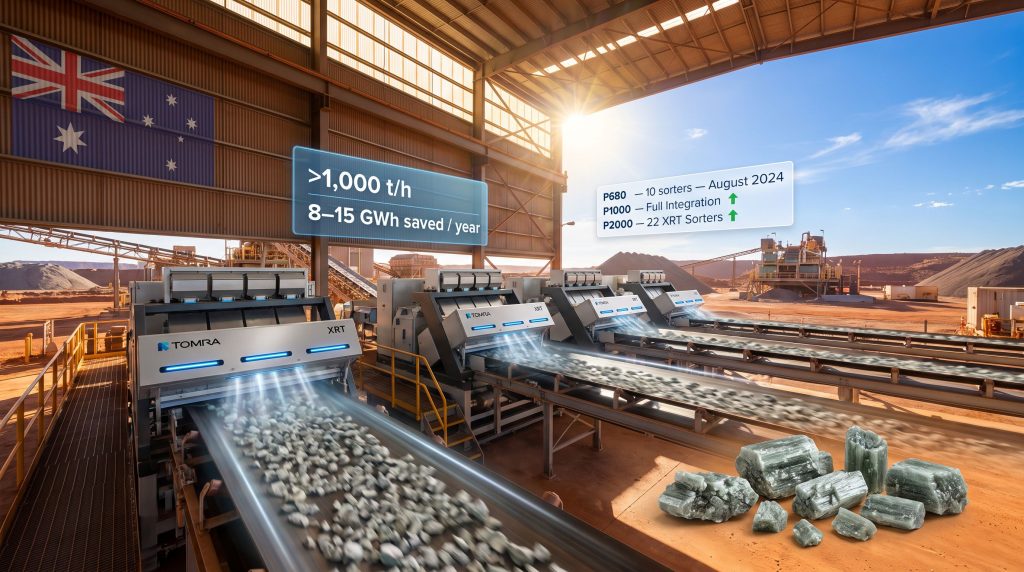
| P680 | August 2024 | 10 sorters across three circuits | World's largest lithium ore sorting plant at commissioning |
| P1000 | Completed prior to 2026 | Full industrial-scale integration | Ore sorting embedded as standard flowsheet step |
| P2000 | Awaiting board approval (2026) | 22 XRT ore sorters ordered | Largest single Tomra deployment at Pilgangoora |
The P680 installation, commissioned in August 2024, was instrumental in demonstrating that sensor-based sorting could operate reliably at throughput rates exceeding 1,000 tonnes per hour. This was not a pilot plant or a scaled-down demonstration circuit. It was a full-production installation operating within a live processing environment, generating real operational data under real conditions.
The P1000 expansion built on that foundation, embedding ore sorting more deeply into the processing flowsheet and expanding the scope of particle fractions being treated. By the time the P2000 equipment order was placed, both Tomra and PLS Group had accumulated years of performance data across successive expansion cycles, substantially reducing the technology risk that might otherwise have given a board pause before approving a 22-sorter procurement package.
The decision to proceed with equipment ordering ahead of formal board approval for the P2000 project is itself an important signal. It reflects a procurement strategy designed to protect project scheduling against supply chain lead times, and it treats ore sorting infrastructure with the same operational criticality as primary crushing or dense media separation. In practical terms, it means both organisations regard the P2000 expansion as a matter of timing rather than technology validation.
A Three-Circuit Sorting Configuration: Matching Technology to Particle Physics
One of the less-discussed but technically significant aspects of the Pilgangoora installation is its particle-size-specific circuit architecture. Rather than applying a single sorting modality across the entire ore stream, the processing flowsheet segments feed material by particle size and applies different sensing technologies to each fraction.
The three-circuit configuration at P680 consisted of:
- Fines circuit: COM Tertiary XRT units, four sorters handling smaller particle fractions where dense media separation becomes less effective and mineralogical liberation is more complex.
- Mid-size circuit: COM XRT 2.0 units, three sorters targeting intermediate particle fractions with higher throughput capacity and improved classification accuracy.
- Coarse circuit: PRO Primary Color units, three sorters using optical and near-infrared sensing to identify and reject large, visually distinguishable waste particles.
This configuration reflects a nuanced understanding of ore heterogeneity. In a pegmatite deposit like Pilgangoora, mineral grain sizes vary considerably, and the relationship between particle size, mineralogical composition, and sorting detectability is not uniform. Coarse particles tend to be mineralogically simpler and more amenable to optical discrimination, while finer fractions require the greater penetrating analytical power of XRT to reliably distinguish spodumene from gangue.
The 22-unit XRT sorter package ordered for P2000 represents a significant expansion of this sorting infrastructure. While the precise circuit configuration for P2000 has not been publicly detailed, the scale of the deployment positions Pilgangoora as one of the most extensively instrumented ore sorting installations in the global hard-rock mining industry.
Quantified Benefits: Energy, Efficiency, and Environmental Performance
The operational case for large-scale ore sorting at Pilgangoora rests on a combination of energy savings, processing efficiency gains, and environmental performance improvements that compound across the downstream circuit.
| Performance Metric | Reported Outcome |
|---|---|
| Annual energy savings | 8 to 15 GWh per year |
| Sorting throughput capacity (P680) | More than 1,000 tonnes per hour |
| Processing stage | Pre-concentration upstream of DMS and flotation |
| Product quality impact | Improved concentrate grade through early gangue rejection |
The mechanism behind these savings is straightforward but often underappreciated in its scale. When barren rock is rejected at the pre-concentration stage before entering the wet processing circuit, every downstream unit operation treats a smaller, higher-grade feed. Dense media separation plants process less material. Flotation cells treat a more concentrated feed. Calcination furnaces handle reduced volumetric throughput. Each of these reductions translates into lower energy consumption, reduced reagent demand, and decreased water usage per tonne of lithium carbonate equivalent produced.
Annual energy savings in the range of 8 to 15 GWh are not trivial at the project level. For context, this range represents a meaningful reduction in both operational cost and greenhouse gas emissions at a single processing facility, contributing to measurable improvements in scope 1 and scope 2 emissions intensity metrics that are increasingly scrutinised by investors and ESG reporting frameworks.
The tailings management dimension deserves particular attention. By removing waste rock before it enters wet processing circuits, ore sorting reduces the volume of fine waste material that ultimately reaches the tailings storage facility. Tailings storage represents one of the most significant long-term environmental liabilities in hard-rock mining, and any technology that measurably reduces tailings generation rates per unit of product delivers compounding environmental and regulatory benefits over the life of a mine.
The next major ASX story will hit our subscribers first
Comparing Pre-Concentration Technologies in Hard-Rock Lithium Flowsheets
Ore sorting does not exist in isolation within a lithium processing flowsheet. It occupies a specific pre-concentration role that is complementary to, rather than competitive with, the downstream beneficiation technologies that follow. Furthermore, direct lithium extraction represents an entirely separate technological pathway that is more applicable to brine-based operations than to the hard-rock context at Pilgangoora.
| Technology | Operating Mechanism | Primary Application | Key Limitation |
|---|---|---|---|
| XRT Ore Sorting | Atomic density differentiation via X-ray | Coarse to fine spodumene pre-concentration | Requires dry feed; particle size constraints |
| Dense Media Separation | Specific gravity in heavy liquid suspension | Mid-grade ore concentration | High water consumption; reagent costs |
| Flotation | Surface chemistry mineral separation | Fine particle lithium recovery | Energy-intensive; reagent-sensitive |
| Optical and Color Sorting | Visual and near-infrared reflectance | Coarse, visually distinct ore fractions | Less effective for mineralogically similar gangue |
The economic logic for stacking ore sorting ahead of DMS and flotation lies in its impact on capital sizing. If a pre-concentration stage removes 20 to 30 percent of feed material as waste before the DMS circuit, the DMS plant can be designed at a proportionally smaller scale to achieve the same unit output. This capital cost reduction can be substantial in high-throughput operations where DMS and flotation infrastructure represents a major component of project capital expenditure.
For new project developers, this creates a compelling design argument: incorporating ore sorting from project inception rather than retrofitting it post-commissioning allows downstream circuits to be right-sized from the outset, potentially improving project economics at the feasibility study stage.
What the PLS and Tomra Partnership Reveals About Technology Maturity
The multi-phase nature of the Tomra and PLS Group collaboration at Pilgangoora carries broader implications for how the mining industry evaluates and adopts processing technology. Albert du Preez, head of Tomra, has characterised the P2000 order as evidence that sensor-based sorting has moved beyond its innovative origins to become an established and trusted component of modern lithium processing flowsheets. This assessment aligns with the observable trajectory at Pilgangoora, where each successive expansion has treated ore sorting with increasing operational centrality.
For investors and project financiers, the existence of a multi-phase performance track record at industrial scale significantly reduces the technology risk premium that might otherwise be applied to ore sorting in project valuations. A technology that has operated reliably across multiple expansion cycles at one of the world's largest spodumene operations is substantially de-risked compared to a technology appearing in a feasibility study for the first time.
Investor perspective: The pre-board-approval equipment order for P2000 is a procurement signal worth examining carefully. It suggests that lead times for large-scale sensor-based sorting equipment are long enough to influence project scheduling decisions, and that both parties have sufficient confidence in the expansion proceeding to absorb the commercial risk of early ordering. For investors monitoring PLS Group's capital allocation decisions, it reflects operational momentum rather than speculative technology adoption.
The Emerging Design Standard for Next-Generation Lithium Processing Plants
The Pilgangoora multi-phase deployment is increasingly being discussed within the processing engineering community as a reference architecture for hard-rock lithium operations. Its staged, data-validated approach to ore sorting integration demonstrates a replicable methodology: begin with a full-scale industrial installation, generate operational performance data, use that data to inform subsequent procurement decisions, and progressively embed the technology more deeply into the standard flowsheet.
Several factors suggest this trajectory will influence processing design decisions at other large-scale spodumene operations globally. Bankable feasibility studies for new hard-rock lithium projects are increasingly expected to address pre-concentration in their processing chapters. Investors and lenders familiar with the Pilgangoora performance record will naturally apply that benchmark when evaluating the processing assumptions of competing projects.
For processing engineers, the three-circuit, particle-size-specific sorting configuration at Pilgangoora offers a practical design framework that acknowledges the mineralogical complexity of pegmatite deposits. The principle that different sensing modalities should be matched to the physical characteristics of different size fractions, rather than applying a uniform approach across the entire feed stream, is likely to become embedded design practice in new spodumene project development.
The broader implication is that Tomra ore sorters for the Pilgangoora expansion have done more than improve processing economics at a single operation. They have helped define what a modern, high-throughput hard-rock lithium processing plant is expected to look like.
This article contains forward-looking statements and references to projected operational outcomes. Actual performance may differ from reported or anticipated figures. Readers should conduct their own independent research before making investment decisions based on the information presented here. The P2000 expansion project had not received formal board approval from PLS Group as of August 2026.
Want to Spot the Next Major ASX Lithium Discovery Before the Market Does?
As hard-rock lithium processing technology matures and projects like Pilgangoora demonstrate what world-class operations look like, identifying the next transformative spodumene discovery early becomes the critical investment challenge — one that Discovery Alert's proprietary Discovery IQ model addresses by delivering real-time ASX mineral discovery alerts, turning complex geological data into actionable insights the moment announcements hit the exchange. Explore Discovery Alert's dedicated discoveries page to understand the historic returns major mineral discoveries have generated, and begin your 14-day free trial to position yourself ahead of the broader market.