July 17, 2026
The Geography of Risk: Why Two Waterways Now Hold the Global Economy Hostage
Maritime chokepoints have shaped the economics of energy for centuries, but the architecture of global oil trade has never faced a stress test quite like the one unfolding across the Middle East in 2026. The simultaneous disruption of two of the world's most strategically vital shipping corridors is no longer a theoretical scenario confined to geopolitical risk models. It is an active, accelerating reality with price consequences already radiating into household fuel costs, central bank deliberations, and the foreign policy calculations of every major energy-importing nation on earth.
The Yemen Houthis oil shock is the newest and most volatile dimension of this crisis. As the Strait of Hormuz remains effectively non-operational following disruptions that began in February 2026, Houthi rebels in Yemen are now threatening to enforce a blockade of the Bab al-Mandeb Strait — an 18-mile-wide corridor separating Yemen from Djibouti that serves as the southern gateway between the Red Sea and the Gulf of Aden. This is not a redundant pressure point. It is the second critical link in the Europe-Asia energy supply chain, and its closure would compound, not merely add to, the supply shock already underway.
| Chokepoint | Daily Oil Flow (Approx.) | Primary Risk Actor | Alternative Route | Rerouting Cost Premium |
|---|---|---|---|---|
| Strait of Hormuz | ~21 million bpd | Iran | None viable at scale | Extreme |
| Bab al-Mandeb | ~4–6 million bpd | Houthi rebels | Cape of Good Hope | +10–15 days transit |
| Suez Canal | ~5 million bpd | Egypt (political) | Cape of Good Hope | +7–10 days transit |
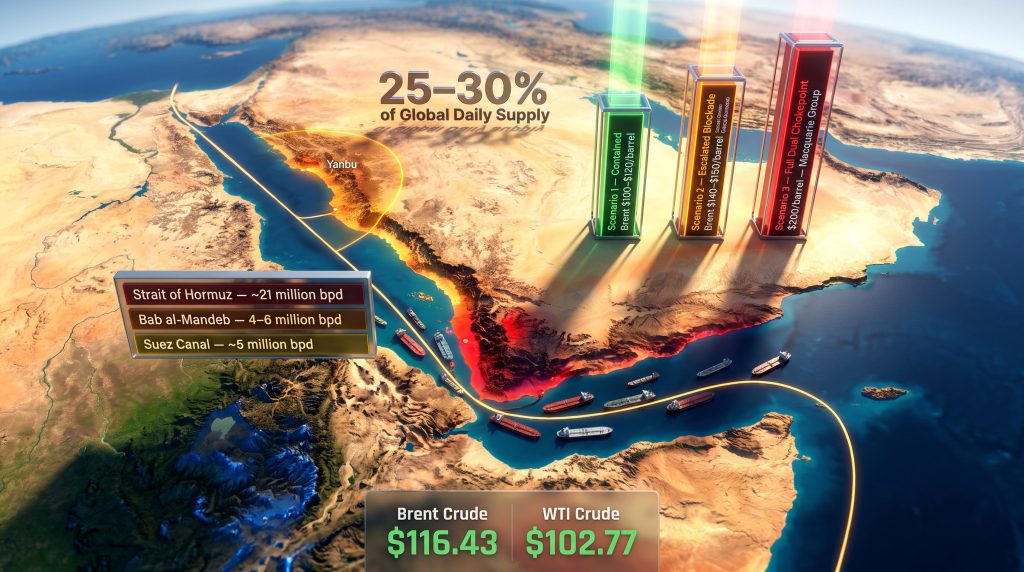
What makes this configuration uniquely dangerous is the absence of viable alternative routing at scale. The Strait of Hormuz, through which approximately 21 million barrels per day of crude flows, has no meaningful bypass. The Bab al-Mandeb can theoretically be circumnavigated via the Cape of Good Hope, but this adds 10 to 15 additional transit days per voyage and significantly inflates freight costs and insurance premiums. The two waterways together represent an estimated 25 million barrels per day of seaborne supply, or roughly 25 to 30 percent of global daily consumption. No strategic petroleum reserve mechanism, and no OPEC spare capacity pool, can fully absorb that volume.
When big ASX news breaks, our subscribers know first
How Yemen's Civil War Reignited and Why Geopolitical Alignment Matters
The roots of the current escalation trace back through several years of fragile informal ceasefire conditions that held from approximately 2022 until mid-2026. The unofficial truce was never underwritten by a formal peace agreement, and the structural conditions driving the conflict — including Houthi military capability, Iranian weapons transfers, and the absence of a functioning unified state — remained largely unchanged beneath the surface.
The sequence of escalation milestones in 2026 reveals a pattern of deliberate, coordinated provocation rather than opportunistic insurgency. According to the Red Sea crisis, the broader conflict has steadily evolved into a multi-front confrontation with significant global consequences:
- March 2026: Houthi forces launched direct missile strikes on Israeli territory, representing a significant expansion of their operational theatre beyond Yemen's borders
- February 28, 2026: Disruptions to Strait of Hormuz transit began, effectively reducing accessible seaborne crude supply
- June 8, 2026: The Houthis formally declared a complete prohibition on vessels associated with Israel transiting the Red Sea
- July 2026: Full-scale Yemeni civil war hostilities resumed, accompanied by explicit Houthi threats to close the Bab al-Mandeb
The Iran-Houthi operational relationship is central to understanding why this trajectory is unlikely to self-correct without significant external intervention. Iranian weapons transfers, intelligence coordination, and strategic direction have elevated Houthi military capability well beyond what a domestic insurgency could sustain independently. This is not a group reacting to local grievances alone. It is an operationally coordinated proxy force functioning as an extension of Iran's broader regional conflict posture against the United States and Israel.
Furthermore, OPEC's influence on oil markets has become increasingly constrained as geopolitical actors outside its membership reshape supply dynamics in ways that traditional producer coordination cannot address. Ibrahim Fraihat, a professor of international conflict resolution at the Doha Institute for Graduate Studies, has described the Bab al-Mandeb region as having been positioned on a structural fault line since the earliest days of the Yemen conflict, with the conditions for a major disruption present long before the current escalation materialised. That assessment now appears prescient.
Three Scenarios for the Yemen Houthis Oil Shock: Pricing the Uncertainty
Energy markets are not pricing a single outcome. They are attempting to assign probabilities across a spectrum of scenarios with radically different oil price implications.
Scenario Analysis Framework: The following three scenarios are assessed across a 90-day horizon, based on conflict escalation trajectories, OPEC spare capacity constraints, and seaborne rerouting limitations.
Scenario 1: Contained Disruption (Base Case)
Houthi attacks on Red Sea shipping remain sporadic rather than systematic. The Bab al-Mandeb stays partially accessible. Saudi Arabia's Yanbu export terminal continues operating. Brent crude stabilises in the $100 to $120 per barrel range as Cape of Good Hope rerouting absorbs the freight cost burden.
Scenario 2: Escalated Blockade (Adverse Case)
The Houthis enforce a sustained Red Sea shipping prohibition. Yanbu infrastructure comes under sustained drone strike pressure. Societe Generale's modelled price ceiling of $140 to $150 per barrel becomes the operative benchmark. U.S. retail gasoline prices breach $4.00 per gallon, triggering consumer spending contraction across discretionary categories.
Scenario 3: Full Dual Chokepoint Closure (Tail Risk)
Both the Strait of Hormuz and the Bab al-Mandeb become effectively non-operational for 60 or more consecutive days. Macquarie Group's modelled oil price ceiling of $200 per barrel moves from theoretical to plausible. Emergency IEA strategic reserve releases are triggered. Inflation spikes across import-dependent economies, and demand destruction begins to function as the primary price correction mechanism. Houthi warnings of oil prices hitting $200 if the war widens have rattled energy markets globally.
| Institution | Price Target | Trigger Condition |
|---|---|---|
| Societe Generale | $150/barrel | Supply interruptions persist into Q2 2026 |
| Macquarie Group | $200/barrel | Conflict extends to June; Hormuz remains shut |
| Bloomberg Economics | ~$140/barrel | Renewed Houthi Red Sea shipping attacks sustained |
What Markets Are Pricing Right Now
The market response has already been significant. Brent crude surged above $116.43 per barrel on March 30, 2026, putting it on track for a record monthly gain. WTI crude moved past $102.77 per barrel in the same period. Current crude oil price trends show oil prices jumped approximately 12 percent in a single week as Middle East war risks re-entered trader consciousness.
The OPEC basket recorded a +10.42 percent gain in recent trading sessions, while Brent futures flipped into backwardation — a structure in which near-term contracts trade at a premium to forward contracts. Backwardation signals that physical supply anxiety is dominating price formation, rather than long-term demand expectations.
This structural shift in the futures curve is analytically significant. Backwardation creates a financial incentive to draw down inventories rather than build them, which can amplify near-term price volatility and reduce the buffer that commercial storage normally provides during supply disruptions.
U.S. gasoline prices, which had been declining since May 2026, reversed direction following the collapse of the Iran ceasefire. Analysts are now warning that a breach of $4.00 per gallon at the retail pump is possible within days if escalation continues. The transmission mechanism is relatively predictable:
- Crude supply reduction or rerouting cost increases push benchmark prices higher
- Refinery input costs rise, compressing or eliminating margins
- Wholesale gasoline prices respond and are passed through to retail
- Consumer fuel expenditure rises with a typical lag of two to four weeks
- Discretionary spending contracts, feeding broader inflationary pressure
Saudi Arabia's Workaround and Its Structural Vulnerability
One of the least widely understood dimensions of the current crisis involves Saudi Arabia's response strategy. Facing the closure of the Strait of Hormuz, the Kingdom has redirected more than 70 percent of its crude exports through the Red Sea port of Yanbu, effectively bypassing Hormuz entirely.
This is a logistically sophisticated workaround, but it carries a critical exposure that markets have not fully priced. Yanbu sits within operational range of Houthi drone and missile systems. A sustained or successful strike campaign against Yanbu's export terminal infrastructure would simultaneously eliminate both the primary and the bypass routing for a substantial portion of Saudi crude, creating a supply impact more severe than either chokepoint acting alone.
Reports of a temporary production halt at Yanbu following an earlier drone strike provide evidence that this vulnerability is not theoretical. If Iran directs the Houthis to prioritise Yanbu as a target, the tail risk scenario transitions from a stress test to an operational reality. In addition, oil price movements amid trade war pressures have further complicated the Kingdom's ability to stabilise markets through conventional output adjustments.
Yemen's Internal Energy Collapse: The Destabilisation Multiplier
Separate from its role in global energy market disruption, Yemen is simultaneously experiencing a severe domestic energy crisis that functions as a political destabiliser in its own right.
Fewer than 50 percent of Yemen's population has reliable electricity access under normal conditions. During summer 2026, the city of Aden is experiencing outages of up to 20 hours per day. Two key generation facilities are affected:
- The Hiswa Power Station has gone offline following what authorities describe as a network strike
- The President Power Station is running at reduced capacity due to a shortage of crude oil feedstock for its generators
Faced with this collapse in grid reliability, Yemeni households have been forced into two energy substitution pathways, both of which carry serious physical hazards:
- Improvised solar-battery systems: Installed without professional oversight, these systems have become a major source of battery fires. Dr. Mohammed Saeed, head of the emergency department at the burn unit of Al-Thawra Hospital in Taiz, has confirmed that the facility regularly receives patients suffering burns caused by battery fires connected to improperly installed solar systems, with cases arriving from Taiz city and surrounding governorates
- Cooking-gas vehicle conversions: Vehicles retrofitted to operate on cooking fuel rather than petrol, creating serious explosion and fire risks. Malik Al-Sabri, manager of planning and information for the Taiz police, has confirmed a significant increase in fire incidents directly attributable to these two alternative energy practices
Analytical Note: Yemen's domestic energy collapse is not a separate story from the global oil market disruption. It is a political destabiliser. When civilian populations lose access to basic services at scale, the legitimacy of internationally recognised governing bodies erodes, and insurgent movements with organisational structure and community networks become the de facto providers of order. The Houthis have demonstrated a consistent ability to exploit exactly this dynamic.
Yemen's internationally recognised government has signalled interest in resuming energy sector investment ties with the United States, with the strategic rationale that rebuilding energy infrastructure could reduce civilian desperation and undermine Houthi recruitment narratives. The critical obstacle is that active conflict conditions make the risk profile of foreign energy investment in Yemen effectively uninsurable under current frameworks.
The next major ASX story will hit our subscribers first
How Global Supply Chains Are Adapting: The Rerouting Economy
Since the initial wave of Houthi Red Sea attacks in 2023 and 2024, major shipping carriers have been operating rerouting protocols around the Cape of Good Hope. The cumulative economic impact of this shift has been substantial:
- Each voyage between Asia and Europe now requires approximately 10 to 15 additional transit days
- Asian LNG spot prices have jumped 10 percent as Hormuz supply fears intersect with Red Sea disruptions
- Pakistan has been forced to pay the highest spot LNG prices in four years as Qatar supply chain reliability deteriorates; furthermore, LNG supply market implications are rippling across the entire Asia-Pacific energy import structure as Strait of Hormuz traffic stalls
- China's crude oil imports have fallen to decade-low levels as Hormuz disruption bites, with the country also cutting Saudi crude orders as Hormuz risks and pricing discounts reshape trade flows
- China's refinery runs have crashed to levels comparable to pandemic-era lows
- India has urged shipowners to avoid deploying Indian nationals on Strait of Hormuz voyages, a significant diplomatic and operational signal
- Asian oil importers broadly are pivoting toward U.S. and Atlantic Basin crude suppliers to reduce Middle Eastern route dependency
The IEA has warned publicly that the world has only weeks to avoid the full economic impact of a Hormuz supply shock, and the organisation's member nations hold strategic petroleum reserves equivalent to approximately 90 days of net imports. That buffer is meaningful but not indefinite, and deployment speed and political coordination among IEA members will be critical variables in determining how long price spikes can be moderated through reserve releases.
Infrastructure bypass solutions are also being accelerated. U.S. support for an Iraq-Syria pipeline designed to route crude exports around Hormuz is one example. Dubai is actively planning port expansion and strategic storage builds specifically calibrated to the next Hormuz crisis cycle.
Three Variables That Determine Whether This Becomes a Historic Oil Shock
The transition from elevated prices to a genuinely historic supply crisis is not inevitable. It depends on three variables, each of which remains uncertain.
Variable 1: Houthi Military Capability Durability
Previous U.S. and allied strikes on Houthi infrastructure in 2024 produced temporary reductions in attack frequency but did not eliminate operational capability. The question is whether a sustained military campaign can meaningfully degrade Houthi missile and drone capacity before the Bab al-Mandeb closure becomes fully enforced.
Variable 2: Iran's Strategic Decision-Making
Iran's choice about whether to direct Houthi operations specifically against Saudi energy infrastructure — particularly Yanbu — is the single highest-impact variable in the system. A deliberate instruction to escalate attacks on Gulf energy facilities would likely shift the probability mass decisively toward Scenario 3. However, the trade war impact on oil markets adds another layer of complexity, as economic pressure on Iran may influence its willingness to escalate.
Variable 3: OPEC+ and IEA Reserve Response Speed
OPEC+ spare capacity is estimated at 3 to 5 million barrels per day, which is meaningful in a contained disruption scenario but wholly insufficient to offset a dual chokepoint closure. The coordination speed and political will of IEA member nations to deploy reserves will determine price spike duration rather than magnitude.
The Yemen Houthis oil shock is not yet a supply collapse. It is a compounding risk premium event with a clear pathway to becoming something far more severe. The critical threshold is whether Iran actively directs Houthi operations from maritime harassment of shipping toward direct Gulf energy infrastructure attacks. Until that question is definitively answered, energy markets will remain in a state of structurally elevated, volatile uncertainty that neither strategic reserves nor OPEC spare capacity can fully resolve.
This article is intended for informational purposes only and does not constitute investment advice. Oil price forecasts and scenario projections referenced herein are drawn from third-party institutional analysts and carry inherent uncertainty. Readers should conduct their own due diligence before making any financial decisions.
Want to Stay Ahead of the Next Major Resource Discovery Amid Global Energy Volatility?
Discovery Alert's proprietary Discovery IQ model delivers real-time alerts on significant ASX mineral discoveries, instantly cutting through complex market data to surface actionable opportunities — even as geopolitical shocks reshape commodity supply chains. Start your 14-day free trial today, or explore how historic mineral discoveries have generated extraordinary returns on Discovery Alert's dedicated discoveries page.