
August 6, 2026
The Growing Risks of Yen Carry Trade Unwinding
Understanding the psychology of financial markets requires examining how seemingly stable trading strategies can suddenly unravel, triggering widespread panic and forced liquidation. When institutional investors become comfortable with low-volatility environments, they often increase leverage and concentrate positions in strategies that appear to offer consistent profits. This behavioural pattern creates the foundation for systemic risks that can cascade across global markets when conditions shift unexpectedly.
The yen carry trade unwinding represents one of the most significant examples of how investor psychology can drive both excessive risk-taking and subsequent market disruption. By analysing the mechanics behind this strategy and its potential unwinding, we can better understand the interconnected nature of modern financial markets and the amplification effects of leveraged positioning.
What Is the Yen Carry Trade and Why Do Investors Love It?
The Mechanics Behind Japan's Low-Cost Funding Strategy
The carry trade fundamentally operates on interest rate differentials between countries, with investors borrowing in currencies offering low yields to invest in higher-yielding assets elsewhere. Japan's monetary policy environment has created an ideal funding source for this strategy, with the Bank of Japan maintaining ultra-low interest rates for extended periods.
According to market analysis, the typical structure involves borrowing yen at approximately 1.00% to earn around 4.00% on US Treasury bonds, creating a theoretical spread of 3% annually. This differential becomes particularly attractive when amplified through leverage, allowing institutions to generate substantial profits on borrowed capital.
Historical context reveals that Japan's low interest rate environment began in the 1990s and persisted through various economic cycles. The sustained nature of this policy stance encouraged widespread adoption of yen-funded carry strategies across global financial institutions, from hedge funds to commercial banks. Furthermore, the tariffs impact on markets has created additional considerations for cross-border investment strategies.
Psychology of "Free Money" Trading
The appeal of carry trades extends beyond simple mathematics to encompass behavioural finance principles. During periods of low market volatility, risk perception becomes distorted as investors extrapolate recent calm conditions into future expectations. This psychological anchoring leads to increased position sizes and reduced hedging as the strategy appears consistently profitable.
Institutional appetite for leveraged yield strategies grows particularly strong when traditional fixed-income returns remain compressed. Portfolio managers facing pressure to generate alpha often turn to carry trades as a seemingly reliable source of enhanced returns, especially when these strategies have performed well over extended periods.
Typical Carry Trade Return Scenarios:
| Market Environment | Expected Returns | Risk Factors |
|---|---|---|
| Low volatility | 2.5-4% annually | Minimal currency fluctuation |
| Medium volatility | 1-3% annually | Moderate hedging costs |
| High volatility | -5 to -15% | Forced liquidation scenarios |
The psychological comfort derived from years of successful carry trade performance can create overconfidence bias, leading investors to underestimate tail risks and currency volatility. This behavioural pattern contributes to position concentration and inadequate risk management practices across the industry.
When big ASX news breaks, our subscribers know first
When Does the Yen Carry Trade Start Unwinding?
Interest Rate Differential Compression Triggers
Market dynamics shift dramatically when the fundamental drivers of carry trade profitability begin deteriorating. Bank of Japan policy normalisation signals represent one primary catalyst, as any movement toward higher Japanese interest rates directly impacts the funding cost advantage that makes these strategies viable.
Simultaneously, Federal Reserve policy expectations play a crucial role in determining the attractiveness of target assets. When markets anticipate aggressive Fed rate cuts, the yield differential between yen funding and US Treasury investments compresses, reducing the profit potential of new carry positions and threatening the viability of existing ones. Additionally, US-China trade war impacts continue to influence global monetary policy decisions.
Data compilation from financial markets shows Japanese Government Bond yields have been rising since September 2019, creating a multi-year trend that gradually erodes the traditional funding advantage. This sustained increase in Japanese yields represents a structural shift that challenges the long-term viability of yen carry strategies.
Critical Threshold Analysis:
Rate differential compression below 200 basis points historically signals increased stress in carry trade positions, while USD/JPY implied volatility surges above 15% typically coincide with forced liquidation events.
Currency Appreciation Risk Factors
Currency movements add another layer of complexity to carry trade unwinding scenarios. When the yen strengthens unexpectedly, leveraged positions face dual pressures from both reduced interest income and capital losses on the currency component of their trades.
Margin call cascades become particularly problematic during rapid yen appreciation, as institutions must purchase yen to meet funding obligations while simultaneously facing mark-to-market losses on their existing positions. This creates a self-reinforcing cycle where forced buying pressure accelerates the very currency moves that triggered initial position stress. Furthermore, the carry trade mechanisms outlined by institutional research help explain these complex dynamics.
Early Warning Indicators:
• USD/JPY implied volatility term structure inversions
• Cross-currency basis swap pricing widening beyond normal ranges
• Prime brokerage reports indicating leverage reduction requirements
• Japanese institutional investor repatriation flows
• Bank of Japan verbal intervention commentary
Market professionals monitor these indicators to assess the probability of systematic unwinding events, though predicting the exact timing remains challenging given the complex interplay of global monetary policy expectations and risk sentiment.
How Does Unwinding Create Market-Wide Contagion?
The Self-Reinforcing Liquidation Cycle
The unwinding process exhibits characteristics of a complex adaptive system where individual rational responses collectively produce systemic instability. When multiple institutions simultaneously attempt to exit similar positions, their actions amplify market movements in directions that create additional stress for remaining participants.
Market commentary indicates the unwinding involves potentially trillions of dollars in repositioning, with US Treasury bonds facing selling pressure as institutions liquidate funded positions while simultaneously increasing demand for Japanese Government Bonds to hedge currency exposure. However, investors seeking protection may consider gold as an inflation hedge during such volatile periods.
Step-by-Step Unwinding Process:
- Initial Position Stress: Rate differential compression or currency moves create unrealised losses
- Margin Call Activation: Prime brokers reduce leverage allowances, triggering forced liquidations
- Yen Buying Pressure: Position closures require yen purchases, strengthening the currency further
- Cascade Amplification: Additional positions become unprofitable as yen appreciation accelerates
- Cross-Asset Spillover: Liquidity needs force selling across multiple asset classes
Cross-Asset Spillover Mechanisms
Contagion spreads beyond currency markets through multiple transmission channels. Treasury bond selling pressure emerges as institutions liquidate their funded positions, potentially driving up yields at a time when economic conditions might otherwise support bond prices.
Emerging market assets face particular vulnerability during carry trade unwinds, as these investments often represent the higher-yielding targets of carry strategies. When funding becomes expensive or unavailable, emerging market bonds, currencies, and equities experience coordinated selling pressure. Moreover, the current gold market performance often reflects these broader risk dynamics.
Asset Class Impact During Major Unwind Events:
| Asset Class | Typical Response | Duration |
|---|---|---|
| Japanese Government Bonds | Yield compression from buying pressure | 2-6 weeks |
| US Treasuries | Yield expansion from liquidation selling | 1-4 weeks |
| Emerging Market Currencies | Depreciation pressure | 4-12 weeks |
| Global Equities | Risk-off selling, correlation increase | 2-8 weeks |
The interconnected nature of modern financial markets means that stress originating in currency carry trades can rapidly spread to equity, bond, and commodity markets through both direct exposure and indirect confidence effects.
What Are the Historical Precedents for Yen Carry Unwinds?
The 2008 Financial Crisis Unwind
The global financial crisis provided the most dramatic example of systematic carry trade unwinding in modern history. As credit markets seized and risk appetite evaporated, massive deleveraging occurred across global financial institutions, with the yen appreciating approximately 25% against the US dollar over six months.
This currency movement coincided with severe stress across multiple asset classes, as institutions faced the dual challenge of meeting margin calls while operating in increasingly illiquid markets. The correlation between yen strength and global equity market crashes during this period highlighted the systemic importance of carry trade positioning.
The speed and magnitude of the 2008 unwind demonstrated how quickly market conditions can deteriorate when leveraged strategies face coordinated liquidation pressure. Traditional risk management models proved inadequate for capturing the tail risks associated with simultaneous deleveraging across multiple institutions.
Recent 2024 Volatility Episodes
More recent market disruptions have provided additional evidence of carry trade vulnerability. The August 2024 period witnessed significant global equity market stress, with major indices declining 3-5% in single trading sessions as yen carry trade unwinding contributed to broader risk-off sentiment.
2024 Unwind Timeline:
July: Bank of Japan rate hike speculation intensifies, creating uncertainty about funding costs
August 5: Global equity markets experience coordinated selling pressure
Recovery Period: Gradual position rebuilding occurs as volatility subsides
These episodes illustrate how modern market structure can amplify volatility through algorithmic trading systems and high-frequency trading strategies that may withdraw liquidity during stress periods. The interconnection between carry trade stress and broader market volatility has become more pronounced in recent years. In addition, analysis of potential market disruption provides valuable insights into these dynamics.
Which Market Indicators Signal Active Unwinding?
Foreign Exchange Volatility Metrics
Professional traders monitor multiple volatility indicators to assess carry trade stress levels. USD/JPY implied volatility term structure analysis reveals market expectations for future currency fluctuations, with inversions often preceding major unwinding episodes.
Cross-currency basis swap pricing provides another critical indicator, as these instruments reflect the actual cost of swapping currencies on a hedged basis. During normal market conditions, these basis swaps trade within tight ranges, but stress periods can cause significant widening as funding becomes scarce.
Volatility Threshold Monitoring:
| Market Condition | Implied Volatility Level | Interpretation |
|---|---|---|
| Normal Environment | <10% | Stable carry trade conditions |
| Stress Conditions | 15-20% | Elevated unwinding risk |
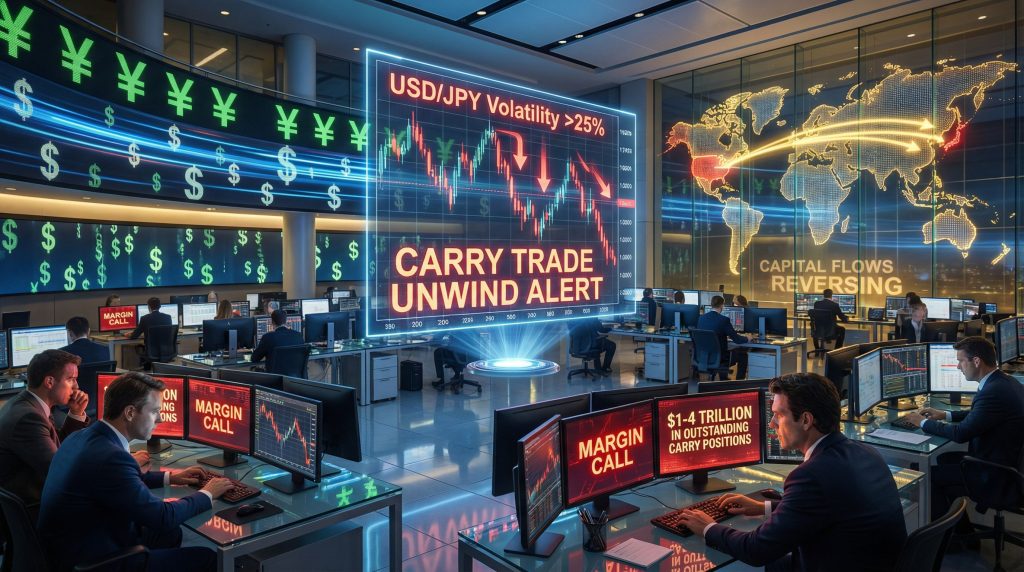
| Crisis Unwinding | >25% | Active systematic liquidation |
Capital Flow Tracking Methods
Institutional positioning data provides valuable insights into the scale and direction of carry trade flows. Treasury International Capital (TIC) data reveals foreign purchases and sales of US securities, including potential carry trade liquidation patterns.
Japanese institutional investor surveys conducted quarterly by monetary authorities offer additional perspective on cross-border investment flows and currency hedging activities. These reports can signal changes in institutional appetite for foreign currency exposure. Furthermore, the Federal Reserve audit impact could influence these capital flow patterns.
Professional Monitoring Approach:
- Weekly TIC Flow Analysis: Track foreign purchases/sales of Treasury securities
- Quarterly Institutional Surveys: Monitor Japanese investor positioning changes
- Prime Brokerage Reports: Assess leverage utilisation and position concentration
- Cross-Currency Funding Costs: Analyse basis swap pricing and availability
- Correlation Pattern Analysis: Monitor changing relationships between asset classes
How Should Investors Position for Potential Unwinding?
Risk Management Strategies for Individual Investors
Individual portfolio management requires careful consideration of currency exposure during periods of elevated carry trade risk. Investors holding international securities may find their returns significantly impacted by currency movements associated with systematic unwinding events.
Volatility positioning through options strategies can provide protection against sudden market dislocations. However, the cost of such hedging must be weighed against the probability and timing of unwinding events, as protective strategies can be expensive to maintain over extended periods.
Portfolio Protection Checklist:
Assess total foreign currency exposure across all holdings
Consider defensive asset allocation adjustments during high-risk periods
Monitor correlation changes between domestic and international investments
Evaluate the cost-effectiveness of currency hedging strategies
Institutional Investment Implications
Professional investment managers face more complex decisions regarding leverage reduction timing and alternative funding source diversification. The challenge lies in balancing the opportunity cost of early position reduction against the potential for significant losses during forced liquidation scenarios.
Alternative funding sources become crucial for institutions heavily reliant on yen-based financing. Diversification across multiple currencies and funding markets can reduce concentration risk, though it may also increase operational complexity and costs.
Hypothetical Scenario Analysis:
• Scenario 1 – Gradual Unwinding: 6-12 month adjustment period with manageable market impact
• Scenario 2 – Rapid Liquidation: 2-4 week forced selling with significant price dislocations
• Scenario 3 – Policy Intervention: Central bank coordination limits volatility and systemic risk
The next major ASX story will hit our subscribers first
What Role Do Central Banks Play in Unwind Management?
Bank of Japan Policy Communication Strategy
Central bank communication has evolved to become a primary tool for managing market expectations around policy transitions. The Bank of Japan's forward guidance regarding interest rate normalisation directly influences the timing and magnitude of carry trade unwinding, as market participants adjust positions based on policy signals.
Intervention thresholds represent another important consideration, as currency authorities may step in to limit excessive volatility during unwinding episodes. The effectiveness of such interventions depends partly on market conditions and the scale of positioning that needs to be unwound.
Coordination between the Federal Reserve and Bank of Japan becomes particularly important during periods of elevated market stress. Joint policy actions or coordinated communication can help stabilise conditions and prevent excessive volatility amplification.
Global Central Bank Response Mechanisms
Swap line activation provides emergency US dollar funding to foreign central banks during periods of funding stress. These facilities proved crucial during the 2008 financial crisis and remain available for deployment during future stress episodes.
Emergency liquidity provision protocols allow central banks to address funding shortages in critical market segments. The effectiveness of these tools depends on early recognition of systemic stress and coordinated implementation across monetary authorities.
Central Bank Tool Effectiveness:
| Intervention Type | Market Impact | Duration of Effect |
|---|---|---|
| Verbal Intervention | Moderate short-term impact | Hours to days |
| Direct FX Intervention | High immediate impact | Days to weeks |
| Policy Rate Adjustments | Fundamental long-term impact | Weeks to months |
Why Is Current Market Positioning Particularly Vulnerable?
Record Leverage Levels in Carry Strategies
Estimates suggest outstanding carry positions may total between $1-4 trillion globally, representing a significant concentration of leveraged exposure to interest rate differentials and currency stability. This scale of positioning creates potential for systematic risk when yen carry trade unwinding occurs simultaneously across multiple institutions.
Retail investor participation through margin trading platforms has democratised access to carry trade strategies, potentially increasing the total size of exposed positions while distributing risk across a broader but less sophisticated investor base.
Current Vulnerability Assessment:
Position sizes appear historically elevated relative to market capacity to absorb unwinding flows. Leverage ratios exceed long-term averages across multiple investor categories, while concentration in yen funding creates single-point-of-failure risk.
Technology-Driven Amplification Factors
Algorithmic trading systems can accelerate unwinding speed beyond historical precedents, as programmatic responses to market stress may trigger additional automated selling across multiple asset classes. High-frequency trading strategies often withdraw liquidity during periods of elevated volatility, potentially exacerbating price dislocations.
Social media sentiment analysis and news-driven trading algorithms can amplify retail investor panic during unwinding episodes. The combination of leveraged positioning and technological amplification creates conditions for rapid market movements that exceed traditional risk management assumptions.
Modern market structure introduces feedback loops between different trading systems that can create synthetic correlation during stress periods, even among assets that are fundamentally uncorrelated under normal conditions.
Frequently Asked Questions About Yen Carry Trade Unwinding
How Quickly Can a Major Unwind Occur?
Historical precedent suggests major adjustment periods typically span 2-4 weeks, though modern market structure may accelerate this timeline. The August 2024 volatility episode demonstrated how quickly conditions can deteriorate, with significant market moves occurring within single trading sessions rather than over extended periods.
Technology-driven amplification factors mean that yen carry trade unwinding events may unfold more rapidly than in previous decades. Algorithmic trading systems and risk management models can trigger coordinated responses across multiple institutions simultaneously, compressing the adjustment timeline.
Regulatory circuit breakers and trading halts may provide some limitation on the speed of unwinding, though these mechanisms are designed primarily for equity markets and may have limited effectiveness in currency and fixed-income markets where much of the unwinding activity occurs.
Which Assets Benefit During Unwinding Episodes?
Japanese Government Bonds typically experience strong performance during unwinding episodes, as institutions purchase these securities to hedge currency exposure and reduce overall risk. This buying pressure can drive yields significantly lower, particularly for shorter-duration instruments.
Safe-haven currencies including the Swiss franc and gold often appreciate during periods of carry trade stress, as investors seek assets with low correlation to leveraged trading strategies. Volatility trading instruments may also provide opportunities for skilled practitioners.
Traditional defensive assets may outperform during unwinding periods, though the correlation structures that typically support diversification can break down during severe stress episodes, requiring careful position management and risk assessment.
Long-Term Implications for Global Financial Stability
Structural Changes in International Capital Flows
Systematic carry trade unwinding events may accelerate longer-term trends toward reduced appetite for leveraged currency strategies. Institutional investors face increasing regulatory scrutiny regarding concentration risk and leverage utilisation, potentially leading to more conservative positioning approaches.
Diversification away from yen funding dependence could reshape global capital flows, as institutions seek alternative funding sources and markets develop new instruments to meet hedging and financing needs. This evolution may reduce the systematic importance of any single funding currency.
Post-Unwind Market Structure Evolution:
| Structural Change | Timeline | Impact |
|---|---|---|
| Funding Currency Diversification | 2-3 years | Reduced systematic risk concentration |
| Enhanced Leverage Limits | 1-2 years | Lower position sizes, reduced amplification |
| Real-Time Monitoring Systems | 6-18 months | Earlier stress detection, faster response |
Investment Strategy Evolution
Multi-currency hedging strategies may become standard practice for institutions engaging in carry trades, increasing operational complexity while potentially reducing tail risks. Dynamic hedging approaches that adjust exposure based on market conditions could replace static positioning strategies.
Real-time risk monitoring systems will likely become essential infrastructure for institutions involved in leveraged currency strategies. These systems must capture not only individual position risk but also systematic exposure to common unwinding triggers.
Future-Proofing Investment Approaches:
Dynamic hedging ratio adjustments based on volatility conditions
Cross-asset correlation monitoring during stress periods
Increased stress testing frequency to capture tail risk scenarios
Enhanced liquidity risk management for forced liquidation events
The evolution of investment strategy in response to carry trade risk represents a broader trend toward more sophisticated risk management practices across global financial markets. Institutions that adapt successfully to these new requirements may gain competitive advantages in attracting capital and regulatory approval for leveraged strategies.
The analysis presented reflects market dynamics and historical patterns as of December 2025. Investment decisions should be based on current market conditions, individual risk tolerance, and professional financial advice. Currency trading and leveraged investment strategies involve substantial risk of loss and may not be suitable for all investors.
Ready to Navigate Market Volatility with Confidence?
Discovery Alert's proprietary Discovery IQ model delivers real-time insights on ASX mineral discoveries, helping you identify actionable opportunities even during periods of global market uncertainty like yen carry trade unwinding. Begin your 30-day free trial at Discovery Alert today to position yourself ahead of market volatility with precise, data-driven investment intelligence.