August 26, 2026
When Land Rights Meet Industrial Scale: The Legal Reckoning Reshaping Australian Mining
Australia's iron ore industry has long operated within a complex web of Indigenous land rights, negotiated agreements, and statutory obligations. For decades, the dominant assumption among major producers was that compensation frameworks under the Native Title Act 1993 would remain modest and largely predictable. The Yindjibarndi appeal Fortescue mining compensation ruling has fundamentally challenged that assumption, introducing a question that could redefine how resource wealth is shared across the Pilbara for generations.
This is not simply a dispute about one mining company and one Indigenous group. It is a stress test of Australia's entire native title compensation architecture, and the outcome of the appeal could recalibrate financial exposure calculations for every miner operating in Western Australia without a formally negotiated Indigenous Land Use Agreement. Furthermore, given the broader WA resources sector impact, the stakes extend well beyond any single courtroom.
When big ASX news breaks, our subscribers know first
What the Federal Court Actually Awarded in May 2026
The Federal Court's May 2026 ruling was historic by almost any measure. The compensation ordered against Fortescue, the world's fourth-largest iron ore producer, represented one of the largest native title payouts in Australian legal history. However, the structure of that award is just as significant as its headline figure, because it reveals the deep fault lines now driving the Yindjibarndi appeal Fortescue mining compensation ruling.
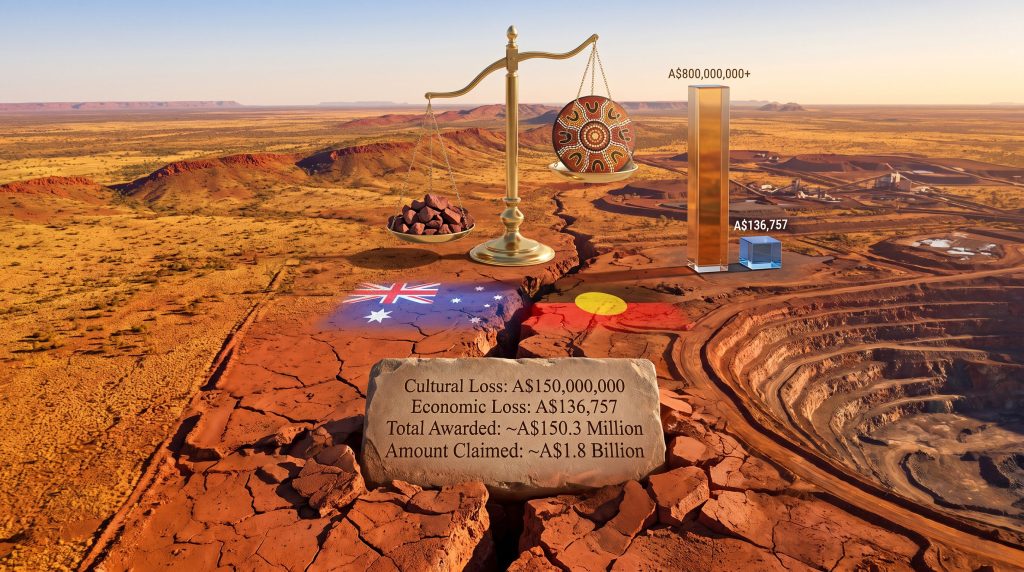
The court awarded approximately A$150 million for cultural loss, reflecting documented destruction of Yindjibarndi heritage. For economic loss, however, the figure awarded was a comparatively minuscule A$136,757, supplemented by A$217,152 in compound interest on that economic loss component.
The contrast is stark and deliberate:
| Compensation Category | Amount Awarded (AUD) | Amount Claimed (AUD) |
|---|---|---|
| Cultural Loss | ~A$150,000,000 | Significant uplift sought on appeal |
| Economic Loss | A$136,757 | A$800,000,000+ |
| Compound Interest on Economic Loss | A$217,152 | Not separately claimed |
| Total Awarded | ~A$150.3 million | ~A$1.8 billion combined |
Source: Federal Court of Australia, Yindjibarndi v State of Western Australia ruling, May 2026
The Yindjibarndi people had originally sought A$1 billion for cultural loss and more than A$800 million for economic loss, arguing they were entitled to a share of profits derived from mining operations on their native title land. The gap between what was claimed and what was awarded on the economic side is the engine driving the appeal.
The Three Core Arguments Behind the Yindjibarndi Appeal
Royalty Benchmarking: The Central Legal Challenge
The most technically significant argument in the Yindjibarndi appeal concerns how economic loss should be calculated. The Federal Court assessed economic loss based on the underlying value of the land, deliberately excluding any value attributable to the iron ore deposits beneath it. This methodology produced the A$136,757 figure.
The Yindjibarndi people argue this approach is fundamentally flawed. Across the Pilbara, where dozens of Indigenous groups hold native title or have negotiated agreements with miners, royalty-style payment structures are the norm. These agreements typically link compensation directly to production volumes or revenue, effectively giving traditional owners a percentage of the economic activity generated on their country. Consequently, the WA iron ore operations of major producers are now being scrutinised through this very lens.
The Yindjibarndi appeal challenges the Federal Court's approach to calculating economic loss, arguing that compensation should be benchmarked against royalty-style payments standard in Pilbara native title agreements, not the underlying land value assessed without reference to iron ore deposits.
If an appellate court accepts this royalty-rate logic, the financial exposure for Fortescue would increase dramatically. The Solomon Hub operations, which have been producing iron ore from Yindjibarndi country since 2012, represent billions of dollars in cumulative output. Royalty-based calculations tied to that production history would yield figures far exceeding the original award, potentially approaching the A$800 million economic loss claim originally pursued.
Social Division as Compensable Harm
A lesser-discussed but legally novel dimension of the appeal is the Yindjibarndi claim that they are entitled to compensation for the social division caused within their community by the mine's presence and the protracted legal conflict. This argument has no strong precedent in Australian native title law, making it one of the more speculative elements of the appeal.
If courts eventually accept that mining-induced community fragmentation constitutes a form of compensable harm, the implications extend well beyond this case. It would open an entirely new category of compensable damage in native title proceedings, one that is inherently difficult to quantify but potentially substantial in communities where cultural cohesion is both legally recognised and deeply valued.
The Mineral Exclusion Problem
Under Australian law, the Crown holds ownership of minerals regardless of who holds native title to the surface land. This means that when courts assess the economic value of land for compensation purposes, they are legally required to strip out the value of any mineral deposits. The result, in a region like the Pilbara where the land's primary economic significance is its iron ore content, is that land value assessments produce figures that bear almost no relationship to the actual wealth extracted from the ground.
This structural tension is at the heart of why the Yindjibarndi appeal is so significant. The royalty-rate argument is, in part, an attempt to find a compensation mechanism that reflects economic reality without requiring the court to assign mineral ownership to native title holders.
A Timeline of the Yindjibarndi-Fortescue Conflict
Understanding the depth of this dispute requires tracing its origins:
- 2012: Fortescue commences mining on Yindjibarndi native title land through its Solomon Hub operations, without entering into an Indigenous Land Use Agreement with the Yindjibarndi Ngurra Aboriginal Corporation (YNAC).
- 2020: Rio Tinto's destruction of the Juukan Gorge rock shelters, approximately 46,000 years old, triggers a national reassessment of cultural heritage protections and accelerates compensation renegotiations across the Pilbara.
- 2026 (May): The Federal Court issues its landmark compensation ruling, one of the largest under Australian native title law.
- 2026 (July-August): YNAC votes to appeal the ruling, citing inadequacy of both economic and cultural components.
- 2026 (August 26): The appeal is formally lodged with the Federal Court. The Western Australian state government files a concurrent appeal on the same day.
The Scale of Cultural Destruction Documented by the Court
The Federal Court's findings on cultural heritage damage are, by any measure, extraordinary. Fortescue had itself designated 240 heritage sites on Yindjibarndi country. Of those, 124 had been completely destroyed through mining operations. The court found that significant damage had been done to Yindjibarndi song lines, which are routes of deep cultural and spiritual significance traversing country in ways that integrate law, ceremony, and identity.
Critically, the court noted that this destruction occurred legally and within approved government processes. However, it proceeded without the consent or involvement of YNAC, which holds exclusive native title rights over the land. This distinction matters enormously: the absence of illegality did not preclude compensability, but it did shape the court's framing of the cultural loss calculation.
Song lines are not simply cultural curiosities. In Australian Indigenous law, they function as living maps that encode knowledge about country, ceremony, relationships, and obligations. Their disruption is not analogous to demolishing a building; it severs connections that cannot be rebuilt through financial payment alone. The challenge for courts is translating this kind of irreversible intangible harm into monetary terms within a legal framework designed primarily for quantifiable economic relationships.
Why the Western Australian Government Filed Its Own Appeal
The concurrent filing of an appeal by the Western Australian state government adds a significant political and legal dimension to proceedings. Western Australia Attorney General Tony Buti stated publicly that native title compensation represents a complex and emerging area of law, and that the state's appeal seeks judicial clarity to inform future negotiations and native title settlements across Western Australia, not to diminish the rights of Indigenous Australians.
Western Australia's decision to appeal reflects the state's recognition that the legal principles established by this ruling will govern compensation negotiations with dozens of Indigenous groups across the Pilbara and beyond, creating fiscal and regulatory uncertainty that requires resolution at a higher judicial level.
This is a fiscally material concern for the state. Western Australia is the custodian of mineral royalties from Pilbara iron ore, and any judicial recalibration of how native title compensation is calculated has direct implications for the structure of future agreements. Indeed, the WA resource contribution to national prosperity makes these legal questions all the more consequential.
The next major ASX story will hit our subscribers first
What This Means for Fortescue and Pilbara Miners
Fortescue's position in this dispute is uncommon even by industry standards. The company has reportedly sought to reach a settlement with YNAC for 15 years, and has already paid the compensation sum awarded by the Federal Court. Yet the appeal means that the legal process is far from complete, and the financial exposure remains open-ended pending the Full Federal Court's determination.
| Metric | Detail |
|---|---|
| Australia's global iron ore ranking | World's largest producer |
| Primary production region | Pilbara, Western Australia |
| Fortescue's global ranking | Fourth-largest iron ore miner |
| Indigenous groups with traditional ties to Pilbara | Dozens of distinct groups |
| Fortescue mining without ILUA | Since 2012 |
| Heritage sites designated by Fortescue | 240 |
| Sites completely destroyed | 124 |
The broader industry implication is significant. If the appellate court endorses royalty-rate benchmarking as a compensation methodology for operating without an ILUA, every Pilbara miner operating under similar conditions faces potential retrospective exposure. This would fundamentally alter the risk calculus for resource companies considering whether to pursue formal agreements with traditional owners or proceed without them. In addition, shifting iron ore market trends mean that the financial stakes attached to these decisions are higher than ever.
The Post-Juukan Gorge Compliance Environment
The Juukan Gorge destruction in 2020 was a turning point for cultural heritage management across the Australian resources sector. In the years since, major miners including BHP, Rio Tinto, and others have updated their heritage agreements, increased consultation requirements, and in some cases agreed to binding veto rights for traditional owners over certain site disturbance decisions. The Yindjibarndi case is accelerating this trend, adding legal precedent to what had previously been driven primarily by reputational pressure.
Investor Risk and ESG Implications
For institutional investors and ESG-focused funds with exposure to Australian iron ore producers, the Yindjibarndi appeal Fortescue mining compensation ruling introduces a category of financial risk that is difficult to model with precision. Traditional project-level risk assessments typically treat native title agreements as a compliance box to be checked rather than a variable with material upside or downside.
That framing is increasingly untenable. Consider the following risk factors now in play:
- Retrospective compensation exposure for operations conducted without ILUAs, potentially calculated on a royalty-rate basis tied to production history.
- Novel compensable harm categories, including social division claims, which could expand the scope of future litigation.
- Judicial recalibration of land valuation methodology in compensation proceedings, removing the mineral exclusion approach.
- Precedent-setting appeal that, if escalated to the High Court, could produce binding national guidance on native title compensation calculations.
Furthermore, the broader context of resource export challenges facing the Australian mining industry means that unresolved legal liabilities of this magnitude carry amplified consequences for investor confidence. The shift from cultural courtesy frameworks toward legally enforceable economic partnership models is no longer theoretical. The Yindjibarndi appeal is forcing courts, governments, and corporations to confront whether the financial benefits of resource extraction on Indigenous land have ever been equitably distributed, and what legal mechanisms can correct that imbalance going forward.
Frequently Asked Questions: Yindjibarndi Appeal and Fortescue Compensation
What is the Yindjibarndi appeal about?
The appeal challenges the Federal Court's May 2026 ruling on both the economic and cultural loss components of compensation awarded against Fortescue for mining on Yindjibarndi native title land without an agreement since 2012.
How much did the Federal Court originally award?
Approximately A$150.3 million in total: roughly A$150 million for cultural loss, A$136,757 for economic loss, and A$217,152 in compound interest on the economic loss component.
What is an Indigenous Land Use Agreement?
An ILUA is a voluntary agreement between a native title group and others, such as mining companies or governments, about the use and management of land or waters. It provides legal certainty for both parties and typically includes compensation and benefit-sharing arrangements.
Why does the absence of an ILUA matter here?
Fortescue commenced and continued mining on Yindjibarndi country from 2012 without entering into any such agreement with YNAC, which holds exclusive native title rights. This formed the legal basis for the compensation claim.
Could the appeal result in a higher payout?
If the appellate court accepts royalty-rate benchmarking as the appropriate methodology for economic loss, the compensation figure could increase substantially, potentially approaching the A$800 million originally claimed. The Yindjibarndi Native Title Compensation Case page maintained by the Yindjibarndi organisation provides further detail on the community's perspective on these figures.
What are song lines and why do they have legal weight?
Song lines are culturally significant routes traversing Indigenous country, encoding law, ceremony, and relationships with the land. Their destruction constitutes a recognised form of cultural harm under Australian native title compensation law.
Why did the Western Australian government also appeal?
The state government sought judicial clarity on the emerging legal principles governing native title compensation, to provide a more predictable framework for future negotiations across Western Australia.
Disclaimer: This article contains analysis of ongoing legal proceedings and includes hypothetical scenarios regarding potential compensation outcomes. Nothing in this article constitutes legal or financial advice. Readers should consult qualified professionals before making decisions based on information contained herein. Outcomes of appellate proceedings are inherently uncertain and actual results may differ materially from scenarios described.
Want to Stay Ahead of Major ASX Discoveries Before the Broader Market Reacts?
As legal and regulatory frameworks reshape the risk landscape for Australian resource companies, identifying high-potential mineral discoveries early has never been more critical. Discovery Alert's proprietary Discovery IQ model delivers real-time alerts on significant ASX mineral discoveries, turning complex data across more than 30 commodities into clear, actionable insights — explore the historic returns major discoveries have generated and begin your 14-day free trial today to position yourself ahead of the market.