June 19, 2026
The global rare earth elements sector continues experiencing unprecedented market dynamics, with the yttrium price surge serving as a prime example of how geopolitical tensions and supply chain vulnerabilities create perfect storm conditions for dramatic price movements. Understanding these market forces becomes essential for industries dependent on critical materials, particularly as traditional supply relationships face increasing strain from international trade policies and regional conflicts. Furthermore, the critical minerals strategy adopted by major economies reflects growing recognition of supply chain concentration risks affecting strategic materials markets globally.
Understanding Yttrium's Strategic Market Position
Yttrium represents a unique position within the rare earth elements landscape, functioning as both a critical industrial input and a geopolitical leverage point. This transition metal, with atomic number 39 and atomic weight of 88.906, exhibits properties that make it indispensable across multiple high-technology applications where substitution remains technically challenging or economically prohibitive.
The industrial significance of yttrium stems from its exceptional thermal stability and electronic properties. Unlike many other rare earth elements primarily used in magnetic applications, yttrium serves specialised functions in phosphors, ceramics, and superconductors where its chemical characteristics create substantial barriers to replacement. This positioning places yttrium demand in a distinct category from the more widely discussed neodymium-praseodymium magnet markets.
Key Applications Driving Industrial Demand
The phosphor industry represents the largest consumption sector for yttrium, accounting for approximately 40-50% of global demand according to U.S. Geological Survey analysis. Yttrium oxide (Y₂O₃) and yttrium vanadate (YVO₄) serve critical roles in LED technology, where they enable red light emission in display systems and solid-state lighting applications.
The photoluminescent properties of yttrium compounds make them essential components in modern display technologies, from smartphone screens to large-format commercial displays. Moreover, the energy transition in minerals increasingly relies on these advanced materials for renewable energy infrastructure development.
Yttrium-stabilised zirconia (YSZ) applications continue expanding across industrial sectors. When yttrium oxide combines with zirconium dioxide at concentrations of 6-10 mol%, the resulting material exhibits thermal conductivity retention at temperatures exceeding 1000°C. This property proves critical for:
- Thermal barrier coatings in jet engines
- Solid oxide fuel cell electrolytes
- Industrial furnace components
- Advanced ceramic manufacturing processes
The superconductor market, while smaller in volume, represents a high-value application where yttrium barium copper oxide (YBCO) compounds enable commercial high-temperature superconductivity. These materials function above the boiling point of liquid nitrogen (77 Kelvin), making them viable for power transmission applications and medical imaging systems where operational economics justify premium material costs.
Market Size and Consumption Patterns
Global yttrium consumption patterns reflect the concentrated nature of high-technology manufacturing. The United States, European Union, Japan, and South Korea represent the primary consuming regions, with demand driven by electronics manufacturing, aerospace applications, and medical device production.
The U.S. Geological Survey classifies yttrium among critical minerals under federal designation, reflecting its strategic importance to national security applications. Additionally, medical applications continue growing, particularly in interventional oncology where Yttrium-90 radiopharmaceuticals treat hepatocellular carcinoma.
Approximately 40,000-50,000 patient procedures annually utilise yttrium-90 therapeutics globally, representing a specialised but growing market segment with limited price sensitivity due to medical necessity.
When big ASX news breaks, our subscribers know first
How Supply Chain Concentration Creates Price Vulnerability
The global yttrium supply chain exhibits extreme concentration that amplifies price volatility during periods of disruption. While China accounts for approximately 70% of global rare earth element production according to USGS data, its dominance in yttrium-specific processing approaches 85-95% of refined separation capacity globally.
This concentration creates systemic vulnerabilities that extend far beyond normal commodity market dynamics. The European CRM facility initiatives represent attempts to address these supply chain dependencies through alternative processing capabilities.
China's Dominant Production Role
China's strategic advantage in yttrium production derives from multiple converging factors developed over four decades of industrial policy focus. The country's rare earth processing infrastructure represents the world's most comprehensive integration from mining through final product refinement, creating economies of scale and technical expertise that prove difficult for other nations to replicate rapidly.
Ion-adsorption clay deposits in Southern China provide the foundation for yttrium production advantages. These weathered crust elution-deposited rare earth formations, concentrated in Jiangxi, Fujian, and Guangdong provinces, naturally concentrate heavy rare earths including yttrium at economic grades not achieved in light rare earth deposits elsewhere.
The geological advantage combines with established processing capabilities to create sustained competitive positioning. The technical complexity of rare earth separation presents substantial barriers for new market entrants. Ion-adsorption clay processing requires specialised leaching techniques using dilute mineral acids, achieving yttrium recovery rates of 60-85% depending on processing technology employed.
The process generates significant acidic waste streams requiring environmental remediation infrastructure that represents both regulatory and capital barriers for potential competitors outside China. Chinese rare earth companies have optimised solvent extraction and fractional crystallisation techniques through decades of operational experience, creating proprietary know-how advantages documented in extensive patent portfolios.
The separation industry requires specialised equipment including mixer-settlers and crystallisers that mandate 5-10 year lead times and specialised engineering expertise to implement successfully outside established production centres.
Export Control Framework and Market Impact
China's administrative measures governing rare earth exports create additional supply chain vulnerabilities through regulatory mechanisms. Since 2020, export licensing requirements have applied to rare earth materials including yttrium compounds, with 2024-2025 seeing increased scrutiny of export licence applications according to industry reporting.
The quota system operates through quarterly approval processes managed at provincial levels, with export licences allocated to designated state-owned enterprises and approved private companies. This framework enables artificial scarcity creation during periods of reduced quota allocation, amplifying price volatility independent of underlying supply-demand fundamentals.
Recent export policy changes have contributed to the yttrium price surge observed in certain regional markets during 2024-2025. Market analysis suggests quota reductions of 20-30% below previous year levels across certain quarters, though specific yttrium volumes remain confidential within Chinese administrative processes.
Secondary Supply Sources and Limitations
Myanmar historically contributed 5-15% of global heavy rare earth feedstock through monazite and xenotime deposits in Kachin State. However, production volumes face significant constraints following the February 2021 military coup, with trade data showing Myanmar rare earth exports declining from estimated 10,000+ tonnes annually during 2015-2020 to minimal recorded exports by 2022-2023 according to UN Comtrade statistics.
Processing capacity outside China remains extremely limited despite decades of discussion about supply diversification:
| Region | Processing Capacity | Current Status | Key Limitations |
|---|---|---|---|
| United States | ~5% of global capacity | Reduced operations | Mountain Pass facility restructuring |
| European Union | <1% commercial capacity | No primary separation | Lack of integrated infrastructure |
| Japan/South Korea | Specialty processing only | Limited scale | Focus on downstream applications |
| Australia | Development stage | Multiple projects planned | 7-10 year implementation timelines |
Recycling potential offers theoretical supply diversification but faces substantial practical limitations. Current global recycling recovery rates for rare earths including yttrium remain at 1-5% of consumption according to USGS technical reports.
Economic barriers include low concentration of rare earths in most end-use products (typically 2-10% by weight), complexity of separating mixed rare earth compositions, and energy costs comparable to or exceeding primary production in lower-cost regions.
What Factors Triggered the 2024-2025 Price Surge?
The yttrium price surge during 2024-2025 reflects multiple converging factors that highlight the vulnerability of concentrated supply chains to both regulatory and geopolitical disruptions. While specific price data requires verification from independent commodity indices, directional evidence suggests significant tightening in European and North American markets during this period.
Regulatory and Trade Policy Impacts
China's Ministry of Commerce and Ministry of Industry and Information Technology implemented enhanced administrative measures on rare earth export quotas beginning in mid-2024. While specific quota volumes for yttrium compounds remain confidential, total rare earth export quota reductions have been reported at 20-30% below 2023 levels across multiple quarters according to trade flow analysis and industry reporting.
The licensing framework creates bottlenecks through several mechanisms:
- Quarterly approval cycles that concentrate administrative decisions into discrete time periods
- Designated enterprise systems limiting approved exporters to state-owned and selected private companies
- Provincial-level coordination requiring alignment between central policy and local implementation
- Strategic supply chain stabilisation objectives prioritising domestic consumption over export markets
Industry sources indicate increased scrutiny of export licence applications during 2024-2025, with potential reduction in approved volumes creating periodic supply constraints for international buyers. This administrative approach enables supply management independent of production capacity, amplifying price volatility during periods of tightened availability.
Geopolitical Disruptions Affecting Supply
Myanmar's contribution to heavy rare earth feedstock faced severe disruption following the February 2021 military coup, with effects continuing through 2024-2025. The Kachin State mining operations, historically supplying materials for yttrium recovery, experienced operational challenges that reduced available feedstock for Chinese processing facilities.
Trade statistics reveal the magnitude of this disruption:
- 2015-2020 period: Myanmar exported approximately 10,000+ tonnes of rare earth materials annually
- 2022-2023 period: Exports declined to minimal recorded volumes according to UN Comtrade data
- 2024-2025 impact: Continued operational constraints affecting heavy rare earth availability
This supply reduction forced greater reliance on Chinese domestic ion-adsorption clay deposits, potentially constraining overall heavy rare earth availability during periods of strong demand growth across multiple application sectors. Furthermore, the strategic antimony outlook demonstrates similar supply chain concentration risks affecting other critical materials markets.
Demand-Side Pressures Intensifying Competition
Global electronics manufacturing growth contributed to increased competition for available yttrium supplies during 2024-2025. Industry data indicates electronic device shipments grew at approximately 5-7% annually according to IDC and Gartner reports, driving corresponding increases in LED and display panel production volumes.
Key demand drivers during the price surge period include:
- LED phosphor manufacturing expansion for solid-state lighting applications
- Fuel cell component production supporting renewable energy initiatives
- Medical imaging equipment manufacturing growth
- Defence and aerospace procurement increases
The global LED market, valued at approximately $110-120 billion in 2023, utilises phosphor materials representing 2-5% of input costs according to market research. Yttrium-based red phosphors constitute a critical portion of this category, with limited substitution options available for achieving required performance specifications.
Solid oxide fuel cell (SOFC) market growth from approximately $500 million in 2023 toward projected $2-3 billion by 2030 creates additional yttrium demand through YSZ electrolyte applications. While still representing a smaller volume compared to phosphor applications, fuel cell growth occurs during the same period as supply constraints, contributing to competitive pressure for available material.
Which Industries Drive Long-Term Yttrium Demand?
Long-term yttrium demand trajectories reflect fundamental technological trends rather than cyclical market dynamics. The element's unique properties create demand patterns driven by structural changes in energy systems, electronics miniaturisation, and advanced materials applications where substitution remains technically challenging or economically prohibitive.
High-Growth Application Sectors
LED phosphor manufacturing represents the largest and most stable long-term demand driver for yttrium consumption. Global LED market projections indicate growth toward $150+ billion by 2030 at compound annual growth rates of 8-12% according to multiple market research organisations.
Yttrium oxide in red-emitting phosphors (Y₂O₃:Eu³⁺) maintains dominant market position in warm-white LED applications, utilised in approximately 70-80% of commercial LED packages according to industry standards from major manufacturers.
The technical requirements for LED phosphor applications create sustained demand advantages for yttrium-based formulations:
- Thermal stability at operating temperatures exceeding 150°C in high-power LED applications
- Colour rendering performance achieving targeted chromaticity coordinates for white light production
- Efficiency maintenance over extended operational lifespans exceeding 50,000 hours
- Manufacturing compatibility with established production processes and equipment
Yttrium-stabilised zirconia (YSZ) applications continue expanding across multiple industrial sectors driven by decarbonisation trends and advanced manufacturing requirements. The solid oxide fuel cell market represents particularly strong growth potential, with projections indicating expansion from $500 million in 2023 toward $2-3 billion by 2030 according to specialised market research.
YSZ serves as the primary electrolyte material in SOFC systems, with yttrium content typically comprising 6-10 mol% of zirconia composition. The material's ionic conductivity at operating temperatures of 700-1000°C enables efficient electrochemical energy conversion with minimal degradation over extended operational periods.
Emerging Technology Integration
Advanced ceramics manufacturing increasingly incorporates yttrium compounds for applications requiring exceptional thermal and mechanical properties. The aerospace sector drives demand growth through next-generation jet engine components, where YSZ thermal barrier coatings enable higher operating temperatures and improved fuel efficiency.
Electric vehicle component requirements create potential new demand streams for yttrium applications, though current incorporation remains limited compared to other rare earth elements. Research into solid-state battery electrolytes explores yttrium-based ceramics for improved ionic conductivity and thermal stability, though commercial applications remain in development phases requiring several years for potential market impact.
Superconductor applications maintain specialised but growing demand for yttrium compounds. The global superconductor market, valued at approximately $500 million in 2023, focuses primarily on medical imaging, power transmission, and research applications where YBCO materials provide operational advantages over conventional alternatives.
Key growth drivers in superconductor applications include:
- Medical imaging equipment expansion in emerging markets
- Power grid modernisation initiatives requiring efficient transmission
- Quantum computing research applications demanding specialised materials
- Magnetic levitation transportation systems in select regions
Medical and Pharmaceutical Applications
Yttrium-90 radiopharmaceuticals represent a specialised but growing segment with limited price sensitivity due to medical necessity. Approximately 40,000-50,000 patient procedures annually utilise yttrium-90 therapeutics globally for interventional oncology applications, particularly treating hepatocellular carcinoma and neuroendocrine tumours.
The medical applications market exhibits characteristics distinct from industrial yttrium demand:
- Regulatory barriers creating high switching costs for established treatment protocols
- Quality requirements mandating pharmaceutical-grade material specifications
- Volume stability based on patient population demographics rather than economic cycles
- Price insensitivity due to insurance coverage and medical necessity considerations
Growth projections for yttrium-90 medical applications indicate 8-10% compound annual growth through 2030, driven by aging population demographics in developed economies and expanding healthcare infrastructure in emerging markets.
How Do Geopolitical Factors Amplify Market Instability?
Geopolitical dynamics create amplification effects in yttrium markets that extend far beyond normal commodity fundamentals. The concentration of production capabilities within specific geographic regions, combined with the strategic nature of rare earth elements in national security applications, transforms routine supply chain disruptions into potential leverage points for international relations.
Myanmar's Political Situation Impact
The February 2021 military coup in Myanmar created lasting disruptions to heavy rare earth supply chains that continue affecting global yttrium availability during 2024-2025. Kachin State's monazite and xenotime deposits historically provided 5-15% of global heavy rare earth feedstock, with mining operations concentrated in regions experiencing ongoing conflict and administrative instability.
Operational disruptions in Myanmar affect yttrium supply through multiple channels:
- Direct mining operation interruptions due to security concerns and logistics constraints
- Administrative complications preventing normal export processing and documentation
- International banking restrictions limiting transaction capabilities for mineral exports
- Transportation infrastructure damage affecting material movement to processing facilities
The economic impact extends beyond immediate supply volumes. Myanmar's heavy rare earth concentrates typically feed into Chinese separation facilities, meaning disruptions affect the overall feedstock availability for yttrium production even when Chinese domestic operations continue normally. This interdependence amplifies regional political instability into global market effects.
Trade data from UN Comtrade reveals the magnitude of Myanmar's supply disruption, with rare earth exports declining from approximately 10,000+ tonnes annually during 2015-2020 to minimal recorded volumes by 2022-2023. The continued effects through 2024-2025 represent structural rather than temporary supply chain adjustments.
Strategic Stockpiling and National Security Considerations
Government stockpiling programmes across major economies create additional demand pressures that can amplify the yttrium price surge during periods of supply constraint. The U.S. Department of Defense allocated over $500 million for critical minerals and rare earth strategic initiatives during fiscal 2023-2024, with yttrium included among materials designated for national security stockpiling.
Critical materials designation drives government procurement through several mechanisms:
- Defence Production Act authorities enabling priority allocation of domestic production
- Strategic reserve accumulation targets based on consumption projections and supply risk assessments
- Industrial base development funding for domestic processing capability creation
- Research and development support for alternative supply sources and recycling technologies
European Union initiatives similarly prioritise rare earth supply chain resilience through the Critical Raw Materials Act and related industrial policy measures. These programmes create additional demand for yttrium during the same period as natural supply constraints, contributing to price volatility amplification beyond market fundamentals.
The strategic nature of yttrium applications in defence and aerospace creates procurement patterns distinct from commercial markets. Government buyers often maintain higher inventory levels and demonstrate greater willingness to pay premium prices during supply disruptions, creating price floors that support sustained volatility during constraint periods.
Regional Security Concerns Affecting Logistics
Transportation and logistics vulnerabilities compound geopolitical risks affecting yttrium supply chains. The concentration of processing capability in specific regions creates chokepoint risks where regional conflicts, natural disasters, or administrative disruptions can affect global availability disproportionately to the actual geographic scope of disruptions.
Key logistics vulnerabilities include:
- Shipping route dependencies for material movement between producing and consuming regions
- Port facility concentration creating single points of failure for import/export operations
- Banking and financial services disruptions affecting international trade transactions
- Insurance availability and cost increases during periods of elevated regional risk
The integration of rare earth supply chains means that disruptions in one geographic region can cascade through multiple processing stages located in different countries. Yttrium supply chains particularly exhibit this vulnerability due to the separation of mining operations (Myanmar, Australian projects), processing facilities (primarily China), and end-use manufacturing (globally distributed).
What Investment Opportunities Emerge from Price Volatility?
The yttrium price surge and underlying supply chain vulnerabilities create specific investment opportunities across multiple segments of the value chain. These opportunities reflect both short-term arbitrage potential from price volatility and longer-term structural themes supporting supply diversification and processing capability development outside traditional producing regions.
Mining Project Development Outside China
Australian rare earth projects represent the most advanced near-term opportunities for yttrium supply diversification. Multiple development-stage projects focus specifically on heavy rare earth deposits containing economic yttrium grades, with timelines suggesting potential production within 5-7 years given adequate financing and regulatory approvals.
Key development projects include:
- Ion-adsorption clay deposits in Queensland and New South Wales targeting heavy rare earth concentrations
- Hard rock mining projects incorporating yttrium recovery from xenotime and monazite processing
- Integrated processing facility development combining mining operations with separation capabilities
- Joint venture structures pairing Australian resources with Asian processing expertise
Investment requirements for new rare earth processing capability typically range from $500 million to $2 billion depending on scale and integration level. These capital requirements create barriers for smaller participants while offering opportunities for institutional investors and sovereign wealth funds seeking strategic materials exposure.
North American processing facility investments focus primarily on establishing separation capabilities for imported concentrates rather than domestic mining development. The regulatory environment supports strategic materials processing through Defence Production Act authorities and Department of Energy loan guarantee programmes, providing risk mitigation for qualifying projects.
Technology transfer agreements represent critical success factors for new processing facilities outside China. The specialised equipment and operational expertise required for rare earth separation creates partnership opportunities between Western capital and established Asian processing companies willing to share technology for market access or strategic positioning.
Value Chain Integration Strategies
Downstream processing capability development offers investment opportunities with shorter development timelines compared to upstream mining projects. Yttrium compound manufacturing, YSZ ceramic production, and phosphor formulation represent value-added processing stages where regional supply chain advantages may justify investment despite higher input costs.
The fuel cell industry expansion creates specific opportunities for YSZ production capability development. Projected SOFC market growth from $500 million toward $2-3 billion by 2030 supports dedicated yttrium ceramic processing facilities serving renewable energy applications. These facilities typically require $50-200 million in capital investment depending on scale and automation level.
Recycling technology advancement represents an underexplored investment opportunity with potential for substantial returns as yttrium prices remain elevated. Current recycling recovery rates of 1-5% indicate significant room for improvement through technology development and collection infrastructure investment.
Investment themes in yttrium recycling include:
- LED phosphor recovery from electronic waste streams
- YSZ ceramic reclamation from industrial applications
- Medical isotope processing facility waste stream capture
- Automated sorting and separation technology development
Alternative Material Research and Development
Research into yttrium substitutes and alternative materials offers longer-term investment opportunities with potentially transformative returns. While yttrium's unique properties create substitution challenges in many applications, targeted research programmes may identify alternatives for specific use cases, reducing overall demand pressure.
Promising research areas include:
- Alternative phosphor chemistries for LED applications using more abundant elements
- Ceramic compositions replacing YSZ in selected fuel cell applications
- Superconductor materials offering similar performance without yttrium content
- Manufacturing process innovations reducing yttrium consumption per unit output
Venture capital and government research funding support alternative materials development through multiple programmes. The U.S. Department of Energy's Advanced Research Projects Agency-Energy (ARPA-E) allocates funding for critical materials substitution research, while private investors seek early-stage opportunities in materials science companies developing alternatives to strategic elements.
The next major ASX story will hit our subscribers first
How Can Buyers Navigate Yttrium Market Uncertainty?
Industrial buyers facing the yttrium price surge require sophisticated risk management approaches that balance cost control with supply security. Traditional commodity purchasing strategies prove inadequate for markets characterised by extreme concentration, regulatory intervention, and geopolitical volatility affecting availability independent of normal economic cycles.
Risk Management Approaches for Industrial Users
Long-term supply agreement structuring represents the foundation of effective yttrium procurement strategy during volatile periods. These agreements require careful attention to pricing mechanisms, force majeure provisions, and supply allocation frameworks that account for potential regulatory disruptions in producing regions.
Effective supply agreements incorporate several critical elements:
- Pricing formulae linking yttrium costs to verifiable benchmark indices while providing protection against extreme volatility
- Volume commitments ensuring minimum supply availability during constraint periods in exchange for demand guarantees during surplus periods
- Quality specifications preventing substitution with inferior materials during periods of supply tightness
- Force majeure definitions clearly delineating responsibilities during geopolitical or regulatory disruptions
Supplier diversification and qualification processes require substantial lead times and investment but provide essential protection against single-source supply risks. Qualifying new yttrium suppliers typically requires 12-24 months for technical validation and supply chain integration, making proactive diversification essential rather than reactive.
The qualification process includes technical validation, quality system auditing, and supply chain verification to ensure new suppliers can maintain consistent material specifications and delivery reliability. This process becomes particularly complex for yttrium applications requiring high-purity materials or specialised chemical forms.
Strategic Inventory Optimisation
Inventory management during volatile periods requires balancing carrying costs against supply security risks. Traditional just-in-time inventory approaches prove inadequate for materials exhibiting extreme price volatility and supply disruption potential. Strategic stockpiling becomes necessary while avoiding excessive capital commitment to inventory positions.
Optimal inventory strategies consider multiple factors:
| Factor | Strategic Consideration | Implementation Approach |
|---|---|---|
| Price volatility | Buffer against cost spikes | 3-6 month forward coverage |
| Supply disruption risk | Maintain operational continuity | Emergency inventory reserves |
| Storage requirements | Material degradation prevention | Climate-controlled facilities |
| Capital efficiency | Balance costs and security | Consignment arrangements |
Consignment inventory arrangements with qualified suppliers offer alternatives to direct inventory ownership while maintaining supply security. These agreements enable access to strategic materials without full capital commitment, though they require careful contract structuring to ensure availability during constraint periods.
Price Discovery and Market Intelligence
Understanding yttrium pricing mechanisms becomes critical during periods of market dysfunction when traditional benchmark indices may not reflect actual transaction conditions. The thin nature of yttrium markets means published prices often lag actual market conditions, requiring additional intelligence gathering to inform purchasing decisions.
Effective market intelligence combines multiple information sources:
- Published pricing indices from recognised services (Asian Metals, Metal Bulletin)
- Direct supplier pricing discussions and competitive intelligence gathering
- Industry conference participation and peer network information sharing
- Government trade data analysis identifying import/export trend changes
- Regulatory monitoring tracking policy changes affecting supply availability
Early warning indicators for potential supply disruptions enable proactive rather than reactive purchasing strategies. These indicators include regulatory announcements from producing regions, trade dispute escalations, and operational issues at major processing facilities.
Hedging strategies for yttrium procurement face limitations due to the absence of established futures markets or financial instruments specifically covering yttrium price risk. However, currency hedging, long-term fixed-price contracts, and financial arrangements with suppliers can provide partial risk mitigation for price and availability concerns.
What Does the Future Hold for Yttrium Markets?
Future yttrium market development reflects the intersection of technological advancement, geopolitical restructuring, and environmental regulation affecting both supply and demand dynamics. The current yttrium price surge represents early manifestation of structural changes that will likely persist and evolve rather than reverting to historical patterns.
Supply Side Development Scenarios
Timeline for new production capacity outside China suggests gradual but meaningful diversification over the next 5-10 years. Australian projects represent the most advanced alternatives, with several development-stage operations targeting heavy rare earth production including economic yttrium recovery. However, the technical complexity and capital requirements for rare earth separation ensure that meaningful supply diversification will occur gradually rather than rapidly.
The mining industry evolution suggests that technological advancement and environmental considerations will increasingly influence development priorities in strategic materials sectors.
Realistic capacity development timeline includes:
- 2025-2027: Pilot-scale operations and technology validation for select Australian projects
- 2028-2030: Commercial production initiation from 2-3 major non-Chinese projects
- 2030-2035: Potential for 15-25% of global yttrium processing capacity located outside China
- Post-2035: Mature alternative supply chain serving strategic materials requirements
Technology advancement in extraction and processing offers potential for cost reduction and efficiency improvement across the supply chain. Innovation areas include biotechnology applications for rare earth separation, automated processing systems reducing labour requirements, and environmental remediation technologies addressing waste stream concerns.
Environmental regulations affecting global production create both constraints and opportunities for yttrium supply development. Stricter environmental standards in China may increase production costs and limit capacity expansion, while simultaneously creating competitive advantages for projects in jurisdictions with established environmental compliance frameworks.
The regulatory environment increasingly favours operations demonstrating sustainable practices, creating investment opportunities for projects incorporating advanced environmental technologies despite higher initial capital costs.
Demand Trajectory Analysis Through 2030
Technology adoption rates in key application sectors support sustained yttrium demand growth despite potential price volatility. LED market expansion continues driven by energy efficiency requirements and lighting infrastructure modernisation globally. Solid-state lighting adoption in emerging markets provides multi-year demand growth visibility for yttrium-based phosphors.
Fuel cell vehicle and stationary power applications represent potentially significant demand growth drivers, though timeline uncertainty affects investment planning. Projected SOFC market expansion from $500 million toward $2-3 billion by 2030 supports yttrium demand through YSZ electrolyte requirements, while automotive fuel cell adoption remains dependent on hydrogen infrastructure development and cost reduction achievement.
Substitution threats and material science breakthroughs could materially affect long-term yttrium demand, though current research suggests limited near-term alternatives for most applications. LED phosphor chemistry alternatives using more abundant elements continue under development, but achieving equivalent performance specifications while maintaining manufacturing compatibility remains technically challenging.
| Application Sector | 2025 Demand Level | 2030 Projected Growth | Key Uncertainties |
|---|---|---|---|
| LED Phosphors | Baseline consumption | 5-8% annual growth | Alternative chemistry development |
| Fuel Cell Electrolytes | Emerging demand | 15-25% annual growth | Infrastructure development pace |
| Medical Applications | Stable growth | 8-10% annual growth | Regulatory approval timelines |
| Superconductor Uses | Specialty applications | 10-15% annual growth | Quantum computing advancement |
Investment Risk Assessment Framework
Political risk evaluation in major producing regions requires ongoing monitoring and scenario planning given the strategic nature of rare earth elements in international relations. China's export control policies will likely continue evolving based on trade relationship dynamics and domestic industrial policy objectives, creating recurring uncertainty for international buyers.
Technology disruption potential affects both supply and demand sides of yttrium markets. Alternative separation technologies could reduce Chinese processing advantages, while substitution research may limit demand growth in specific applications. However, the technical complexity and capital requirements for meaningful disruption suggest gradual rather than sudden market transformation.
Regulatory change impact modelling must account for environmental standards, trade policies, and strategic materials classification affecting market access and pricing. The trend toward critical materials designation in major economies creates government intervention potential that may support prices during supply constraints while potentially limiting export availability from producing regions.
Investment strategies require balancing exposure to potential upside from continued supply constraints against risks from demand substitution, capacity addition, or geopolitical normalisation. The specialised nature of yttrium markets creates opportunities for informed investors while presenting substantial risks for participants lacking detailed market knowledge and supply chain understanding.
Key Takeaways for Strategic Decision-Making
The yttrium price surge of 2024-2025 provides valuable lessons for understanding how concentrated supply chains, geopolitical tensions, and regulatory policies combine to create extreme volatility in strategic materials markets. These dynamics extend beyond short-term price movements to represent fundamental shifts in how critical minerals trade globally.
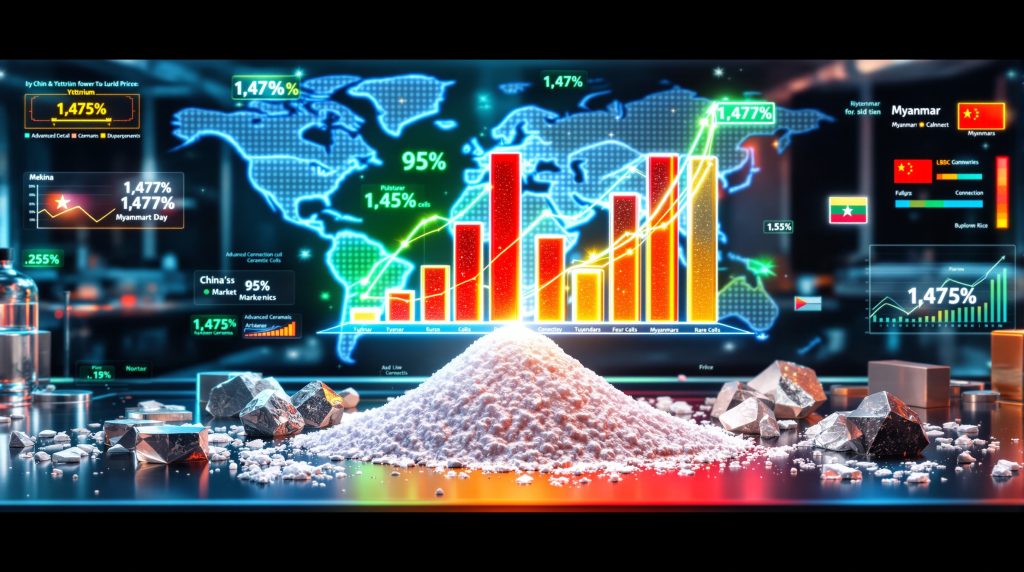
Industry analysts note that yttrium prices have surged to record levels, with some estimates suggesting increases approaching 1,500% in certain market segments. Furthermore, the Financial Review reports that this dramatic price movement demonstrates why major economies seek greater control over rare earth supply chains.
Critical Success Factors for Market Participants
"Supply Diversification: Reducing dependence on single-source suppliers requires sustained investment and multi-year planning horizons, but provides essential protection against regulatory and geopolitical disruptions that increasingly affect strategic materials availability."
"Technology Investment: Developing alternative processing capabilities and substitution research offers both defensive protection against supply constraints and offensive opportunities for competitive advantage as markets restructure around supply chain resilience rather than cost optimisation alone."
"Market Intelligence: Establishing robust monitoring and forecasting systems becomes essential as traditional commodity market dynamics prove inadequate for understanding materials subject to government intervention, strategic stockpiling, and national security considerations."
"Strategic Partnerships: Building relationships across the value chain enables access to supply allocation during constraint periods while providing market intelligence and risk sharing opportunities that individual companies cannot achieve independently."
Investment Framework for Strategic Metals
Successful navigation of yttrium market volatility requires framework thinking that accounts for multiple risk and opportunity dimensions simultaneously. Traditional commodity investment approaches based primarily on supply-demand balance prove insufficient for materials exhibiting geopolitical characteristics alongside economic fundamentals.
Essential framework elements include:
- Geopolitical risk assessment tracking regulatory changes, trade relationship developments, and national security policy evolution affecting material availability
- Technology disruption monitoring identifying both threats and opportunities from alternative materials research and processing innovation
- Supply chain mapping understanding dependency relationships, chokepoint vulnerabilities, and alternative sourcing potential
- End-use demand analysis evaluating application sector growth, substitution threats, and cyclical versus structural demand drivers
The convergence of supply chain concentration, technological complexity, and geopolitical significance in yttrium markets creates investment opportunities for participants with patience and expertise while posing substantial risks for those approaching these markets with conventional commodity perspectives.
Long-term strategic considerations suggest that current market disruptions represent early manifestation of broader restructuring in critical materials trade rather than temporary aberrations. Supply chain resilience increasingly takes precedence over cost optimisation in strategic materials procurement, creating sustained opportunities for alternative suppliers and processing capabilities despite higher costs compared to traditional sources.
Understanding these dynamics enables better decision-making for both industrial users requiring reliable yttrium supplies and investors seeking exposure to structural themes supporting strategic materials value chains. The key lies in recognising that yttrium markets operate according to strategic materials logic rather than conventional commodity fundamentals, requiring adjusted expectations and risk management approaches accordingly.
Looking to Capitalise on Critical Minerals Market Volatility?
Discovery Alert's proprietary Discovery IQ model delivers instant notifications on significant ASX mineral discoveries, transforming complex market data into actionable investment insights for strategic materials opportunities. Understand why historic critical mineral discoveries have generated exceptional returns by exploring real-world examples of market-leading outcomes.