
July 17, 2026
Understanding Zambia's Copper Market Fundamentals
Global copper markets face unprecedented supply-demand imbalances that could reshape investment landscapes across emerging mining jurisdictions. Current market analysis indicates a projected 330,000 metric ton global copper deficit in 2026, creating strategic opportunities for nations capable of rapidly scaling production capacity. This deficit represents approximately 4.5% of global refined copper production, establishing substantive price support mechanisms for new market entrants.
Price trajectory modelling suggests copper could reach $11,900 per metric ton, representing a 19.6% increase from 2025 levels. These market fundamentals provide the economic foundation for understanding why Zambia courts investors for copper output tripling initiatives that could position the nation as a critical supplier in global supply chain diversification strategies. Furthermore, the record high copper prices demonstrate the compelling economics driving international mining investment decisions.
Table: Zambia's Current Copper Production Metrics
| Production Indicator | 2025 Baseline | Growth Potential | Strategic Significance |
|---|---|---|---|
| Annual Output | 890,346 tons | Below 1M target | Capacity optimisation opportunity |
| Regional Position | #2 in Africa | Behind DRC only | Strategic market positioning |
| Export Revenue Share | ~75% of total | Growth trajectory | Economic transformation catalyst |
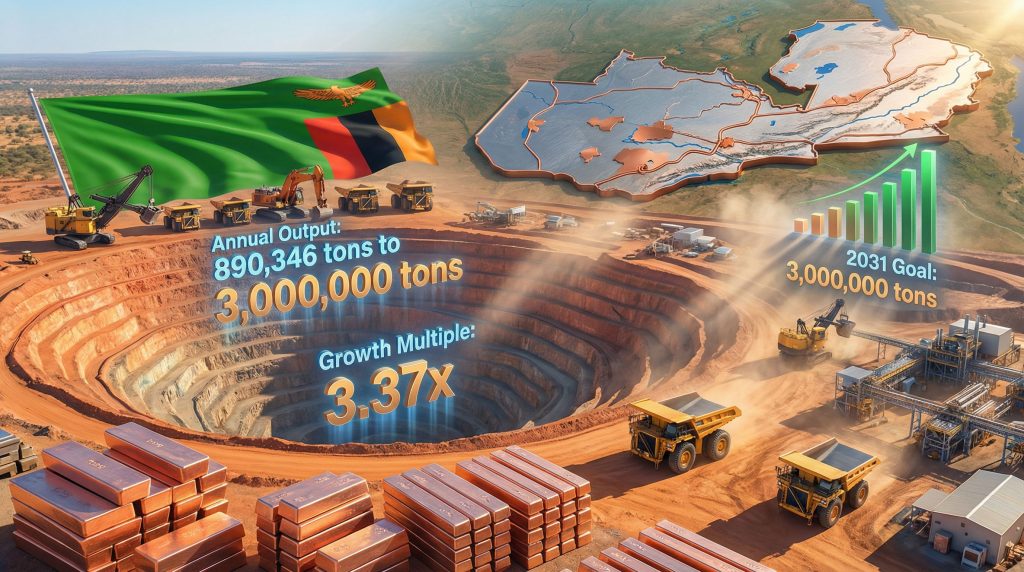
Africa's second-largest copper producer generated 890,346 tons in 2025, falling approximately 109,654 tons short of announced one million ton capacity targets. This production gap suggests existing operations were performing at roughly 89% of stated capacity goals, indicating immediate optimisation potential through operational efficiency improvements and infrastructure upgrades.
The strategic importance extends beyond raw production volumes. Zambia's mineral portfolio encompasses cobalt, nickel, manganese, graphite, lithium, and rare-earth elements, positioning the nation as a diversified critical minerals supplier rather than single-commodity producer. This resource diversity reduces market vulnerability whilst aligning with global energy transition material requirements.
When big ASX news breaks, our subscribers know first
Investment Architecture Driving Copper Expansion
Zambia's approach to tripling copper output combines brownfield optimisation with greenfield development through structured public-private partnership frameworks. The dual-track strategy recognises that existing asset enhancement provides faster capital deployment with reduced execution risk, whilst new project development addresses medium-term capacity expansion requirements. Consequently, successful copper investment strategies require careful consideration of both operational enhancement and new development opportunities.
Brownfield Enhancement Portfolio:
- Konkola Copper Mines: Targeting 300,000 tons annually through systematic infrastructure upgrades
- Mopani Operations: Capacity doubling to 230,000 tons by 2030 through operational optimisation
- Processing Facility Modernisation: Advanced ore sorting technology and efficiency system implementation
- Equipment Replacement Programmes: Aging infrastructure renewal to maximise existing site productivity
Current brownfield projects account for approximately 530,000 tons of additional production capacity, representing nearly 60% of the expansion pathway toward tripling objectives. Industry benchmarks suggest brownfield upgrades require $500-$1,000 per annual ton of production capacity, implying total brownfield investment requirements of $265-$530 million.
Greenfield Development Framework:
The Super Pit Expansion represents the largest discrete investment commitment at $2 billion, establishing capital intensity parameters of approximately $666 million per one million tons of annual production capacity. This greenfield project timeline requires immediate initiation to achieve 2031 production targets, given typical 3-5 year permitting phases and 2-3 year construction periods.
Mumbezhi Project development incorporates integrated copper-gold-cobalt recovery systems, demonstrating strategic positioning toward battery mineral markets experiencing explosive demand growth. Multi-commodity operations provide revenue diversification whilst leveraging shared infrastructure investments across mineral processing systems.
International mining companies currently operational in Zambia include China's JCHX Mining, Canada's Barrick Gold and First Quantum Minerals, India's Vedanta Resources, and US-backed KoBold Metals. This multinational presence indicates existing technical expertise and infrastructure capabilities that can serve as expansion foundations. However, global market dynamics continue to evolve, particularly considering how China's tariffs impact copper supply chains globally.
Geopolitical Competition for Strategic Resource Access
Multiple global powers recognise copper demand trajectories driven by electric vehicle proliferation, renewable energy infrastructure expansion, and artificial intelligence data centre buildout cannot be satisfied through existing supply chains dominated by concentrated geographic sources. This recognition creates strategic windows for supply chain diversification initiatives.
Electric Vehicle Copper Intensity Analysis:
Individual electric vehicles require approximately 80-100 kilograms of copper compared to 10-15 kilograms in conventional internal combustion engines. With global EV production projections exceeding 40 million units annually by 2030, this sector alone generates demand for approximately 2.4-3.2 million tons of copper, representing substantial portions of Zambia's targeted expansion output.
Renewable Energy Infrastructure Requirements:
- Wind Turbines: 5-7 metric tons of copper per megawatt of installed capacity
- Solar Installations: 5-10 metric tons per megawatt of capacity
- Grid Modernisation: Smart grid and transmission system copper intensity
- Energy Storage Systems: Battery manufacturing and installation copper requirements
With global renewable capacity additions projected at 300-400 gigawatts annually through 2031, copper demand from renewables represents 1.5-4 million tons annually, creating persistent baseline demand independent of economic cycles. Therefore, the copper–uranium investment outlook demonstrates significant long-term potential for resource investors.
Table: International Strategic Positioning Matrix
| Nation/Entity | Strategic Objective | Investment Vehicle | Market Access Priority |
|---|---|---|---|
| United States | China alternative sourcing | KoBold Metals backing | Critical minerals security |
| Canada | African mining expertise | Barrick Gold, First Quantum | Resource portfolio expansion |
| India | Manufacturing supply chains | Vedanta Resources operations | Industrial demand fulfilment |
| UAE | Resource diversification | International Resources Holding | Regional processing hub |
US engagement reflects strategic assessment that Chinese supply chain dominance in key commodities creates vulnerabilities in Western manufacturing capabilities. Zambia represents accessible entry point for supply chain rebalancing without requiring direct confrontation with established Chinese interests in top-tier mineral-producing nations. In this context, the tariffs impact on copper supply remains a critical consideration for strategic planning.
Artificial Intelligence Infrastructure Demand:
Data centres and computing infrastructure underlying AI services require copper for electrical distribution systems, cooling networks, and interconnecting cables. Industry estimates suggest approximately 2-3 kilograms of copper per teraflop of computing capacity, with global AI computing capacity expanding exponentially through the decade.
Economic Transformation Scenarios Through Copper Tripling
High-success scenario modelling projects 6.1% annual GDP growth rate achievement through expanded copper sector contribution, representing approximately 1-2 percentage point increases above typical African economic growth baselines. This acceleration potential stems from mining sector employment multiplication effects and foreign exchange generation enabling increased capital imports across other economic sectors. Moreover, Zambia seeks global investment to triple copper production, demonstrating clear governmental commitment to expansion objectives.
Employment Multiplication Framework:
Industry benchmarks indicate approximately 8-12 indirect jobs created for each direct mining position, implying potential total employment creation scenarios of 120,000-180,000 positions across primary and secondary economic activities. Mining sector wages flow through local economies, generating consumption and service sector employment with documented multiplier coefficients of 2.5-3.5x for developing economy mining sectors.
Value Chain Capture Opportunities:
- Raw Copper Ore: Baseline revenue generation
- Concentrate Production: 5-8% value addition
- Refined Copper Output: 10-15% value enhancement
- Cable Manufacturing: 35-40% value capture through ZAMEFA operations
Local processing development through ZAMEFA cable manufacturing demonstrates value-addition opportunities beyond raw copper exports, potentially capturing additional 15-20% margins whilst creating domestic manufacturing capabilities. Copper cable production adds approximately 35-40% value to raw copper, substantially improving economic returns for the host nation. Additionally, lessons from the Codelco-Adani partnership insights provide valuable frameworks for international collaboration structures.
Infrastructure Investment Catalysts:
Copper sector expansion necessitates coordinated investment in electricity generation capacity, transportation network enhancement, telecommunications infrastructure development, and workforce housing construction. These infrastructure investments generate employment and economic activity independent of direct mining operations whilst improving broader economic competitiveness.
Market Risk Assessment and Scenario Planning
Operational Risk Matrix:
- Power Supply Dependencies: Kariba Dam hydroelectric reliability and backup generation requirements
- Transportation Capacity: Rail and port infrastructure for tripled output volumes
- Water Resource Management: Mining operation sustainability during climate variations
- Community Stakeholder Relations: Benefit-sharing agreements and local engagement protocols
Energy security represents the most critical operational risk factor. Zambia's hydroelectric dependency creates vulnerability to drought conditions affecting Kariba Dam output levels. Backup generation systems and alternative energy source development require immediate attention to support expanded mining operations.
Table: Risk-Adjusted Production Scenarios
| Scenario | Probability | 2031 Output Level | Economic Impact | Mitigation Requirements |
|---|---|---|---|---|
| High Success | 25% | 3.0M tons | 6.1% GDP growth | Full infrastructure investment |
| Moderate Success | 45% | 2.2M tons | 4.5% GDP growth | Selective bottleneck resolution |
| Limited Success | 25% | 1.6M tons | 3.2% GDP growth | Brownfield focus only |
| Downside | 5% | 1.2M tons | 2.1% GDP growth | Operational optimisation only |
Geopolitical Risk Considerations:
Regulatory stability across political transitions represents ongoing concern for international investors committing multi-billion dollar capital over extended timeframes. Policy continuity mechanisms and investment protection frameworks require strengthening to maintain investor confidence through electoral cycles.
Regional conflict spillover effects, particularly Middle East instability affecting global commodity flows, could impact copper price trajectories and investment decision-making timelines. Diversified customer base development reduces single-market dependency risks.
Investment Structure Optimisation Frameworks
Public-Private Partnership Models:
Joint venture frameworks enable risk sharing between international mining companies and government entities whilst ensuring technology transfer and local capacity building obligations. Production sharing agreements provide revenue distribution mechanisms aligned with both investor returns and national development objectives.
Financial Risk Management Strategies:
- Currency Hedging: Kwacha volatility management for international investors
- Commodity Price Protection: Forward contracts and derivative instruments
- Political Risk Insurance: Multilateral development bank coverage options
- Exit Strategy Planning: Asset divestiture and capital repatriation mechanisms
Infrastructure development partnerships offer opportunities for coordinated investment in transportation networks and energy systems that benefit multiple stakeholders whilst reducing individual project risk exposure.
Technology Transfer Requirements:
Investment agreements increasingly incorporate local content mandates, skills development programmes, and research institution partnerships designed to build domestic technical capacity. These requirements create additional project complexity whilst establishing sustainable long-term operational foundations.
The next major ASX story will hit our subscribers first
Performance Measurement and Validation Frameworks
Success measurement requires comprehensive tracking across production volumes, investment commitments, employment creation, and export revenue generation. Quarterly milestone achievement and transparent reporting mechanisms build investor confidence whilst demonstrating government commitment to expansion objectives.
Table: Comprehensive Success Metrics Framework
| Performance Category | 2026 Target | 2028 Milestone | 2031 Objective |
|---|---|---|---|
| Production Volume | 1M+ tons | 1.8M tons | 3M tons |
| Capital Investment | $2B committed | $5B deployed | $8B total |
| Direct Employment | 15,000 positions | 35,000 positions | 60,000 positions |
| Export Revenue Share | 75% of total | 80% of total | 85% of total |
| Local Processing | 5% of output | 12% of output | 20% of output |
Validation Mechanisms:
Binding investment agreements with major mining companies provide concrete commitment verification beyond government announcements. Production milestone achievement through quarterly output reporting establishes credible progress tracking systems.
Infrastructure development progress in transportation and energy capacity expansion serves as leading indicator of expansion feasibility. Economic impact assessment through GDP contribution and employment generation tracking validates broader transformation objectives.
Regional Development and Global Supply Chain Implications
Zambia's copper expansion success could catalyse broader Southern African mining corridor development through cross-border infrastructure integration and logistics optimisation. Regional skills development networks and technology innovation centres represent potential secondary benefits extending beyond national boundaries.
Supply Chain Localisation Opportunities:
Component manufacturing and specialised service provider development within Zambia reduces operational costs whilst building domestic industrial capacity. Mining equipment maintenance, specialised logistics services, and technical consulting represent high-value service sector development opportunities.
Global Resource Security Impact:
Western supply chain resilience through diversified sourcing reduces strategic vulnerabilities associated with concentrated supplier dependencies. Emerging market resource-backed development models provide templates for other African nations seeking similar economic transformation pathways. For instance, Zambia courts investors to expand mining operations and diversify copper supply chains globally.
Technology Innovation Acceleration:
Mining efficiency improvements and processing technology advancement driven by competitive pressures benefit global industry development. Environmental and social governance standard setting in African contexts influences broader international best practices.
The success of Zambia courts investors for copper output tripling strategy extends implications far beyond national economic transformation, potentially reshaping global supply chain architectures and establishing new paradigms for resource-based development in emerging markets. Investment decision-makers must evaluate these broader strategic contexts alongside project-specific risk-return calculations.
This analysis is based on publicly available information and industry benchmarks. Investors should conduct comprehensive due diligence and seek professional advice before making investment decisions. Commodity markets and political conditions in emerging markets involve significant risks that could materially affect investment outcomes.
Could Zambia's Copper Boom Create Your Next Investment Opportunity?
With global copper deficits looming and Zambia targeting a massive production tripling by 2031, astute investors need immediate access to emerging mining opportunities across all critical commodities. Discovery Alert's proprietary Discovery IQ model delivers real-time alerts on significant ASX mineral discoveries, instantly empowering subscribers to identify actionable opportunities ahead of the broader market in copper, lithium, rare earths, and other battery metals driving the energy transition. Begin your 14-day free trial today and position yourself to capitalise on the next major mineral discovery before the market catches on.