June 4, 2026
The Structural Forces Reshaping Global Copper Supply
The global copper market is undergoing a fundamental reorganisation. For decades, the architecture of copper supply was relatively stable, anchored by a handful of dominant producing nations and a predictable flow of refined metal toward industrial consumers. That structure is fracturing. The intersection of accelerating electrification, intensifying geopolitical competition over resource access, and the strategic repositioning of sovereign and corporate capital is creating a new hierarchy of producing nations, and Zambia sits at an increasingly critical point within it.
Understanding Zambia's copper ambitions requires looking beyond the headline production targets. The deeper story involves geology, infrastructure deficits, competing foreign interests, fiscal policy mechanics, and the complex question of whether a country with extraordinary mineral endowment can translate that endowment into durable industrial and economic advantage.
When big ASX news breaks, our subscribers know first
Why Zambia's Copper Sector Is at a Strategic Inflection Point
From Underperformer to Global Focal Point
Zambia has long been recognised as a tier-one copper jurisdiction. The Copperbelt Province, straddling the border with the Democratic Republic of Congo, contains some of the world's highest-grade and most geologically accessible copper deposits. Yet for much of the past three decades, Zambia's output has underperformed relative to its resource base, constrained by power shortages, regulatory instability, and cycles of underinvestment.
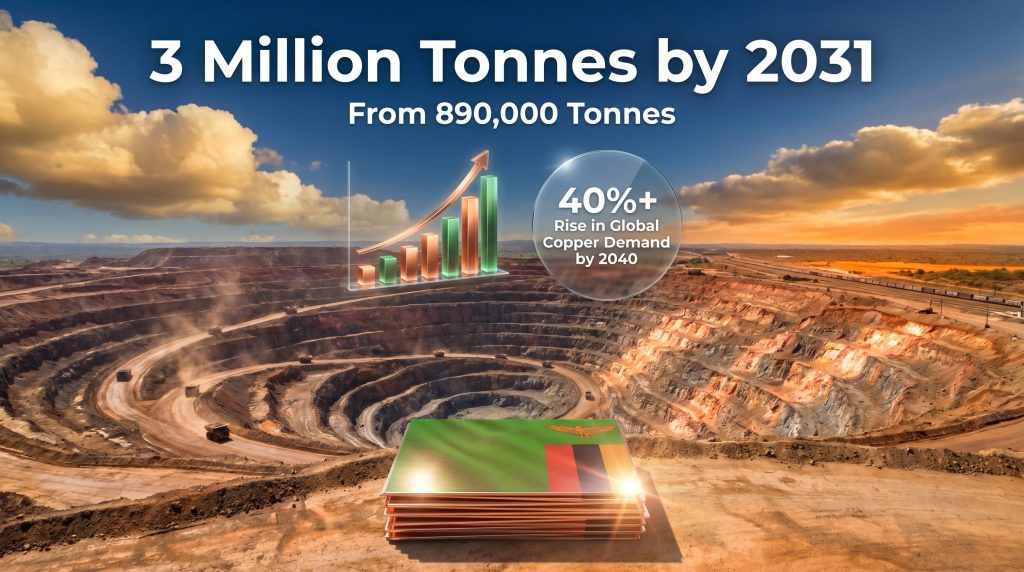
That dynamic is shifting. The country produced approximately 890,000 tonnes of copper in 2025, missing its one-million-tonne target but still representing a meaningful operational baseline. The Zambia copper growth forecast points to a significant gap between current output and the government's stated target of 3 million tonnes per year by 2031, though the direction of capital flows and policy attention has changed materially.
The Demand Signal Rewriting Zambia's Economic Calculus
In its May 2025 Global Trade Update, UNCTAD projected that global copper demand will rise by more than 40% between now and 2040, driven principally by electric vehicles, grid-scale energy storage, and the explosive growth of data centre infrastructure. Each of these sectors is copper-intensive in ways that have no near-term substitution pathway.
This demand trajectory creates a structural argument for Zambia that goes beyond cyclical commodity pricing. Nations and corporations are not simply seeking copper for the next project cycle. They are attempting to secure access to long-duration supply in a world where new large-scale copper deposits are increasingly difficult to discover, permit, and develop. Zambia's geology positions it as one of the few jurisdictions capable of delivering meaningful new volume at scale within the relevant timeframe. Furthermore, the broader critical minerals demand picture reinforces why Zambia's endowment commands such strategic attention.
What Does Zambia's 3 Million Tonne Target Actually Require?
Breaking Down the Production Gap
The distance between 890,000 tonnes of current annual output and a 3 million tonne target represents more than a tripling of production. Achieving it within six years would require a pace of capacity addition that has no direct precedent in Zambia's recent history. To contextualise the scale of the challenge, the four primary growth levers can be structured as follows:
| Growth Lever | Current Status | Target Contribution |
|---|---|---|
| Existing mine expansions (Kansanshi, Lumwana, Mopani, KCM) | Underway or partially active | Primary near-term driver |
| New project commissioning (e.g., Sinomine Kitumba) | Pipeline stage | Medium-term volume uplift |
| Policy and fiscal stability reforms | In progress | Investor confidence signal |
| Infrastructure and power constraint resolution | Critical bottleneck | Prerequisite for scale |
The Realistic Timeline
Government-aligned projections frame the 3 million tonne target as achievable with sustained capital inflows and continued regulatory reform. Independent analysts, including researchers at the Centre for Strategic and International Studies, have characterised the goal as structurally ambitious, identifying energy supply deficits, regulatory unpredictability, and investment conditions as the most consequential obstacles. According to Zambia's mining sector development plans, however, the roadmap to 2031 reflects a coordinated national strategy rather than aspirational rhetoric alone.
A more grounded scenario analysis suggests three plausible trajectories by 2031, each dependent on a distinct set of assumptions about how Zambia's structural constraints are resolved.
| Scenario | Key Assumptions | Projected Output Range |
|---|---|---|
| Base Case | Existing expansions complete on schedule; power constraints partially resolved | 1.5–2.0 million tpa |
| Optimistic Case | Full capital deployment, new projects commissioned, policy stability maintained | 2.5–3.0 million tpa |
| Downside Case | Energy deficits persist, investment delays, commodity price softening | Below 1.2 million tpa |
The base case is arguably the most instructive. Even under conditions where major mine expansions proceed as planned but power and regulatory constraints are only partially addressed, Zambia could roughly double its output without reaching its stated ambition.
How Are Major Mining Operators Positioning for Growth?
Barrick Mining's Lumwana Super Pit Expansion
Barrick Mining is committing US$2 billion to a Super Pit Expansion at its Lumwana mine in Zambia's North-Western Province. The project is designed to approximately double output at the site to 240,000 tonnes per year, making it one of the larger single-asset copper expansion commitments currently underway anywhere in Africa. Barrick has publicly framed the expansion as integral to its broader partnership with the Zambian state, including a signed Memorandum of Understanding with the government covering additional exploration across the Copperbelt.
First Quantum Minerals: The Dominant Private Producer
No single private entity shapes Zambia's copper output more directly than First Quantum Minerals. The Canadian company operates two flagship assets:
- Sentinel Copper Mine (North-Western Province): Produced approximately 396,000 tonnes in 2025, making it one of the highest-volume copper operations on the continent
- Kansanshi Mine (near Solwezi): Widely regarded as Zambia's largest open-pit copper operation, with ongoing expansion activity
Together, First Quantum's Zambian assets account for roughly half of the country's total annual copper output, a concentration of private production influence that gives the company extraordinary relevance to any serious discussion of Zambia's copper ambitions.
The Broader Operator Landscape
The Zambian copper sector is, in competitive terms, unusually internationalised. Capital from at least five distinct national origins is actively deployed across the Copperbelt:
| Operator | Ownership Structure | Key Asset | Notable Development |
|---|---|---|---|
| Barrick Mining | Canadian-listed | Lumwana Mine | US$2bn Super Pit Expansion targeting 240,000 tpa |
| First Quantum Minerals | Canadian-listed | Sentinel + Kansanshi | ~396,000 tpa from Sentinel alone (2025) |
| Mopani Copper Mines | Abu Dhabi IRH + ZCCM-IH | Mopani | 100,000 tonne duty-free export quota under waiver |
| Nkana Mining and Minerals Processing | Chinese-owned | Nkana | Beneficiary of export duty suspension |
| Vedanta Resources | India-based | KCM assets | Active Copperbelt operator |
| KoBold Metals | US-backed | Exploration stage | Represents Washington's emerging direct stake |
KoBold Metals, the US-backed exploration company, is a relatively recent entrant but carries significant symbolic weight. Its presence signals that American capital is beginning to move beyond diplomacy into direct operational engagement with Zambian copper assets.
The Geopolitical Contest Behind Zambia's Copper
East vs. West: Competing for Copperbelt Access
Zambia's copper sector has become one of the most active theatres of great-power resource competition in the world. China is structurally embedded through ownership positions at multiple operations, including JCHX Mining's Lubambe Copper Mine and the Chinese-owned Nkana Mining and Minerals Processing operation. Beijing has also backed the TAZARA railway upgrade, a significant infrastructure commitment connecting Zambia's interior to Tanzania's Indian Ocean coastline.
Western powers are responding with an alternative infrastructure vision. The Lobito Corridor, backed by the United States and European Union, is a competing rail route running westward through Angola to the Atlantic coast. Its strategic purpose is explicit: to redirect Zambian and Congolese copper flows toward European and North American markets rather than through Chinese-controlled logistics networks.
The Policy and Partnership Dimension
Canada's position within Zambia's mining sector is already the strongest of any Western nation, anchored by First Quantum's production dominance. Across its broader global programme, Canada has mobilised more than US$18.5 billion in critical minerals partnerships through its Critical Minerals Production Alliance.
The UK published its Vision 2035 Critical Minerals Strategy in November 2025, which includes targets to reduce dependence on single-country supply for minerals including copper. In addition, India's Zambia copper investment has emerged as another significant dimension of this multinational contest for Copperbelt access, further diversifying the geopolitical landscape. Meanwhile, Zambian Mines Minister Paul Kabuswe has confirmed that investment discussions with Washington are actively underway.
ZCCM Investment Holdings, Zambia's state mining vehicle, has articulated the country's leverage clearly. Its chief executive has made publicly that no major economy is willing to accept exclusion from access to critical minerals, a statement that captures the negotiating position Zambia now occupies as a geological asset in a geopolitically contested market.
How Policy Is Shaping Investment Decisions
The Export Duty Suspension and Its Operational Logic
Zambia has extended its suspension of the 10% duty on copper concentrate exports. The mechanics behind this policy decision are instructive. Several of Zambia's major smelting facilities are undergoing extended maintenance and repair cycles, creating a situation where unprocessed copper concentrate is accumulating at mine sites without the domestic processing capacity to absorb it.
The duty suspension provides operators with a pathway to export concentrate in its unprocessed form without the tax penalty that would ordinarily apply. Beneficiaries include Barrick Mining, First Quantum Minerals, Nkana Mining and Minerals Processing, and Mopani Copper Mines, which holds a specific 100,000-tonne duty-free export quota under the current waiver framework.
This is not simply a revenue management decision by the Zambian government. It is also a signal to investors that the regulatory environment will adapt to operational realities rather than rigidly enforce fiscal structures that could damage production economics during periods of infrastructure constraint.
Fiscal Stability as a Long-Term Investment Signal
Mining investment decisions, particularly those involving multi-billion-dollar commitments with decade-long payback periods, are acutely sensitive to fiscal regime predictability. Investors need confidence that royalty rates, export duty structures, and tax frameworks will remain stable across the life of their capital deployment. Consequently, those evaluating copper investment strategies will weigh Zambia's policy trajectory as carefully as its geological fundamentals.
Zambia's historical record on this dimension has been mixed, with several policy shifts over the past two decades that created uncertainty for operators. The current administration's approach, including the duty suspension extension and the MOU framework with Barrick, suggests a more deliberate effort to signal durability of terms.
The next major ASX story will hit our subscribers first
Beyond Raw Copper: The Value-Added Industrial Question
The DRC-Zambia EV Battery Value Chain
One of the most strategically significant, and least publicly discussed, dimensions of Zambia's copper positioning is the potential to participate in downstream battery manufacturing rather than simply exporting refined metal or concentrate. The DRC-Zambia electric vehicle battery value chain concept envisions the two neighbouring countries collaborating to move further along the processing chain, capturing value that currently exits the region entirely.
This matters for a fundamental reason: the economic return per tonne of copper embedded in a battery cell is substantially higher than the return per tonne of copper cathode exported to a foreign smelter. If Zambia is serious about translating copper geology into durable national wealth, the ratio of raw exports to processed output is as important as the volume target itself.
Workforce Capacity as a Hidden Constraint
A constraint that rarely appears in headline production targets is the availability of skilled technical labour. Tripling copper output within six years is not only a capital and infrastructure challenge. It requires a proportional expansion of engineering, metallurgical, and operational expertise. Zambia's workforce development pipeline is a binding constraint that will need parallel investment if physical production targets are to be matched by operational sustainability.
The Most Significant Risks to Zambia's Copper Ambitions
Power Infrastructure: The Critical Bottleneck
Zambia's energy supply situation is the single most consequential operational constraint on its copper ambitions. The country's power grid relies heavily on hydroelectric generation, which is vulnerable to the increasingly erratic rainfall patterns associated with regional climate variability. Extended dry cycles reduce reservoir levels and curtail generation capacity precisely when mining demand is growing.
Without a credible resolution to the energy deficit, the capital being deployed into mine expansion cannot be fully converted into incremental output. This is the structural reality that sits behind the more cautious independent analyst projections.
Commodity Price Volatility and Capital Commitment Risk
Long-cycle mining investment is particularly exposed to the copper supply crunch and broader price volatility dynamics. A sustained period of price weakness, even well below current levels, can cause operators to defer expansion decisions or reduce capital allocation. Given that Zambia's production growth is dependent on continued commitment from a relatively small number of large operators, any deterioration in investment economics carries disproportionate national consequence.
The DRC Competition Factor
The Democratic Republic of Congo remains Africa's largest copper producer and Zambia's most direct regional competitor for investment, capital, and market attention. The DRC's geological endowment is, if anything, larger than Zambia's, and its production trajectory creates a persistent competitive reference point for international capital allocation decisions.
Frequently Asked Questions About Zambia's Copper Ambitions
How much copper does Zambia currently produce?
Zambia produced approximately 890,000 tonnes of copper in 2025, below its one-million-tonne target for that year.
What is Zambia's copper production target by 2031?
The Zambian government has set a target of 3 million tonnes per year by 2031, which would require roughly tripling current output.
Which companies are the largest copper producers in Zambia?
First Quantum Minerals is the dominant private producer, with Sentinel mine alone delivering approximately 396,000 tonnes in 2025. Barrick Mining is the second major Canadian operator, with its Lumwana expansion targeting 240,000 tonnes per year.
Why is Zambia suspending its copper concentrate export duty?
The suspension of the 10% duty addresses a specific operational constraint: major smelting facilities are undergoing extended maintenance, preventing the processing of concentrate domestically. The waiver allows operators to export unprocessed material without the standard tax penalty.
How does Zambia compare to the DRC as a copper producer?
Zambia is Africa's second-largest copper producer. The DRC produces significantly more copper annually and holds a larger known resource base, making it Zambia's primary regional benchmark and competitor for international mining investment.
Is Zambia's 3 million tonne target realistic?
The target is achievable under an optimistic scenario involving full capital deployment, successful new project commissioning, and resolution of power constraints. Independent analysis suggests the base case outcome is more likely to fall in the 1.5 to 2.0 million tonne range by 2031, with the gap between ambition and reality determined primarily by energy infrastructure and regulatory stability.
Zambia's Copper Trajectory in a Fracturing Global Supply Chain
The competitive dynamics now surrounding Zambia's copper sector are unlikely to diminish. As electrification accelerates and the geopolitical value of secure mineral supply chains increases, the Copperbelt will attract growing attention from state and corporate actors whose strategic interests are fundamentally at odds with one another.
Zambia's position in this environment is more advantageous than at any point in recent history. The geology is proven, the investment is flowing, and the demand signal from UNCTAD and others is unambiguous. What remains uncertain is whether the country's institutional and infrastructure frameworks can absorb and convert that opportunity at the pace required.
For investors and analysts tracking the critical minerals landscape, Zambia's copper ambitions represent one of the defining case studies of the decade: a resource-rich nation attempting to navigate competing foreign interests, close a structural infrastructure gap, and move up the value chain simultaneously. The outcome will matter well beyond Zambia's own borders, shaping the availability and geopolitical distribution of one of the most consequential industrial materials of the coming generation.
Readers seeking further coverage of Zambia's copper sector and broader critical minerals supply chain developments can explore ongoing reporting and analysis at Mining Digital, which tracks operational, investment, and policy shifts across the global mining industry.
Want to Position Yourself Ahead of the Next Major Copper Discovery?
Discovery Alert's proprietary Discovery IQ model scans ASX announcements in real time, instantly identifying significant mineral discoveries — including copper — and translating complex data into actionable investment insights for traders and long-term investors alike. Explore how historic discoveries have generated extraordinary returns on Discovery Alert's dedicated discoveries page, and begin your 14-day free trial today to secure a market-leading edge as the global copper supply chain continues to reshape itself.