June 20, 2026
The Hidden Cost of Energy Dependency: How Landlocked Nations Become Hostages to Pipeline Politics
When global oil markets fracture under the weight of geopolitical conflict, it is rarely the coastal refining hubs that feel the sharpest pain. It is the nations sitting hundreds of kilometres from the nearest port, with no domestic crude production and a single corridor connecting them to the world's petroleum supply. These countries carry an energy security vulnerability that remains largely invisible during stable periods but becomes existentially apparent the moment external shocks hit.
Zambia sits precisely within this category of structurally exposed nations. Its fuel supply architecture is built on two pillars: one dominant, one supplementary, and neither offering the kind of redundancy that insulates an economy from crisis. Understanding what is now unfolding around the Vitol emergency fuel deal in Zambia requires looking first at the foundations of that architecture before examining the decisions being made on top of it.
When big ASX news breaks, our subscribers know first
Why Zambia's Fuel Supply Chain Carries Systemic Risk
Zambia imports every drop of refined petroleum it consumes. There is no domestic crude extraction, no refining capacity of national significance, and no buffer stock infrastructure that would allow the country to ride out extended supply disruptions without external intervention. This is not an unusual condition for sub-Saharan African nations, but Zambia's landlocked geography makes it structurally more exposed than most.
The country's fuel import network operates through two channels:
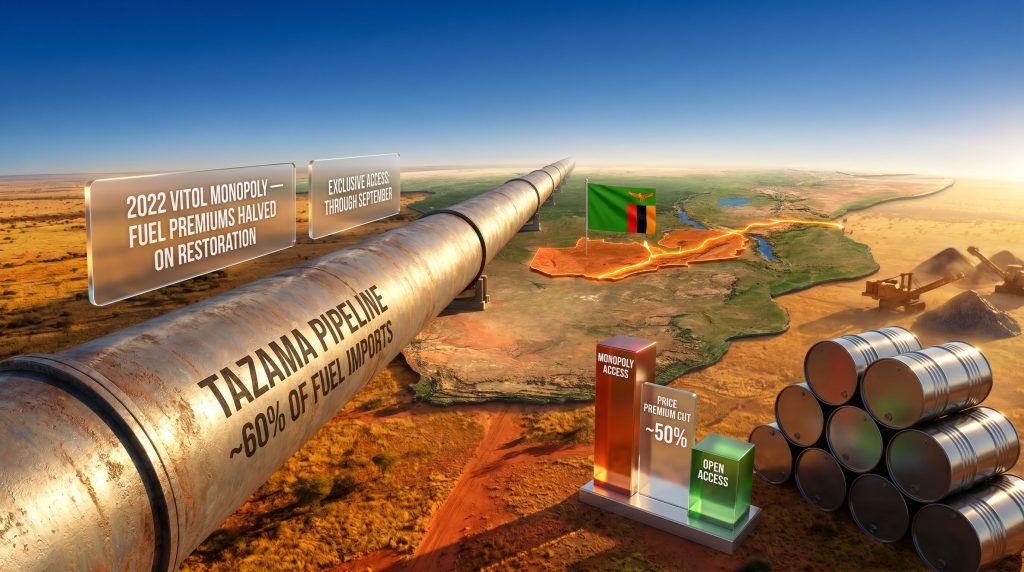
- The Tazama pipeline, which accounts for roughly 60% of total national fuel imports, connecting Zambia's copper-producing heartland to a port in neighbouring Tanzania
- Overland road transport, which covers the remaining 40%, carrying fuel across multiple international borders at higher cost and with greater logistical complexity
| Supply Channel | Share of Imports | Primary Risk | Flexibility Rating |
|---|---|---|---|
| Tazama Pipeline | ~60% | Single operator dependency | Low |
| Road Transport | ~40% | Cost premium, border friction | Moderate |
The pipeline's dominance creates what engineers and supply chain analysts call a single-point-of-failure risk. When the Tazama system is disrupted, whether by technical failure, political decisions, or access restrictions, there is no equivalent alternative that can absorb the volume shortfall at equivalent cost or speed. Furthermore, the supply chain disruption risks inherent in this model are compounded by Zambia's distance from major refining centres.
The Mining Sector's Diesel Dependency Amplifies the Problem
Zambia's copper mining industry, which positions the country as Africa's second-largest copper producer, is extraordinarily diesel-intensive. Haulage fleets, ore processing equipment, and remote site power generation all run on diesel. The mining sector alone accounts for approximately one-third of total national diesel consumption, meaning that any sustained elevation in fuel costs or availability constraints translates almost directly into compressed mining margins and reduced fiscal revenues for the government.
This feedback loop between pipeline access, fuel pricing, and commodity prices and mining margins is central to understanding why the current emergency arrangement has attracted such intense scrutiny from international institutions. Consequently, the stakes extend well beyond fuel logistics into the heart of Zambia's economic model.
The Vitol Emergency Fuel Deal in Zambia: What Actually Happened
In April 2026, Zambia's government suspended the open-access framework that had previously governed operations on the Tazama pipeline. The government cited fuel supply security as the justification, but did not publicly identify which entity had assumed sole operational control of the corridor.
The identity of the exclusive operator was subsequently confirmed by Zambia's Energy Ministry permanent secretary Ephraim Munshifwa, who disclosed at a Cape Town conference that Vitol Group had become the pipeline's sole provider. The arrangement extends through September 2026, framing the Vitol emergency fuel deal in Zambia as a time-limited emergency measure rather than a permanent structural change.
Critical context: Vitol Group is one of the world's largest independent energy trading companies by volume. Its involvement in frontier and emerging market fuel supply is a well-established feature of its business model, and its presence in Zambia is not new.
The 2022 Precedent: Why History Matters Here
This is not the first time Zambia has handed Vitol exclusive control over the Tazama pipeline. A nearly identical arrangement was established in 2022, when Vitol and its local partner Agro-Fuel Investments were granted monopoly access to the corridor. That arrangement drew sharp criticism from the International Monetary Fund, which linked the monopoly structure to elevated fuel price premiums. When open access was subsequently restored, the IMF reported that the premium on fuel prices was approximately halved.
The chronological sequence of events is instructive:
- 2022: Vitol and Agro-Fuel Investments granted exclusive pipeline access
- Post-2022: IMF pressure leads Zambia to restore competitive open-access framework; fuel price premiums reportedly fall by roughly 50%
- April 2026: Zambia suspends open access following oil market disruption triggered by the Iran conflict
- June 2026: Energy Ministry confirms Vitol as the sole pipeline operator through September
- May to June 2026: IMF formally calls on Zambia to restore open access and publish the terms of the emergency arrangement
The pattern is difficult to ignore. Zambia has now moved through this cycle twice within four years, raising legitimate questions about whether the emergency designation is genuinely extraordinary or whether it has become an available policy tool that bypasses competitive procurement norms.
The Iran War's Role in Triggering the Current Crisis
The immediate catalyst for the 2026 suspension was the escalation of conflict involving Iran, which introduced significant volatility across global oil supply chains. Broader oil price movements during this period amplified the pressure on landlocked import-dependent nations, which cannot easily reroute supply chains, switch between suppliers, or absorb short-term price spikes through domestic production flexibility.
For Zambia, the Iran war-related disruption created a scenario where the government perceived the open-access model — which involves multiple competing suppliers drawing through the same pipeline — as insufficiently robust to guarantee volume delivery during a period of acute market stress. The decision to consolidate pipeline access under a single, large-volume trader reflected a preference for supply certainty over price competition.
Whether that trade-off is economically justified remains contested. The IMF's position is unambiguous: the costs imposed on Zambian consumers and businesses by monopoly pricing outweigh the supply security benefits of exclusive access, particularly when the arrangement lacks transparency.
Why the IMF Is Opposing the Arrangement
The Washington-based lender's objections operate on two distinct levels: economic and governance.
On the economic side, the core concern is pricing. The 2022 experience demonstrated empirically that exclusive pipeline access is associated with materially higher fuel price premiums. When competition was restored, those premiums fell by roughly half. Reinstating a single-operator model in 2026 creates a strong prior expectation that similar price inflation will return, with downstream consequences for transport costs, food prices, and the operating economics of Zambia's mining sector.
On the governance side, the IMF has specifically called for the terms of the emergency arrangement to be publicly disclosed. The government's initial refusal to even name the exclusive operator signals a level of opacity that sits uncomfortably alongside Zambia's existing commitments under its IMF lending programme and broader debt restructuring obligations.
Governance benchmark: A defensible emergency procurement arrangement typically includes published contract terms, competitive pricing benchmarks, independent regulatory oversight, and defined sunset clauses. The current Zambia-Vitol arrangement has not been publicly measured against any of these standards.
What Monopoly Pipeline Access Costs in Practice
The price premium problem cascades through Zambia's economy in ways that extend well beyond the fuel pump:
- Mining cost inflation: Higher diesel prices compress operating margins across copper extraction, processing, and haulage operations, directly affecting the sector that generates the bulk of Zambia's export revenue. The Zambia copper production outlook becomes considerably more uncertain when fuel costs remain elevated and unpredictable.
- Transport cost pass-through: Elevated fuel costs increase the cost of moving goods across a landlocked country already burdened by distance-to-market disadvantages
- Food price inflation: Transport cost increases flow through to consumer goods prices, disproportionately affecting lower-income households
- Fiscal pressure: If mining sector profitability declines, royalty and tax revenues flowing to the government contract at a time when Zambia is managing a complex debt restructuring process
Scenario Analysis: What Happens After September?
The September 2026 deadline creates a defined decision point, but three materially different outcomes remain plausible depending on how geopolitical and institutional pressures evolve.
| Scenario | Key Driver | Fuel Price Outlook | IMF Program Implications |
|---|---|---|---|
| Open access restored at deadline | IMF leverage plus political will | Premium reduction likely | Positive for program compliance |
| Exclusive arrangement extended | Continued supply market instability | Elevated premiums persist | Risk of program friction |
| Competitive tender process initiated | Governance reform momentum | Medium-term uncertainty | Neutral to positive |
The second scenario carries the greatest systemic risk. An extension of exclusive access beyond September, particularly without published terms or regulatory oversight, would represent a further departure from the market liberalisation commitments that underpin Zambia's IMF engagement. It would also likely prompt a formal response from the Fund, potentially complicating the country's access to concessional financing at a time when fiscal headroom is already constrained.
The next major ASX story will hit our subscribers first
Broader Lessons: Pipeline Governance Across Landlocked Africa
Zambia's situation is not unique in its structural exposure, but the specific governance failure pattern it exhibits offers lessons relevant across the region. Uganda, Zimbabwe, and Malawi each face analogous landlocked fuel import challenges, and each has at various points navigated the tension between emergency procurement and competitive market principles.
What distinguishes the Zambia case is the recurrence. The 2022 and 2026 arrangements follow an almost identical template, suggesting that the institutional mechanisms for preventing monopoly access from re-emerging have not been sufficiently embedded in Zambia's regulatory framework. A single episode of emergency exclusive access can be characterised as crisis response. However, a repeated pattern raises questions about structural incentives, regulatory capture, and the durability of market reform commitments.
The IMF's dual intervention across both episodes underscores a broader shift in how multilateral lenders are approaching fuel market governance in sub-Saharan Africa. Competition in fuel distribution is increasingly being treated not as a secondary market efficiency concern but as a macroeconomic stability variable with direct implications for inflation, fiscal revenue, and debt sustainability. This shift is also visible in how the global copper supply forecast accounts for input cost risks in mineral-dependent economies.
Comparisons can also be drawn to Namibia's experience, where Vitol was similarly designated as the sole fuel supplier, raising comparable questions about pricing transparency and the governance of emergency energy arrangements across the region.
Key Takeaways for Analysts and Investors Watching Zambia
Several structural themes emerge from this situation that carry relevance beyond the immediate fuel supply question:
- Energy security and market liberalisation are in direct tension in landlocked import-dependent economies, and crisis conditions routinely expose the fragility of competitive frameworks built during stable periods
- Monopoly pipeline access carries measurable, quantifiable costs that flow through to consumer prices, mining economics, and government revenues, making it a macroeconomic issue rather than a narrow sector concern
- Transparency is a leading indicator of governance quality in emergency procurement, and the absence of published contract terms is itself a signal worth monitoring for investors and creditors with Zambia exposure
- The IMF's repeated intervention in this specific issue signals that fuel market competition has become a conditionality-adjacent concern in the Fund's engagement with Zambia, with potential implications for future programme compliance assessments
- The copper sector's diesel dependency means that Zambian mining equities and debt instruments carry indirect fuel price risk that is structurally linked to pipeline governance decisions
Disclaimer: This article is intended for informational purposes only and does not constitute financial or investment advice. All forecasts, scenario projections, and probability assessments represent analytical perspectives only and should not be relied upon as predictions of future outcomes.
Want to Stay Ahead of the Next Major ASX Mineral Discovery?
Discovery Alert's proprietary Discovery IQ model delivers real-time alerts on significant ASX mineral discoveries — instantly converting complex commodity and exploration data into actionable investment insights, ideal for investors tracking resource-dependent economies like Zambia's copper sector. Explore how historic discoveries have generated substantial returns and begin your 14-day free trial today to secure a market-leading edge.