May 15, 2026
The Sovereign Equity Revolution: How Africa's Resource Nations Are Reclaiming Mineral Value
Across the global mining industry, a structural shift has been building for years beneath the surface of commodity cycles and capital flows. Resource-rich nations that once ceded operational control and revenue rights to foreign operators in exchange for investment capital are now methodically reassembling their economic positions. This is not the blunt nationalisation of the 1970s, characterised by forced takeovers and capital flight. It is something more sophisticated: a deliberate architecture of incremental equity expansion, royalty engineering, and revenue diversification designed to capture lasting sovereign value from finite mineral endowments.
Zambia sits at the centre of this recalibration. As Africa's second-largest copper producer and host to one of the world's most geologically endowed copper belts, the country holds reserves whose strategic importance has intensified with the global energy transition. Electric vehicles, grid-scale battery storage, and renewable power infrastructure all depend on copper at a scale that analysts increasingly describe as part of the critical minerals demand surge. Within this context, ZCCM Investments Holdings mining stakes in Zambia are quietly executing one of the continent's most architecturally interesting sovereign resource strategies.
When big ASX news breaks, our subscribers know first
From Passive Minority to Strategic Participant: Understanding ZCCM-IH's Ownership Philosophy
The distinction between holding a 10% financial interest in a mine and holding a 25% to 30% "significant minority" stake may appear to be a matter of degree. In practice, it represents a categorical difference in governance influence, information access, and strategic leverage. ZCCM Investments Holdings mining stakes in Zambia span this entire range, and the company's leadership has been explicit that the directional intent is upward movement across the board.
CEO Kakenenwa Muyangwa has communicated clearly that the organisation holds a firm intention to build substantial positions across its existing mining portfolio. Critically, the pathway to these expanded positions is defined by commercial negotiation rather than compulsion. Any stake increases, Muyangwa has confirmed, will be executed on commercial terms without recourse to forced sales or legislative mandates. This positioning is strategically significant because it signals to foreign capital that Zambia's resource sovereignty agenda does not come at the cost of investment security.
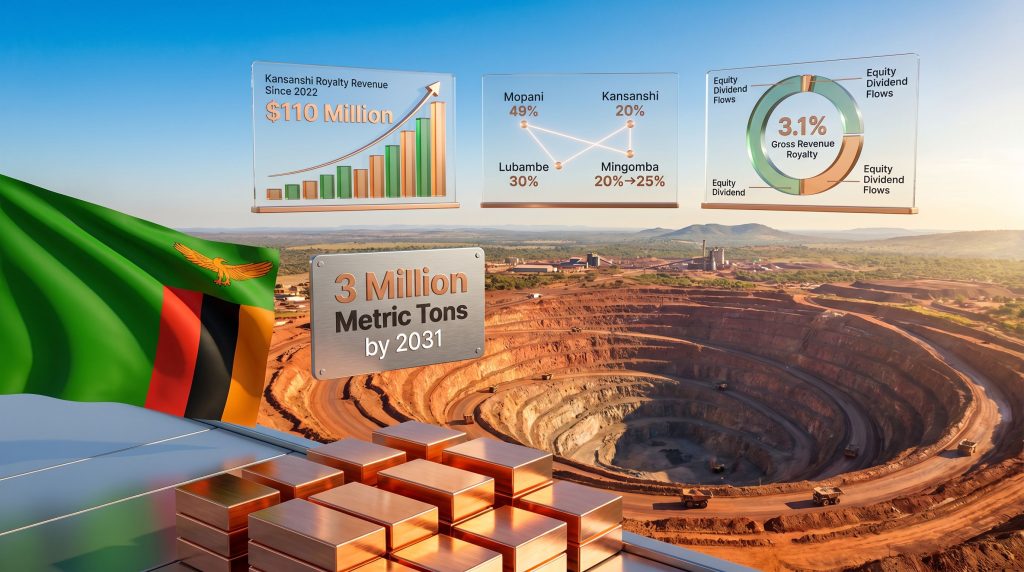
This commercial discipline distinguishes ZCCM-IH from more coercive approaches seen in other jurisdictions. The underlying logic is that a commercially credible sovereign investor is more likely to attract the capital flows Zambia needs to meet its ambitious 3 million metric ton copper production target by 2031 than one that relies on regulatory leverage to extract equity concessions. Furthermore, copper investment strategies of this kind signal long-term market confidence to international partners.
ZCCM-IH's Mining Portfolio: Stake Sizes, Partners, and Strategic Logic
The breadth of ZCCM-IH's portfolio reflects decades of privatisation-era deal-making, with equity positions negotiated at different points in time under different market conditions. The result is a layered ownership structure spanning some of Zambia's most significant copper assets.
Core Portfolio Stakes
| Mining Asset | ZCCM-IH Stake | Key Operating Partner |
|---|---|---|
| Mopani Copper Mines Plc | 49% | Previously Glencore |
| Konkola Copper Mines Plc | 20.6% | Vedanta Resources (India) |
| Kansanshi Mining Plc | 20% | First Quantum Minerals (Canada) |
| CNMC Luanshya Copper Mines Plc | 20% | China Nonferrous Metal Mining Group |
| Lubambe Copper Mines Plc | 30% (increased from 20%) | JCHX Mining (China) |
| Mingomba Mining Ltd | 25% (raising from 20%) | KoBold Metals (USA) |
| Chibuluma Mines Plc | 15% | Various |
| NFC Africa Mining Plc | 15% | NFC Africa |
| Chambishi Metals Plc | 10% | Various |
| Copper Trees Minerals Ltd | 15.58% | Various |
At the lower end of this ownership spectrum, positions of 10% to 15% function largely as passive financial interests. Revenue flows are dependent on dividend distributions, which are subordinate to operating performance, capital expenditure programmes, and debt servicing obligations. These structures leave the state exposed to the discretionary decisions of operators over whom it has limited formal influence.
By contrast, the 20% to 30% band that ZCCM-IH is systematically pursuing represents what corporate governance practitioners often call the "significant minority" threshold. At this level, state entities typically gain meaningful board representation rights, access to material financial and operational information, and the ability to influence decisions on environmental compliance, community engagement, and capital allocation priorities.
Why Shareholder Transitions Create Strategic Windows
One of the less widely understood dynamics in sovereign equity expansion is that major shareholder transitions at foreign-operated mines create negotiating opportunities that do not exist during stable ownership periods. The Lubambe Copper Mines transaction illustrates this mechanism precisely.
When EMR Capital exited Lubambe in 2024 and sold its majority shareholding to China's JCHX Mining, the resulting change in the mine's ownership architecture gave ZCCM-IH the opportunity to renegotiate its position. The state entity's stake rose from 20% to 30% as a direct consequence of this corporate event. From a strategic perspective, this suggests that ZCCM-IH's expansion programme is not solely dependent on organic capital deployment; it also benefits from monitoring the portfolio for shareholder transition events that unlock renegotiation rights.
Simultaneously, ZCCM-IH is actively raising its interest in Mingomba Mining from 20% to 25%. The Mingomba project is backed by KoBold Metals, a U.S.-based exploration technology company known for applying machine learning and data science to mineral discovery. The fact that ZCCM-IH is pursuing expanded positions in both Chinese-operated and U.S.-backed projects signals that its equity expansion strategy is capital-source agnostic.
Free Carry Mechanics: How Zambia Captures Equity Without Upfront Capital
One of the most technically significant instruments in ZCCM-IH's expansion toolkit is the free carry provision. This mechanism deserves more detailed examination than it typically receives in mainstream coverage of resource nationalism, because it fundamentally alters the capital equation for sovereign equity participation in greenfield mining development.
A free carry entitlement arises where a government entity holds the mining licence for a development-stage project. Under this structure, the licence holder is entitled to receive an initial equity stake in the project without contributing capital proportionally to early-stage development costs. Only beyond this threshold does the state entity assume a proportional share of ongoing capital requirements.
Muyangwa has indicated that where ZCCM-IH holds the licence, a free carry in the range of 5% to 15% would be appropriate, with the exact level subject to negotiation based on project economics and the nature of the development programme.
Why Free Carry Matters: For a state investor with finite capital resources, free carry provisions effectively decouple initial equity acquisition from immediate cash deployment. This two-stage ownership ladder allows ZCCM-IH to establish a meaningful position in new mines before the heavy capital expenditure phase begins, then scale up its investment as the project matures and revenue certainty improves.
This structure is particularly valuable in the context of development-stage projects where exploration risk remains material. By securing a free carry position early, ZCCM-IH participates in upside without bearing disproportionate downside during the highest-risk phase of mine development.
The Royalty-to-Revenue Transition: Reengineering How the State Gets Paid
Perhaps the most financially consequential aspect of ZCCM-IH's current strategic architecture is its deliberate shift away from dividend-based returns toward revenue royalty arrangements. This transition addresses a structural vulnerability that has historically undermined the fiscal value of state mining equity across sub-Saharan Africa.
Why Dividends Are a Fragile State Revenue Mechanism
Dividend distributions from mining operations are the residual claim on profit after every other obligation has been met. Operating costs, capital expenditure, loan repayments, hedging costs, and management fees all take precedence. In practice, this means that during periods of commodity price weakness or cost inflation, dividends can be compressed or eliminated entirely even when a mine continues to produce and sell metal at substantial volumes.
This dynamic is not merely theoretical. The mining industry has a well-documented history of structuring costs and intercompany transactions in ways that reduce reported profit at the operating entity level, effectively suppressing dividend flows to minority shareholders, including state entities. For a sovereign investor dependent on mining dividends to fund public programmes, this exposure creates genuine fiscal instability.
The Kansanshi Blueprint: Revenue Royalties in Practice
ZCCM-IH's arrangement at Kansanshi Mining, where it holds a 20% stake in the First Quantum Minerals-operated asset, has demonstrated that an alternative model is both viable and financially material.
Rather than receiving dividends, ZCCM-IH collects 3.1% of gross revenue from Kansanshi operations. Since this arrangement came into effect in 2022, it has delivered $110 million to the state entity. This figure is significant because it represents a top-line entitlement that is insulated from cost structures, capital decisions, and operational performance variability.
| Revenue Model | Exposure to Cost Inflation | Payment Basis | Predictability | State Fiscal Value |
|---|---|---|---|---|
| Traditional Dividends | High | Residual profit | Low | Volatile |
| Revenue Royalty (3.1%) | Minimal | Gross revenue | High | Stable |
The directional intent is now to replicate this model across other portfolio assets. ZCCM-IH is appointing a financial adviser to support capital raising for its expansion programme, and royalty structuring negotiations with other portfolio companies are expected to be part of that mandate.
Metals Trading as a Third Revenue Pillar
Beyond royalties and equity distributions, ZCCM-IH is reportedly exploring a third revenue channel: direct physical metal trading proportional to its equity entitlement. Discussions with commodity trading firm Mercuria have been referenced in relation to this initiative. If executed, this strategy would allow Zambia to capture commodity price upside beyond the fixed percentage royalty structure, accessing the full market price for physical copper allocated against its ownership stake.
This approach mirrors strategies employed by other sovereign resource funds globally, and represents a meaningful evolution in sophistication relative to passive minority shareholding. In addition, understanding global copper production trends helps contextualise why Zambia is acting with such urgency.
Zambia's 3 Million Metric Ton Ambition: Production Scale and ZCCM-IH's Role
Zambia's national copper output target of 3 million metric tons by 2031 is an ambition that would require more than tripling production from current levels. The country's geological endowment is not in question — the Zambian Copperbelt contains some of the world's highest-grade copper deposits, with ore grades that compare favourably against mature mining jurisdictions globally. The constraint has historically been capital, infrastructure, power availability, and the regulatory and fiscal environment for attracting sustained foreign investment.
ZCCM-IH's portfolio companies, including Mopani, Kansanshi, Konkola, Lubambe, and the development-stage Mingomba project, collectively represent a significant portion of the production capacity needed to approach this target. Each asset faces its own development timeline, capital requirements, and operational challenges. The Zambia copper growth forecast reflects both the opportunity and the scale of investment required to reach these levels.
Three Scenarios for Production Growth
Scenario A: Base Case
- Incremental production increases across existing operating mines
- Mopani rehabilitation delivers partial output recovery
- Mingomba and other development-stage projects advance on schedule
- ZCCM-IH royalty income grows proportionally with expanded revenue bases
Scenario B: Accelerated Growth
- Full delivery on Mingomba, Mopani rehabilitation, and KCM expansion
- Royalty model successfully extended to three or more portfolio assets
- Metals trading strategy becomes a material contributor to state revenues
- ZCCM-IH achieves significant minority thresholds across the majority of its portfolio by 2031
Scenario C: Structural Headwinds
- Copper price correction reduces royalty and dividend income
- Capital market tightening delays development-stage mine advancement
- Geopolitical friction with Chinese-operated assets creates governance complications
- ZCCM-IH's financial adviser appointment stalls, limiting capital raising capacity
The next major ASX story will hit our subscribers first
Risks, Constraints, and the Geopolitical Dimension
Any honest assessment of ZCCM-IH's expansion strategy must account for the constraints that could limit its execution. Three stand out as particularly material.
Capital availability is the most immediate. Raising equity stakes in commercial transactions requires capital, whether internally generated from existing royalty and dividend flows, or accessed externally through debt or equity capital markets. ZCCM-IH's announcement that it is seeking a financial adviser signals that its current internal capital generation may be insufficient to fund the full breadth of its expansion ambitions without external financing. This introduces balance sheet risk, particularly if copper prices soften during a period of active capital deployment.
Partner concentration presents a structural consideration. A substantial portion of ZCCM-IH's portfolio is operated by Chinese-backed companies, including CNMC at Luanshya, JCHX at Lubambe, NFC Africa, and Chambishi Metals. While this reflects historical Chinese investment in Zambia's mining sector, it creates concentration exposure to a single geopolitical relationship. However, ZCCM-IH is building its position in Western-backed assets through Kansanshi and Mingomba, suggesting a deliberate effort to diversify partner relationships. Considerations around resource nationalism and geopolitics are increasingly shaping how these deals are structured globally.
Governance leverage versus operational influence remains a practical constraint. Holding a 20% to 30% stake does not automatically translate into the ability to change operational decisions at a foreign-operated mine. The gap between formal governance rights and practical influence over day-to-day management, environmental practices, and community relations requires active engagement, technical capacity within ZCCM-IH itself, and effective board-level representation.
How ZCCM-IH Compares to African Sovereign Mining Peers
| Country | State Vehicle | Ownership Model | Primary Revenue Mechanism |
|---|---|---|---|
| Zambia | ZCCM-IH | Minority stakes (10-49%) | Royalties + dividends |
| Botswana | Debswana (JV) | 50% state ownership | Profit sharing |
| DRC | Gécamines | Minority stakes + royalties | Royalties + dividends |
| Ghana | MIIF | Equity + royalties | Dividends + royalties |
| Zimbabwe | ZMDC | Majority/full ownership | Operational revenues |
What separates ZCCM-IH's model from many of its continental peers is the deliberate combination of three mechanisms: commercially negotiated stake expansion, revenue-based royalty arrangements that bypass profit-layer risk, and an emerging physical metals trading capability. No single one of these is unique to Zambia, but the intentional layering of all three within a single state entity represents a more architecturally sophisticated approach than is common across the region. As an established investment holding company, ZCCM-IH has the institutional foundations to pursue this multi-layered strategy credibly.
Frequently Asked Questions: ZCCM-IH and Zambia's Mining Sector
What is ZCCM Investments Holdings?
ZCCM Investments Holdings is Zambia's state-linked diversified mining and energy investment holding company. It retains sovereign equity stakes ranging from 10% to 49% across a portfolio of copper and mineral projects throughout Zambia's Copperbelt and related regions, functioning as the primary vehicle through which the Zambian state participates financially in its mining sector.
What is a free carry stake in mining?
A free carry is an equity interest granted to a party without requiring that party to contribute capital proportionally to initial development costs. In ZCCM-IH's framework, where the company holds a mining licence over a development project, it is entitled to negotiate a free carry of between 5% and 15% before assuming proportional capital obligations. It is effectively an upfront equity entitlement derived from licence ownership rather than cash investment.
Why is ZCCM-IH switching from dividends to royalties?
Dividends are a residual payment subordinate to operating costs, debt service, and capital expenditure. In volatile commodity environments or periods of cost inflation, dividend payments can be suppressed or eliminated entirely even at productive mines. Revenue royalties, applied to gross sales rather than net profit, sidestep these deductions entirely. The 3.1% gross revenue arrangement at Kansanshi has delivered $110 million since 2022, demonstrating that this model produces more predictable and reliable state income.
Is Zambia trying to take over its mines?
No. ZCCM Investments Holdings mining stakes in Zambia are pursued through commercial negotiation, not compulsion. The company has confirmed it has no plans to assume operational control of mines in which it currently holds no equity. Its expansion focus is on increasing positions within its existing portfolio and securing free carry entitlements in development-stage projects where it holds the mining licence.
The Strategic Outlook: Building a More Resilient Fiscal Architecture from Mineral Wealth
The transition from dividend dependency to royalty-based income, when combined with incremental equity expansion and a nascent metals trading capability, represents a genuinely different approach to sovereign resource participation than has characterised much of Africa's post-privatisation mining history. For Zambia specifically, predictable royalty streams provide a more stable fiscal baseline that is less exposed to the commodity cycle volatility that has historically undermined resource-dependent government revenues.
The broader significance of ZCCM-IH's commercially disciplined, non-coercive approach extends beyond Zambia's borders. African resource policymakers watching the execution of this model will assess whether it successfully combines increased sovereign capture with sustained foreign investment attraction. If ZCCM-IH can demonstrate that expanded state equity and revenue royalties are compatible with the capital flows required to achieve the 3 million metric ton production target, it will have constructed a replicable template for 21st-century resource sovereignty.
This article is intended for informational purposes only and does not constitute financial, investment, or legal advice. All forward-looking statements, production targets, and scenario projections involve inherent uncertainty. Readers should conduct their own due diligence before making any investment decisions related to the companies or jurisdictions discussed. Past financial performance figures cited are drawn from reporting by Reuters via Zawya (May 15, 2026).
Want to Identify the Next Major Mineral Discovery Before the Market Does?
Discovery Alert's proprietary Discovery IQ model delivers real-time alerts on significant ASX mineral discoveries, instantly translating complex mineral data into actionable investment insights for both short-term traders and long-term investors. Explore historic discoveries and the exceptional returns they have generated, then begin your 14-day free trial to position yourself ahead of the broader market.